The Mess House of the 32nd Regiment

Adjacent to the Moti Mahal stood the Kursheed Manzil – a large, 2-storey building, constructed by Nawab Sadaat Ali Khan and his son Ghazi-ud-Din Haider. The design and construction had been executed by Captain Duncan McLeod in 1811. The building had a central dome and 8 octangular towers which rose to the whole height of the building and were topped with battlements. McLeod then added certain features which would not have been amiss in a fanciful English lord’s castle, such as a 12-foot wide moat and two drawbridges. It was surrounded by this masonry-revetted ditch and stood on high ground in the middle of a large garden. Once a place where the Nawab entertained his foreign guests for breakfast and tea, it was nicknamed “Palace of the Sun” by the Marquis of Hastings who visited it in its glory in 1818. It too, served as the residence of one Captain Herbert, astronomer to the court of Awadh – being adjacent to the Tara wali Kohi – the observatory, Captain Herbert could indulge in his passion for watching the stars at just a stone’s throw from home. Following the annexation of Awadh, it became the mess house of the HM’s 32nd Regiment.
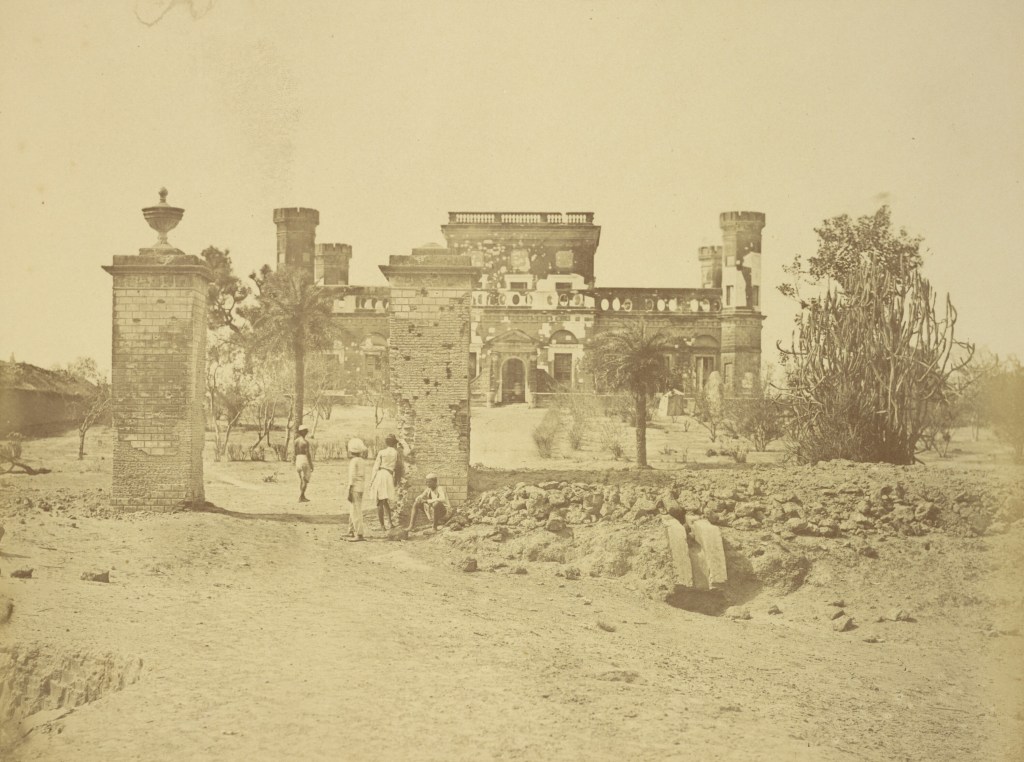

The last obstacles left for Sir Colin Campbell to capture were the 32nd Mess House and the Moti Mahal. This was not lost on Sir Henry Havelock nor on James Outram, and they had not been idle. During the night of the 16th of November, a battery was erected and armed in front of the Engine House -with Campbell’s guns, it would begin battering the Mess House on the morning of the 17th.
To protect his left flank, Sir Colin ordered Brigadier Russell to occupy the houses in the Hazratganj no less than 600 yards from the bridge over the road. With the support of Longden’s mortars which had been working ceaselessly since daybreak, Russell quickly achieved his objective. After occupying four bungalows that had previously been the homes of the officers of the 32nd, Russell pushed on towards Bank’s House. By crossing the canal by which the force communicated with the Dilkusha, he avoided the main road and under cover of artillery, forced the rebels out of the house. Subsequently, Bank’s House was held by 30 men of the 2nd Punjabis under Lieutenant Keen.

From early morning until three in the afternoon, Peel bombarded the Mess House with the support of Maude and Olphert’s batteries from their positions; from noon, Longden moved his mortars forward from the left and joined in. All fire from the left bank of the river was answered by the 18 pounders that had been placed in a small breastwork, constructed during the night by the engineers.
A half-hour before the assault a large body of rebels, some 600 men, whose retreat had been cut off to the city, now crossed from the Mess House to the Moti Mahal and formed up, under cover of some huts between the Shah Manzil and the Moti Mahal with the obvious thought of regaining the Shah Najaf.
“They debouched on the plain with a number of men in front carrying scaling ladders; Captain Dawson…ordered all men to kneel down behind the loopholes with rifles sighted for 500 yards and wait for the word of command. it was now our turn to know what it felt like to be behind loopholed walls, and we calmly awaited the enemy, watching the forming up for a dash oat our position. The silence was profound…”
Captain Dawson continued watching the advance of the enemy. Calculating their distance, he called out, “Attention 5oo yards, ready – one, two, fire!” In an instant, 80 rifles replied and the rebels went down “like ninepins.” The leader on his charger was hit as was his horse – he wheeled round and galloped off towards the river but both fell before they reached the water’s edge. After the first volley, the men in the Shah Najaf fired at will. Unfortunately for the rebels, they were caught between two fires – the force sent to secure the Moti Mahal and the Shah Manzil threw grape and canister at the rear while the fire from the Shah Najaf continued unslacking. In moments, they threw away their scaling ladders and bolted, routed back to the river. Only a quarter of the original number ever reached the other side for when they were in the river, “our men rushed to the corner nearest them to them and kept peppering at every head above water.” Those who managed to get across ran straight for the Badshahbagh.
By three p.m. they had almost completely stopped firing their muskets and the Commander-in-Chief called the attack.

To lead the advance, he called on Captain Wolseley and his company of the 90th. To the captain, Campbell made a “flattering little speech,” adding that if Wolseley could not take the building he was to place his men under cover and report back to Campbell what he had seen. Wolseley was left feeling that Campbell did not believe his men were up for the task, however, he was still “seventh heaven of delight and extremely proud at being thus selected for what Sir Colin evidently deemed a difficult and dangerous duty. Yet, in the back of his mind, Wolseley could not help thinking that his men were about to be used to open the way for Sir Colin’s darling regiment, the 93rd – if the 90th did not succeed it would be a 93rd charge once again. Wolseley’s men too, agreed.
“…the conviction that inspired them sharpened the rowels of the spur which stimulated all ranks in my company at the moment and made them determine that no breechless Highlanders should get in front of them that day. I overheard many of them express that determination in very explicit Saxon English. But some Scotch generals were at this time prone to magnify the noble deeds of Scotch battalions in a way that seriously irritated those from England and Ireland.”
The attacking party under Brevet-Major Wolseley of the 90th Light Infantry consisted of a company of his own regiment, Captain Hopkins and a picquet of the 53rd, Captain Powlett with a few men of the 2nd Punjabis and supported by Brantson’s Detachments now under Captain Guise of the 90th.
Forbes of the engineers and his men had managed to get up to the circular mud wall of the enclosure without any opposition. More men were sent forward and still no shots were fired. Sir Colin ordered the advance.
Wolesely front formed his men and they started at a “good double” towards the Mess House. He had with him three subalterns – Carter, Hereford and Haig; close behind his company came Captain Irby with whom trotted Dr Robert Jackson, the regimental surgeon. Wolesely steadied his men and “whipped them in ” at the garden wall – they rushed over it and made straight for the open doorway of the Mess House. The drawbridge, to Wolesley’s joy, was down and despite being damaged by the bombardment, was still holding. As Wolseley ran across it he saw not a soul. He then ran to the door on the opposite side of the house and saw the rebels scuttle “quickly from the bullets some of my men fired to help them on their way.” The bugler of the 90th sounded the call and the advance and the Mess House, and its myriad of outbuildings, were carried with a rush as the rebels beat a hasty retreat towards the Moti Mahal. They were followed across the road but the troops were stopped by a high wall which enclosed that position – not to be outdone, Wolseley sent for some sappers. With accustomed rapidity, they quickly opened a space for the troops to pass through.
In the midst of it all, an officer, who Woseley only remembered most politely by his face and not his name, asked Woseley who, pray tell, was the senior officer – he or Wolseley? The brevet-major answered in words “not couched in very polite terms” and the other officer vanished for the rest of the day.
Then, someone placed a flag in one of the turrets to allow Outram to gauge just how far the force had come and the Mess House was won.
The Flag on the Mess House
As the myths of the taking of Lucknow grew over the years, it was asserted the flag had been raised by Wolseley himself – he denied it but would go on to say it “had been taken by my company, immediately supported by Captain Irby’s company, also of the 90h Light Infantry.” Yet he had no idea who actually hoisted it. He also claims there was no flag on the Mess House as long as he was in it and this was done after his company had left to take care of the Moti Mahal.
The man responsible for hoisting the flag was Lieutenant Roberts. Requested to do so by Sir Colin so Outram could assess how far they had come, but having no flag at hand, Roberts had been given one of the Colours of the 2nd Punjab Infantry by their commander, Captain Green. He then galloped off to the Mess House where he met Sir David Baird, one of Sir Colin’s ADCs, and Captain Hopkins. With their help, Roberts managed to get the flag and its very inconveniently long staff up the narrow staircase and planted it on the turret nearest the Kaiserbagh only 850 yards distant. The rebels promptly shot the flag down. Resolute in his task, Roberts ran down, picked it up and positioned it a second time only to have it shot down again and this time, fall into a ditch just last as Lennox and Norman arrived on the roof who had been sent to report to Sir Colin Campbell as to what was happening in the Kaiserbagh. Undaunted, Roberts ran down again but found to his chagrin, that the flagstaff had been smashed in two. Shorter now he managed to prop it up again and at least for a while the rebels stopped shooting at it. The one man to doubt the entire incident was Francis Cornwallis Maude – in his estimation, the rebel artillery, unless they had developed a sudden talent for marksmanship was thoroughly incapable of shooting down the flag not once, but twice and he believed it had fallen over by itself.
Not to be undone, the rebels hoisted a Union Jack on top of the Kaiserbagh to mislead Campbell but soon after, with one well-aimed shot, Peel brought that erroneous flag tumbling down.
 Mutiny Reflections