Showing me summer in western land
Now, as the cool breeze murmureth
In leaf and flower - And here I stand
In this plain all bare save the shadow of death;
Leaving my life in its full noonday,
And no one to know why I flung it away.
                          - Moriturus Loquitur, A.C.Lyall
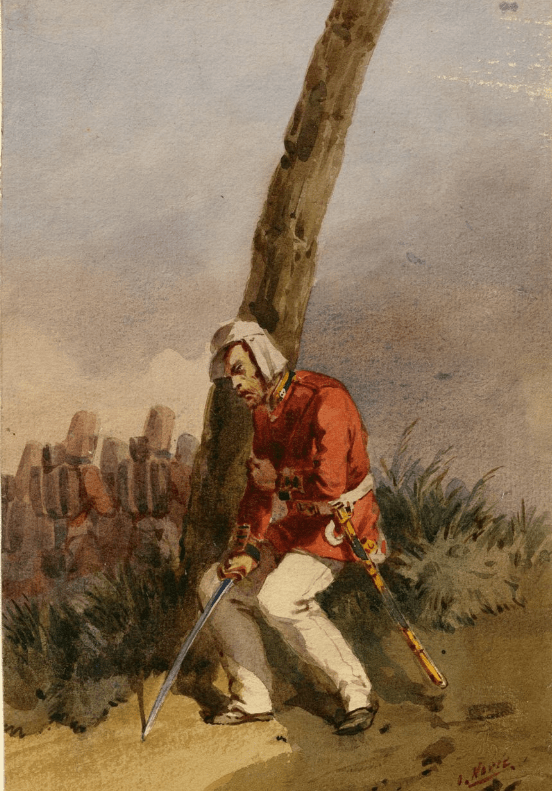
Returns from the 16th to 24th of November, 1857
16th of November
Staff
General Sir Colin Campbell – slightly wounded in the thigh
” Sir Colin, in order to get a better view of tho position, and thus be able to decide in what direction the attack could most advantageously be made, rode up the bank and placed himself close to one of Blunt’s guns. Mansfield and Hope Grant were on either side, and Augustus Anson and I were directly behind, when I heard the Commandor-inChief exclaim, ‘ I am hit.’ Luckily it was only by a spent bullet, which had passed throuph a gunner (killing him on the spot) before it struck Sir Colin on the thigh, causing a severe contusion, but nothing more. It was a moment of acute anxiety until it was ascertained that no great damage had been done.” (Roberts)
Brigadier D. Russell (Commanding 5th Brigade) – severely
Major Archibald Alison (Military Secretary) – severely wounded. Left arm amputated

Captain Frederick M. Alison (A.D.C. to Sir Colin Campbell) – slightly wounded
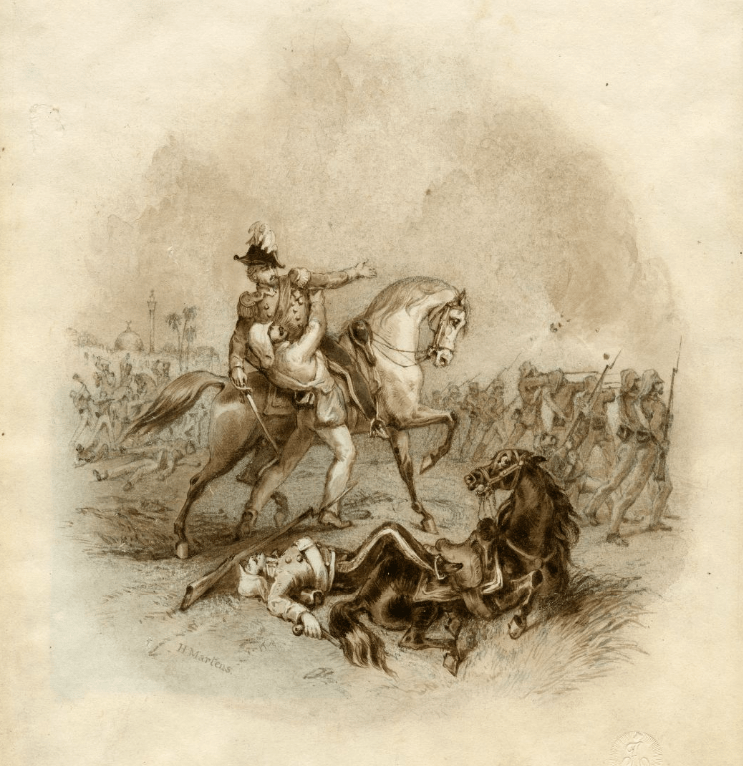
“Some time after the attack had commenced we noticed Captain Alison and his horse in a heap together a few yards behind where we were in shelter. Sergeant Findlay rushed out, got the wounded officer clear of his dead horse under a perfect hail of bullets and round-shot, and carried him under the shelter of the walls where we were lying. He then ran off in search of a surgeon to bandage his wounds, which were bleeding very profusely; but the surgeons were all too busy, and Sir Colin was most strict on the point of wounds being attended to.
“However, there was no surgeon available; so Sergeant Findlay took In’s own bandage, — every soldier on going on active service is supplied with lint and a bandage to have them haudy in case of wounds — set to work, stanched the bleeding, and bandaged up the wounds of Captain Alison in such a surgeon-like manner that, when Dr. Menzies of the Ninety-Third at length came to see him, he thought he had been attended to by a doctor. When he did discover that it was Sergeant Findlay who had put on the bandages, he expressed his surprise, and said that in all probability this prompt action had saved Captain Alison’s life, who otherwise might have been weakened by loss of blood beyond recovery before a doctor could have attended to him. Dr. Menzies there and then applied to Captain Dawson to get Sergeant Findlay into the field-hospital as an extra assistant to attend to the wounded...The bullets were literally flying round him like hail ; several passed tlirough his clothes, and his feather bonnet was shot off his head. When he had finished putting on the bandages he coolly remarked: “ I must go out and get my bonnet for fear I get sunstruck;” so out he went for his hat, and before he got back scores of bullets were fired at him from the walls of the Shah Nujeef.“
Both Major Archibald Alison and Frederick Alison were the sons of Archibald Alison, 1st Baronet, the noted advocate and historian. The brothers were wounded during the attack on the Shah Najaf.
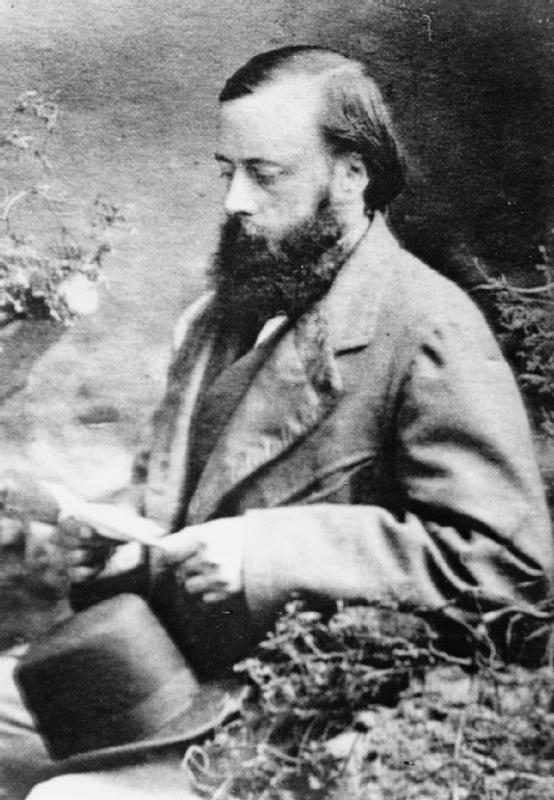
Captain Honourable Augustus Anson (ADC to General Grant) – slightly wounded
Third son of the 1st Earl of Litchfield. Nephew of General the Honourable George Anson, Commander in Chief, India until May 1857
Lieutenant Charles James Salmond (/7th Bengal Light Cavalry/2nd Gwalior Contingent; Orderly Officer to General Grant, – slightly wounded
He is mentioned by Sir Colin Campbell as having greatly distinguished himself – due to illness, he was unable to rejoin the rorce in the pursuit of the rebels and was found dead near Cawnpore, on the 6th of December. Following the mutiny in Gwalior, Salmond escaped to Agra and joined Greathed’s force on the march to Cawnpore in October.
1st Battalion 5th Foot
Colour Sergeants
Cattermole, J – wounded
Ives, N. – wounded
O’Brien, W. – slightly wounded
Sergeant W. Payne – wounded
Privates
Bolger, E. – severely wounded
Green, J. – severely wounded
Hill, T.- killed in action
Kelly, J. – killed in action
Killackey, T. – dangerously wounded
Mayo, J.- killed in action
Risborough, E – killed in action
Sheady, M. – killed in action
Thompson, J. – dangerously wounded. Died of wounds.
Tomkins, J. – killed in action
Weldon, T. killed in action
1st Battalion, 23rd Foot
Lieutenant John H. Henderson – slightly wounded
Sergeant Thomas Walker – wounded
Privates
Bishop, James H.- wounded
Connolly, Thomas – wounded
Deighton, Aaron – wounded
Keenan, John – slightly wound
Lewis, John – killed in action
Limber, John – slightly wounded
Luby, E. – slightly wounded
McDonald, William – wounded
Mace, Henry – severely wounded
Maynard, George – slightly wounded
Spearing, James – killed in action
Stainer, Edward – severely wounded
Sweeney, Michael – slightly wounded
Westicott, John – slightly wounded
White, George – slightly wounded
53rd Regiment of Foot
The detachment, which included the Grenadier Company led by Lieutenant Ffrench, was under the command of Captain Walton haover, Lieutenant-Colonel Gordon of the 93rd Highlanders was put in overall command, as Sir Colin Campbell deemed Walton too junior for the position.
Captain Bendyshe Walton – dangerously wounded at Sikandar Bagh
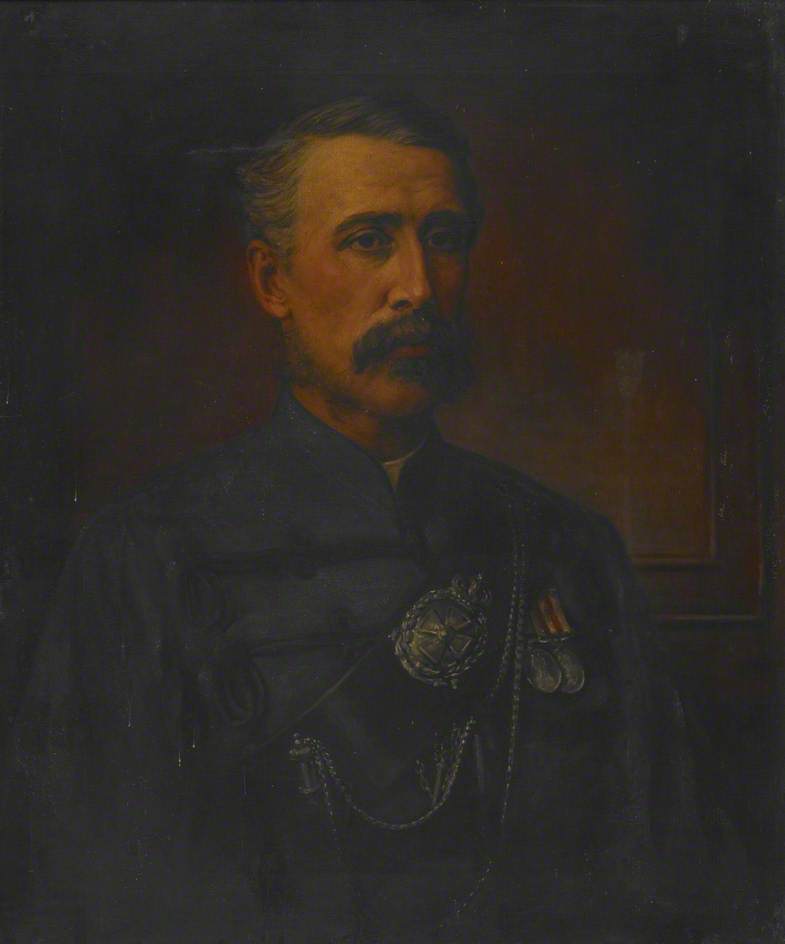
He joined the 53rd Regiment as an ensign in 1848 and was present with this regiment at the Battle of Gujerat during the Punjab Campaign. In 1851-52 he saw service in the Peshawar Valley, against the hil tribes. Following the mutiny, he transferred to the 38th Regiment in 1859 and in 1862 joined Dinapore as a brigade major. Walton joined the Bengal Staff Corps in 1864 and was shortly after appointed military storekeeper in Calcutta. He served as commander of the Calcutta Volunteer Rifles from 1877 until his retirement. He was honorary ADC to the Viceroy from 1879 to 1886.
Lieutenants
Ffrench, Thomas Charles – slightly wounded at Sikandar Bagh
Munro, Donald Harvey – dangerously wounded at Sikandar Bagh. Died on the 10th of May, 1858
Colour Sergeant Michael Kennedy – wounded at Sikandar Bagh
Sergeants
Godding, Henry -killed in action at Sikandar Bagh
Thompson, Thomas Joseph- dangerously wounded at Sikandar Bagh
Corporal Daniel Sullivan – wounded
Privates
Bates, William
Benjamin, Ryan – wounded. Died on the 10th of October, 1858
Berry, Thomas – dangerously wounded at Sikandar Bagh, died of wounds
Blaygrove, George – severely wounded
Boden, Thomas – dangerously wounded at Sikandar Bagh. Died on the 23rd of November
Brien, John – wounded. Died 8th of August 1858
Brien, William – wounded. Died 3rd of December 1858
Brown, Michael – wounded
Brown, Samuel – dangerously wounded at Sikandar Bagh
Buckham, William – wounded
Burke, James – wounded “…by a musket ball, which entered the front of the left thigh, about the junction of the lower with the middle third, fracturing the femur, and passing inwards and backwards; it was cut out two days after in the inner side of the thigh; no piece of bone came away. Was sent back to Cawnpore in a dooley, and his leg retained in the long splint; went from Cawnpore, in a hackrey, to Allahabad, on the 2nd December, and arrived there on the 10th, and shortly after the limb was put on a double- inclined plane, and finally upon the long splint; was unable to bear his weight on the limb until April, 1858.”
Byrnes, Peter – killed in action at Sikandar Bagh
Cassidy, Thomas – wounded
Colbert, Robert – wounded. Died 3rd of August 1858
Cooney, Connor – dangerously wounded at Sikandar Bagh
Coonehan, Michael – wounded
Corbitt, William – dangerously wounded at Sikandar Bagh
Currey, Samuel – wounded
Deering, George – dangerously wounded at Sikandar Bagh
Donovan, James – wounded. Died 25th of May 1858
Fagan, William – wounded
Fisher, William – mortally wounded at Sikandar Bagh
Fitzpatrick, James – wounded
Gill, John – killed in action at Sikandar Bagh
Gleeson, Thomas – dangerously wounded at Sikandar Bagh
Hannafin, Patrick – dangerously wounded at Sikandar Bagh “…by a musket ball, which entered on
the inner side of the left tibia, about three inches above the ankle joint, and passed through the fibula, three inches from its lower extremity; about one month after, secondary hæmorrhage took place, following sloughing of the wound, requiring ligature of the posterior tibial at the lower third of the leg. He was also wounded in the right thigh by a musket ball, which entered on the outside near its centre and passed through in front of the femur, on the inner side, close to the course of the femoral artery. Both wounds are healed .”
Hassell, M.- wounded
Hassett, William – dangerously wounded at Sikandar Bagh
Hogan, John – wounded
Irwin, Charles – severely wounded in the right shoulder at Sikandar Bagh
Ivers, Patrick – wounded
Kavanagh, Patrick – dangerously wounded at Sikandar Bagh
Kearey, John – dangerously wounded at Sikandar Bagh
Lamb, Anthony – killed in action at Sikandar Bagh
Leahey, Michael – wounded
Learmouth, Robert -wounded
Leary, Timothy – dangerously wounded at Sikandar Bagh, died of wounds on the 27th of November.
Lewis, Richard – dangerously wounded at Sikandar Bagh, died of wounds on the 21st of November.
Linsey, John – severely wounded at Sikandar Bagh
Madden, Charles – dangerously wounded at Sikandar Bagh, died of wounds 24th of November.
Marroney, Patrick – wounded
Marshall, James – dangerously wounded at Sikandar Bagh
Mayer, Charles – killed in action at Sikandar Bagh
McDonald, Peter – killed in action at Sikandar Bagh
McFarlane, Alexander – wounded
McGrath, George – wounded
Moorey, George – killed in action at Sikandar Bagh
Morgan, Patrick – wounded
Mullen, Edward – wounded
Murton, John – killed in action at Sikandar Bagh
Nelson, James – killed in action at Sikandar Bagh
O’Brien, Richard – wounded
Parsons, Alfred – wounded
Potts, Thomas – wounded
Ready, John – severely wounded at Sikandar Bagh. Died on the 18th of December.
Reid, John -wounded. Died on the 31st of May 1858
Solan, James – severely wounded at Sikandar Bagh
Spillane, Bartholomew – wounded
Treadwell, John – wounded
Welsh, Patrick – wounded
The 53rd lost 76 killed and wounded.
81st Regiment of Foot (2nd Battalion The Loyal Regiment)
Privates
Harris, William (1) – wounded. Died of wounds
Harris, William (2) – wounded. Died of wounds
82nd Regiment of Foot
Sergeants
McNamara, Richard – wounded at Sikandar Bagh
Smith, William – wounded at Sikandar Bagh
Corporals
Row, William – wounded
Tobin, Michael – wounded
Privates
Britt, John – wounded
Brown, Edward – wounded
Harris, William (1) – dangerously wounded. Died of wounds
Harris, William (2) – dangerously wounded. Died of wounds
McGuinness, Arthur – wounded
Nicholas, Thomas – wounded
Riedoubt, John – wounded
84th Regiment of Foot
Captain Hon. A.H. Anson (attached 9th Lancers, ADC to General Grant) – slightly wounded at Delhi, on 14th September, and again on 16th November at Lucknow
Captain David O’Brien – wounded
Lieutenant H.A.W. Ayton – severely wounded in the arm. Arm amputated. Died of wounds on the 29th of November 1857.
Son of Surgeon Robert Ayton, late 34th Foot.
Corporal Robert Fisher – wounded at Sikandar Bagh
Privates
Andrew, Evan – killed in action at Sikandar Bagh
Boulger, Thomas – wounded “…by a musket ball, which struck him on the left hand, fracturing the first, second, and third fingers, and then passed through the anterior and outer part of the upper third of the left thigh from behind forwards. Wounded by a second musket ball in the anterior aspect of the left thigh, the ball entering about three inches below Poupart’s ligament, close to the course of the femoral artery, where it lodged. Amputation of the fore and middle fingers, between the first and second phalanges, was performed four days after.”
Clearey, Thomas – killed in action at Sikandar Bagh
Kearnes, James – dangerously wounded at Sikandar Bagh, died of wounds
Lavery, More – severely wounded at Sikandar Bagh
Manion, John – severely wounded at Sikandar Bagh
Purcell, Robert – wounded at Sikandar Bagh
Shea, Timothy – dangerously wounded at Sikandar Bagh. Died of wounds
90th Regiment of Foot
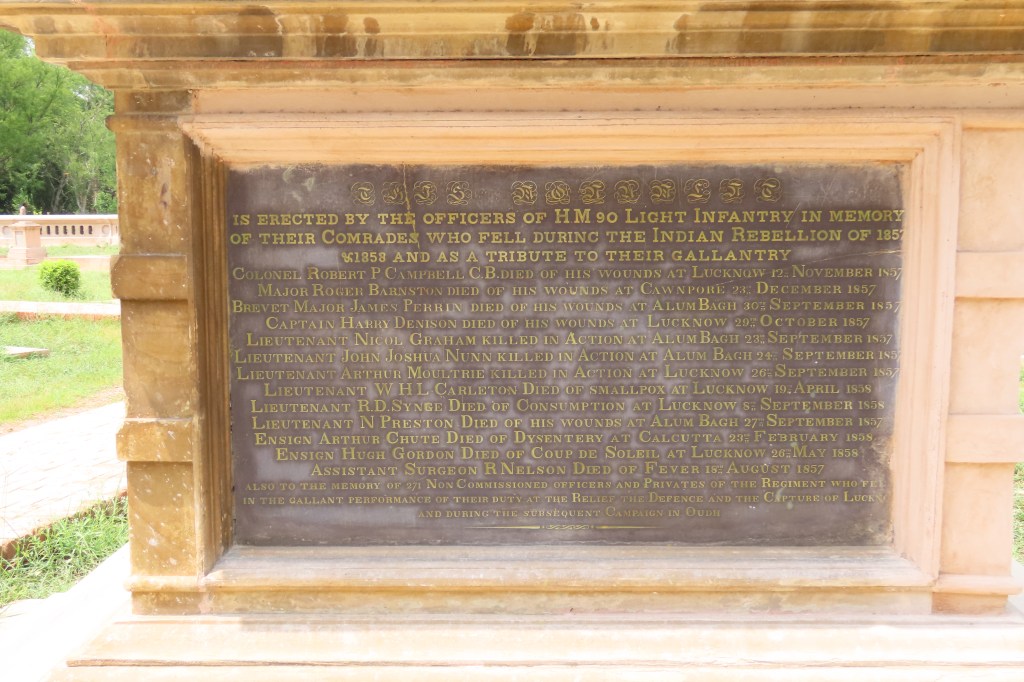
Major Roger Barnston, CB – wounded at Shah Najaf. Died of wounds on 23rd December. Aged 31.
Son of the late Roger Harry Barnston, of Crewe Hall, Chester.
“As soon as I entered the garden I was fired at by some of the enemy in one of the corner towers of the building, and having ascertained that none of our wounded were in the place I returned to my bivouac with a saddened heart at having failed to find my chum, Major Barnston. Later on I found him. He was quite cheery but said he was cold, so I gave him my overcoat. We parted, and my heart was sore indeed, for I knew from personal experience how dangerous big wounds in India always are. I never saw him again. He was taken to Cawnpore, and during the morziing of the day he died, as I was afterwards told, he received a letter from me, which was read to him, at which he was much pleased, and he was greatly interested with the military news it contained.” (Wolseley)
He died in Cawnpore on the 23rd of December, 1857
Corporal G.H. Powell – severely wounded
Privates
Aiken, J. – killed in action
Butler, J. – killed in action at Sikandar Bagh
Farrell, P.- wounded at Sikandar Bagh
Franks, L. – wounded at Sikandar Bagh
Gallagher, Thomas – wounded “by a musket ball, which entered in front of the right ear, and passed out under the eye of the same side, close to the nose. One piece of bone came away from the entrance of the ball.” Dr. Williamson noted, on the 13th of July 1858 – “Wound healed; cannot open his mouth to any extent, and has lost the sight of the right eye ; the pupil of left is very much dilated, and the eye has an amaurotic appearance, but the ball of the eye is uninjured.”
Gardiner, A. – wounded
Kennedy, P. – killed at Sikandar Bagh
Ponter, R. (or Porter) – killed at Sikandar Bagh
Russ, T. – killed at Sikandar Bagh
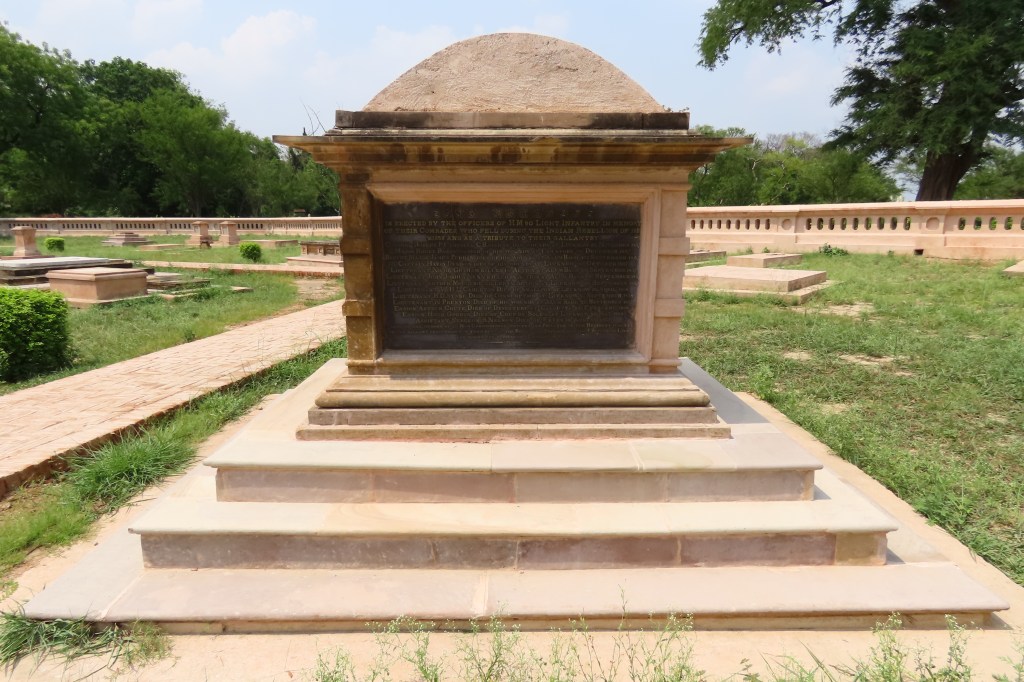
93rd Regiment of Foot
Major John Alexander Ewart – slightly wounded in the right arm and hand at Sikandar Bagh
Captains
Traill-Burroughs, Frederick William – slightly wounded. Born in Fatehgarh in 1831, the son of General Frederick Burroughs and his wife, Caroline de Peyron. At the age of 17 he was commissioned into the 93rd and he served with his regiment in Crimea.
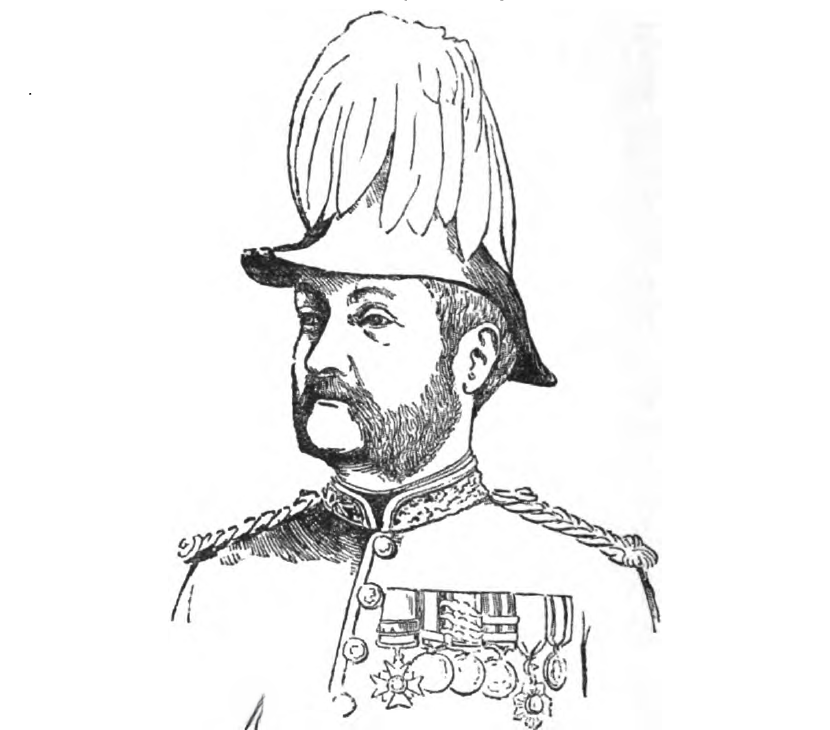
Dalzell, James – killed in action at Sikandar Bagh
Lumsden, John Tower – killed in action at Sikandar Bagh. Attached from the 30th BNI as interpreter to the 93rd
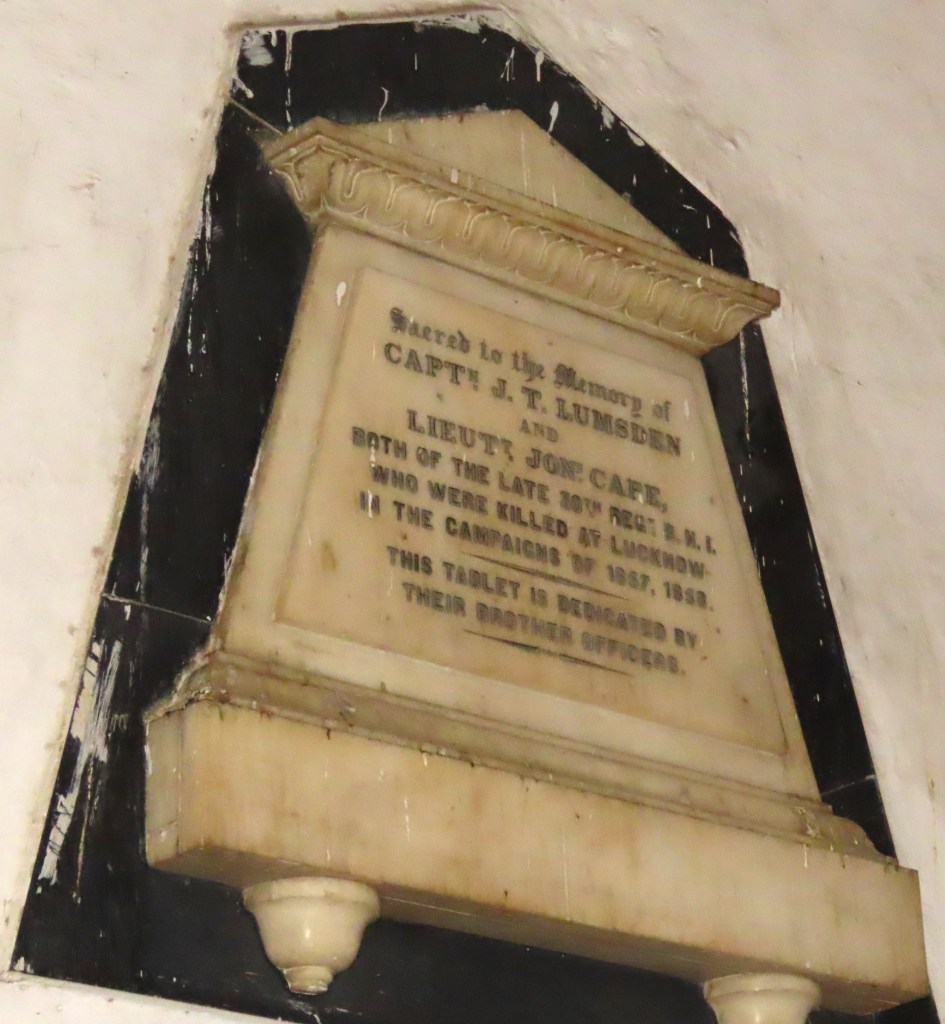
Sacred to the Memory of Capt. J.T. Lumsden
and
Lieut. Jon Cafe,
Both of the late 30th Regiment BNI
who were killed at Lucknow
in the campaign of 1857.,1858
This tablet is erected by
their brother officers.
Lieutenants
Cooper, R.A. – severely wounded at Sikandar Bagh
“Cooper went straight into their midst. In his own words, he ‘worked away’ at them with his whole strength, until he had laid many low eith his sword. Then he was singled out by a Native officer – one of the Loodiana regiment which had mutinied at Benares – bearing a shield in his left hand and a tulwar on his right. Dropping his shield, the rebel – a very tall man – cut straight at Cooper who, however, at the same moment had aimed a blow at his antagonist. The tulwar cut through Cooper’s feather bonnet and deep into his head, but the Highlander’s sword struck home and the rebel fell dead. Cooper too, sank to the ground.” (Cromb, The Highland Brigades)
Goldsmith, O.- severely wounded at Sikandar Bagh
Welch, E. – severely wounded by a musket shot at Sikandar Bagh
Wood, S.E. – severely wounded
Ensign F.R. MacNamara – severely wounded at Sikandar Bagh; sword cut to the head.
Sergeant Major Donald Murray – killed in action at Sikandar Bagh. Shot dead.
Colour Sergeant James McPherson – wounded at Sikandar Bagh
Sergeant Robert Swanson – wounded at Sikandar Bagh
Corporals
Fraser, Alexander – wounded at Sikandar Bagh
Hume, James – wounded at Sikandar Bagh
McLean, John – killed in action at Sikandar Bagh
Corporal McKenzie is mentioned in Forbes Mitchell as being killed at the Sikandar Bagh
Drummer James Grant – dangerously wounded. Died of wounds 17th November
Piper Eward McDonald – severely wounded at Sikandar Bagh
Privates
Allan, Andrew – killed in action at Sikandar Bagh
Allan, John – killed in action at Sikandar Bagh
Anderson, Robert – killed in action at Sikandar Bagh
Campbell, James – severely wounded
Chisholm, John – severely wounded at Sikandar Bagh
Clarke, John (1) – severely wounded
Clarke, John (2) – severely wounded
Crichton, David – severely wounded at Sikandar Bagh
Cuban, William – killed in action at Sikandar Bagh
Drysdale, Alexander – killed in action at Sikandar Bagh
Duff, John – wounded
Dunlay, John – severely wounded at Sikandar Bagh “…by a musket ball, which struck him on the inner side of the right knee, two inches from the side of the patella , passed through the condyle of the femur and knee joint, and passed out on the outside of the joint, close to the head of the fibula.”
Dunn, Peter – severely wounded at Sikandar Bagh
Fisher, John – killed in action at Sikandar Bagh
Fleming, Duncan – severely wounded at Sikandar Bagh
Foot, Robert – killed in action at Sikandar Bagh
Gilchrist, George – wounded at Sikandar Bagh
Gilfillan, James – wounded at Sikandar Bagh
Halfpenny, Edward – killed in action at Sikandar Bagh
Hannay, James – severely wounded at Sikandar Bagh
Henderson, Francis – dangerously wounded at Sikandar Bagh. Died of wounds
Hope, Thomas – killed in action at Sikandar Bagh
Horne, Charles – severely wounded at Sikandar Bagh
Houston, James – killed in action at Sikandar Bagh
Hunter, William – killed in action at Sikandar Bagh
Hussey, Charles – killed in action at Sikandar Bagh
McArthur, George – killed in action at Sikandar Bagh
McCaw, James – severely wounded at Sikandar Bagh
McCulloch, Thomas – killed in action at Sikandar Bagh
McDonald, Mathew – killed in action at Sikandar Bagh
McGregor, Thomas – killed in action at Sikandar Bagh
McIntosh, William (3759) – killed in action at Sikandar Bagh
McKay, David – severely wounded at Shah Najaf
McLeod, Hugh – killed in action
McLeod, Neil – killed in action at Shah Najaf
McNaughton, Donald – killed in action at Shah Najaf
Mitchell, William (1) – killed in action at Shah Najaf
Montogomery – killed in action at Shah Najaf
“But one unfortunate man of the regiment, named Montgomery, of No. 6 company, exposed himself a little too long to watch the effect of our volley, and before he could get down into shelter again an arrow was sent right through his heart, passing clean through his body and falling on the ground a few yards behind him. He leaped about six feet straight up in the air, and fell stone dead.” (Forbes-Mitchell)
Muir, Francis – wounded at Shah Najaf
Murray, John – killed in action at Shah Najaf
Murray, Peter – killed in action at Shah Najaf
Naylor, Thomas – killed in action at Shah Najaf
Neill, Robert – killed in action at Shah Najaf
Penny – killed in action at the Shah Najaf – an arrow pierced his head
Porter, Christopher – severely wounded at Shah Najaf – “by a small rifle ball, which entered the left orbit at the side of the nose, and passed across the right orbit, and out about the centre of the right zygoma,
destroying the sight of both eyes. The scar of entrance of the ball cannot be detected, but that of exit is evident; there was considerable hæmorrhage from the wound.”
Reid, David – killed in action at Shah Najaf
Reid, William – wounded at Shah Najaf
Roy, John – killed in action at Shah Najaf
Smith, Alexander (2) – killed in action at Shah Najaf
Smith, William – severely wounded at Shah Najaf
Stewart William (6) – severely wounded at Shah Najaf
Sweeney, James – killed in action at Shah Najaf
Taylor, John (2) – severely wounded at Shah Najaf
Thomson, Joseph – killed in action at Shah Najaf
Youngson, Alexander – killed in action at Shah Najaf
Artillery Brigade
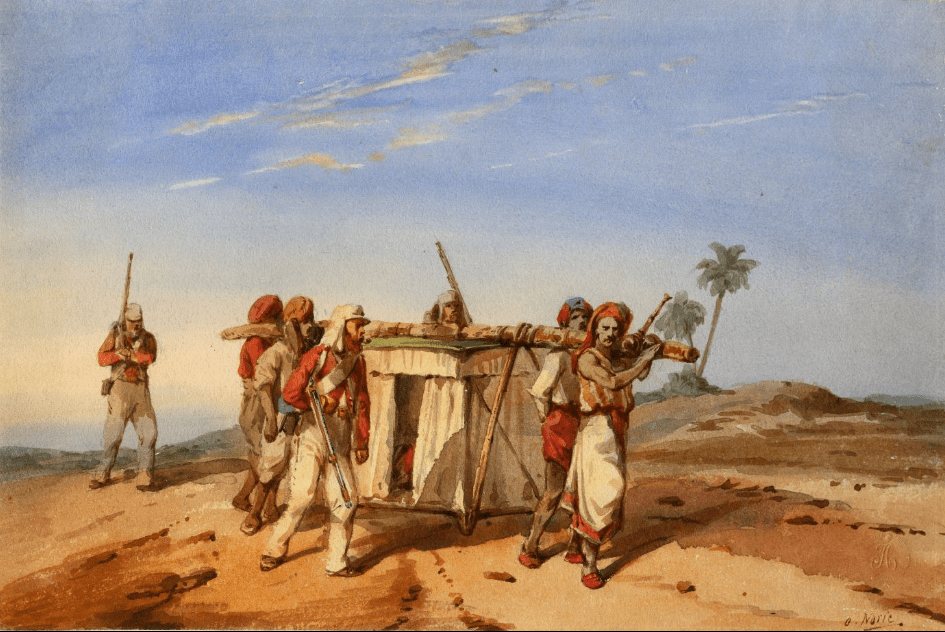
Artillery
Royal Artillery
Major J.F. Pennycuick – slightly wounded atLucknow on 25th September and again on 16th November
Captains
Hardy, Whaley Nicoll – killed in action at Sikandar Bagh.
Hardy’s Battery had advanced to 300 yards westwards of the Sikandar Bagh and came under a severe cannonade of shot, shell and grape. Captain Hardy was killed while lay a second round by a shot that tore away part of his head and his neck. He had served at the siege of Sebastopol in 1855. Son of the late Colonel Edmund Hardy, Bombay Artillery
Middleton, W.A. – slightly wounded
Millman, W.G. – slightly wounded
Tracey, H.A. – slightly wounded
Travers, F. – slightly wounded
Young – severely wounded
Lieutenant Arthur Ford (6/14) – slightly wounded
Ford assumed command of Hardy’s Battery when Hardy was killed. Although wounded, he was able to direct the removal of an 8-inch howitzer before handing over command to Lieutenant W.S. Brown.
Sergeants
Caircross, D. (4/5) – killed in action
Hemsley, W. (6/13) – severely wounded
McLeod, A. (5/13) – slightly wounded
Corporal J. Bird (6/13) – severely wounded
Gunners and Drivers
Abberley, John (6/13) wounded “…wounded by a musket ball at Lucknow, the ball striking the
upper third of the bone, under the attachment of the ligamentum patellæ, and carrying away a large portion of the bone.” He died on the 3rd of July 1858 as a result of gangrene that set in during the voyage home.
Arnold, J (4/5) – slightly wounded
Attenborough, J. (4/8) – slightly wounded
Bain, J. (6/13) – severely wounded. Died of wounds
Barrett, W. (6/13) – severely wounded
Bissett, T. (4/8) – slightly wounded
Blackley, T. (6/13) – severely wounded
Bracey, H. (6/13) – slightly wounded. Killed in action at Lucknow on the 17th of March 1858
Burns, S. (6/13) – slightly wounded
Canning, D. (6/13) – slightly wounded
Clarke, J. (6/13) – slightly wounded
Coulter, J. (4/5) – slightly wounded
Deenen, E. (6/13) – slightly woudne
Flynn, W. (5/13) – slightly wounded
Gibbon, William (5/13) – killed in action
Gribbon, J. (4/5) – slightly wounded
Gillott, William (5/13) – slightly wounded
Hannigan, P ( 4/5) – slightly wounded
Hilliard, T. (5/13) – killed in action
Holdsworth, T. (6/13) – slightly wounded
Howard, E. (4/5) – severely wounded. Died of wounds
Kerrigan, M. (6/13) – killed in action
Lankey, J (5/13) – slightly wounded
Mitchell, B. (4/5) – slightly wounded
Poole, W. (6/13) – slightly wounded
Sage, H. (6/13) – slightly wounded
Sherry, F. (6/13) – slightly wounde
Towner, J (6/13) – severely wounded- Died of wounds
Virgin, J. (6/13) – severely wounded
Watson, R. (6/13) – severely wounded
Williams, G (4/5) – slightly wounded
Yates, T. (6/13) – slightly wounded
Wheeler Thomas Morgan (6/13) – severly wounded
Bombardier J. Prescott (3/8) – slightly wounded
Assistant Surgeon H. Veale – severely wounded
Naval Brigade
Captain J.C. Gray (Royal Marines) – severely wounded
Lieutenant M. Salmon (Royal Navy) – slightly wounded
Midshipman Martin Abbot Daniel – killed in action. The right side of his head was torn off by roundshot.
“It was in the front of the Shah Najeef, and in command of an 8 -in. howitzer, that your noble son was killed ; the enemy’s fire was very heavy, and I had just asked your son if his gun was ready; he replied ” All ready, sir,” when I said, ” Fire the howitzer,” and he was answering “Aye, aye,” when a round shot in less than a moment deprived him of life. We buried him where he fell, our chaplain reading the service,
and in laying him in his resting place we felt, captain, officers and men, that we had lost one of the best and noblest of the Shannons.” (Captain Peel in a letter to Daniel’s father)
Leading Seaman John Matthews – killed in action
Botswain’s Mate John Harrison – slightly wounded
Able Seamen
Fairbourne, G.W. – killed in action
Southwell, Richard – killed in action
The total loss for the Naval Brigade was 4 killed and 18 wounded.
Bengal Field Artillery
Captain H. Hammond – severely wounded
Sergeant William Johnson (2/3) – slightly wounded
Bombardier Richard Cullen – slightly wounded
Bengal Horse Artillery
3rd Brigade, 2nd Troop
Sergeant William Johnson – slightly wounded
Cavalry Brigade
9th Lancers
“The same evening a curious accident befell my nephew, Frank Grant, of the 9th Lancers. He had gone into the Secundra Bagh, and had left his horse, with an orderly, standing near a small building which was adjacent to the wall, and which had been set on fire. A quantity of powder had been concealed therein by the rebels, and when the flames reached it, it exploded with great violence, scorching the horse very severely. The poor animal broke away at a gallop and never stopped until he reached the place where the veterinary surgeon of the 9th Lancers kept his wounded horses, as if he felt that here alone he had a chance for his life. He died a day or two afterwards.” (Knolleys, The Life of General Sir Hope Grant)
Hodson’s Horse
Lieutenant Robert Davidson Craigie-Halkett – mortally wounded
“After the capture of Secundra Bagh I was ordered to join the remainder of the cavalry force, occupied in watching and guarding our flanks and communication— a work certainly more suited to our capacities than being involved in the midst of an infantry action — where, though never actively engaged, we were exposed to a considerable fire during the day, and I had to deplore the loss of my subaltern, young Craigie – Halkett, who, struck by a fragment of shell in the spine, was mortally wounded, and died after a month of great suffering. A right gallant lad, he had joined me at Agra but a short time before, and now his career was closed. Our other casualties were three or four sowars wounded and one killed.“ (Gough)
Military Train
Surgeon A. McArthur – slightly wounded
Royal Engineers
Sapper Thomas Thoms – dangerously wounded, died of wounds
Punjab Infantry
2nd Punjab Infantry
Lieutenant Thomas Frankland – severely wounded at Delhi on the 14th of September. Killed in actionat Lucknow. Aged 29. (48th Madras Native Infantry)
Son of Sir Frederick Frankland and Dame Katherine Margaret Frankland. Two other sons also died in service – Midshipman Frederick Roger Frankland, HMS Winchester who died of fever at Sierre Leone, 23 jan. 1844, aged 20 and Midshipman Harry Albert Frankland, HMS Alarm, died of fever off Vera Cruz, 9 May 1847, aged 17. Memorial at St. Marys Church, Thirsk – “Sacred to the memory of Thomas Frankland, Lieut 48th Madras Native Infantry and 2nd in Command 2nd Punjab Regt killed in action with the sepoy rebels, leading an assault at the Relief of Lucknow 16th Nov. 1857 aged 29 years.
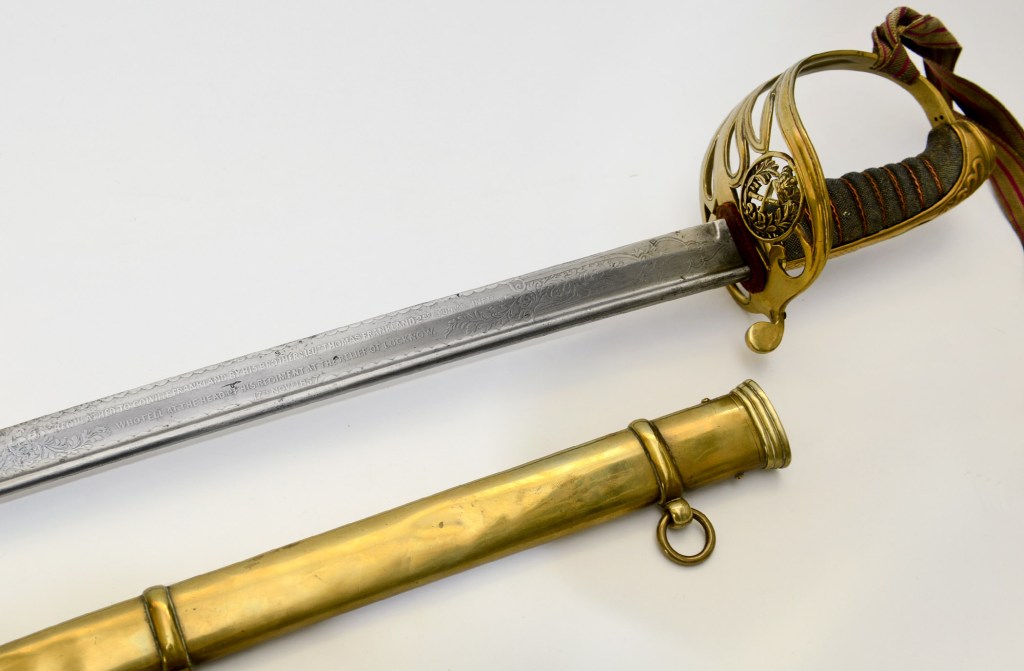
The inscription on the blade reads: Bequeathed to Colville Frankland by his brother Lieut Thomas Frankland who fell at the Head of his Regiment the 2nd Punjab Infantry during the storming of a tower in the Secunder Bagh during the Relief of Lucknow 17th November 1857.
https://www.lawrences.co.uk/sales/fine-art-sales/fs171116/view-lot/39/
4th Punjab Infantry
All the 4th Punjab Rifles officers were killed or wounded.
Lieutenants
McQueen, John Withers – severely wounded in the leg, trying to bring back the body of Captain John Tower Lumsden. He was cecommended for the Victoria Cross.
“…he felt as if someone had given him a severe kick behind. He turned in a rage to see who it was, and seeing no one, looked at his hand and found it covered in blood. This wound was to keep him in hospital for about five months as the bullet could never be discovered and remains in him to this day.”
Oldfield, Frederick Folliot – Dangerously wounded. Died of wounds at Dilkusha. Aged 19.
Son of Henry Oldfield (Bengal Civil Service). Born in Mozaffarpur in the 30th of October, 1838. Joined the Bengal Army in 1855.
He was shot near the elbow which severed the large artery. The Assistant-Surgeon of the Highlanders had put on a tourniquet to stop the bleeding. He was then brought to Fairweather’s field hospital where Fairweather wanted to tie off the artery but Oldfield implored him “to leave him alone as he said he had lost so much blood already that he would surely die if he lost anymore.” Lieutenant Oldfield had confided in James Fairweather, back in Mynpoorie, that he would be killed in Lucknow. During the advance, he drew up his horse next to that of Fairweather and “..reminded me of the circumstances. I made a poor endeavour to take his mind off the subject, but he went on to tell me he didn’t wish the horse he was riding to be sold, but to be given to his brother. His sword, revolver and watch he wished to be sent to his father. He said I would find in his writing desk a number of letters addressed which he asked me to post, whic of course, I promised to do, but told him to try and get rid of these morbid feelings.”
The fate of Oldfield was sealed, however. A few days later Fairweather received a message that the young lieutenant was gravely ill and was requesting to see Fairweather. Arriving at the Dilkusha, Fairweather found that the wound had mortified and gangrene was spreading down his side. There was nothing he could do for him so he sat at his bedside as Oldfield gave him his final instructions. By morning he was dead. Fairweather buried him in a corner of the Dilkusha Park.
Paul, William -severely burned in an explosion at the Sikandar Bagh. Died of wounds.
“Poor Paul was blown up in an explosion of gunpowder in one of the bastions, along with 2 native officers and 2 men, and was terribly burnt before his wadded coat (meerzai) could be torn off him.”

Here lie
the remains of
Lieut. W. Paul
of the 4th Punjab Rifles
who was killed in the attack upon
Secundra Bagh
with the relieving force
under Major-Gen. Sir Colin Campbell
on the 16th Nov 1857
Erected by the Officers of the
4th Punjab Rifles
The dhoolies containing MacQueen, Oldfield and Paul were taken away by the dhoolie bearers when the rumour came up that the Sikandar Bagh was to blown up. Fairweather managed to find MacQueen and Paul but he could not locate Oldfield. He was brought back to the field hospital at the Sikandar Bagh the next morning. With the help of Dr. Clarke of the 2nd Punjab Infantry he removed the tourniquet and tied the artery – after rebandaging the arm, he him and the other wounded men to the Dilkusha with “a bottle of beef tea under each of their pillows and some biscuits.” Paul died in the dhoolie on the wy to the Dilkusha.
Subadar Mukarrab Khan – severely injured.
“The enemy, having been driven out of the earthwork, made for the gateway, the heavy doors of which were in the act of being closed, when the Mahomedan (Mukarrab Klian by name) pushed his left arm, on which ho eanied a shield, between them, thus preventing their being shut ; on his hand being badly wounded by a sword-cut, he drew it out, instantly thrusting in the other arm, when the right hand was all but severed from the wrist.”
For this action, he received the Order of Merit. In 1863 he served as Colonel Wilde’s orderly during the Umbeyla Expedition. Although Khan had left the army after the mutiny, he insisted on serving Wilde.
Subedar Summa Singh – burned in the same explosion that wounded Paul.
“…a very fine old Sikh Subedar named Summa Singh and one of the smartests NCOs’ in the Regiment, whose name I have forgotten, was also badly scorched…” (Fairweather) Both men died at the Dilkusha.
69 Native Officers were killed or wounded during the Relief of Lucknow.
1st Madras Fusiliers
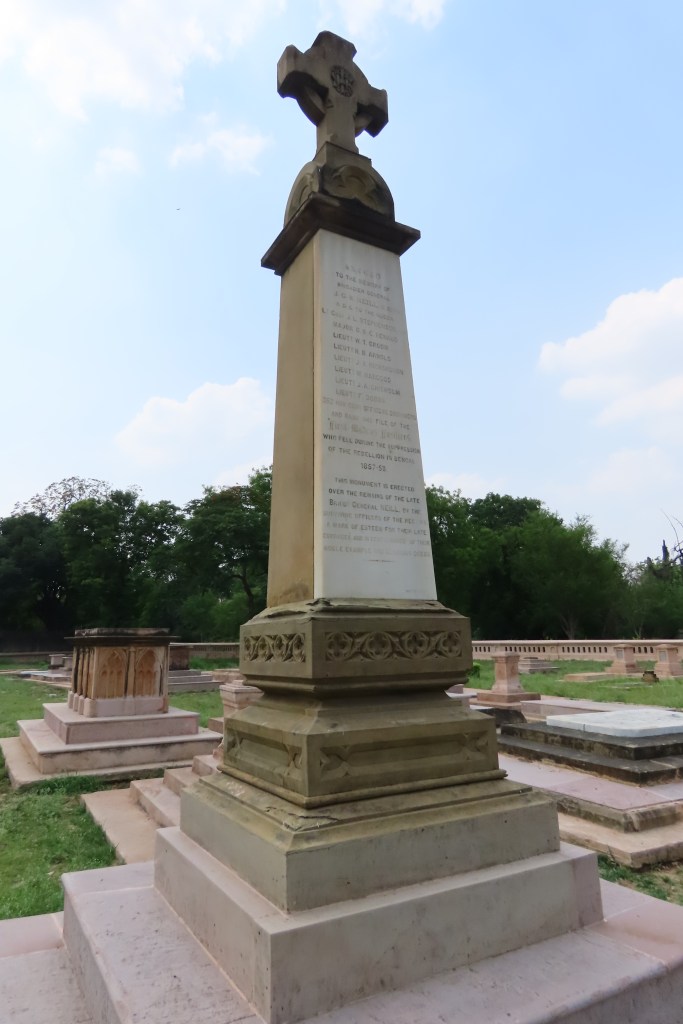
Lieutenant Francis H. Dobbs- killed in action in the advance on the Shah Najaf
“The fire was hellish. In a second every field officer was dismounted, either wounded or with his horse shot under him…To had advanced further would have been madness, so were ordered to lie down under such cover was we could find. In this advance Lieutenant Dobbs was mortally wounded; a bullet went clean through his leg, shattering the bone and piercing the other leg. We carried him under cover and left in him in charge of a sergeant, having said goodbye forever…” (Jones-Parry in Neill’s Blue Caps)
Privates
Beneridge, John – wounded
Blannin, George – wounded
Burke, William – wounded
Collins, Patrick – killed in action at Sikander Bagh
Combe, Alexander – killed in action at Sikandar Bagh
Curtis, James – wounded
Donaghay, Edward – killed in action
Fox, Patrick – wounded at Sikandar Bagh
Grey, Hugh – killed in action at Sikandar Bagh
Kenney, Thomas – severely wounded. Died of wounds on the 19th of November.
Leahy, Dennis – slightly wounded
Moir, John – slightly wounded
Mahon, James – severely wounded. Died of his wounds on the 16th of December
Smith, James – slightly wounded in the head at Sikandar Bagh
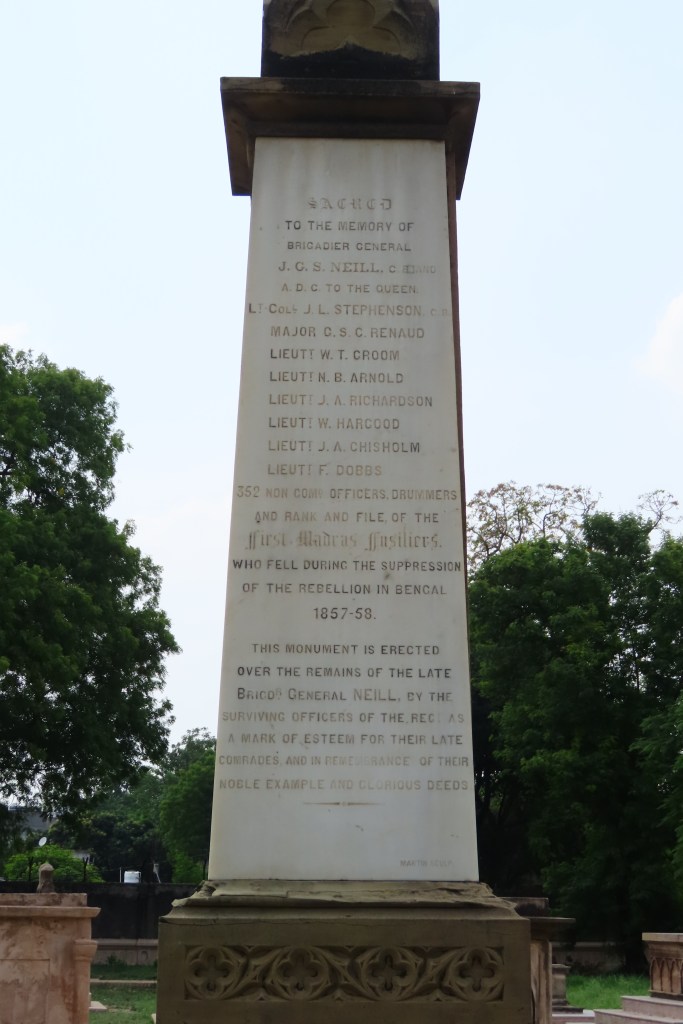
The returns of the Oudh Field Force for the 16th of November under General Sir Henry Havelock reported 7 Rank and File killed and 25 wounded.
According the General Sir Hope Grant, the force under Sir Colin Campbell had lost 43 officers and 496 men killed or wounded on the 16th of November.
17th of November
Staff
Colonel Robert Napier – severely wound
1st Battalion 5th Foot
Private T. Jones – wounded
1st Battalion, 23rd Foot
Privates
Thomas, Charles – killed in action
Collins, Edward – wounded
Kelly, Laurence – severely wounded
Phillips, Edward – slightly wounded
Stone, Samuel – severely wounded
32nd Regiment of Foot
Private Thomas Carroll – wounded 14th and 17th of July and again on 17th November
82nd Regiment of Foot
Private Morgan Connolly – kiled in action
84th Regiment of Foot
Drummer Arthur Anderson – wounded
Privates
Gavin, Patrick – severely wounded
Hogg, Richard – severely wounded
Morton, Robert – killed in action
Mulcahy, Patrick – killed in action
Rushworth, Thomas – wounded “by a musket ball, in the left wrist, which entered on the front nearly in the centre, passed directly through, and made its exit on the posterior side; several pieces of the carpal bones were removed at the time, and great swelling of the hand ensued.”
90th Regiment of Foot
Major J.C. Guise – slightly wounded at the Mess House
Lieutenant E.C. Wynne – severely wounded
Corporal E. Clarke – Wounded
Privates
Barnes, J.- wounded
Chatwin, B. – wounded
Collier, J. – wounded
Cronan, J.- wounded
Crowley, R.- wounded
Gallagher, T. – wounded
Good, W. – wounded
Vanse, T.- wounded
93rd Regiment of Foot
Sergeants
Bannerman, James – wounded
Cuthill, George – dangerously wounded. Died of wounds.
Munro, James – “wounded by a musket ball through the loins; the ball entered a little behind and below the crest of the left ilium, and passed a little upwards and backwards, nearly across the back, and made
its exit immediately above the crest of the right ilium; numerous pieces of bone came away from both apertures.” He was invalided in September 1858.
Corporal James Carroll – wounded
Privates
Davidson, Robert – wounded
Douglas, Robert – wounded
Duncan, Peter – severely wounded
Fiddes (or Finnes), George – killed in action
Fraser, Alexander – wounded
Kerr, John – wounded
Kirkland, William – severely wounded
Leslie, John – wounded
McDonald, Angus – severely wounded
McGowie, James – wounded
McIntosh, William (2922) – severely wounded
McKay, David – wounded “by a musket ball penetrating the right side of chest, emerging at the centre of the back, about an inch above the level of the lower angle of the scapula. During the progress of the case a piece of the spinous process came away, and during a full inspiration air came through the posterior wound with a loud report.” He was back on duty by July 1858 but continued to note pain in the right side when lying down.
Milliwick, William – wounded
Purdie, James – wounded
Riddle, Alexander – wounded
Robertson, Benjamin – killed in action
Sanderson, James – wounded
Simpson, John – dangerously wounded. Died of wounds
Wylie, James – severely wounded
Royal Artillery
Private Felton, C. (5/13) – slightly wounded
Royal Engineers
Second Corporal Peter Duff – dangerously wounded. Died of wounds.
Sappers
Heggie, James – wounded
Thoms, Thomas – dangerously wounded. Died of wounds.
31st Bengal Native Infantry
Captain F.H. Sitwell (ADC to General Havelock)- slightly wounded at Lucknow 25th September. Severely wounded 17th November.
Volunteer George Sackville Benson, Bengal Civil Service, shot at the Sikandar Bagh. Died of wounds. Had volunteered as his brother was in the Lucknow Residency.
He had started his career in India in 1849, after leaving Haileybury College. His final appointment was Assistant Magistrate and Collector of Allahabad. He died at the Sikandar Bagh on thr 19th of November. (Mentioned in theDiary and Letters of Arthur Moffatt Lang)
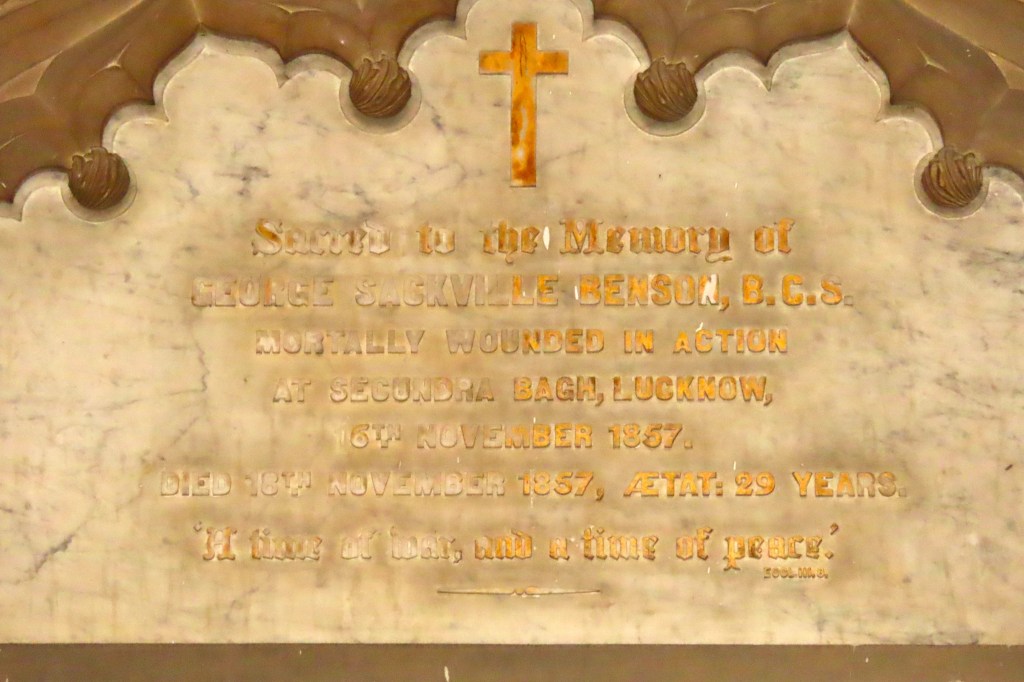
Sacred to the Memory of
George Sackville Benson, B.C.S.
Mortally wounded in action
at Secundra Bagh, Lucknow
16th November 1857.
Died 18th November 1857, AETAT: 29 Years
“A time of war, and a time of Peace” – ECCL.III.8
18th of November
Staff
Brigadier David Russell – severely wounded
Russell was born in Scotland in 1809, the son of Colonel James Russell of the Stirlingshire Militia and his wife, Mary née Stirling. Educated both in Edinburgh and in Dresden, Germany, Russell was commissioned as a cornet in the 7th Light Dragoons in January 1828. he died in London on the 16th of January 1884.
Lieutenant-Colonel George Biddulph (45th Bengal Native Infantry) – killed in action Aged 46. Son of Rev. John and Sophia Biddulph, of Frankton, Warwickshire
He served with the the 3rd Irregular Cavalry during the second Sikh War, and was engaged at Sakoolapore, Chilianwala, and at Gujerat, Sadoolapore and passage of the Chenab.. When Brigadier Russell was wounded, and as he was explaining the plans of storming the hospital, a bullet, after passing through Hale’s hat, struck him dead, passing through his brain.
32nd Regiment of Foot
Drummers
Conway, William – died of wounds
Phelan, Patrick – wounded
53rd Regiment of Foot
Drummer Thomas Murray – wounded
Privates
Osbinson, William – killed in action
Smith, Henry – severely wounded
84th Regiment of Foot
Private Hugh Fleming – killed in action
90th Regiment of Foot
Privates
Lackey, W.H. – wounded
Lancaster, T. – killed in action
Lavin, J. – wounded
McDermott, J.- wounded
Palmer, J.- wounded
93rd Regiment of Foot
Privates
Cutler, Samuel – wounded
Gibson, Lawrence – wounded
Herdman, Robert – wounded
McDermott, James – wounded
Reid, James – wounde
Ritchie, James – severely wounded
WIlliamson, James – wounded
Royal Engineers
Colour Sergeant Philip Morant – killed in action
Sergeant Edward Holman – wounded
Royal Artillery
Shoeing Simth R. Locock (5/13) – severely wounded
Bengal Horse Artillery
3rd Brigade, 2nd Troop
Sergeant Jeremiah Fielding – severely wounded
5th Brigade, 1st Troop
Gunner Richard Behan – killed in action
Bengal Field Artillery
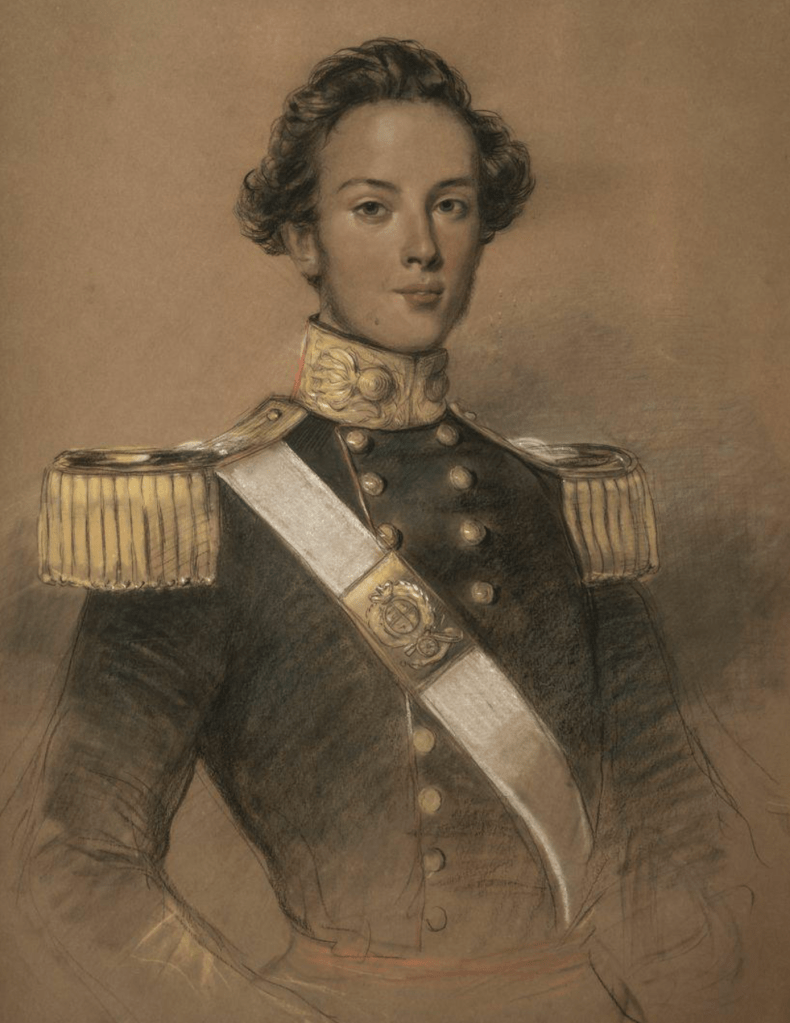
Lieutenant Hastings Harington – severely wounded. In the attack on the hospital compound, he sprinted towards an enemy gun which was firing at him from 25 yards and silenced it, then ran through a garden fire to reach the casualty who he carried to safety. In a later attack at the same compound, a bullet entered his skull under his right ear, leaving him deaf, with lockjaw and unconscious.
Staff Sergeant Patrick Barrett- dangerously wounded. Died of wounds
Gunner Robert Griffiths – slightly wounded
1st Madras Fusiliers
Private Robert Jaques – dangerously wounded on the 25th of September. Died of wounds 18th of November.
19th of November
1st Battalion 5th Foot
Colour Sergeant H. McManus – killed in action
90th Regiment of Foot
Private C. James – killed in action
93rd Regiment of Foot
Private William Petrie – wounded
Bengal Engineers
Sappers&Miners
Second Corporal S.B Brittain – severely wounded
Sapper E. Davies – severely wounded
Bengal Horse Artillery
5th Brigade, 1st Troop
Sergeant George Miller – severly wounded
Gunner Patrick Mackailey – slightly wounded
1st Madras Fusiliers
Private Thomas Kenny – killed in action
20th of November
90th Regiment of Foot
Private J. Hampton – wounded
West, A.- wounded
21st of November
53rd Regiment of Foot
Private Patrick Wade – killed in action
Bengal Field Artillery
Gunner George Gallerday – slightly wounded
22nd of November
84th Regiment of Foot
Lieutenant Benjamin Sandwith – killed in action
Privates
Higgins, John – killed in action
Kirkpatrick, John – killed in action
Bengal Field Artillery
Staff Sergeant Patrick Roddy – slightly wounded
23rd of November
90th Regiment of Foot
Private Pierce – desperately wounded in the explosion at the Martinere. Died of wounds.
Whien we had reached the Martiniere, I was ordered to halt and pile arms not far from a deserted battery of the enemy’s. It was now daylight, and most of us were soon asleep; I know I was.
“I was roused suddenly by something hitting me in the face, a small clod of earth I think, and upon jumping to my feet I saw a huge cloud of white smoke rising up from this battery. There was no explosion, so it must have been a quantity of loose powder that had been accidentally ignited by some careless smoker. A blackened object rushed madly from this smoke, and when in a few minutes afterwards I saw the poor fellow lying before me, he said he was Private Pierce—my plucky and faithful servant who had behaved so well when we were shipwrecked. He had probably inhaled the flame, for his inside seemed to have been burned, and when I saw him some time later on—he was then unconscious—yellow pus was running from his mouth. He could not then say a word, and we never knew how this terrible accident occurred, for he died very soon.” (Wolseley)
The incident was far more grim when told by Alexander of the 93rd.
“Corporal Cooper, of No. 8 Company, an excellent non-commissioned officer and a very fine-looking soldier, reported to me that he had discovered, in a large, open, unenclosed courtyard to the rear of the right wing of the College, a huge supply of cartridges piled up in boxes out in the open, and that all round them and through the court there was a great quantity of loose gunpowder strewn about, either intentionally or by accident…I told Corporal Cooper that he might take what volunteers he could find to sweep up the loose powder at once, and carrying it carefully down, throw it into the lake in front of the Martiniere, whilst I went to report to Burroughs and ascertain what was to be done with the cartridges…Having reported to Burroughs what Corporal Cooper had said, I went with him to the side of the parapet of the tower which looked down upon the court where Corporal Cooper had informed me the cartridge boxes were stacked, and there, sure enough, was the great stack of cartridge-boxes, with Corporal Cooper and some eight or ten men vigorously sweeping up the loose powder into heaps with some improvised sort of brooms. As we watched, and before Burroughs had time to ask for instructions from any of the staff about the disposal of the cartridges, I noticed some two or three men of the 53rd Foot, who had wandered down from the Dilkusha, enter the court through the columns of the covered semicircular colonnade which joined the wings to the main building on either side of the Martiniere, and I further had time to notice that one of these men had a burning brand in his hand, taken no doubt from one of our numerous fires in front of the College, with which he was unconcernedly lighting his pipe. Whether he threw it down, or whether a spark from it fell on the loose powder about his feet, I cannot say, but suddenly fire seemed to run along the ground, and the stack of cartridge boxes, near which poor Corporal Cooper and his party were sweeping, blew up with a dull explosion that seemed to shake the huge tower on which we were standing. Dr. William Munro, our regimental surgeon, who happened also to be on the tower looking at the view, shouted to us to hurry down and try to get between the burnt men and the artificial lake lying in front of the building. We all raced down the staircase and made for the lake, to the astonishment of the men of the guard, who had stood to their arms and fallen in when the explosion took place; for, although there was no very loud report, it shook the whole building…Arrived at the edge of the water, we joined hands, perhaps a dozen of us, and intercepted the poor maddened creatures, who were presently seen emerging through the colonnade from the court. It was one of the most appalling and heart-rending sights I ever witnessed. Corporal Cooper and, I think, four of his party came feebly running down to the water, their clothes all on fire and dropping off them as they ran, with patches of skin adhering to them. The feathers of their bonnets had been entirely destroyed, and the tower of skeleton-wires above their heads looked very weird. Where the skin did not fall off with the burning clothes, disclosing the raw flesh, it was perfectly black, and with their faces thus blackened and the hair of their heads and faces either entirely burnt off or actually smouldering, their appearance was truly awful. The authors of the catastrophe disappeared, and of the eight or ten men of the 93rd, only four or five in all were burnt, as I have described, and died in great agony during the next two days.”
93rd Regiment of Foot
Corporal Andrew Couper (Cooper) – mortally injured in the explosion at the Martiniere. Died of wounds.
Colour-Sergeant Alexander Knox – missing in action
“Two very unfortunate incidents occurred on the 23rd. A corporal and three men were terribly burnt by the accidental explosion of a quantity of gunpowder that had been left on the ground, and all died in a day or two afterwards. The accident is said to have been caused through a spark falling from a soldier’s pipe.
And Colour-Sergeant Knox is lost. Hed had formly been in the 78th Highlanders, which regiment having come out of the Residency, was close by. Hed had been mustered in the morning and naturally went to see his old comrades. He continued absent so long that inquiries were made for him, when it was acertained that he had remained some time with the 78th, and left them just before dawn, saying he must return to the 93rd. From that moment nothing was ever heard of Knox. He may have missed his way and fallen into the hands of the enemy; but it supposed to be more probable that in the uncertain light he fell into one of the many deep wells which abound in Lucknow.” (Captain Burgoyne)
24th of November
Staff
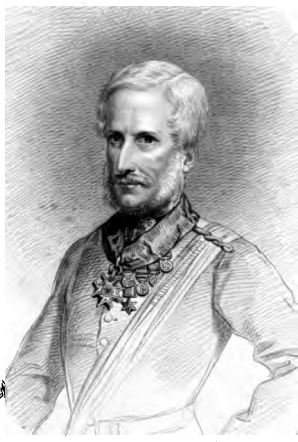
Major General Sir Henry Havelock – died of sickness at Dilkusha Park. Aged 63.
“Honours now poured thickly on him. On the 20th of September he received the distinction of Knight Commander of the Bath. On the 29th of that month he wjus raised to the rank of Major-General. On the 20th of November, two days after his death, wliich was at the time unknown in England, the dignity of a baronet was conferred on him; and on the meeting of parliament her Majesty sent the following gracious message to the House of Commons : “Her Majesty, being desirous of conferring a signal mark of her favour and approbation on Major-General Sir Henry Havelock, Bart., K.C.B., for the eminent and distinguished services rendered by him in command of a body of British and native troops in India, and particularly in the gallant and successful operations undertaken for the relief of the garrison at Lucknow recommends to the House of Commons to enable her Majesty to make provision for securing to Sir Henry Havelock apension of 1,000/. per annum for tiie term of his natural life.” He lived long enough to hear of his elevation to the honours of the Bath; and, after forty-two years of unacknowledged service, the heart of the veteran seemed to experience a glow of delight at the announcement of this unexpected dignity, but the honours bestowed by his sovereign, and the plaudits of his countrymen, were sounded over his grave.” (Marshman)
The news of his death reached England on the 7th of January 1858.
78th Regiment of Foot
Corporal John Aselford – died of wounds
84th Regiment of Foot
Drummer John Devine – wounded
Sources:
Blomfield, David, ed. Lahore to Lucknow: The Indian Mutiny Journal of Arthur Moffat Lang, 1st Lt., Bengal Engineers. London: Leo Cooper, 1992.
Burgoyne, Roderick Hamilton. Historical Records of the 93rd Sutherland Highlanders, Now the 2nd Battalion Princess Louise’s Argyll and Sutherland Highlanders. London: Richard Bentley and Son, 1883.
Cromb, James. The Highland Brigade: Its Battles and Its Heroes. Edited by David L. Cromb. Stirling: Eneas Mackay, 1902.
Ewart, John Alexander. The Story of a Soldier’s Life; or, Peace, War, and Mutiny. 2 vols. London: Sampson Low, Marston, Searle, & Rivington, 1881.
Forbes-Mitchell, William. Reminiscences of the Great Mutiny 1857–59: Including the Relief, Siege, and Capture of Lucknow, and the Campaigns in Rohilcund and Oude. London: Macmillan and Co., 1893.
Gordon-Alexander, William. Recollections of a Highland Subaltern: During the Campaigns of the 93rd Highlanders in India, under Colin Campbell, Lord Clyde, in 1857, 1858 and 1859. London: Edward Arnold, 1898.
Gough, Hugh. Old Memories. Edinburgh: William Blackwood and Sons, 1897.
Grant, Hope. Incidents in the Sepoy War, 1857-58: Compiled from the Private Journals of General Sir Hope Grant. Edited by Henry Knollys. Edinburgh: William Blackwood and Sons, 1873.
Marshman, John Clark. Memoirs of Major-General Sir Henry Havelock, K.C.B. London: Longman, Green, Longman, and Roberts, 1860.
Roberts, Frederick Sleigh. Forty-One Years in India: From Subaltern to Commander-in-Chief. Vol. 1. London: Richard Bentley & Son, 1897.
Tavender, I. T., comp. Casualty Roll for the Indian Mutiny, 1857-59. Polstead, Suffolk: J. B. Hayward & Son, 1983.
Verney, Edmund Hope. The Shannon’s Brigade in India: Being some Account of Sir William Peel’s Naval Brigade in the Indian Campaign of 1857-1858. London: Saunders, Otley, and Co., 1862.
Williamson, George. Military Surgery. London: John Churchill, 1863.
Wolseley, Garnet. The Story of a Soldier’s Life. Vol. 1. London: Archibald Constable & Co., 1903.
Wright, William, ed. Through the Indian Mutiny: The Memoirs of James Fairweather, 4th Punjab Infantry. Stroud, Gloucestershire: The History Press, 2011.
Links:
https://www.memorialsinportsmouth.co.uk/churches/royal_garrison/rugbeians2.htm
 Mutiny Reflections