Lucknow, 18th – 25th November 1857

“When the commander-in-chief’s orders came for the abandonment of the Bailie Guard position, which we had so long and .strenuously defended, it came like a blow to my chief, Brigadier Inglis. He went to Sir James Outram, commanding the division, and pleaded, though without success, that our flag should be kept flying on the ruins of the old Residency — the only spot in Oude from which, through the dreadful crises of the mutiny, it had never been removed. He volunteered to maintain our former position, if only one regiment were left him, and the sick and wounded, as well as the women and children, removed. Outram had much of the hero in him, and liked the spirit of the offer. He repeated it to his excellency the commander-in-chief, but no representations at headquarters were of any avail. It had been determined to make another campaign of it in the succeeding year, and the fiat went forth for immediate relinquishment.’“(Captain Birch, 17th November)
It was indeed a sore blow for Brigadier Inglis – the position that had been so valiantly defended was to be abandoned – he had held to Residency with fewer men that Sir Colin Campbell had brought with him; it seemed absurd to abandon it now instead of standing to fight – he could verily run the rebels out of Lucknow, re-establish rule and then march out triumphantly at will. He was not alone in his feelings – Sir Hope Grant and James Outram pressed him to attack the Kaiserbagh and capture the city. However, for Sir Colin, no matter what argument Inglis had for keeping the Residency, he remained firm. There would be no third Siege of Lucknow and he would confine his operation to the relief of the garrison.
He had lost 43 officers and over 496 men killed and wounded just achieving this juncture – he had no reserves to fall back on and his force was now barely strong enough to for the service it was still expected to perform. The Lucknow Residency was in Sir Colin’s opinion a “false position.” Defendable as it was, it could not be reached by any relieving army without severe loss. For now, the rebels could keep Lucknow. He would fall back on Cawnpore taking the Lucknow garrison, their stores, guns and treasure with him.
It remained, however, how to withdraw from Lucknow and retreat from a foe who still presented themselves in overwhelming numbers; Sir Colin, hampered as he would be by an immensely long train, realised it would be difficult – but in his estimation, not impossible.
The advance had secured a route but it needed some refinement if it was going to be practicable for an evacuation. From the Residency to the Dilkusha was no less than 5 miles – every part of the way needed to be guarded and he had already ordered the withdrawal of a portion of the 75th from Alambagh to the Dilkusha, which he could only do as a small force had lately been sent up to the Alambagh from Cawnpore. He now had to decide whether he would withdraw the garrison using the same circuitous route he had taken. This, though less hazardous, was in places difficult to traverse due to the roads being narrow and in part not paved but only consisting of fine sandy tracks which could undoubtedly hinder the flow of carriages and conveyances. It was determined therefore to see if perhaps a shorter way was available.


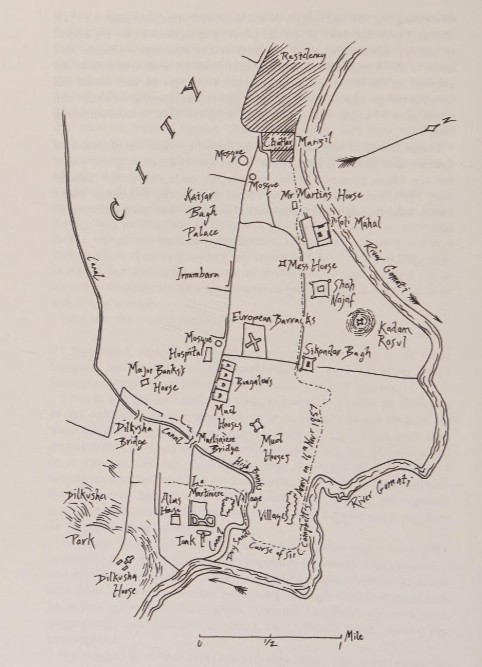
It was proposed to try and open the route past the Barracks and Bank’s House where the main advantage was the road was metalled. Then by crossing over the Dilkusha Bridge over the canal – protected by a detachment in Bank’s House – it would shave hours off a tedious journey. If this was possible there would be two possibilities of retreat available but it all depended on Brigadier Russell, if he could make this proposed line secure. He was in possession of the four bungalows (marked D on the map) and the Barracks (E), but he was exposed to such a fire of musketry from the surrounding buildings, extending from the buildings (G) to the opposing mosque (K), from the loopholed walls (KH) and from the fire of a battery of an 18-pounder (M) it was impossible to walk beyond the walls of his positions. Russell had been hard-pressed on the 17th already and repeatedly requested heavy guns be sent to him to answer the ceaseless rebel bombardment of musketry and cannon shot. So the first objective of the day was to silence the fire on Russell’s position. With this in view, Captain Bourchier set off to reconnoiter early on the morning of the 18th with Colonel Biddulph all the roads lying between the barracks and the canal to find a passage through which the guns could be brought to Russell.
They succeeded in finding a road. Bourchier readied a 9-pounder and a 24-inch howitzer, with 4 5 1/2 inch mortars, with the mortars placed behind the bungalow (D2) to shell the surrounding neighbourhood. As no mounted man could show his head along the road without being shot, the guns had to be moved entirely by hand.
” The iron 18-pounder was not above 120 yards distant, and to avoid giving notice to the enemy of our intentions by opening an embrasure, the muzzle of the 9-pounder was crammed through a hole that a shot had just made.”
As the 9-pounder fired, simultaneously, a round shot from the 18-pounder struck the mud wall immediately in front of it, throwing up great clods of dirt, dust and pieces of wall. The shot knocked Bourchier, Russell and Captain Oglvie onto their backs. The round shot hit Russell, grazing the back of his neck and cutting his watch chain in two – it also left him paralyzed in the legs for the next coming days. Bourchier scrambled to his feet and continued to fire the 9-pounder, filling it with round shot behind a charge of grape over and over again until the rebels gave up. While they stopped firing their gun, they certainly did not leave off with musketry – their position was still full of hundreds of riflemen. While Bourchier worked the 9-pounder, Lieutenant Burnett of the Royal Artillery had managed to get his mortars underway and “opened such a shower of shells upon our neighbours as soon greatly decreased the musketry fire, although not silencing it.”
With Russell injured, it fell on Colonel Biddulph to take command – he ordered Lieutenant Roberts to inform Sir Colin he planned to take the hospital and turned back to his plans. Biddulph had “hitherto wandered about in a shower of bullets as if they had no power over him..” and he quickly organised a column to storm the troublesome hospital. As he stood explaining the attack to Colonel Hale at the gate of the bungalow (D3 on the plan) a bullet struck him in the head and he fell dead. It had first passed through Colonel Hale’s hat. Bourchier believed Hale had a “charmed life” having previously seen a round shot that killed Hale’s horse had left the rider untouched; this time a third bullet only grazed Hale’s heel.
With Biddulph dead, Hale took command.
At 4 o’clock, covered by a quick fire from the 24-pounder howitzer at the gate and a relentless flight of shells from Burnett’s mortars, Hale led his column from the bungalow (D3) into the opposing garden and straight to the hospital. It was stormed and carried after a stiff fight. Unfortunately, for Hale the rebels had a different plan – the hospital was thatched and as it was commanded by the loopholed parapet around the mosque, which the rebels now commenced shelling until all the buildings along the road leading to the Imambara were turned into a blazing inferno. The heat alone made it impossible for Hale to hold the hospital – he formed up his men and withdrew back to the bungalows, covered by the howitzer.
“Lieutenant Harrington, Bengal Artillery and another officer (whose name I regret I never knew) belonging to HM’s Service with a gunner of artillery and a drummer of infantry did most gallant service. A man of the storming column had been wounded and left in the garden for an hour and a half. The drummer stuck by him, and dashed into the picquet to report the fact. The little party above mentioned, under a very hot fire, rushed out, and brought in the wounded man. As they left the picquet a round shot struck the ground under their feet.”
While Hale was attacking the hospital, heavy firing was heard from the direction of the Barracks followed by an attempt by the rebels to storm the picquets between the Sikandar Bagh and the barracks but they were quickly repulsed by Captain Remmington’s troop of Horse Artillery with 2 companies of infantry, the 23rd and 53rd Foot who had been rapidly brought up by Sir Colin Campbell himself. He would later congratulate Remmington for “the brilliant manner in which his troop had come into action.” However, with Hale’s failure to hold the hospital, all thoughts of withdrawing the garrison through that route were abandoned. Hale was ordered to hold his present position and with the efforts of Captain Ogilvie, the whole was effectually entrenched to become comparatively safe – where they would remain until the withdrawal was completed.
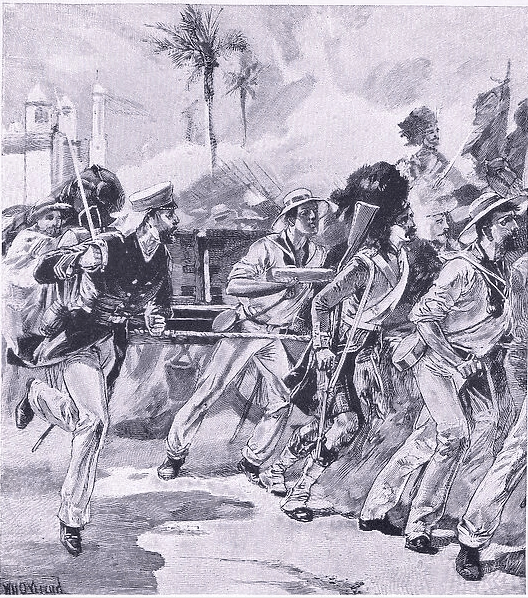
At daybreak on the 18th of November, Arthur Moffatt Lang went over to the Moti Mahal. The position was serving as the Engineer Quarters and just outside of it, Peel was already pounding at the Kaiserbagh – a clever ruse which would leave the rebels believing Sir Colin was planning an assault on the position. On the 20th of November, the Naval Brigade succeeded in breaching the wall in three places to complete the illusion to the last and continued shelling the position for another 3 days.
Under the cover of the initial battering, together with Pritchard, Lang was ordered to build a sheltered way “a regular mockery of one,”– by constructing a flying sap of canvas screens to shield the evacuees from the fire levelled from the Kaiserbagh when they cross the open space between the Engine House and Moti Mahal. It extended as far as Martin’s House and would effectively shield the retreating force from the rebel artillery and sharpshooters from the opposite side of the river. A battery of artillery and some of Peel’s guns with a covering force of infantry were then posted on the northeast corner of the Moti Mahal, with all the best shots in the Shah Najaf posted on the northwest side of the ramparts next to the river. The sharpshooters were placed under the command of Sergeant Findlay, lately an impromptu medical officer, and one of the best shots the 93rd had to offer. To prove his point, when the retreat was underway, Findlay
“…unhorsed a rebel officer close to the east gate of the Badshahibagh, who came out with a force of infantry and a couple of guns to open fire on the line of retreat; but he was no sooner knocked over than the enemy retreated into the bâgh, and did not show themselves any more that day.”
From these two positions the rebels were brought under a serious cross-fire “the accuracy of which made them keep a very respectful distance from the river.” The Engineering officers were to continue making reconnaisances of the captured buildings, ensuring there would be no unwanted surprises.
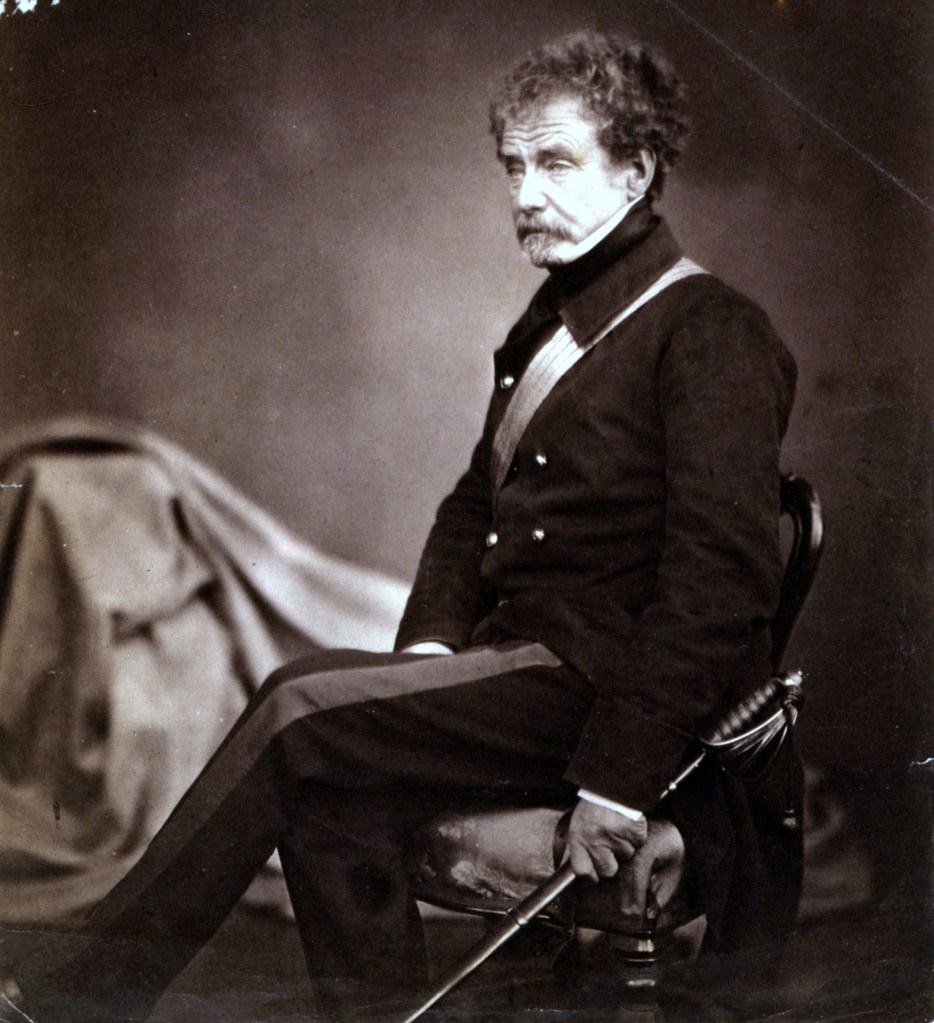
Major Ewart, ensconced in one of the towers at the Shah Najaf, watched the progress of the fights on the 18th. He observed the rebels, standing on a raised platform at the mosque, brandishing their swords “and dancing about as if daring the British to come on.” It occurred to him that perhaps a rifle could reach them and sighting at 800 yards, Ewart fired several shots and took them in the flank. If it had any effect, he never found out. He had enough work at his post; sleep was out of the question with the noise of Peel’s guns, the incessant musketry and the constant expectation of an attack, the men finally became so worn out, that they could hardly keep their eyes open and slept in snatches, standing up.
Meanwhile, Garnet Wolseley was giving Sir Colin Campbell a wide berth. Angered that Wolseley had pushed his men up to the Moti Mahal the day before, thus upsetting “Sir Colin’s little plan for the relief of Lucknow by the 93rd Highlanders” (Wolseley), Brigadier Adrian Hope had advised him to take his men and retire on the 17th on the main road close to the Shah Najaf. A little put out by what Hope told him, Woseley gathered his men together and marched to the appointed spot. They piled arms on the side of the road and then settled down to sleep.
Sometime during the night, Wolseley was awoken by the angry swears of Carter his subaltern – “a charming man, Carter” – Woseley asked what had happened; “he said some infernal son of a gun had put one of the legs of his charpoy right in the middle of his stomach.” None the worse for wear, Woseley soothed the irate man and fell back asleep. The next morning, on the 18th, as Wolseley awoke, so did the occupant of the charpoy, who, desiring a little sleep, had come along the road and placed his bed, in the dark, on Carter. It was none other than Sir Colin Campbell. He sat up in his bed and upon seeing Wolseley, shook his fist at him with a “pleasant smile. If I had but caught you yesterday!” he said.
Wolseley would remain at his picquet near the breach in the wall of the Moti Mahal and watch, for the next days, as shadows marched silently past him in the dark, the women and children of Lucknow. Some of them would drop their bundles and talk to his men – Woseley would quickly remind them they were by no means safe and hurry them along.
Before retiring on the 18th, Sir Colin Campbell made his intentions clear to all the officers, what part they were to play during the evacuation – his orders were so meticulous, some officers felt obliged to write down their instructions. When the retreat began, it would prove to be one of the finest manoeuvres ever envisaged, at such short notice.
The morning of the 19th of November dawned. Lieutenant Roberts was sent with a note for Sir James Outram from the Commander-in-Chief. In it was contained the information of the arrangements thus accomplished for the withdrawal of the garrison and shortly conveyances would arrive from the Dilkusha for the women and children as soon as they arrived. Sir James read the note and questioned Roberts if he had observed the breaches made in the walls and houses along the route if they were large enough for carriages, guns and carts to pass through. Roberts replied he had not particularly given them much thought but believed some of them might prove rather small.
“My answer, to my astonishment, roused the ire of a wounded officer lying on a couch at the end of the room, for he wrathfully asked me whether I had measured the openings, and on my saying I had not, he added; ‘ You had better wait to give your opinion until you know what you are talking about; those openings were made by my orders, and I am quite sure they are the necessary size.’” The irate officer was Colonel Robert Napier. Sir James, seeing Roberts was feeling quite snubbed by such an unwarranted rebuke, kindly explained Roberts had simply answered his question and it was not in any way, Roberts’ opinion. Napier however, refused to be appeased – however, afterwards Roberts had the last laugh – as it turned out, he had been right in his estimation – some of the breaches were indeed too narrow and would need to be enlarged before the guns and carriages could pass through. What Napier thought of this is sadly not recorded.

Upon hearing of the imminent departure, Gubbins noted,
“Great was the revulsion of feeling produced by this intelligence. A handful of men, we had defended the Residency post for nearly six months; and now that our force was strong in numbers, and stronger still in guns, we were to go, and to go in all the hurry and confusion attending a move on the brief notice of twenty-four hours! One feeling of disappointment and gloom succeeded the previous satisfaction produced by the events of the day; and the orders to abandon everything being peremptory, the ladies began sewing pockets, in order to convey about their persons any valuables which they might be able to save. With these sad feelings, common, I believe, to every one of the garrison, and certainly shared in by both our generals, the day of our relief closed.“
While Peel continued to batter the Kaiserbagh, from the advanced post under Colonel Eyre, a second barrage was unleashed. The palace gates were successfully breached and Sir Colin was once again entreated to storm the place – again he refused. Only after he reached Cawnpore was he informed the rebels had lost stomach for the fight – they had begun packing up their belongings and were planning to abandon the Kaiserbagh. However, on the 19th of November, with musket fire still emanating from the palace, Sir Colin Campbell would not take the chance. The evacuation would go on as planned.
In the Residency, a sense of desperation set in as women strove to pack as many of their valuables on their person, falling into a frenzy of packing and repacking as orders came in that they were firstly to leave everything behind and then anything that might be saved might be brought away while some carriage would be provided from Sir Colin’s camp to transport the baggage. Amid the confusion, all the artillerymen who could be spared were hard at work at the guns that could not be taken away or were deemed useless. All day long explosions rattled around the Residency as Captain Evans of the Church battery performed his task of destroying the guns. A large amount of shot was thrown down wells while the rest were taken. Over the next 2 days, all the guns worth moving were withdrawn.
By noon of the 19th, the first of the women and children had started leaving the Residency. Many had found room in carts, others in carriages but some walked – from the Bailey Guard Gate they passed through the Farhat Baksh and Chattar Manzil where they gained the high road to the Sikandar Bagh.
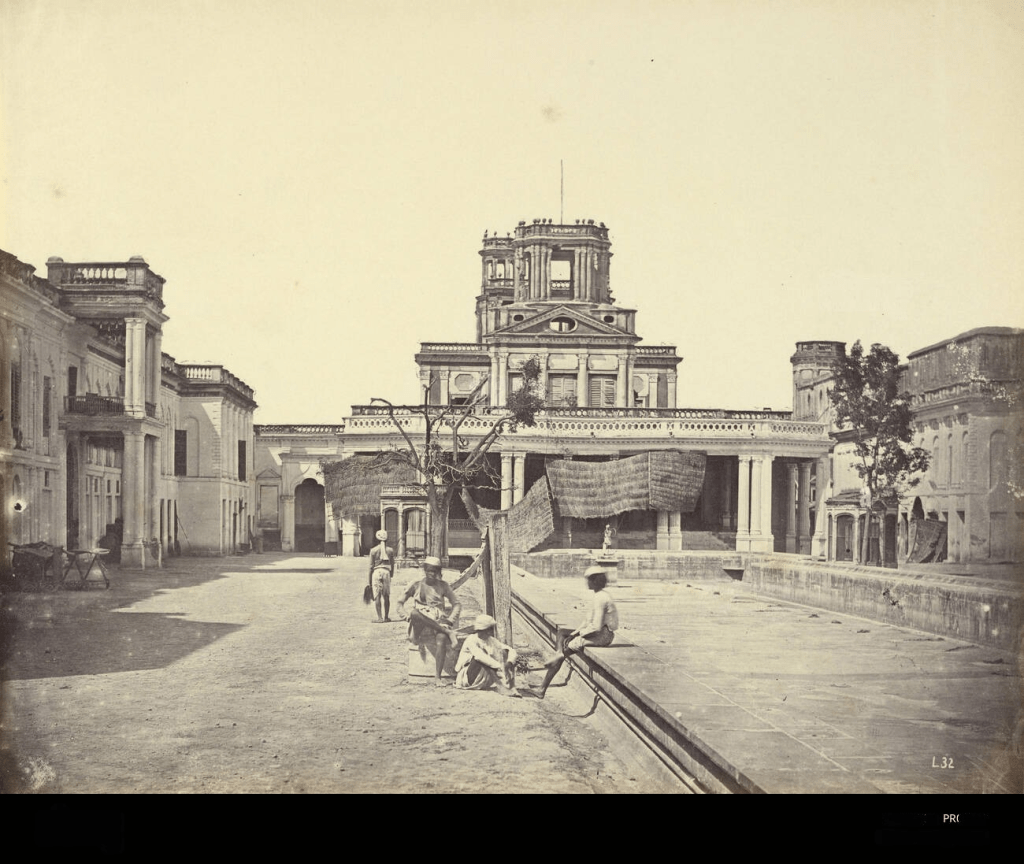
“Although every precaution was taken, and every species of carriage available was placed at the disposal of the ladies, it was indeed a sad sight to see the shifts many were put to. I went once down to the Residency to see if I could assist any friend, and found Mrs. Flctcher Hayes, who had attempted to walk, seated on the steps of a house, with no means of getting on. Captain Ximenes, of H. M.’s 8th Regiment, an old friend, was with her. It was no time to hesitate; so, although terribly exhausted, she mounted my horse. Lieutenant Hunter, of the Artillery shouldered the baby; and off we all started. Before we brought her to safety to the Secunder Bagh many shot had flown past us, and nothing but the extreme danger of stopping on the road could have carried her through.” (Bourchier)
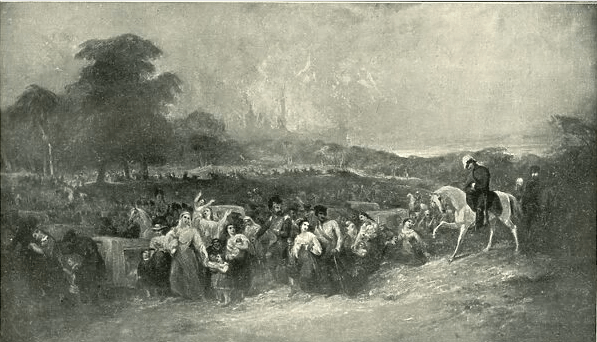
Along the way they were exposed to the fire of the rebel guns from across the river – but Lang had done his work well. Their route was lined with screens, some made of nothing more than the canvas walls of tents, others of doors and shutters and they were enclosed in this makeshift tunnel as far as the Moti Mahal, while on one side of this ditch a traverse had been dug along which, after dismounting from their carriages, they could walk through the exposed areas. Waiting for them at the Sikandar Bagh was Sir Colin Campbell. They would be detained here until nightfall as it had come to his attention the way to the Dilkusha was not as secure as he wanted it – an officer had been shot traversing it during the afternoon. As soon as it was dark, the ladies resumed their march and by morning they reached the Dilkusha. By midnight on the 22nd of November, the Residency was completely evacuated, the rebels still unaware that this particular coupe had been performed right under their noses.
Firstly, the garrison at the furthest end of the compound was marched out. Every other garrison in their turn fell in behind it, in complete silence, breaking step instead of a steady march, until the whole position was evacuated. Behind them came the positions held by Sir Henry Havelock, post by post, all coming up behind the Residency garrison. After them came the men of Sir Colin Campbell’s force, regiment after regiment withdrawing with the utmost order.
“Never shall I forget that eventful night. The withdrawal of the fourteen garrisons which occupied our defensive positions was entrusted to three staff officers: Captain Wilson, assistant adjutant-general, the brigade major, and myself, as aide-de-camp. Brigadier Inglis stood at the Bailie Guard gate as his gallant garrison defiled past him; with him was Sir James Outram, commanding the division. The night was dark, but on our side, near the Residency house, the hot gunmetal from some guns which we burst before leaving set fire to the heap of wood used as a rampart and lighted up the place. The noise of the bursting of the guns, and the blazing of the rampart, should have set the enemy on the qui vive, but they took no notice. Somehow a doubt arose whether the full tale of garrisons had passed the gate. Some counted thirteen, and some fourteen, probably two had got mixed; but, to make certain, I was sent back to Innes’ post, the furthest garrison, to see if all had been withdrawn. The utter stillness and solitude of the deserted position, with which I was so familiar, struck coldly on my nerves; I had to go and go I did…I think I may fairly claim to have seen the last of the Residency of Lucknow before its abandonment to the enemy. “ (Birch)
As Birch made his report to the commanders waiting at the gate, Sir James motioned to Brigadier Inglis to precede him but Inglis did not move and said he would be the last man to leave the grounds that the 32nd had so hard fought for. Outram merely smiled and extending his hand, said, “Let us go out together;” so shaking hands they walked side by side out of the Bailey Guard Gate.
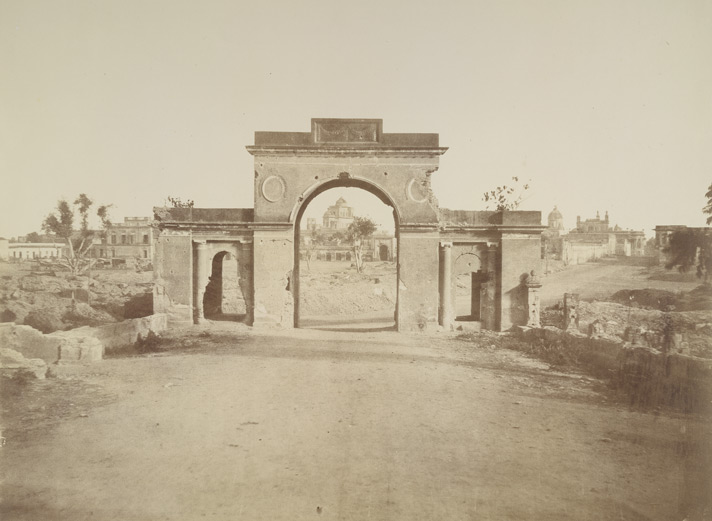
Long after Inglis and Outram had walked out of the Bailey Guard Gate, the last man alive in the Residency woke up from his slumber. Captain Waterman had retired to a quiet corner of the Brigade Mess earlier in the evening, intent on getting a little rest before the night’s march. At two o’clock in the morning he woke with a start and realised there was something wrong. He leapt to his feet and hope against hope, he ran from post to post looking for any signs of life. To his sudden horror, he realised he was quite alone in this vast compound, one man alone with a city full of furious rebels on the other side of a wall. He took to his heels and ran – out the Bailey Guard, through the palaces – and still all was silent. Now in a blind terror, he scrambled through the rubble, down the road until he finally came up to the very end of the rear-guard. The very horror of what had befallen him proved too much for Waterman’s nerves and for some time “affected his intellect.”
Waterman was not the only man to be left behind that night.
The next morning, as the roll was called at the Martiniere, it was found that Sergeant Alexander MacPherson of No.2 Company, 93rd Regiment and one of Ewart’s detachment, was not present. Shortly after he was seen running across the plain. He immediately reported to Ewart that he had, contrary to orders, after roll call, that no man was to sit down for fear of falling asleep, he had done exactly that and promptly dozed off. When daylight had crept over the wall of the Barracks, MacPherson awoke to find himself alone. Guessing what had happened and alert enough to remember in which direction the column was to retire, he quickly followed. It was only his good fortune that the rebels were still so occupied in firing at the Residency, no one noticed one lone European in the streets of Lucknow. The regiment dubbed him “Sleepy Sandy” and so he remained. Unfortunately, another man was not so lucky.
“Later in the day our sadness increased when it was found that Colour-Sergeant Alexander Knox, of No. 2 company, was missing. He had called the roll of his company at daylight, and had then gone to see a friend in the Seventy-Eighth Highlanders. He had stayed some time with his friend and left to return to his own regiment, but was never heard of again. Poor Knox had two brothers in the regiment, and he was the youngest of the three. He was a most deserving and popular non-commissioned officer, decorated with the French war medal and the Cross of the Legion of Honour for valour in the Crimea, and was about to be promoted sergeant-major of the regiment, vice Murray killed in the Secundrabâgh. His fate was never known.” (Forbes-Mitchell)
Parties of Highlanders searched for him through out the day, but he was never found. Ewart assumed he had either missed his way in the dark and walked back to Lucknow where he was undoubtedly killed, or he fell down a well; others supposed he might have been murdered by camp followers.
The 23rd of November was a day of regrets. Shortly after roll call at the Martiniere an explosion was heard coming from the college. It was not strong enough to destroy the house but it blew out the doors and windows and with it Corporal Cooper and five other men. They had been in one of the rooms of the Martiniere in which a quantity of loose poweder had been left by the rebels – no one knew what happened but the powder ignited and the men were blown up with it. Their “bodies were completely charred and their eyes scorched out.” Not a man of them survived and they died within an hour of the accident, unable to say what had happened.
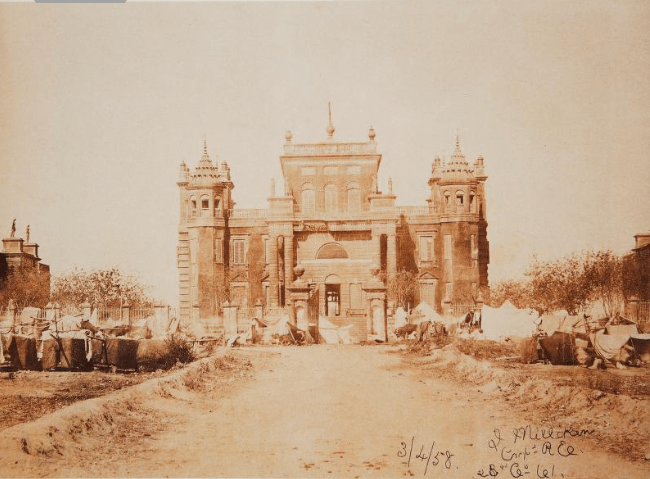
It was also clear that Sir Henry Havelock, who had been ill since the 21st was slowly dying. Suffering from dysentery, the desperate jolting he had received in the dhoolie through the night’s march had done nothing to better his situation. A soldier’s tent was pitched for him in the Dilkusha Park and his dhoolie was carefully placed inside. During the 22nd the rebels took a swift swipe at the park and while bullets fell around his tent, Havelock was moved to a more sheltered spot. The next day, he had not improved. By evening, shunning all save his son, who now sat beside his bed, his arm still in a sling, was attending to his father’s wants as best he could. Age, hard work, anxiety and now finally disease, proved too much for even his soldierly form. At 9.30 in the morning of the 24th of November, Sir Henry Havelock quietly died. His remains, wrapped in a flag, were carried to the Alambagh, where he was buried under a mango tree in the garden.
“There stood around the grave Sir Colin Campbell and the chivalrous Outram, the staunch old Walter Hamilton, and the ever-ready Tytler; and the ‘boy Harry’ to whom the campaign had brought repute for recklessness and the loss of a father; and the devoted Hargood, his ‘heart in the coffin there with Caesar’, and the heroic William Peel; and the ‘colossal red Celt’ the valiant ill-fated Adrian Hope; and honest Dick Pearson the General’s bugler; weeping for the loss of the best friend the Ross-shire lad had ever known. Behind stood in a wide circle the soldiers of the Ross-shire Buffs and the Madras Fusiliers who had done the dead chief’s bidding in many a hard fight, and in whose war-worn hearts, as they looked down on the last of the old commander, was stirring many a memory of his ready praise for valour and his ceaseless regard for the welfare of his soldiers. The volleys of the firing party were the good soldier’s fittest requiem; and so Henry Havelock was buried.”
On the 27th of November, camp was struck at the Alambagh and the Commander-in-Chief, with the women and children in tow continued the march towards Cawnpore. A different kind of mischief had already reared its head there – Brigadier Windham had met the Gwalior Contingent on the open field and things could not have gone any worse.
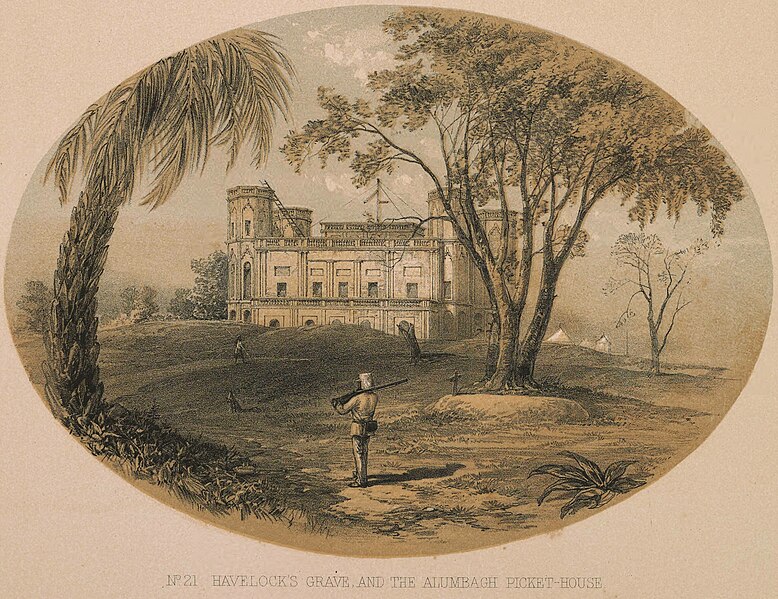
As the chapter closes, the scene changes. Sir James Outram will remain at the Alambagh to hold the last position on this side of the river for Sir Colin Campbell until he returns.
For now, Lucknow is lost.
As for the ladies, they had their own story of how they left Lucknow.
Sources:
Blomfield, David, ed. Lahore to Lucknow: The Indian Mutiny Journal of Arthur Moffat Lang, 1st Lt., Bengal Engineers. London: Leo Cooper, 1992.
Bourchier, George. Eight Months Campaign against the Bengal Sepoy Army during the Mutiny of 1857. London: Smith, Elder, and Co., 1858.
Ewart, John Alexander. The Story of a Soldier’s Life; or, Peace, War, and Mutiny. 2 vols. London: Sampson Low, Marston, Searle, & Rivington, 1881.
Fayrer, Joseph. Recollections of My Life. Edinburgh: William Blackwood and Sons, 1900.
Forbes-Mitchell, William. Reminiscences of the Great Mutiny 1857–59: Including the Relief, Siege, and Capture of Lucknow, and the Campaigns in Rohilcund and Oude. London: Macmillan and Co., 1893.
Grant, Hope. Incidents in the Sepoy War, 1857-58: Compiled from the Private Journals of General Sir Hope Grant. Edited by Henry Knollys. Edinburgh: William Blackwood and Sons, 1873.
Gubbins, Martin Richard. An Account of the Mutinies in Oudh, and of the Siege of the Lucknow Residency. London: Richard Bentley, 1858.
Holmes, T. Rice. A History of the Indian Mutiny: And of the Disturbances Which Accompanied It Among the Civil Population. 5th ed., rev. and enl. London: Macmillan and Co., 1897.
Inglis, Julia Selina. The Siege of Lucknow: A Diary. London: James R. Osgood, McIlvaine & Co., 1892.
Roberts, Frederick Sleigh. Forty-One Years in India: From Subaltern to Commander-in-Chief. Vol. 1. London: Macmillan and Co., 1911.
Ruutz-Rees, Leopold Edward. A Personal Narrative of the Siege of Lucknow: From Its Commencement to Its Relief by Sir Colin Campbell. London: Longman, Brown, Green, Longmans & Roberts, 1858.
Verney, Edmund Hope. The Shannon’s Brigade in India: Being some Account of Sir William Peel’s Naval Brigade in the Indian Campaign of 1857-1858. London: Saunders, Otley, and Co., 1862.
Wolseley, Garnet. The Story of a Soldier’s Life. Vol. 1. London: Archibald Constable & Co., 1903.
Wright, William, ed. Through the Indian Mutiny: The Memoirs of James Fairweather, 4th Punjab Infantry. Stroud, Gloucestershire: The History Press, 2011.
 Mutiny Reflections