My dreams were rudely broken into by the crash of a round-shot through the top of the tree under which I was lying, and I jumped up repeating aloud the seventh verse of the ninety-first Psalm, Scotch version:
A thousand at thy side shall fall,
On thy right hand shall lie
Ten thousand dead; yet unto thee
It shall not once come nigh.
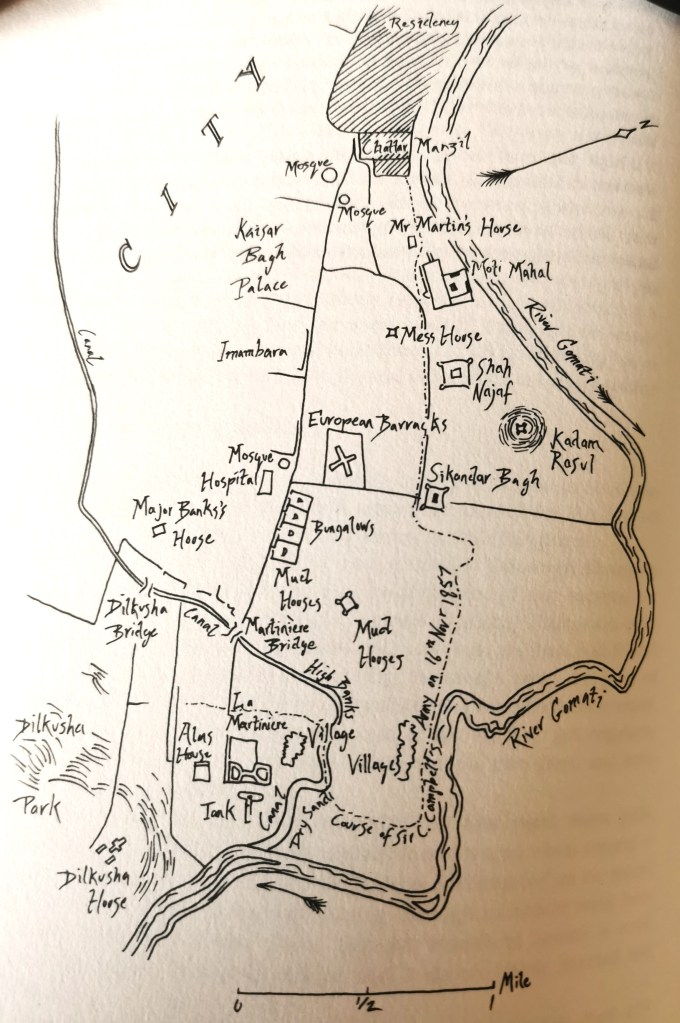
It was a rude awakening on the 17th of November, for William Forbes-Mitchell. At least he would have a good breakfast. Several men had kindled a fire in one of the smaller rooms, the roof of which had been shelled the day before, leaving a gaping hole and in this instance, a convenient chimney for the smoke. In a copper pot left behind by the sepoys, they poured water and filled it with 2 dozen pigeons that had been abandoned in a dovecot in the compound. These with vegetables they had found and the chapatis the sepoys had not had time to eat before their flight on the 16th, it was an admirable stew. Forbes-Mitchell contributed his matchbox of salt, a piece of advice he had been given by an old soldier who had served in the Peninsular War and at Waterloo, that a man should always carry salt in his haversack. It left Forbes-Mitchell thinking, quite soundly,
“I may here say that my experience is that the soldiers who could best look after their stomachs were also those who could make the best use of the bayonet, and who were the least likely to fall behind in a forced march. If I had the command of an army in the field my rule would be: “Cut the grog, and give double grub when hard work has to be done!”
Work had been going on since dawn – Forbes-Mitchell’s discovery of the gunpowder had given Captain Dawson a worrisome night – before light, he had organised a party of ordnance lascars from the ammunition park and several Ordnance Department officers to cart it away. It turned out to be nearly 5000lbs of loose powder, 20 ordinary powder barrels and what Forbes had not seen the night before, more than 150 loaded 8-inch shells. What the Europeans only just discovered the sepoys already knew; scarcely had the last cart left that they started to pour a “red-hot” fire on the Shah Najaf from their batteries at the Badshahbagh across the river, directly at the rooms where the powder had been stored. Had they started their shelling an hour earlier, there most likely would have been no Forbes-Mitchell left to eat stew in the morning.
“Immediately after the powder left by the enemy had been removed from the tomb of the Shâh Nujeef, and the sun had dispelled the fog which rested over the Goomtee and the city, it was deemed necessary to signal to the Residency to let them know our position, and for this purpose, our adjutant, Lieutenant William M’Bean, Sergeant Hutchinson, and Drummer Ross, a boy of about twelve years of age but even small for his years, climbed to the top of the dome of the Shâh Nujeef by means of a rude rope-ladder which was fixed on it; thence with the regimental colour of the Ninety-Third and a feather bonnet on the tip of the staff they signalled to the Residency, and the little drummer sounded the regimental call on his bugle from the top of the dome. The signal was seen, and answered from the Residency by lowering their flag three times. But the enemy on the Bâdshâhibâgh also saw the signalling and the daring adventurers on the dome, and turned their guns on them, sending several round-shots quite close to them. Their object being gained, however, our men descended; but little Ross ran up the ladder again like a monkey, and holding on to the spire of the dome with his left hand he waved his feather bonnet and then sounded the regimental call a second time, which he followed by the call known as The Cock of the North, which he sounded as a blast of defiance to the enemy.
When peremptorily ordered to come down by Lieutenant M’Bean, he did so, but not before the little monkey had tootled out—
There’s not a man beneath the moon,
Nor lives in any land he,
That hasn’t heard the pleasant tune
Of Yankee Doodle Dandy!
In cooling drinks and clipper ships,
The Yankee has the way shown,
On land and sea ’tis he that whips
Old Bull, and all creation.
When little Ross reached the parapet at the foot of the dome, he turned to Lieutenant M’Bean and said:
“Ye ken, sir, I was born when the regiment was in Canada when my mother was on a visit to an aunt in the States, and I could not come down till I had sung Yankee Doodle, to make my American cousins envious when they hear of the deeds of the Ninety-Third. Won’t the Yankees feel jealous when they hear that the littlest drummer-boy in the regiment sang Yankee Doodle under a hail of fire on the dome of the highest mosque in Lucknow!”
Long before daybreak, Sir Colin visited Lieutenant-Colonel Ewart and the 93rd at the European barracks – he gave him the sobering order that he was to hold the position as long as he had a man alive; he was not to attempt any “aggressive movement” but only to act on the defensive. Ewart asked if he had a gun or two to spare, but he replied,
“No, I cannot spare you a single one; you must depend upon your rifles and bayonets,” but he promised to send him infantry reinforcements. Two more companies of the 93rd – the grenadiers under Captain Middleton and No. 1 under Captain Clarke soon made the appearance, together with some Madras sappers who helped to put the position into defence. All the while, Ewart, who had been injured the day before, was suffering from the cut on his right arm, obliging him to put his arm in a sling he had made from his neck handkerchief. A supply of provisions came in from the Dilkusha and Ewart’s bearer came along with them, much to his relief. With the reinforcements came Arthur Moffatt Lang.
With Stephenson and Pritchard with the sappers and three companies of the 93rd, he was busy closing all the openings with sandbags, shutters and anything else that came to hand.
As for Ewart, who had gone to see Sir Colin at the Shah Najaf to report on the state of affairs at the barracks, and to complain the position was receiving heavy fire from the Kaiserbagh. Ewart proposed sallying out to the building and put the rebels to rout – when Sir Colin asked if he could do without losing a single man, Ewart had to admit he could not. He returned to his post to continue in a curious pastime of trying to shoot down the rebel sharpshooters out of the towers of the Kaiserbagh.
Presently, Lang was ordered off to the Mess House. Forbes (of the engineers) with 20 sappers was ordered to throw a bridge over the moat, while Lang was to lay mussocks (leather water bags made of inflated animal skins) of powder at the doors and blow them in. Luck was on their side – the rebels were too busy to pay much heed to Lang. In a few huts on the plain he laid out his mussocks, powder hoses and quick matches -they then watched the reconnoitring. Forbes went forward with some men to see if the pounding of the guns had dislodged the rebels. It soon became apparent the day of shelling had had some effect and Forbes proceeded unhindered – Arthur Moffatt Lang would not need to risk his limbs after all – “So my life was saved and Victoria Cross gone, thinks I!”
At the Shah Najaf, with their breakfast over, Forbes-Mitchell and his comrades told off in sections and proceeded to shoot back across the Goomti. Then they sponged out their rifles. After four days the rifles were so foul they were near impossible to load and the severe recoil left men’s shoulders black from bruises. As soon the rifles were cleaned, the next order was to try and silence the infernal racket from the Badshahbagh. To shorten the distance, the sepoys had brought their guns out into the open outside the gate to within 1200 yards of the Shah Najaf, on the river’s edge. Unfortunately for them, the 93rd was armed with Enfields – had they known, they might not have been so hasty.
Twenty of the best shots were called forward. They watched until a number of sepoys had gathered near the guns, then, raising their sights to full height and taking care to aim high, they fired a volley “by word of command slowly given – one, two, fire!” – and 6 sepoys fell dead. The rest quickly withdrew their guns inside the gate and closed it. Nothing was heard from them again.
As for Forbes-Mitchell, he was sent by Dawson to the field hospital. As events would have it, several men were wounded in an ongoing repartee with the rebel sharpshooters stationed in the high towers of the Moti Mahal from whence they could pepper the Shah Najaf at will. What the company had in the way of ammunition, they could not make for a missing surgeon and it fell on Forbes-Mitchell to find one. He raced back to the Sikandar Bagh only to be told by Dr Munro that no assistant surgeons or attendants could be spared as the attack on the 32nd Mess House would soon begin – he would, if time allowed, send a hospital attendant with a supply of lint and bandages to the Shah Najaf. By the time Forbes Mitchell had raced back, the attack had begun. In his wake came Sergeant Finlay with a single doolie and a scant few medical supplies.
The sick and wounded had faired badly during the night of the 16th. During the night they had been under constant threat of attack and heavy firing could be heard around the Sikandar Bagh where they lay under the walls, as the rebels engaged the picquets. It was decided to move the patients to a village 150 yards further back – it consisted of a square court surrounded by cottages whose doors opened onto the courtyard – the walls were thick enough to withstand an assault but the rebels were not going to let the move pass unhindered. The sick and wounded had barely been deposited in their new quarters when several round shot were sent flying into the court – the second one killed two camels and the third went through the roof of the building that Dr Dickson and the staff had taken for their quarters. On the 17th, they moved some of the wounded to the Dilkusha but more would soon be coming in.
 Mutiny Reflections