The Sorties
By the morning of the 26th, only a part of the relieving force was inside the Residency – some had found their way to the Tehri Kothi, a part was still in the streets from the Pyne Bagh, and the rear guard was half a mile away, in the Moti Mahal. It was Outram’s objective to bring them all together. Accordingly, he sent out a party of the 250 men of the 5th Fusiliers and a detachment of Brayser’s Sikhs to bring in the rear guard. What they had not anticipated was, that even though the insurgents had indeed been beaten back from the Residency on the 25th, they had not abandoned their positions – heavy firing from the Kaiserbagh prevented the rear guard from moving out and the reinforcing party were left to seize and occupy the gardens and buildings adjacent to the Moti Mahal, with the 90th Regiment who had already spent an uncomfortable night in the Chattar Manzil, remained in their position in the forwardmost garden of the palace.
Outram’s next objective was to hold the entire river-front from the Iron Bridge to the Chattar Manzil Palace and on the same day, and on the 26th of September, the first sortie was sent out with this objective in mind.
The party consisted of 150 men of the 32nd Regiment under Captain Lowe, with Mcleod Innes as their guide. Proceeded from Innes’ Post they proceeded down to the river. Although they encountered a considerable body of rebels, Lowe managed to sweep them back, forcing them into the river and over the bridge, but they failed to either hold the bridge or any of the buildings near it. The rest of Lowe’s party, 2 detachments under the command of Captain Bassano and Captain Lawrence, cleared the Captain’s Baazar, and then sweeping off to the right, met up with Aitken in the Tehri Kothi, capturing an 18-pounder and several light guns in the process.
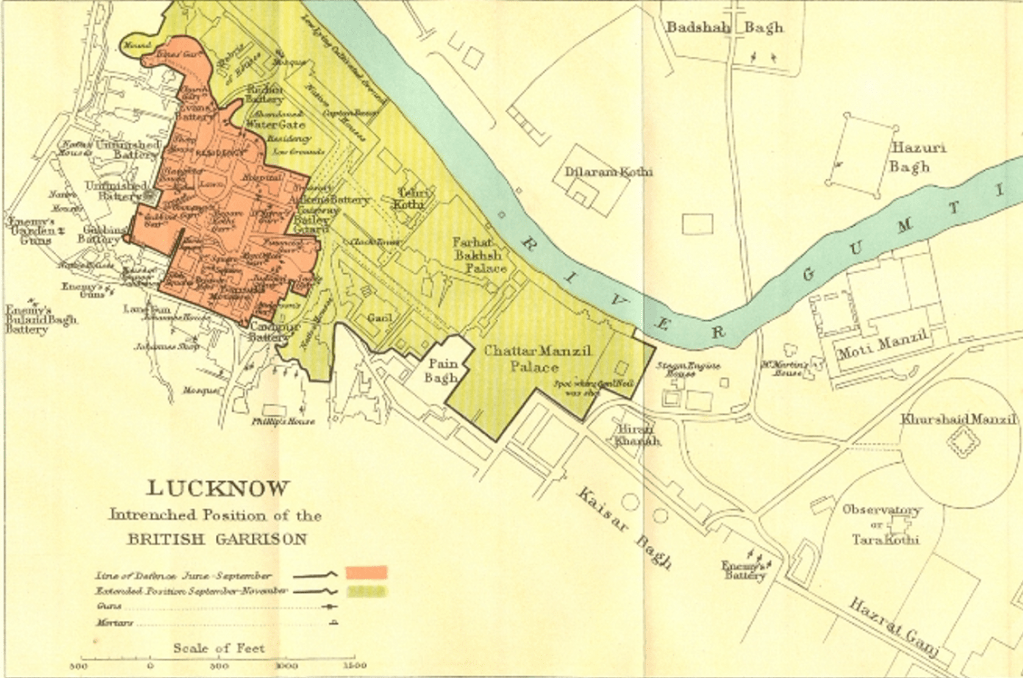
They then moved off from the Tehri Kothi towards the Farhat Baksh Palace (known during the latter part of the siege as the Ferret Box) and the enclosure, so by evening, the position of the Residency had been extended as far as the Chattar Manzil. It would be left to Colonel Napier to bring in the rear guard with a party of 100 men of the 78th and a few additional officers. Their guide was one Henry Kavanagh.
“The heavy guns having to pass under a close fire from the Red Gate, I offered to guide a party, after dark, to take it by surprise, and Colonel Napier entrusted the attack to me. I led it into the square before the gate, (where lay our wounded in the doolies dropped the previous evening), without alarming the enemy, who could be distinctly heard overhead, and behind a screen drawn across the passage. In three minutes the Gate would have been ours,, but, at the moment for action, the two young officers in command urged that the enemy were too many, and being overheard by the men, they at once whispered their concurrence, and alluded to me as a drunken madman. I did reel, indeed, from the effects of pain and fatigue; I was many hours on my feet, and my toes had been severely squeezed by Captain Hardinge’s horse. In vain I urged the certainty of success, and the necessity for holding the gate while our heavy guns passed by: my party retired, pursued by a sharp fire from the enemy, who were warned by their noisy flight. We had unconsciously been close to nine devoted men, who shut up in a house for two nights and a day, had resisted the persevering efforts of the enemy to destroy them, and endeavoured to preserve the wounded in the doolies — the victims of General Havelock’s too great haste to reach the Residency.”
One of the wounded men brought in was Havelock’s son.
27 September
On the afternoon of the 27th, Major Stephenson with the whole of the Madras Fusiliers made a sortie on the left of the Cawnpore Road and again, Henry Kavanagh stepped up as a volunteer.
They were divided into three divisions, under Captain Galway, Raikes and Fraser. Another party of the 32nd men was led by Lieutenant Warner (of the 7th Light Cavalry). Lieutenant Huxham, Lieutenant Mecham and Captain Kemble were led by Lieutenant J.C. Anderson of the engineers and Lieutenant Innes. The objective was to clear the Garden Battery, situated just outside the Residency defences, close to the Cawnpore Battery, at the southeast corner of the defences.
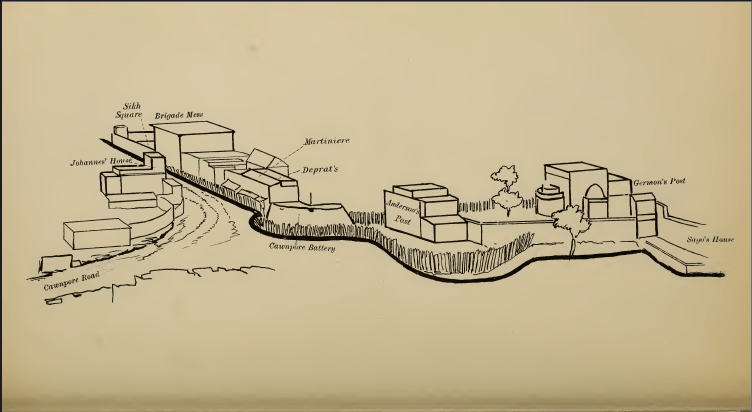
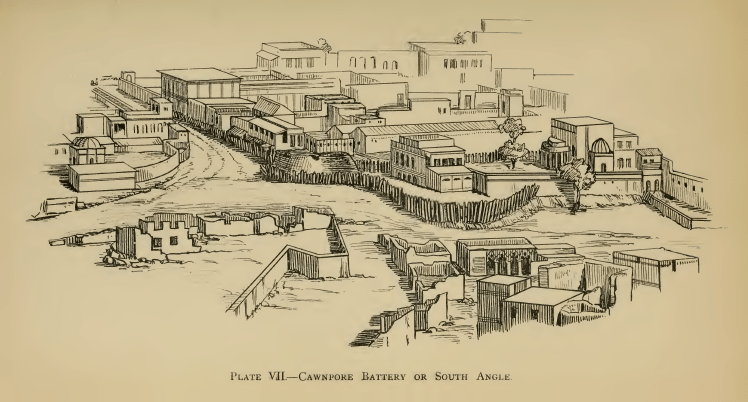
At 2pm, the party moved out of the Residency, through the Tehri Kothi, across the road in the rear of the Clock Tower and then turned right towards the Garden Battery. Instead of listening to Anderson and Innes who had called for caution from the start, knowing full well how the rebels fought, the party of the Fusilier had rushed forward without waiting for orders and promptly lost their way. As soon as they crossed the road, the insurgents opened fire.
The men rushed across a courtyard through a doorway to the right and then through a succession of narrow streets and holes in walls to come out finally on the Cawnpore road. Here they came upon one of the rebel guns which was firing grape down the road – Warner took his party off to one side of the embrasure and on receiving the word of command from Stephenson, rushed the battery. The rebels in the meantime, had fled, leaving their gun to be spiked by a naik of the 13th Regiment. Warner then tried to burst it but realising there was no water to wet the clay, failed to do so.
Meanwhile, Captain Fraser reconnoitred further up the road and stumbled into another battery consisting of a 24-pounder and an 18-pounder. The guns were abandoned but the insurgents kept up such a fire on Fraser and his men from the adjoining houses, he was obliged to send word back to Stephenson for reinforcements. He promptly sent forward Captain Galway but it was hopeless. Under a galling fire, Stephenson ordered to retreat.
“The enemy on their approach, after a short time abandoned their guns, but fired on the assailants from all points. The insurgents were, however, in such force that our men could not maintain the position they had taken, and were obliged to return eventually after spiking three guns and burning the battery. The delay in bringing up the blasting party prevented their bursting the guns as they intended to have done…The men had drunk most of the water intended for bursting the guns, and the party had to return sooner than they had expected.”
Kavanagh had a more spirited telling of the sortie.
“We captured and spiked three guns after much firing, when, from want of confidence in the guide, and uncertainty as to where we were, the commander became confused — our men grew uneasy standing still — the enemy crowded forward, encouraged by yells and bugles — and we scrambled out of the battery, and followed our inclinations home... As we lingered in the battery a Sepoy of the 13th Native Infantry, who came out as a pioneer, advanced to a broad opening through which the enemy kept up a brisk fire, and, flourishing his pick-axe, called to the Europeans to follow him to another gun, till he was shot down. But the uproar and confusion at that, moment was such that nobody heeded him, and he would have been left behind had I not helped him out of the battery, and put him on the road, along which I was myself in full flight soon after.“
The sortie was withdrawn under a murderous fire from the surrounding buildings and cost the lives of four men of the Madras Fusiliers, seven wounded of which two were mortally hit, and three men killed of the 32nd, among the Privates Cooney and Smith. The 32nd, which could ill-afford any losses, had one sergeant and four privates wounded, Lieutenant Huxham was severely injured and a young civilian named Crabbe was killed.
Inseparable in life and so in death were Corporal William Cooney and Private Michael Smith, two men who had always fought side by side. In a previous sortie during the siege they had charged a battery themselves, scaring the insurgents away by shouting “Right and left extended!” as if they had a whole army behind them. On the 27th, Cooney had removed the sling from his arm and quietly joined the detachment, unwilling to let Smith go out on his own. When their bodies were brought in, Brigadier Inglis looked down at them and said,” There lie two of the bravest men who ever wore a red coat.” It was left up to Lieutenant Warner to write to Smith’s parents.
28 September
On the 28th the planned sortie to the same position was cancelled but events continued as Outram insisted. Lieutenant Moorsom and 50 men of the 9th and the 5th Fusiliers were sent out to hold the Chattar Manzil. Meanwhile, Outram dispatched a letter through a messenger, to Major MacIntyre to continue holding the Alamabagh with whatever resources he had open to him. He then went back to planning the sorties with the engineers. Another sortie, this time to rid the Residency of the menace presented by the house of the merchant, Johannes, was carried out with more success. The house, on the very walls of the Residency, had been cleared in a sortie once before during the siege but with not enough men to hold the position, Inglis had reluctantly been forced the relinquish the position, hoping the insurgents would not have the cheek to occupy it again. He was wrong and within hours of his men withdrawing, they took up their old position and continued firing on the nearby posts, especially those of Martiniere and Deprat. Determined to rid the Residency of this particular nuisance, the sortie stormed the house and succeeded in blowing it up with gunpowder.
On the 29th of September, three sorties were carried out, the first intended to carry the Iron Bridge, the second to clear and demolish the houses which had long harassed Gubbin’s Post, and the third to clear the area to the left of the Brigade Mess.
The first column, under Major Shute of the 64th Foot advanced from Innes Post and managed to destroy a 24-pounder that had done so much damage to the garrison during the first months of the siege; they then spiked 2 mortars and dismounted several small calibre guns. They failed to reach the Iron Bridge.
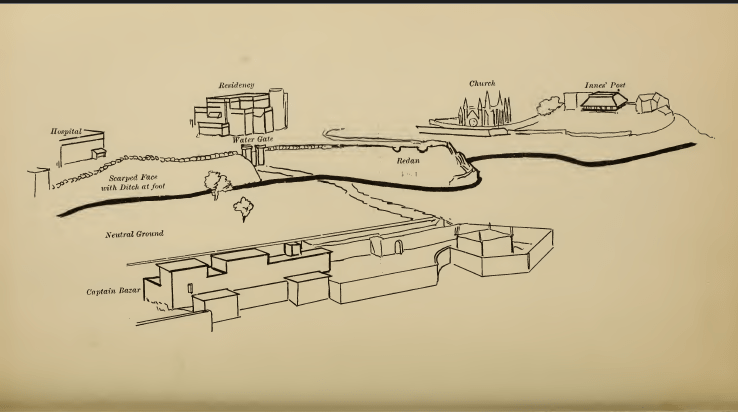
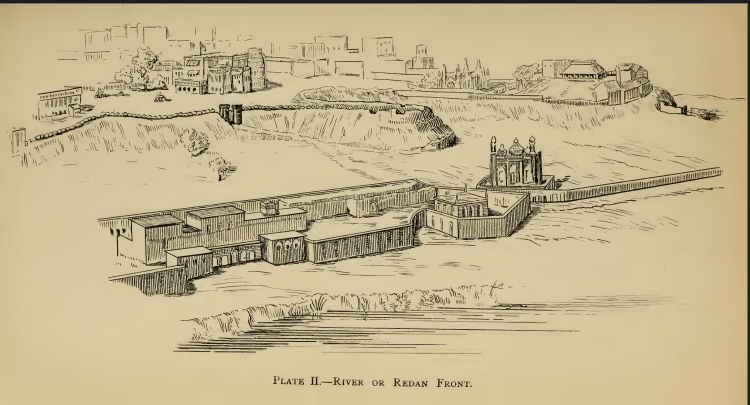
” They issued from our outpost at early dawn and proceeded towards the iron bridge, stormed the house known as Mr. Hill’s shop, close to our garrison, where Lieutenant Tulloch, who accompanied them, after our men had succeeded in driving the enemy out and killing a great number, blew up their favourite gun called Luchminya, which had been captured by the insurgents at Chinhutt, and which had played with such fatal effect upon our garrison and the Residency. Lieutenant Graydon’s order to occupy the houses near the iron bridge, and near the lane commanded by our outpost, was unfortunately not executed. The consequence was, that the insurgent guards there, who in their first surprise had fled across the river, on recovering from their panic, reoccupied them, and fired at our men murderous volleys. We lost no fewer than ihwty^five men, killed and wounded, exactly the third part of the strength of the detachment which had gone out, and our men were obliged to retreat without being able to maintain the positions they had taken temporary possession of.”
Under the covering fire of Innes Post Shute retreated to the Residency with ten men killed and 23 wounded, one mortally.
The second sortie under Major Apthorpe and Lieutenant Hardinge advanced from the Sikh Square and worked across to the right, covered the whole time by musketry from Gubbins’ Post. They managed to destroy several houses, demolish two mine shafts and disable the much dreaded Lane Gun that had wreaked such havoc on Gubbins’ House that the upper storey was left in ruins. Fortunately for the party, Mr. Gubbins was watching their progress from Grant’s Bastion with a party of the 32nd and Lieutenant Maitland of the Royal Artillery. Perceiving the rebels preparing to rush Apthorpe from a nearby mosque, he calmly asked Maitland if he thought he could knock down the minarets. Maitland, after a little consideration, placed a 9-pounder in position and in three rounds at 400 yards brought both the minarets crashing down on the rebels’ heads stopping them well in their tracks. Apthorpe regained the Residency with four killed and eleven wounded.
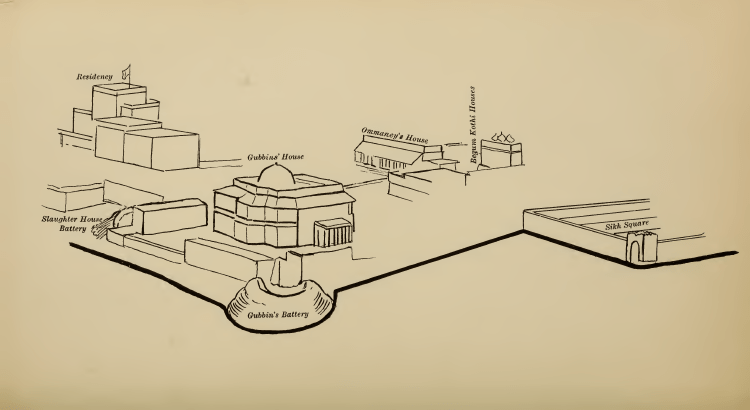
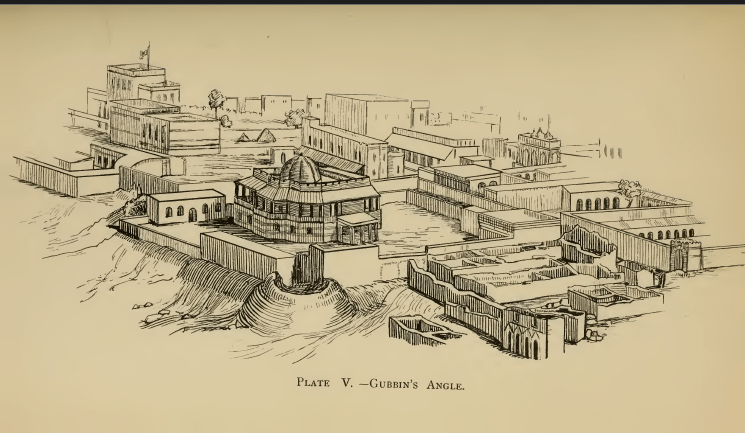
The third sortie led by Captain McCabe of the 32nd and Major Simmons of the 5th Fusiliers filed out of the Residency at daybreak, proceeding from the Brigade Mess. They formed up under cover of a wall and then rushed a breastwork, some 80 yards from the Brigade Mess, that concealed an 18-pounder. The surprised gunners managed to fire off two rounds before abandoning their gun. It was the last sortie McCabe would lead – in the ensuing fight, McCabe would be shot through the lungs and Major Simmons would be killed; nine others would be killed or wounded.
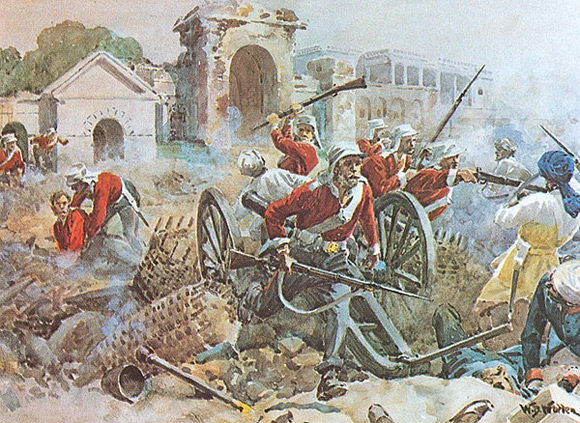
Brigadier Inglis had tried to prevent Outram from sending out McCabe; his men, he said were exhausted and overworked; Outram merely replied that since the men of the garrison knew the territory better than anyone, they would continue to lead the sorties overruling Inglis on every stance. The men themselves, like Lieutenant Warner (of the 71st but attached to the 32nd) were equally irritable. In a letter to his father, he wrote,
“I have hitherto escaped unhurt by God’s blessing, and have volunteered for two sorties against the enemies batteries. I have now done my duty and shall not volunteer again, nothing is to be got by it, and life is precious. I however considered it a duty and have done it.”
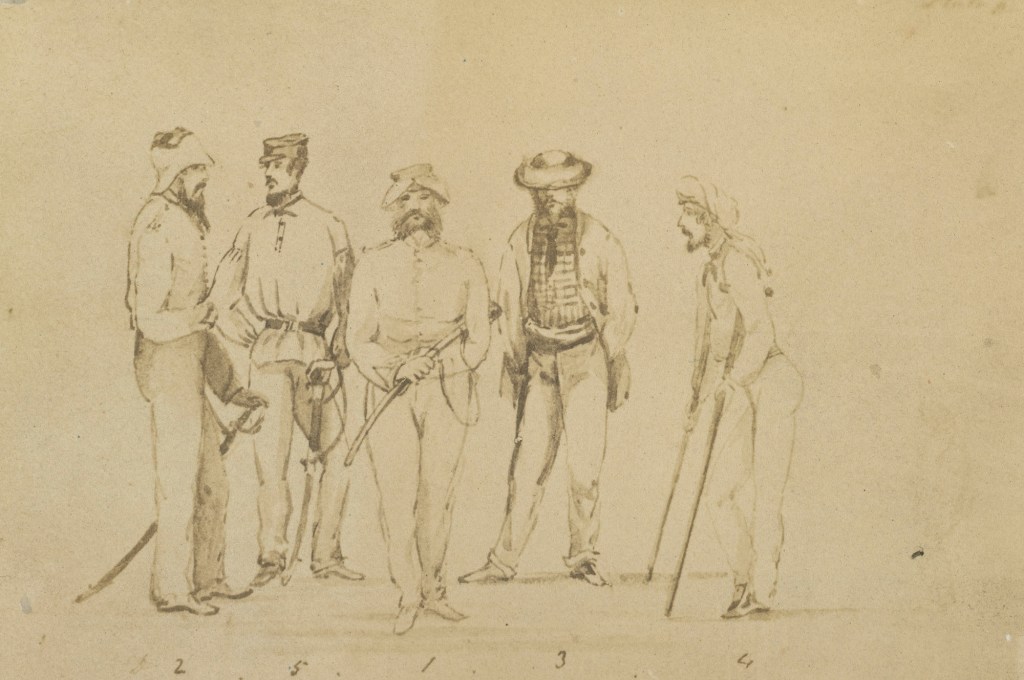
What Outram failed to consider was that although the men of the garrison were familiar with their grounds and those immediately surrounding the Residency, there was no reason for him to believe they knew the ins and outs of the palaces, courtyards and lanes. It appeared he was trying to preserve his own force, which he still believed at this point would be able to cut their way out of the Residency and return to Cawnpore, and in doing so, was willing to sacrifice the men of the 32nd. When Warner was again ordered out on a sortie on the 1st of October, Inglis wrote him the following note,
“My dear Warner – I have had nothing to do in sending you out on the devil Sortie – Yours sincerely, J. Inglis.”
1st October
The objective of the “devil Sortie” Inglis referred to was to secure the possession of the Cawnpore road to a sufficient distance to allow troops, coming over the Charbagh Bridge, to reach the Residency. It began in the morning with a ruse – by the commencement of a battery on the Kaiser Bagh and on the Pyne Bagh, to distract the insurgents by giving them the idea that Outram intended to further extend his position from the Residency. Thus occupied, in the afternoon, the real sortie charged out. Taking the route that should have been taken on the 27th (directly out of the Residency onto the Cawnpore Road instead of the detour through the Tehri Kothi), the objective was to capture Phillip’s House and garden with the battery installed there, which faced the Cawnpore battery and flanked the Cawnpore road.
With one side of the Cawnpore road already cleared in the sortie on the 29th, Phillip’s garden could now be attacked by infantry from two flanks, the artillery took care of the entrenchments in the front, and the storming party was able to take the guns in the garden and then blow up the house itself. Captain Anderson, who had commanded Anderson’s Post throughout the siege, took part in the sortie.
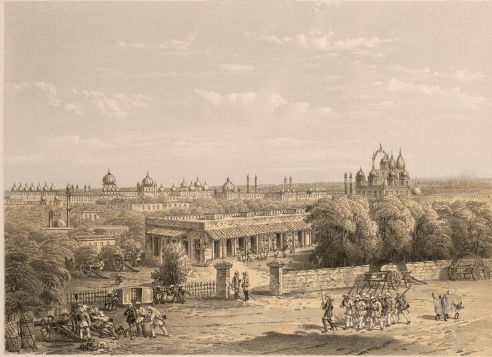
“On the 1st October a force, consisting of some 500 men of various European, corps was ordered out to attack some guns in a garden to the left of my outpost. I was directed to place myself under the orders of Colonel Napier, to act as a guide, and to point out to the men where our outposts were. A Mr. Phillips, a brave old volunteer, took our force out into the main street; and when we got to the place leading to the garden, he accompanied one part to the left and I took the remainder up through the houses to the right. After running up a very narrow lane (whilst a few of the enemy fired down upon us from the tops of the houses), we reached a doorway, which I felt sure led into the line of houses we wanted to drive the enemy out of. I felt convinced of this, as the place was one from which I had throughout the siege, observed the enemy pass towards the garden. We had a private, of the name of Hunter, with a pickaxe, and several others of the 32nd and other corps with us. Dawson, a private of the 32nd, with Hunter of the same corps, were not long in smashing in the first door. Dawson and the rest of us immediately rushed up some steps inside the house, and then came upon another door fastened in a similar manner. We broke it open in a few seconds and then found a clear road through the houses.”
Anderson observed the insurgents never waited to “cross bayonets” but continued retreating ahead of the storming party. Their surprise must have been complete as Anderson mentions they left behind their filled water skins, their fires were lit and food was still cooking when Dawson and Hunter smashed down the doors.
Impetuous to the last, Dawson could not be restrained and he continued forward, even though the order was that no advance was to be made until all the houses in the rear had been taken and occupied. The private however refused to be stopped, and carried on, alone. Anderson, although only the position of a guide, but feeling Dawson was behaving most imprudently, ran off after him.
“Well, when we got up together to a narrow passage, we found the enemy in great force, and they beat the charge, shouted, and tried to form up to drive us back. At this moment there were only five men, including myself, up; the rest were all pretty close, but threading their way through the houses. I at once made all present bring their firelocks to the charging position, and cover the narrow passage. The rascals on the enemy’s side dare not advance a single step, though the yells they gave were horrible. We waited for some time, and were soon joined by the rest of our men, who were close on our heels, and then it was all right. That brave fellow, Dawson, of the 32nd, again rushed off*, unobserved by me, and presently he came running up, breathless, and said, — ” Come here, sir, and I’ll show you one of them.’ I followed him, and, sure enough, there was a Pandy (a slang name given to the Sepoys who mutined), lying dead, with his heels towards us. He had advanced, unknown to us, with some twenty others, to our left, to try and get round our party; but brave Dawson alone stood in a gap of a broken wall of a house, and drove them all back by his steadiness in shooting down the foremost man amongst them. Had I been placed in command, I might have had to check, even further, a man who had no fault but being too anxious to get on, without seeing how he was supported; and I am glad I had not to do so.”
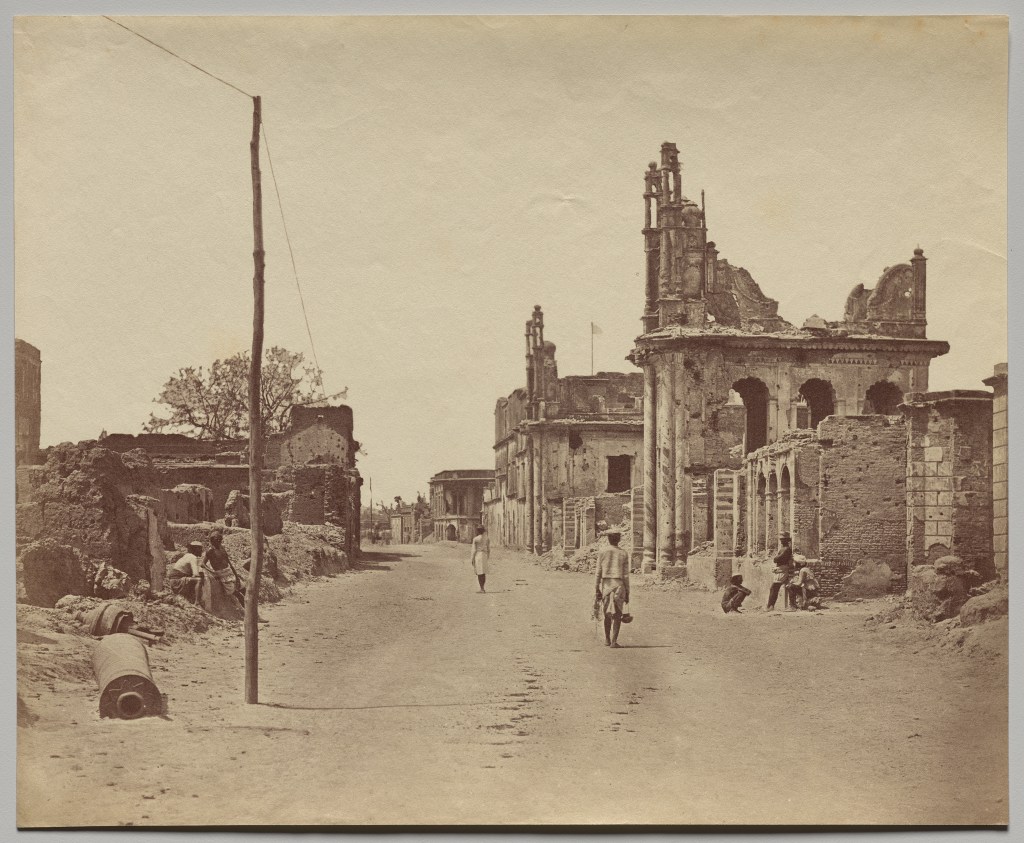
Anderson went back to find the rest of the party and found Colonel Napier. Guiding him to the spot they had first got up to, the party found themselves directly under the fire of the rebel guns, firing grape. The guns, however, were too high, and the shots simply whizzed over their heads, without harming anyone. Seeing that grape did not work, the insurgents commenced “a heavy fire of bricks and clods of earth” one which struck Anderson on the forehead and cut his nose, causing him to fall. He was quickly revived by splashes of water and, seeing he was none the worse for wear, staggered to his feet and proceeded onwards. Colonel Napier however called a halt. They would consolidate and hold the ground they had gained for the night.
“On the 2nd of October, 1857, the garden, in which the guns were, was taken, but the enemy had carried off the 8-inch howitzer. A drummer of Her Majesty’s 32nd, named Conway, a mere boy, presented his musket at a huge Sepoy, and the man then fell on his knees, and begged for his life. The boy said in an authoritative voice, ” Come along with me,'” and then placed his hands on the prisoner, and marched him off, and, on meeting an officer, he said, ” Here, sir, is a prisoner I have taken.'”
It was not the victory Outram had envisioned. To open the Cawnpore Road as a line of communication with the Alambagh, it would have been necessary to fight their way through every house that lined it- as Hunter and Dawson did – and by more harrowing sorties. Halfway down the road, a mosque, heavily fortified and filled with riflemen, put an end to Outram’s endeavours – he could not attack the position without a heavy loss of life nor did he have enough men to hold the ground if he did. So they were compelled to abandon the houses they had occupied on the Cawnpore Road and return to the Residency on the 4th of October. The three guns supposedly spiked on the 1st, were quickly brought back into service and levelled, as usual, against the Residency. However, the extended positions led to some confusion in the rebel lines. On the 6th of October, as new insurgents continued to join the existing army, a guard of the 41st under a havildar came “quietly into a room close to where our guards were; they piled arms, and were taking it very comfortably, whereupon the Europeans rushed upon them, and killed every man. They had, in fact, no idea that our outpost was so close. In fact, the room was our guard-room, that had only just been taken, and the Sepoys fancied it was, as usual, occupied by their own side.“
 Mutiny Reflections