Military Units at Nagpur in 1857
At Takali, Nagpur, Nagpur Irregular Force.
1. One Regiment of Nagpur Irregular Cavalry, about 500 horses (mounted troopers) Major Henry Shakespear (on leave), Capt. Edmund Wood.
2. 1st Regiment, Nagpur Irregular Infantry, consisting of three battalions, Capt.Holland.
3. One company of Horse Artillery, Lt. Playfair.
Total Nagpur Irregular Force consisted of one regiment of Irregular Cavalry, 500 men; three regiments of Infantry, 2,400 men; and one Horse Field Battery, 96 men; in all, 2,996 men. The remaining units were posted at different places in the Nagpur district.
At Sitabuldi Fort
1. One Company of the 26th Madras Native Infantry, Lt. Laurence Johnston.
One guard of eight men on sentry duty, others billeted at Residency (100 men)
Major Bell was Commissary of Ordnance at Sitabuldi Fort.
At Kamptee (old Nagpur Subsidiary Force)
Brigadier Henry Prior Commandant Nagpur Subsidiary Force.
1. 17th Regiment, Madras Native Infantry.
2. 26th Regiment, Madras Native Infantry.
3. 32nd Regiment, Madras Native Infantry, Col. Boileau, Major Baker, Capt. Manley.
4. 33rd Regiment, Madras Native Infantry, Col. Miller, Adj. Benwell, Surgeon Hunter Adam.
5. 4th Madras, Light Native Cavalry, Col. Cumberledge, Lt. Morris.
6. One company of European Artillery, Major Gomm, Major Arrow.
As if this was not enough, there were further military units near Nagpur.
Military Units near Nagpur
1. Chandrapur – eighty-five miles south of Nagpur: 2nd Regiment Irregular Infantry and a detachment of the 1st Regiment.
2. Bhandara – forty miles to the east of Nagpur, another detachment of the 1st Regiment.
3. Raipur – hundred and thirty-seven miles east 3rd Regiment of Nagpur Irregular Infantry.
4. Bilaspur – A detachment of the 3rd Regiment. (Hemant Sane, Nagpur and the Mutiny of 1857)
The Commissioner of Nagpur was one very interesting individual, Mr George Plowden. He was strong-headed and clever but would be much maligned in the future – he suffered from “constitutional laziness”, and his refusal to send in reports to the Government in Calcutta was well nigh legendary. Moreover, in his entire tenure as Commissioner at Nagpur, Calcutta never received “an annual report on the moral and material progress of the country” – the foolishness of such a report was obviously not lost on Plowden, who managed to ignore every request for it.
When he finally left Nagpur, his successor, Colonel E.K. Elliot, was left with a mass of arrears from the rather petulant Plowden. However, what the administration in Calcutta might have thought of Plowden (and he of them), he was still not a failure as an administrator. He had Assistant Commissioner Robert Stanton Ellis keeping an eye on the district with him and between them, they would have much more work to do. However, history has not been particularly kind to Mr Plowden, and he remains mostly forgotten.
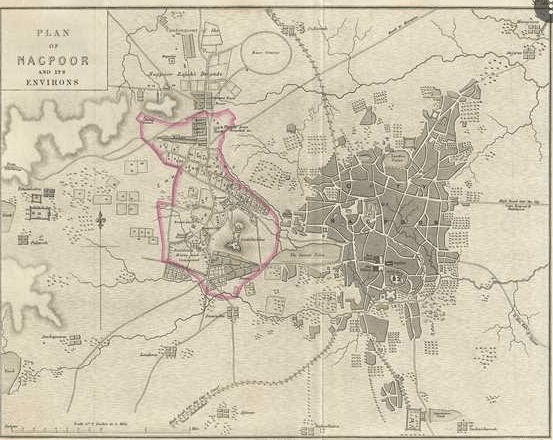
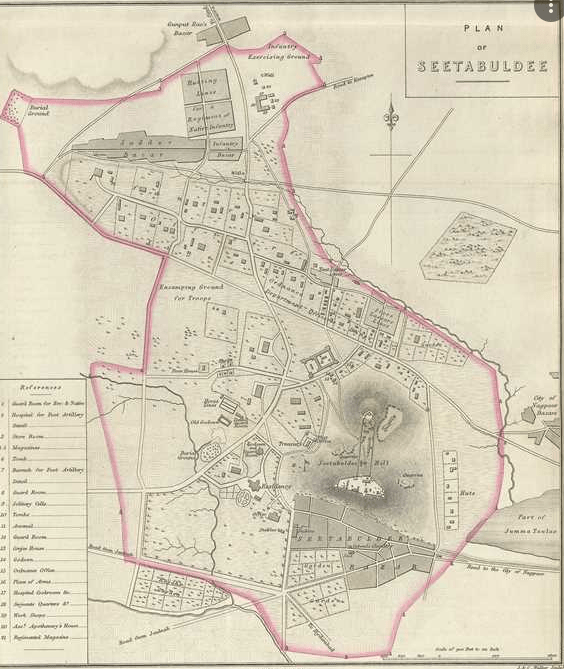
Sitabuldi Fort was something of a headache. Old and dilapidated, by 1857, there were plans to either demolish or abandon it. Built by the EICo in 1822 when Richard Jenkins was Resident to Nagpur, the construction had been overseen by Colonel Adnane, who used black stone from the Katol area and employed a variety of bewildering styles, both Indian and colonial, in its construction. Yet its location on the Sitabuldi Hill was considered most advantageous, giving ample views of the surrounding countryside and Nagpur itself.
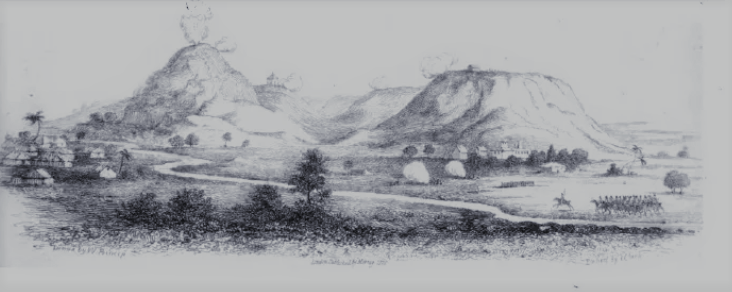
So, what gave the EICo the right to build a fort in the first place, one may ask? For this, we go back to the war the British fought against the Pindaris in 1817. In November of that year, a battle was fought – the Battle of Sitabuldi – when the British forces at Nagpur were attacked by Raja Mudhoji, the nephew of the recently deceased ruler, Raghuji II Bhosale. He had decided to attack the British with the help of the Peshwa, thinking rather wrongly, with the British so busy repelling the Pindaris, he had a chance to drive them out of Nagpur.
Unfortunately, Mudhoji was wrong. He lost the battle and at the next one – the Battle of Sakkardara on 16 December 1817 – he was not only attacked by the British but forced to surrender. Nagpur fell under British control on 6 January 1818. The treaty stipulated the EICo, who now controlled not only the Sitabudli Hills, the village and the area around it, could also use the hills to build fortifications on them. Raja Mudhoji further ceded his territories north of the Narbada as well as those on the south banks of the Gawligarh River, all his territories in Berar, Sirgohah, and Jashpur. All the affairs of Government, both Civil and Military, would be “settled and conducted by ministers in the confidence of the British Government according to the advice of the Resident and His Highness with his family will reside in his palace in the city of Nagpur under the protection of the British troops.”
He further had to give up any forts in his possession should the Government require them for their use, and “The two hills of Seetabuldee with the bazaars and land adjoining to a distance to be hereafter specified shall be henceforth included in the British Boundary and such military works erected as may be deemed necessary.”
As Nagpur itself was in a weak position, a strong fort was considered a good idea – it was a defensive position the British could retreat to where they could hold out until help arrived. And a fort on a hill is, of course, a symbol of dominance, a fact that was not overlooked when it was built. Taking up some 11 acres, divided in two nearly equal parts into outer and inner parts, it also boasted of large adjoining grounds, though most of these have disappeared now and barely 120 acres remain.
Mudhoji II continued to rule in Nagpur as the British built their fort. The British abandoned the original cantonment area and established a new one at Takali and at Sitabuldi itself. A large flat area on the north side of the hills was levelled to make way for the arsenal, and other areas were marked out for tent lines, the parade ground, a bazaar, a hospital and cavalry stables. In short, Sitabuldi was not just a fort – it was a complete, self-contained cantonment. As such, any villages that existed on the east side of the hill were burnt to the ground, and the construction of new ones was prohibited. Only Reverend Stephen Hislop was allowed to build his house on the hill as a personal favour.
However, as forts go, in its entire history, Sitabuldi was rather underutilised. It would be prepared for defence three times – the first time following the annexation of Nagpur, the second time during the mutiny and the third time in 1861:
“The province of Nagpur was joined with Narbada and Sagar Territories to form Central Provinces. As a part of new administrative changes, the Nagpur Irregular Force was disbanded, and many persons were absorbed into the new police force. But many persons had to be discharged. Many of them were from families whose profession was army service. These were unhappy about being discharged and expressed their discontent. Despite the recent example of ruthless suppression of the 1857 revolt, they showed signs of an impending rebellion. Resistance to disbandment was tried as they thought this might induce the government to absorb all persons into the Nagpur police or some other force. The new commissioner, Richard Temple, asked the Kamathi force to show their might in Nagpur and the Sitaburdi fort was once again prepared with guns. This had the effect of overawing the NIF. And the N. I. Force was disbanded peacefully without any untoward incidence.” (Hemant Sane, The Sitaburdi Fort, Nagpur)
Let us now return to 1857.
George Plowden had submitted a report to dismantle Sitabuldi Fort as, according to him, there was no imminent threat to Nagpur, and the fort was frankly very expensive to maintain, besides having a poor water supply. Lieutenant L. Johnston, who was posted to the fort on garrison duty, submitted his report after barely a week’s residence there in May 1857 that it was so dilapidated that it needed to be repaired or torn down. Recommendations were forwarded to Calcutta, and just before the mutiny began in earnest, the renovation plan was approved.
 Mutiny Reflections