In the Other Stations
Of course, it wasn’t enough that Sagar and Lalitpur were in the grip of mutiny. Other stations did not fare any better.
Damoh
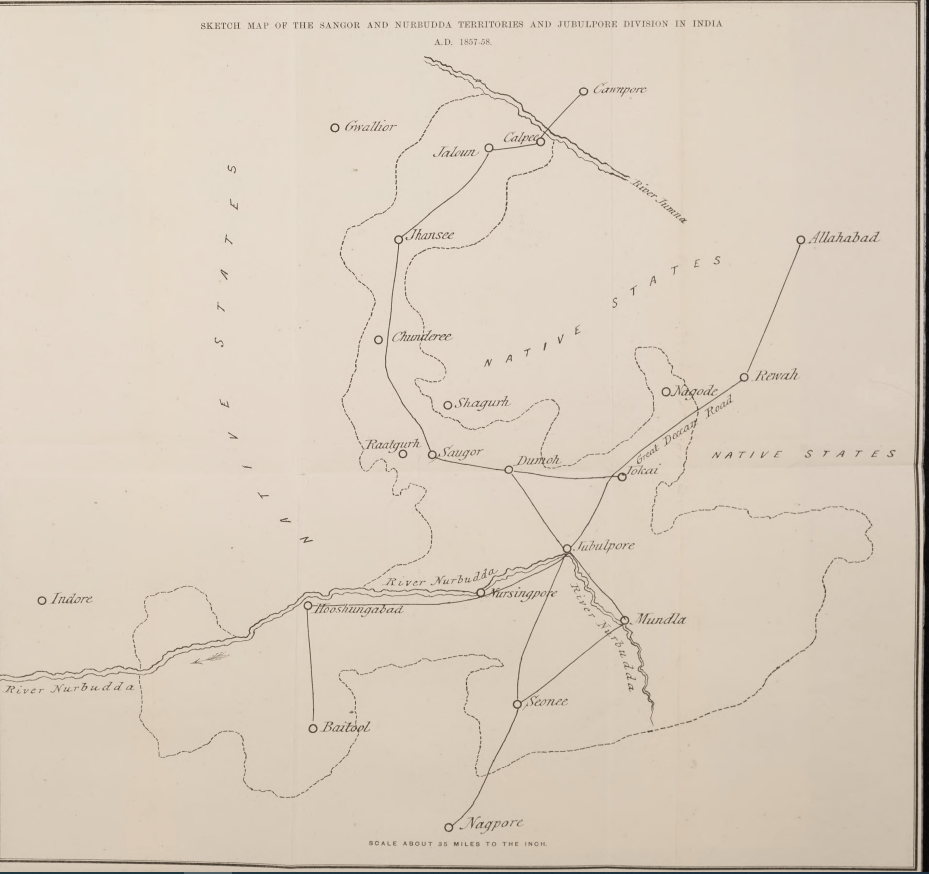
We will start this chapter in the town of Damoh. With two companies of the 42nd BNI who had until now proved themselves unperturbed by mutiny, there appeared to be no reason for alarm. However, the mutiny of Sagar set off not the 42nd, but the English officers at the station. Like Brigadier Sage, they quickly decided to barricade themselves in the only defensible position in the station – the jail fort, accompanied by the 42nd. It was 3 July.
With munitions and the treasure, they grimly determined to hold out. However, the native officers, led by the gallant Subadar-Major of the 42nd and Havildar Ranjit Singh, warned the English officers that not only was their position faulty, it would be unlikely in the event of an attack by the Sagar mutineers or indeed the rest of the countryside, that the remaining men of the 42nd would be able to hold out. Accordingly, the British fled Damoh, under cover of darkness, riding seventy miles through the night to Narsinghpur, leaving Damoh completely in the hands of the 42nd.
The next morning, the rebels from Sagar arrived. Havildar Ranjit Singh met them at the closed gate of the fort jail and refused them entry. They demanded the treasure; the detachment of the 42nd not only attacked them but also sent the rebels fleeing into the countryside. Ranjit Singh held Damoh with his men – he ensured the detachment continued their duties as usual, he set guards, and he commanded the town with the help of a loyal munsif (an Indian judge) he had taken into the fort with him. Together, they managed to carry on duty not just in Damoh but for a few miles around it. The prisoners were kept in jail, and the police remained at their posts.
On the 25th of July, the European officers returned to Damoh, followed shortly after by Captain Pinkney from Sagar, who took charge of the jail fort and the treasure. The 42nd then went on the offensive. A detachment was sent to attack Hindoria, some 12 miles from Damoh, the seat of the rebel leader Kishor Singh, who had been very active, instigating the Shahgarh Raja to attack Damoh. The rebels were thrashed, the battle leaving many dead, and the detachment marched back to Damoh.
“The two companies of the 31st, with two guns which they manned, and some eighty of the 3rd Irregular Cavalry, as well as the two companies of the 42nd, remained at Damoh and had several engagements with the rebels, killing some fifty men in one fight. On the 28th of July, Damoh was attacked, but the rebels were driven off with loss. The whole of the Damoh District was now swarming with rebels, who plundered in every direction, and the Shahgarh insurgents were joined by nearly every man of the Lodi caste in Damoh, with the exception of the petty Raja of Hatri, who remained faithful throughout.“
Jabalpur
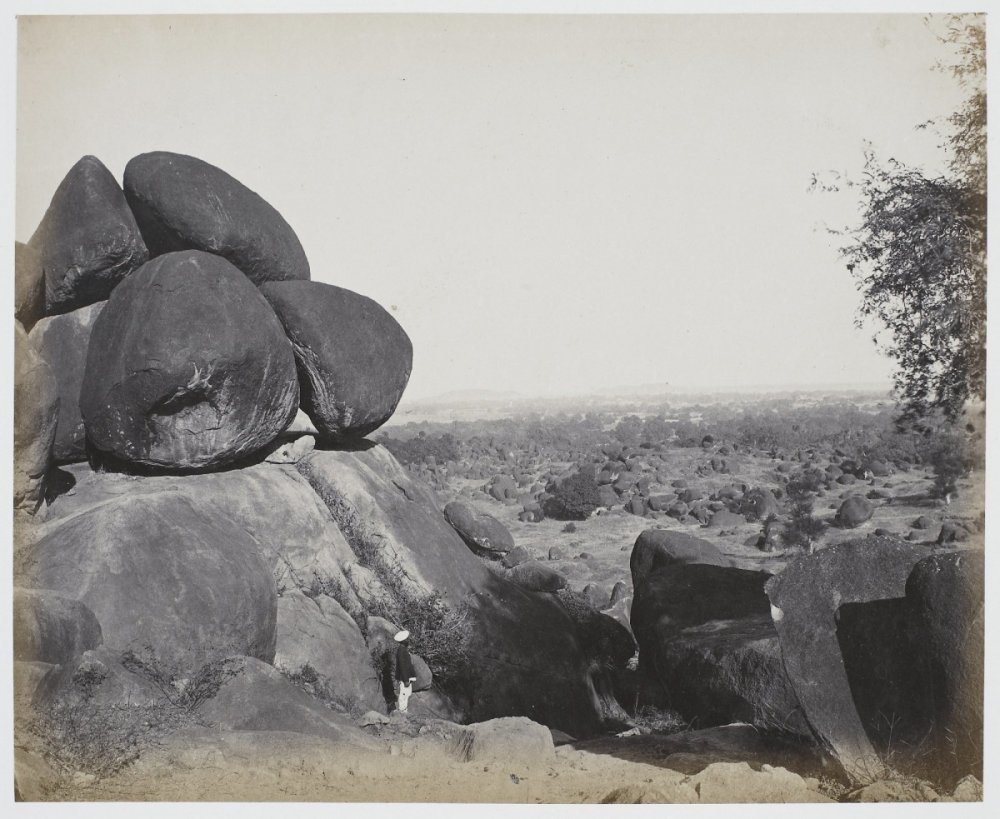
Jabalpur, some 111 miles southeast of Sagar, is our next stop.
It was the headquarters of not only the 52nd BNI under Lieutenant-Colonel Jamieson but the of Major W.C. Erskine, the chief political officer of the Sagar and Narbada Territories. For a few weeks following the news of the mutiny at Meerut, nothing appeared different in Jabalpur. The men of the 52nd, except for treating their officers with a “patronising familiarity” and the attempted murder of the adjutant, nothing untoward happened at Jabalpur. The men of the 52nd declared, most openly, that they would only mutiny if an English regiment was sent to disarm them.
It was pointed out to Major Erskine, that now, in June, was the time to send away the women and children. Erskine refused on the grounds it might excite the men to mutiny – it would be an open sign that their officers distrusted them. Jamieson could not disobey Erskine and many of the women themselves refused to leave – if they had had Ruth Coopland’s hindsight, they might have changed their minds. However, determined not be caught off guard, Erskine ordered the Europeans of the station, some 148 in number to assemble at his house. However Erskine was still wary of the provoking the 52nd.
Erskine is Busy
“The Commissioner therefore gave out that some native chiefs near Jubulpore were threatening us, and he wished to protect the ladies, &c .; so, on the 4th of July, arrangements were hastily made: all the civil and military officers, ladies, women, and children were called into the Residency and out-offices, and that night all ( 68 men, 31 women, and 49 children ) slept there, the officers and ladies dining together, guards of sepoys protecting us. This was a critical night, no doubt, but the measure was unavoidable, and the European officers and civil clerks were formed into a company. All were well armed with rifles, double-barreled guns,&c. , and all in turn stood sentry round the house, watching the sepoys more than the imaginary rebel army. The ruse succeeded, and the farce was kept up for some days. At dawn of day every everyone was busily engaged in fortifying and provisioning the house, and in an incredibly short time, the house became a really safe residence, unless it had been attacked by artillery of which there was none for or against us within some hundred miles.
Officers were selected by the Commissioner for every kind of duty, engineers, commissariat, &c . &c. The sepoys worked hard for us, bringing us in a very large supply of musket ammunition and many stands of spare arms; others worked at the intrenchments; and daily, some of the sepoys, for a long time, came and cleaned the muskets. Indeed they heard of and dug up two old small cannon: these they brought to us and placed them in position! For these, we made ammunition, and the ladies made powder bags, but the guns were honeycombed, and I should have been sorry to fire them often. I believe we did prove them after a fashion with slow matches once, keeping a good wall between them and us, but they looked well. As soon as we were fortified and provisioned, the Commissioner pronounced danger from the rebels over, and the sepoys were marched off to their barracks.
The civil officers, and some of the military ones, with their wives, occupied their own houses generally during the day, and work went on as usual, but all took shelter in the “ garrison at nights. The Commissioner brought the post office clerk into the garrison and appointed an officer to be postmaster. Many were the native letters opened and read, but no treason or information was gained in this way.
The Commissioner again ordered new levies of matchlock -men and cavalry to be raised in each district- and increased the wages of the police. Nearly all of these men remained loyal to the last, but plundering and much bloodshed was going on in all the districts north of the Nurbudda.”
To induce the 52nd to remain faithful he ordered extra marching allowance (batta) to be issued to every man in any likelihood of being called into the field – it was a good idea but Erskine first had to come up with the money. Very few of the farmers in the district were paying their dues and only one banker had continued to give the Goverment any loans at all, the rest claiming they were broke.
Erskine consequently called for an assessment of the bankers, and as the Deputy-Commissioner Western was very well aware of how each banker was situated, he called on each one to lend a certain sum to the Government at 6% per annum – any refusal on their part would lead Erskine to take their money by force. It is little surprise that within a few days, Erskine had the money he needed, at least to tide him over for the moment. Of course, this sum would not hold for long – as such, Erskine issued Government notes in denominations of 5 to 50 rupees. At first, no one would touch them, but they very soon came into general use, and when they were finally called in and paid off, hardly any had been lost. It was an unscrupulous move but it ensured a source of money – it wouldn’t be until March 1858 that any money could be got from the Nagpur treasury.
And so we continue onwards, to Nagpur.
Sources:
Intelligence Branch, comp. The Revolt in Central India 1857-58. Simla: Government Monotype Press, 1908.
Kaye, John William, and G. B. Malleson. Kaye’s and Malleson’s History of the Indian Mutiny of 1857-58. Edited by G. B. Malleson. Vol. V. London: Longmans, Green, & Co., 1907.
Lowe, Thomas. Central India during the Rebellion of 1857 and 1858. London: Longman, Green, Longman & Roberts, 1860.
Smith, George. Stephen Hislop: Pioneer Missionary and Naturalist in Central India. London: John Murray, 1888
Links:
Sane, Hemant. “Nagpur and Mutiny of 1857.” https://www.academia.edu/36433830/NAGPUR_AND_MUTINY_OF_1857_Hemant_Sane.
Sane, Hemant, and Shobha Phansikar. “The Sitaburdi Fort Nagpur.” Academia.edu. https://www.academia.edu/38115611/THE_SITABURDI_FORT_NAGPUR.
 Mutiny Reflections