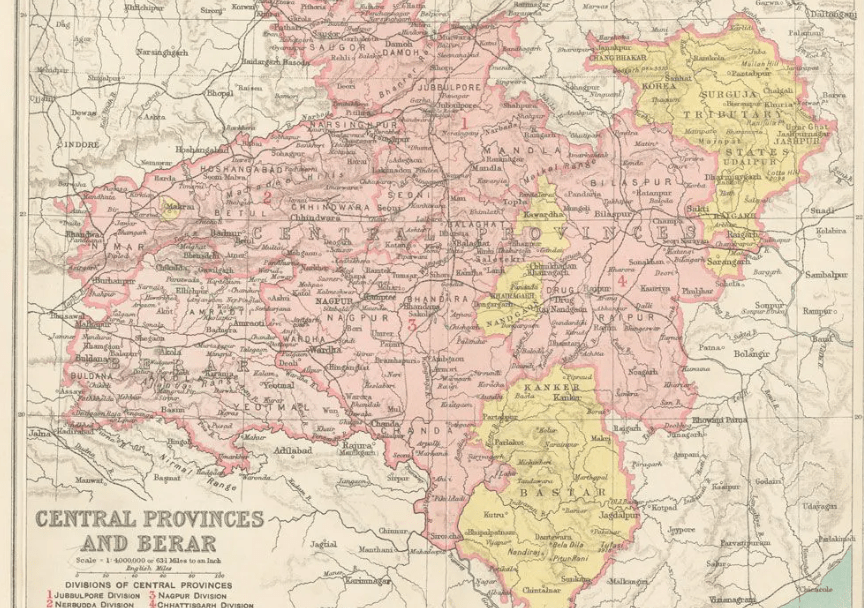
This turbulent and rather historically bewildering district had been annexed in 1854 by that rather infamous tool, the Doctrine of Lapse – prior to the annexation, Nagpur had already been under semi-British control, as during the reign of the last king, Raghuji III which lasted until 1853, a Resident had been appointed to administer Nagpur. We will not dwell on the past history but plow onwards to 1857.
1857 started in Nagpur as elsewhere in India. March saw the circulation of chapattis through the district – interestingly enough, one paisa was charged per chapatti and quickly, rumour spread the money was being collected for the purpose of converting Indians to Christianity. There was no proof of this, and as much of the district was ignorant regarding the meaning of the chapattis, the British chose to ignore it.
Nagpur had quite early on been attached to the telegraphic lines when then Calcutta- Bombay lines were laid in 1854-55, so the news of the Meerut mutiny arrived in Nagpur almost with days of the event. However, the attitude in Nagpur was one of anxious watch and wait.
Bakabai, the widow of the Raghuji II and mother of the late adopted son Raghuji III, was not opposed to British rule, and she used her influence to gain the favour of many local families in their support. She also, rather boldly, informed the citizens of Nagpur that anyone contemplating mutiny would be summarily handed over to the EICo officers.
Of course, not everyone was willing to remain loyal. Some of the local Muslims had been open contact with the mullahs and maulavis of Lucknow, and many secret meetings took place at the house of Nawab Kadar Khan, Another, Nawab Wilayat Mia who had been a minor official Raghuji III’s court and married to one of his Muslim concubines even went so far as to promise “one rupee per hour for every person who who fight against the British on the night of the 13th of June.” (Hemant Sane, Nagpur and the Mutiny of 1857).
On 17 May, a rumour circulated through Nagpur that that very night, the station was to be burned to the ground – nothing happened. This was put down to the old methods of some very unscrupulous charcoal dealers who had previously used the hot summer months as an excuse to practice a little arson, thus acquiring by these means cheap charcoal. At the start of the British administration, the Resident had taken the situation in hand – he simply imprisoned the charcoal dealers until the rains set in, thus putting an end to their endeavours. As for the military presence in Nagpur, it was pretty much filled to the brim. They were divided between Takali at Nagpur and Sitabuldi Fort and consisted of a variety of units, as described below.
The Nagpur Irregular Cavalry had mainly been recruited from the local Muslim population of Nagpur and its surroundings, and they had been in the employ of Raghuji III. For many, it was not so much a profession as a birthright, with sons following their fathers into the regiment. The Nagpur Irregular Infantry, however, had been mainly recruited from northern Indian and Bihar and constituted mostly of Brahmins, thakurs and Rajputs. As for the local police – they had been completely reorganised following the annexation, with much of the duty being given over to the irregular cavalry, called by some the Mulki Police or mounted police.
 Mutiny Reflections