The 50th at Nagode and Osbourne at Rewa
Before we get too far ahead of ourselves, we must turn our attention to the 50th BNI at Nagode. Until 27 August, the regiment stood fast, and their commander, Major Hampton and the other officers discerned no signs of a mutinous spirit. What set them off, as we have seen before with one event cascading a series of others, was the rumour that the rebel leader Kunwar Singh was about to make his appearance in Nagode territory.
Hampton ordered the 50th to prepare to march against the rebels. The men appeared delighted with the order and made all the preparations with unaccustomed alacrity. They set off on the 27th of August.
At the second milestone from Nagode, suddenly, a voice from the ranks gave an order to halt. The regiment stopped in its tracks. Some of the men now came up to their officers and told them, in no uncertain terms, that their services were no longer required, and the officers were free to go wherever they wanted. It was useless to oppose – a few faithful men escorted their officers and their families to Mirzapur, while the rest of the 50th returned to Nagode, burnt the town to the ground and then “inaugurated in the district a career similar to that of their brethren of the 52nd.”
At Rewa, Willoughby Osbourne was still alone. Despite the Raja pleading that he could no longer protect him, Osbourne stuck to his post. Rarely out of the saddle and constantly on the watch, the ever-vigilant Osbourne skillfully managed the Raja’s troops, and he was able to baffle the rebels crossing Rewa territory. His goal was to keep the road between Mirzapur and Jabalpur open – having achieved this, he went on the offensive. Osbourne defeated the rebels at Kachanpur and Zorah and then advanced on their stronghold, Maihar. Here, on 29 December, he stormed the city, pushed onto Jakhani and captured it, thus opening the next 36 miles of road to Jabalpur. Later, he captured the fort at Bijeraghugarh. The final result of Osbourne’s indefatigable exertions was that the rebel cause was unable to gain a foothold in Bundelkhand and lost its way in the adjacent territories.
The mutiny in Central India would eventually end. However, it would take thousands of troops from all corners of India, many from Madras and a year of hard fighting to finally conclude it. Sir Hugh Rose would eventually take to the field and, advancing from Sehore, would begin his famous campaign in Central India with the capture of Rahatgarh, while General Whitlock, with a Madras Column that would include the Kampti Movable Column, would march from Nagpur to take on the Sagar and Narbada Territories. Yet operations in Central India would not reach their final conclusion until 1859.
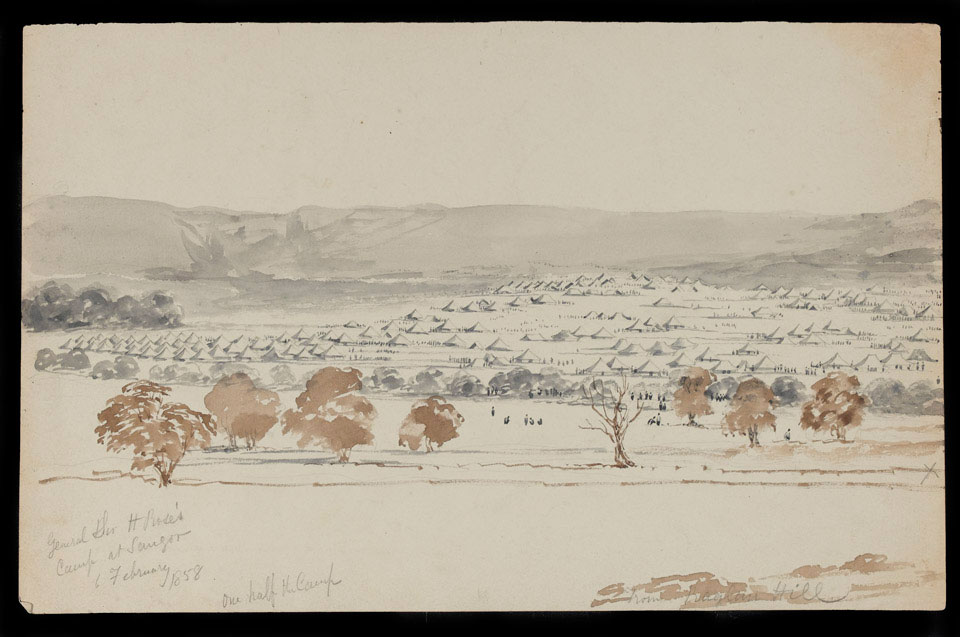
As for Brigadier Sage, he was finally relieved in February 1858 by Sir Hugh Rose. The prisoners (those who had been captured in Lalitpur so long ago) of the Shahgarh Raja were eventually freed, a little haggard perhaps, but unlike many of their compatriots, alive.
Lieutenant Francis Macgregor
At the time of his death, Lieutenant Francis Alexander Robert Murray Macgregor was 34 years old. He was the third son of Major-General Sir Evan Murray Macgregor of Macgregor, 2nd Baronet KB. KCH, a Scottish colonial administrator and senior army officer who had been the Governor of Dominica and the British Leeward Islands and later Barbados, where he died in office in 1844. He had fought in India with the 8th Light Dragoons and served under Sir Thomas Hislop in the Third Anglo-Maratha War. Curiously enough, his son Francis would die in Central India.
The youngest brother of Francis, Ernest Augustus Murray Macgregor would serve with the 9th Light Cavalry and would later be Groom in Waiting to the Queen in 1869. Their grandfather was the Military Auditor General of Bengal between 1789 and 1796 – several uncles and cousins were also officers in the EICo.
Sources:
Delhi Gazette, Former Editor of, comp. The Indian Mutiny to the Fall of Delhi. London: G. Routledge & Co., 1857.
Erskine, Walter Coningsby. A Chapter of the Bengal Mutiny as Seen in Central India, by One Who was There in 1857-58. London: William Blackwood and Sons, 1871.
Great Britain Parliament. Further Papers (No. 4) Relative to the Mutinies in the East Indies. London: Harrison and Sons, 1857.
Intelligence Branch, comp. The Revolt in Central India 1857-58. Simla: Government Monotype Press, 1908.
Kaye, John William, and G. B. Malleson. Kaye’s and Malleson’s History of the Indian Mutiny of 1857-58. Edited by G. B. Malleson. Vol. V. London: Longmans, Green, & Co., 1907.
Lowe, Thomas. Central India during the Rebellion of 1857 and 1858. London: Longman, Green, Longman & Roberts, 1860.
 Mutiny Reflections