“We Will Always be Faithful, Whatever Happens”
Mrs Hawkins was carried out of the house in the bed she was lying in, followed by the nurse with the newborn Hawkins baby in her arms, while a large party of servants carried the other four children. Mrs Stewart set off in a carriage with her two children; the Reverend trying, to the last moment, to give her and Mrs Hawkins whatever comfort he could. As she watched them leave, Ruth remembered what Mrs Stewart had told her after their first flight on the 28th of May. A sepoy had said to her when she came back to her house,
“Why did you leave your husband, Memsahib? That was not brave, but you women are so weak and faint-hearted, you take flight at nothing. See! The Sahib trusted us; we will always be faithful, whatever happens.” That faithfulness would now be put to the test, for Mrs Stewart and Mrs Hawkins were proceeding to the artillery lines.
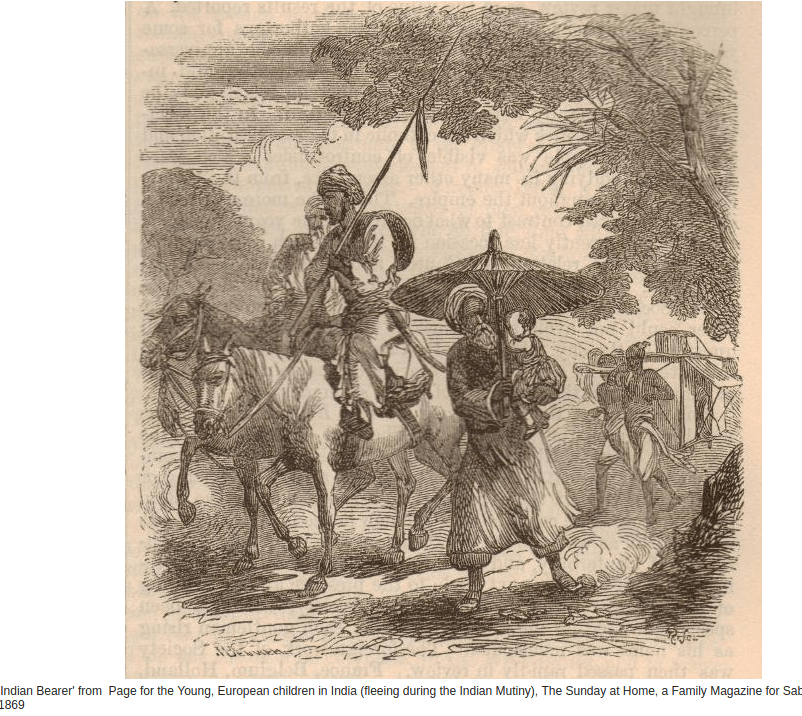
The Cooplands’ syce now appeared with the buggy upon which sat their khitmatgar, very excited and holding in each hand a tulwar. He advised them to cross the bridge and follow the road to Lashkar, but the syce said it was guarded with guns and sentries. They decided then to follow Mrs Stewart to the artillery lines, the oaths of faithfulness ringing in their ears. Just as they were turning towards the artillery lines, a young sepoy came running towards them, weeping and sobbing as he ran. “They have shot the Sahib!” he wailed and ran off into the darkness before the Reverend could speak to him. All around them, the night rang with volleys of musketry, bugles, shots and horrible screams, and some of the bungalows were burning. They turned off towards the house of Major Blake.
In the house, they found Mrs Blake, Mrs Raikes, Dr Kirk and his wife, Ellen, none of them knowing what to do. Major Blake had ridden off to the lines the very instant the bugle had sounded. Although it was quieter here, the party realised they were trapped. It was now 10 o’clock, and although Dr Kirk’s guard promised to stay with them, every road was guarded and flanked by guns, and the cavalry was riding about. The guard suggested the party had better hide in the garden as the sepoys would soon be coming to loot the house, and if they found them inside, they would surely be shot.
There was no way out of the cantonment now- only those who had fled in the first ten minutes of the outbreak had made it safely across the nullah before the sepoys had placed guards along the bank. By now, everyone who was found in the houses on the side of the lines was either dead or hiding. Realising their lives were forfeit no matter what they did, the party followed the advice of the guard and went out into the garden. Mrs Raikes and her baby were taken by her servant to hide somewhere else; the Kirks, with their little boy, decided to return home. Reverend Coopland still had his rifle. Mrs Blake’s khitmatgar, Muza, took them to a dark corner of the garden where they lay on the ground behind a bank, well shaded by trees. He brought a large shawl for the Reverend, who was injudiciously dressed in a white suit. The guard, men of the 1st Regiment, although not hostile in any way, did nothing to help them, but seemed to delight in bringing them various reports – Mrs Campbell was lying dead in her compound, they said, and the Brigadier was shot dead on the bridge, adding Dr Mackellar had been killed in one of the hospitals and Major Blake was killed. Only the last one, it turned out, was true.
An hour later, just as the moon broke through the clouds, a hundred sepoys descended on the Campbells’ house, which adjoined the Blakes. The house Mrs Coopland had so admired was set upon in a frenzy; she could hear the sepoys tearing down the doors and windows and smashing the glass and furniture while others loaded carts with plunder; then they set fire to the bungalow, their wild shouts of glee mixing with the crackling flames. They then turned their attention to the Blakes’ house. Ruth could hear the sepoys looking for them, the moonlight glittering on their bayonets. Finding no one, they returned to the bungalow and proceeded, after plundering it, to set it on fire. Muza crept up to the fugitives and told them they could hide in his house, saying that when they got there, he would get them some native clothes to put on. Gratefully, they scurried through the darkness, following their saviour. The house was a small, low hut close to the garden, and although they passed close to the sepoys, they were so engrossed in their work of destruction that they did not see them. The party crouched close together, scarcely daring to breathe. Muza barred the door and fastened it shut with a chain. It was but one house in a long line of servants’ quarters.
Another half hour passed.
The sepoys, in their fury at not finding any Europeans, now started raiding the servants’ houses. They entered Muza’s house by the kitchen, without realising that just beyond the thin wooden partition, their prize lay hiding. Muza went up to them, protesting that his mother lay ill in the next room and their noise was frightening her. They roughly asked him if he was hiding any foreigners – Muza swore on the Koran he was hiding no one. The sepoys took his cookware and stole what they found in his house; all the while, Muza begged them to leave. Outside again, they saw the locked door and broke it open with the butts of their rifles – Ruth expected them to charge, but they didn’t. The hut was so dark that they could not see the fugitives huddled in the shadows. The sepoys demanded a light, but brave Muza refused, “You see, they are not here: come, I will show where they are.” He slammed the door shut and barred it again. He then led the sepoys off in the direction of the stables, where, a few minutes later, they heard the horrible shrieks of a dying horse. The sepoys, satisfied there was no one there either, threatened Muza that they would return shortly and then, in the morning, they would search the dark room themselves. Muza waited until they left and then ran back to his house. He opened the door and told the party they needed to move – he would take them to the bearer’s house, who would certainly not betray them – but they must hurry, the sepoys would be back soon, and they would kill him for concealing them.
Time had passed quickly in that stifling hut – as they emerged from the hideout, Ruth saw the first smatterings of dawn on the horizon. They had withstood the terrible night. Muza brought them to the bearer’s house, and they lay down on the ground parched with thirst. From somewhere, they heard a baby crying – and a few moments later, Mrs Raikes appeared, trying desperately to stifle the baby’s fretting. In the house, the bearer’s wife tried to help her. As the light became brighter, the sepoys, as promised, returned. They made short work of Muza’s house and then, alerted by the crying baby, ran over to the bearer’s hut. Inside, it was still too dark to see anything, but they demanded to know whose child was crying. The bearer’s wife replied she did not know, and they called for her to bring it out. Mrs Raikes, mad with terror, grasped at her child, screaming, “They will kill my child!” But there was nothing for it; one of the women brought the child outside. “The sepoys yelled, ‘Feringhi, hi! Kill them!’ and I saw through the doorway a great number of them loading their muskets. They then ordered the woman to bring out a large quantity of plunder that lay on the floor of the hut, pictures, plate & c., she took them out slowly, one by one, and gave them to the sepoys.”
The Cooplands, Mrs Charlotte Blake and Mrs Raikes stood close together in a far corner of the hut, each taking up a piece of wood that lay on the ground, thinking for a moment that this would give them a little defence. The Reverend still had his gun, but Ruth could not see it; it was still too dark to even see each other’s faces. Suddenly, the sepoys pulled up the roof of the hut and fired a volley into the middle of the room. At the first shot, the Reverend grabbed his wife’s hand and said, ” We will not die here; let us go outside.” Dropping their bits of wood, Mrs Blake, Mrs Raikes, and Ruth clasped their hands and cried out, “Mut maro, mut maro!” (Don’t kill us!). The sepoys looked at the party and laughed. “We will not kill the memsahibs,” they said, “only the sahib.” The ladies were quickly surrounded by a group of sepoys, and the Reverend was singled out, standing alone now, gun in hand. The sepoys fired at him.
Ruth heard two shots – she later learned her husband had managed to get off just those two before the sepoys turned their guns on him, and volley after volley rang out in the morning light, telling Ruth her husband was dead. The sepoys then dragged the women to the hut of a sweeper and thrust them inside, saying it was good enough for them.
The ladies lay crouched on the ground, unable to move. Ruth saw a little mouse, with its eyes shining brightly, creep out of a corner and stare at them. It was, she noted, not afraid of them at all. The door opened, and in was thrown Mrs Campbell, her hair flying wildly, wearing a native dress; her own clothes had been torn from her. Then Mrs Kirk stumbled in, grasping her little boy – she had watched as the sepoys first shot and then beat her husband’s brains out with the butts of their rifles. They had spared her son Alexander on account of his long ringlets and girlish face; they had mistaken him for a girl. Mrs Kirk’s arms were badly bruised and swollen from where the sepoys had torn off her bracelets, her finger nearly broken from the force they used to take off her wedding ring. Dr Winlow Kirk had served as a medical officer for nearly 20 years, first with the Bundelkhand legion, then as medical adviser to Sir Charles Napier, then with the troops at Bareilly, with the European artillery at Ferozepore, before joining the Gwalior Contingent as superintending surgeon. He was so much liked by not only the Europeans but by the sepoys who had ministered with so much care when they were ill or injured; it was generally thought that if anyone would escape from Gwalior, it would be Dr Kirk. When Mrs Kirk saw them kill her husband, she had cried out, ” Kill me too!” but the sepoys answered, “No, we have killed you in killing him.”
Mrs Raikes, Mrs Kirke and her son, Mrs Campbell, Ruth Coopland, and Mrs Blake stood outside, surrounded by men of the 2nd Infantry. True to their word, they took the ladies to their lines. On arriving, several of the sepoys crowded around Mrs Blake and said with some emotion that they would take her to her husband. His horse lay dead but a few feet from where she stood. Recognising the horse, she suddenly fell over, faint. The sepoys gently took hold of the poor woman and laid her on a charpoy; another one ran to fetch her some water. When she recovered, a native officer of her husband’s regiment approached her; on bended knee and tears in his eyes, he told her the Colours were gone. “It is your fault!” she retorted, reproaching the man with as much courage as she could muster. “Where is he? Why did you kill him?” The officer replied that the major had been killed by the men of the 4th Foot, and he had helped to bury him.
Mrs Proctor and Mrs Gilbert now joined the little group.
 Mutiny Reflections