The 28th of May
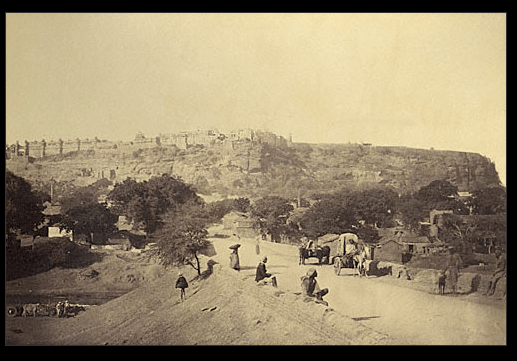
By the end of May, the English community consisted of eleven officers, many of them with their wives and children, three surgeons and the wives and children of four officers who had been sent off with their regiments, plus four sergeants with their families.
We have now heard repeated over and over again that the 28th of May was a failed uprising. Brigadier Ramsay had been hearing reports from Scindia and from Macpherson not to trust the Gwalior Contingent, but he himself had seen no outward signs of dissatisfaction – the English officers were far more attentive to their men in Gwalior than those, say, in Meerut, and this constant discourse had solidified in their minds that they could hold their men. At length, on that day, Ramsay received intelligence that he finally regarded as alarming – some well-meaning Indian officers had told him outright that the Contingent planned to mutiny that very night. He immediately issued directions that, when the ladies were out for the usual evening drive, they should take their children with them and, instead of returning home, proceed directly to the Residency – the home of Major Macpherson.
This melancholy order brought many of the ladies into a state of some despair, believing they would never see their husbands again as they were to remain behind in the cantonment to stand their duty and, if necessary, die at their posts. It did not help when, on their drive outside the cantonments, “the outlook was not promising, for on the road they met a body of Maratha horsemen, who galloped wildly round the carriages, calling out, ‘These people’s hearts are broken’. They began to fear for their own lives too, and entered the Residency with very sad forebodings.”
Although the Residency had been fortified to some extent, the occupants – Macpherson and his sister- were not prepared to meet with quite this many impromptu guests and the night would pass off without much comfort. Dinkar Rao was there to meet them, and he immediately rode off to tell Scindia. He promptly came in person with a strong body of his own guards and posted parties of them in and around the Residency for its protection. At the same time, Scindia strongly recommended that the ladies and their families should be brought the next morning to a large English mansion within the palace precincts, as he would be better able to protect them there. The next morning, they all left in a body for the Palace.
“The sad cortege was headed by a carriage containing the Agent and his sister, Mrs. McLeod Innes, who had anxieties of her own—for her husband, Lieutenant (now General) McLeod Innes, V.C., R.E., was one of the Lucknow Garrison—and was preceded and followed by detachments of Sindhia’s body-guard. It had to pass through the crowded streets of the native town, and the roof of every house was covered, it is said, with “jeering and insulting spectators,”— a proof that, in electing to ” support the British Government,” Sindhia was risking the allegiance of his own people; a fact creditable to His Highness’s loyalty, but not encouraging to the fugitives.”
The party reached the precincts of the palace without any mishap. Although there had been no time to prepare the mansion for so large a gathering, every effort was made to provide them with some modicum of comfort. Unfortunately, although their host was friendly, his servants were not. Although Macpherson and those in his group received kind messages from Bazia Bai and the Maharani and food from their own table, the rest of the fugitives had to shift for themselves, relying on whatever the servants saw fit to give them. The chaplain, Reverend George Coopland and young Mr Hennessey were further made to give up their arms, which did not add to any feelings of goodwill. That night, the Brigadier, his staff and artillery officers slept in front of the loaded guns in the lines, and the night passed off quietly. Since nothing untoward had happened, Ramsay began to believe the alarm was a hue and cry about nothing, and he strongly disapproved of the ladies hiding in the palace grounds. In the morning, he ordered their return.
Dinkar Rao, Macpherson and others tried to stop the ladies from leaving, but Mrs Meade, whose husband believed she was in danger by being that close to the palace, demanded her return to the cantonment and rejoin him at all risks; her sister, Mrs Murray, was determined to accompany her. “They returned accordingly and on reaching the cantonments received an ovation from the sepoys, who expressed the greatest delight that the ladies should have shown this mark of confidence in them.” The obvious delight of the sepoys further fermented in Ramsay’s mind; there was nothing to fear, and all of this was nothing but a false alarm. He wrote his dispatch to the Agent at Indore – Lieutenant- Colonel Durand, who fully concurred with Ramsay’s views and even wrote a few lines praising the ladies!
“The Governor-General in Council [so runs the despatch] has viewed with the warmest admiration the calm confidence and decision, and the noble indifference to personal danger exhibited by Mrs Meade and Mrs Murray in disregarding the threatened outbreak, and returning to cantonments when they were informed by the Brigadier that their remaining at the palace was fraught with mischief.”
So the ladies and children returned to cantonments, but their position was anything but pleasant, yet no one thought of sending them away. Day after day, they received fresh tidings of mutiny and havoc. Ajmer, Nasirabad and Rohilkhand were up in arms, and there was no more news from Cawnpore or from Allahabad. On 3 June, the 7th Regiment of the Gwalior Contingent rose in Neemuch.
Then came Jhansi.
On the 12th of June, a message reached Gwalior from Jhansi, 70 miles away; they were beleaguered and searching desperately for aid. The 4th Infantry Regiment quickly volunteered for service, and a wing was sent with a battery of artillery under the command of Captain John Murray on what was supposed to be a mission of succour and set off in high spirits. When Murray and his men arrived within 30 miles of Jhansi, the true situation became clear: every European had been massacred, so there was little point in them continuing on. Murray turned his force around and returned to Gwalior. “From this moment, the men evinced a restless spirit, the artillery were in almost open mutiny, and the officers had the greatest difficulty in restraining the men from breaking out on the march.” However, as we know, the leaders within the Contingent had expressly forbidden any regiment from rising on their own. They were to return to Gwalior and join the rest of the Contingent.
In his last letter home, Reverend George Coopland wrote with some hope: “I hope now Delhi is taken, things will take a turn for the better…” The next day, he would find out Delhi had not been taken – it was a mistake in a telegram. Then Mr Colvin wrote from Agra that until mutiny broke out in Gwalior, the women and children were to stay where they were. Shortly after, the telegraph with Agra was cut, and the station was dependent on “rumour for intelligence.” The Reverend was bound by duty to remain, and his wife would not leave him. In hindsight, however, she writes with some bitterness, “if the women and children at the numerous small stations had been instantly sent away…their husbands and fathers would probably have had a better chance at escape. Instead of which, the lives of men, women and children were sacrificed through the efforts to avoid arousing the suspicions of the troops…” She had already found out by then how right she was.
 Mutiny Reflections