Sunday, the 14th of June
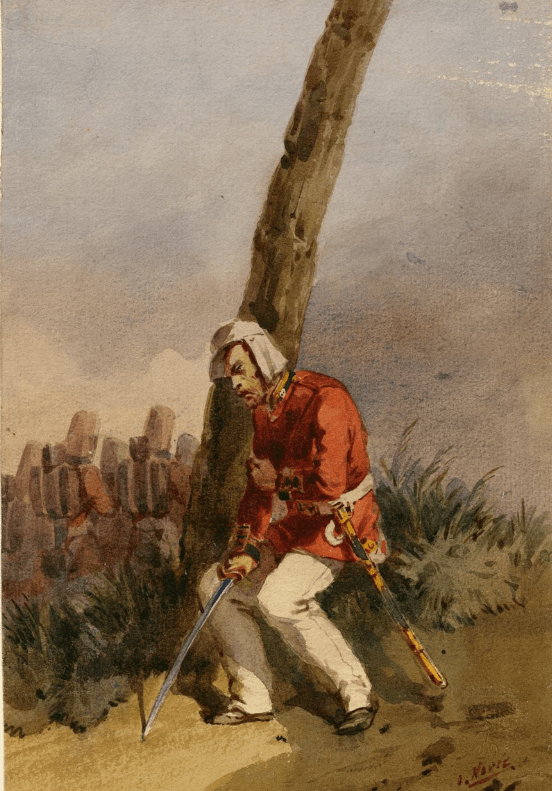
The 14th of June started in the same way – the firing of the big gun at the Fort, Mrs Campbell probably fed her flock of fowls, and Mrs Coopland prepared herself for another day of tedious sitting about in a dark house. There was service as usual, and the Holy Communion was administered by Reverend Coopland to all those who could make their way to the church despite the growing heat.
Suddenly, in the afternoon, the mess-house and a bungalow burst into flames. The sepoys of the 4th Regiment worked with “good-humoured alacrity to extinguish the flames…” and everyone hoped it was either an accident or the work of some roving badmashes. The rest of the day passed without incident.
Back in the cantonments, Ruth Coopland and her husband were quietly going about their afternoon pursuits – she was reading letters from her sister on her wedding tour, and her husband had lain down to take a little rest. He had just finished telling her the details of the Jhansi massacre, and they had looked at each other in some sorrow, unsure how, when the time came, they would bear their fate. Suddenly, a servant burst into the living room, calling out that a little bungalow the Cooplands had but briefly lived in was burning. The 1st Regiment, the servant said, was on hand and was very actively putting out the blaze; as Ruth sardonically notes, “or increasing the flames.”
The sparks shot up into the sky, and the strong, hot wind that had been blowing so persistently threatened to light up the entire cantonment. Up and down the road, the residents were dragging furniture out of their houses as their servants threw water on the thatched roofs, and the Reverend ordered his servants to do the same. The road was crowded with people, and the air filled with smoke. All around them, the flames roared and crackled. In their bungalow, Ruth found her maid making bundles of her clothes, which she had taken from her mistress’s wardrobe and had spread out on the floor, the better to select what she wanted for herself. Ruth angrily ordered the woman to put everything back, at which the maid insolently gave her keys to Ruth and told her to pack her things herself; she would be quite delighted to look after them when Ruth was gone.
When the fires were finally brought under control, the Reverend returned home, more tired than before. After an early dinner, a clerk from the church, named Collins, paid the Cooplands a visit. He was terribly agitated as he asked Coopland the order of service that evening, but he could finally be calmed down enough to explain the reason for his terror – he believed the Contingent would rise that night and murder everyone. Premonition served him poorly, and he would be one of the first civilians to be shot a few hours later.
Reverend Coopland advised his wife to put on a plain dark dress and jacket; she was not to wear any ornaments nor anything that would show up in the dark that would give the sepoys a reason to kill her. They then looked around their home and packed away one or two trifles that they prized and some important papers, which they put into small packets, and then sat down to wait. A picture of composure, the Reverend wrote a note to Captain Meade inquiring where he would like to hold the evening service. Seeing as the mess-house was a smouldering ruin, should it be held in the church? Captain Meade replied that in the current state of things, no one was likely going to go to church, and they should just prepare themselves as best they could, whatever the end may be.
After coffee, a note from Major Sheriff arrived, and shortly after 5 o’clock, the major himself came over, wishing to see the Reverend. “He said it was a hard thing that we should stay to be butchered like sheep, for there was no doubt but that such would be our fate…” Mrs Hawkins, he informed them, had come in from Sipri to join her husband, and the day before, she had given birth to a healthy baby. With much sorrow, he commented that it was terrible that when mutiny came, the women and children could expect no mercy. The purpose of his visit, however, had been to give the Reverend some money he had forgotten to give at holy communion that morning. After spending some time walking around Coopland’s garden in a long conversation with the Reverend Major, Sheriff returned to his duty with Brigadier Ramsay. Ruth would never see him again. There was little left to do but prepare for the worst. The Reverend called together the servants and gave them each handsome presents in the form of money, and he did not neglect to reward the six sepoys who had come to their house to protect it from fire. He then called for their carriage, and for the last time, Ruth and George Coopland drove through the cantonments.
There was scarcely anyone about, but they met Brigadier Ramsay, Major Blake and a passing group of sepoys: Ruth exclaimed to her husband if the sepoys did not salute, the storm was “nigh at hand.” The sepoys did not salute, and the Brigadier and Major Blake looked at them with expressions of astonishment. The Cooplands returned home and found the six sepoys who formed their guard took no notice of them at all.
For the Cooplands, it had already been a trying day; Captain Murray’s baby boy had died that morning, and Ruth could not get the sound of the carpenter’s hammering as he made the babe’s coffin out of her mind. She tried to remember everything her husband had taught her about firing a gun (she could load and fire it) as he had determined they would not die without a struggle. It also occurred to Ruth that the cantonment she had so admired in January was, in fact, one of the worst places to escape from. The houses that had so pleased her were in rows on either side of a mile-long road; behind them, on one side, were the lines of the cavalry and artillery from which branched off the lines of the infantry. There were also lines where the cavalry stacks were kept and the magazine, along with the elephant stables. On the other side of the road, behind those houses, was a steep riverbank. At one end of the long road was a small bazaar, and the Coopland’s house was near the end of the street, while at the opposite end was the cemetery, a parade ground and the gaol. It was indeed a most unfortunate position. The Cooplands, upon returning home, retired to their rooms, Ruth to settle in for the night.
Suddenly, a single gun fired.
Soon after 8pm, it was reported that the artillery had loaded their guns without orders. Upon being asked by their officers the reason for their strange behaviour, the men shamefacedly replied they believed a European regiment was coming to cut them down. The officers did their best to pacify the men and then returned to their homes to wait out the night. An hour later, the whole Gwalior Contingent broke out in open mutiny. With loud shouts, tumult and much bugling in the lines through which the men were called to arms, the long-awaited uprising had come. Brigadier Ramsay ordered the officers who were with him to their lines. The firing began, and the night sky was filled with a lurid red glare as one bungalow after another blazed up.
The Reverend rushed into his wife’s room and ordered her to dress as the maid, and the bearer ran in, calling out, “Fly! The sepoys have risen and will kill you!” Ruth put on the clothes she had prepared to escape in ( a morning wrapper, a cloth jacket and a bonnet)with the help of her maid and stuffed into her pockets a bottle of opium and aromatic vinegar, but left behind her watch and rings. Her husband took her by the hand, and the Cooplands fled into the garden through the bathroom door.
Outside, it was very dark – Ruth suggested they go to the Stewarts’ house to see what they were doing. They entered the house to find Mrs Stewart screaming in blind panic – her husband and Captain Hawkins had just ridden off to the lines. Mrs Hawkins lay in the next room with a sergeant’s wife attending her newborn baby; the Stewarts’ children were crying and clinging to the sobbing servants. While the Reverend tried to calm down the hysterical Mrs Stewart, Ruth went in to comfort Mrs Hawkins. Suddenly, a horse dashed into the compound, riderless. Mrs Stewart screamed, “Oh! They have killed my husband!” The syce (groom) of the unfortunate Captain arrived moments later and told the Reverend, Stewart had indeed been shot, but he was only wounded, he had been taken to the artillery lines, and he had a message for Mrs Hawkins from her husband – she was to proceed without delay to the lines as the artillery had promised to protect her.
Every commanding officer – Major Blake of the 2nd, Sheriff of the 4th and Captains Hawkins and Stewart had been shot down. Blake went to his lines on the first alarm and was shot by his main guard. His men, among whom Doctor Mackellar found him dying before leaving Gwalior, were weeping over him and professing with deep sorrow; it was the 4th Regiment that had murdered their officer, they told the doctor. It turned out it wasn’t true, but his men still gave him a burial with their own hands. It is unclear where Captain Sherriff was shot; in the confusion, no one saw him fall. Hawkins was killed in the cavalry lines, supposedly by the infantry. Lieutenant Proctor, of the 4th Regiment, who had the sick wife of an absent brother officer in his care, could not escape – he did the best he could to conceal himself through the night, but was eventually found out and murdered in front of his wife by men of the infantry and cavalry. Four sergeants and two pensioners were killed in cold blood, as were Mrs Barrows, the wife of a conductor and Mrs Pike, a sergeant’s wife.
 Mutiny Reflections