It was now the 12th of June, and for all their good intentions, the Calcutta Volunteer Corps was not ready for the next panic to strike Calcutta, and the following days would prove to be tumultuous for everyone.
The Gagging Act
On the 13th of June, Canning announced the “Gagging Act” – which, in effect, prevented the press from publishing anything at all unless the presses had a license from the government.
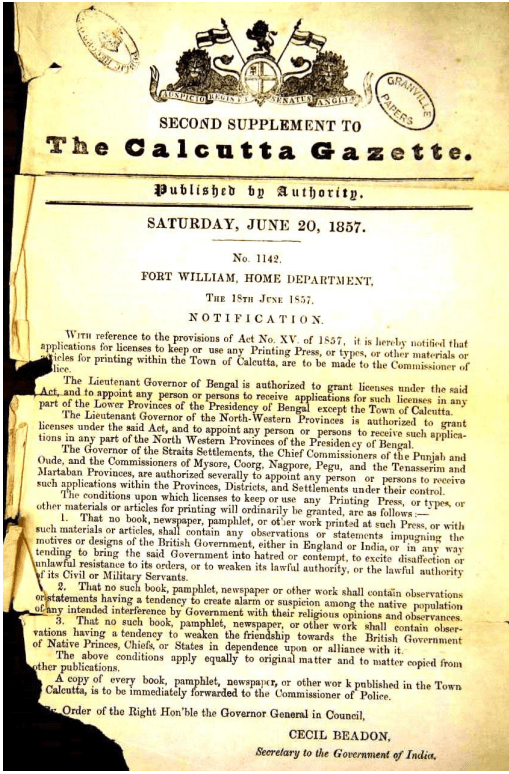
It has to be understood that at the time in India, there was no press regulation as we know it today. Newspapers could be as flattering or as scathing of the government and their officials as they wanted – this was not necessarily to the liking of many civilians, particularly when the press called them out for corruption and greed. The publications vigorously criticized the Government and the officials, and some went out of their way to annoy the Government and its officials, more often than not stooping to attack not just their policies but their very morals of officials, both high and low.
In 1780, John Hickey started the Bengal Gazette, in which he freely criticized Warren Hastings and his policies. Hickey would ultimately be arrested and imprisoned, and that would be the momentary end of the Bengal Gazette. In Madras, the editor of the India Herald was deported for making libelous accusations against the Government and the Prince of Wales; the editor of the Madras Gazette, in his turn, was prohibited from publishing copies of the General order of the Government without the approval of the military secretary. By 1799, the Madras Government insisted that all newspapers had to be submitted for inspection before publication. The Bombay Gazette did not fare any better – its editor incurred his government’s wrath by being particularly unflattering to the police. He, too, had to submit his publication to the government censor board, and this was just one year after starting his paper in 1791.
Lord Wellesley, in 1798, attempted to bring about some regulations regarding the press – his motives however were to prevent the French from getting any information about the political condition of his own government, being at the time, at loggerheads with the French in regards to Mysore, whose sultan was negotiating with the French to boot the British out of India. Wellesley enacted the Press Act of 1799, which stated, in brief, that nothing at all could be published – not even advertisements – without the approval of the government. The penalty for violating this act was the immediate deportation of the editor back to Europe. This, of course, only affected European publications with European editors; only after 1818 did Europeans who were born in India and Indians themselves begin to make headways into journalism. The Marquess of Hastings went ahead and amended this in 1818, setting up a rule that would have affected all publications, but this was never introduced with legality, so until 1823, the press remained largely unfettered. Such was the situation when John Adam, in his position of acting Governor-General, created the regulation of 1823 and changed everything.
- Every publisher or printer was compelled to get a license from the government. Defaulters would be fined 400 rupees by the magistrate and the publication would immediately pass into government hands
- The government of course, could cancel licenses at their discretion.
This, of course, led to a widespread closure of papers, and only three Bengali and one Persian paper were able to continue in Calcutta. The editor of the Calcutta Journal, one James Buckingham, found himself deported.
The next Governor General, Lord William Bentnick, did ease the regulations somewhat and allowed more liberties to the press regarding what they said and about whom. However, it would not be until 1835 that there were any great changes.
The Metcalfe Act (so named for Charles Metcalfe, the Governor-General from 1835-36), which applied to the whole of the EICo territory, required every newspaper’s printer and publisher to declare the premises of their publication, thus effectively ending licensing regulations. It placed the Indian press on the same standing as the British press and resulted in a rapid rise in publications throughout EICo territories.
Canning reintroduced licensing on the 13th of June 1857. The press, naturally, was outraged. The “Friend of India” had the following to say:
“If it is not altogether then to the license of the Press that the sepoy revolt is owing, will it be sufficient to muzzle journalism to obtain the means of putting down disaffection?
In the course of six short weeks, the glorious empire of Britain in the East is seen by all men to slipping from its nerveless grasp; and on when forty regiments are in open rebellion, when towns and treasuries almost withough count are in the hands of despicable traitors it is found that the Press has done it all…
His Lordship has inflicted upon the press that retributive justice which he delays so long to execute upon Delhi. We held him up to the world as an able ruler, and he has painted us as doing the work of the Queen’s enemies. Both statements are wrong, and for our part, we tender to society at large the most ample of apologies.
We are so hopelessly at a loss fo valid reasons in favour of the Gagging Act, thatit has more than once occurred to us that Lord Canning had been casting about for a method to raise the antipathies of the Indian Press, with the view of steeling his mind against the mighty storm of indignation which the news of this rebellion will create at home, and compared with which the wrath of India is as a zephyr to a cyclone. Perhaps the Governor-General needs no heavier censure than a review of facts would warrant, to bear him to the earh, but it is the nature of things that evils of which he could have no knowledge, and misconduct which he was powerless to prevent, will be alleged against his administration. “
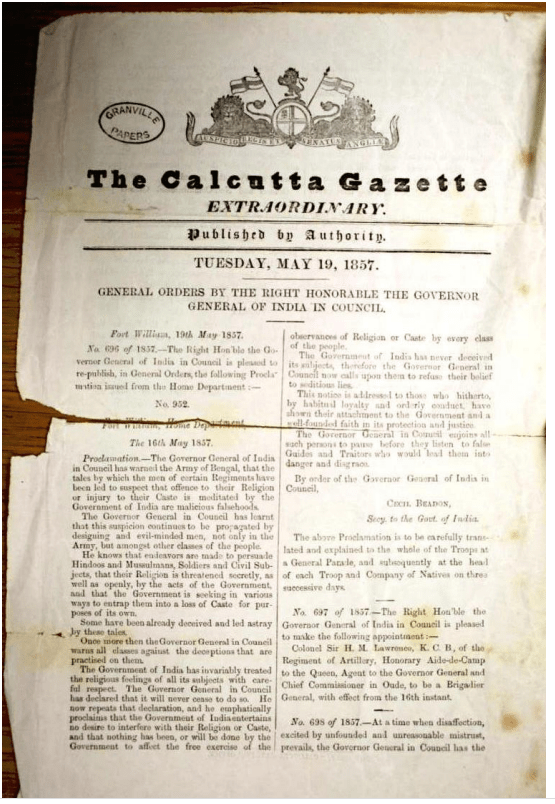
What were then, Cannings’ reasons?
He had already felt the wrath of the press earlier when the 19th mutinied at Berhampur. The press had held an uncompromising stance, calling on the government to implement decided measures, stating that if the spark of mutiny was not immediately put out, there would be a fire. The lndian press, although less aggressive in their opinions, did not openly disagree. With the outbreak at Meerut, the tone of the Indian press. The Persian papers the Durbin, the Sultan-ul-Akhbar and the Hindoo Patriot of Calcutta all published the famous proclamation of Bahadur Shah asking India to prepare for a revolution. The Samachar Sudhabarshan, a bilingual newspaper which published editions daily in Bangali and in Hindi in Calcutta, was printing news and opinions about the progress of revolt; Lord Canning thus decided to reintroduce the Bengal Resolutions of 1823 to regulate the press and restrict the circulation of not just newspapers but books. The Friend of India and the Dacca News were both given warnings, and the Rangpur Bartabaha was closed altogether. Three papers, Durbin, Sultan-ul-Akbar and Samachar Sudhavarshan, were prosecuted for writing seditious articles.
In some fairness to Canning, he was not a man who took this regulation lightly. Having spent his life with a free press, it was with much reluctance that he put this act in place, telling his council members that “the remedy was worse than the disease.” Had he stopped with censuring the Indian press, things might have passed by without more than a few raised eyebrows – but he threw the act at the English press as well. Stating,
“… I see no solid standing ground upon which a line can be drawn marking off one from the other, when the question is to prevent matter calculated to work mischief at a crisis like this. For whilst I am glad to give credit to the conductors of the European Press for the loyalty and intelligence which mark their labours, I am bound by sincerity to say that I have seen passages in some of the papers under their management which, though perfectly innocuous as far as European readers are concerned, may, in times like the present, be turned to the most mischievous purposes in the hands of persons capable of dressing them up for the Native ear. I am glad to admit that the bill is not specially levelled at the European Press, but I do not see any reason, nor do I consider it possible in justice, to draw any line of demarcation between European and Native publications.”
It is no wonder that many Calcutta residents doubted the sincerity of the Governor-General. It had become all too clear to anyone with any sense that Mr. Beadon’s line was broken and that the Bengal Presidency was going up in flames. It seemed that what the government was doing was not so much preventing seditious publications as preventing the press in England from getting wind of how many mistakes Canning and his council had made. However, Canning might have had some reason to be wary of the press.
Extracts translated from a Calcutta daily paper “Simachur Soodhartoursun” published in Bengali and Hindi, dated 5th June 1857
“The mutinies at Meerut and Delhi have filled the mind of our Governor with fear. He had therefore added 24 men to his body-Guards and has ordered the principal gate, and all the minor entrances at Government House to be closed punctually at 8 o’Clock p.m. After the gates are closed, no one is admitted, no matter who he be, or what his business and he goes every day to Dum Dum, Barrackpore and salaaming to the Sepoys with both hands with great address explains to them with sweet words, “I will never attempt anything which can injure your religion. Do whatever your religion requires – no one shall prevent you.”
The Member of the great Council of Parliament, having understood that the order to bite the Cartridges was at the bottom of all the present mutinies of the Sepoys, have sent a letter of command to Lord Canning – In it this is written “Take means to make the Hindu and Mussulman Sepoys abandon their mutinous conduct, or else it will be much the worse for you.” When he got these orders our Governor determined to
burn all the Cartridges made of suspected covers /paper? in the presence of the Sepoys all over the country, in order that they might lose all suspicion in regards to their religion and return to their allegiance, but it does not seem as if the Sepoys would place any confidence in the words of the Governor.
In another article after affirming that it has only been constant war that has made us prosper hitherto, and that our constant aggression were not bad policy, the writer proceeds “But now from the way in which they (our Rulers) have attempted to destroy religion, it seems that God is certainly displeased with them, and hence it is not improbable that they will lose their Empire. When a servant gives answer to his master, death is not far off.
It is clear that the Sepoys have given an answer “to their masters” upon the subject of the loss of their caste. Let our readers consider for themselves what is likely to follow. It was in an unlucky moment that the Governor passed the order for biting the Cartridges, that he will not be able to effect his purpose is a trifle, but he will have difficulty in saving the Empire. Now, he takes every kind of oath, but the mutinous
soldiers attach no credit to what he says and show no inclination to leave off fighting – on the contrary, their rage increases every day, and they have induced the people in many places to join them.
The Raja of Rewa promised the priests of the Sacred God at Goya 2 ½ lacks of rupees if he should conquer the war with the English, so the Priests are praying God that he may be victorious. The Emperors of France and Russia have made peace with the British Government upon condition that the country which the British have taken from them respectively is to be restored, but the orders of restoration have not yet issued. They will probably not long be delayed under present circumstances. Government has passed an order that all merchants are to assist in the war. The Merchants are in great trouble about this. All the country people in Agra are buying weapons and arms in every direction saying, “If we die for it, we will fight with all our might against the English – Let us see what will come of it.”
Catching a Spy
On the same day as the council gagged the press, Town-Major Cavanagh was once again called upon by one of his men. This time, it was young sepoy named Hanuman Dhobi. He asserted to Cavanagh that he had been accosted by a servant of the exiled King of Oudh, residing at Calcutta’s Garden Reach. The servant had impressed on the sepoy that the King was desirous to know to how many Indian and English troops were in the fort; when they were most likely to be caught off guard and whether the Indian troops would be willing to throw in their lot with the sepoys of Calcutta and Barrackpore and the 400 additional men the King himself had rallied. Dhobi managed to evade giving any direct answers by stating he would make the necessary enquiries, and the servant was to meet him that very evening again when he was on sentry duty. The servant agreed and left.
Upon being relieved, Dhobi first reported the matter to his own non-commissioned officer and requested an audience with Cavanagh. The officer told him in no uncertain terms that he couldn’t see the town major and to keep his mouth shut. Unperturbed, the sepoy sought out the European sergeant.
A meeting granted, Hanuman Dhobi appealed to Cavanagh that if he could have few sergeants at his disposal to aid him if necessary, he would capture the spy himself. Cavanagh acquiesed to the young man’s request and then made his way to the Government House for dinner with Canning. After midnight, Cavanagh returned home to the surprising news – Hanuman Dhobi had succeeded in his mission and there was now a spy in confinement.
Busy with taking the depositions of Hanuman Dhobi and the two sergeants to formulate a charge against the man, Cavanagh was interrupted by the figure of General Hearsey’s ADC with a note for Cavanagh. Hearsey expected the sepoys at Barrackpore to rise, and he requested most earnestly for troops to be placed in position to intercept the mutineers should they make their way to Calcutta.
At the same moment, a note arrived from Colonel Birch, directing Cavanagh to send the wing of the H.M.’s 37th just freshly arrived from Ceylon, to Cox’s Bungalow, and to organise steamers to collect at Serampore the 78th Highlanders from Chinsura. They were to be then accommodated in Barrackpore in tents. Then, when possible, Cavanagh was to organise patrols on the Barrackpore road. The only patrol Cavanagh had at his disposal was his newly formed Volunteer Cavalry – these he routed from their beds, and notwithstanding they were neither fully trained and only one troop actually had any arms, the volunteers took up the call.
 Mutiny Reflections
Interesting reference to “biting the bullet’ as a component of the unrest in that extract from piece from the June 1857 “Simachur Soodhartoursun”
And – as always – incredible research and detail. Thank-you.
LikeLike
Orfeur Cavenagh was one of my 3rd great uncles. I enjoyed your post.
Thanks for visiting my bog
Regards
Anne
LikeLiked by 1 person