The Resolutions of Lord Canning
Calcutta would continue to exist in a state of panic, though the only notable one would occur in July – however, on the scale of it, Panic Sunday would remain in everyone’s memories for time to come.
On the 30th of May, the Legislative Council passed Act XIV, which would, in one blow, sweep away all notions of justice in any province or district where rebellion showed itself. It placed unfettered power into the hands of the executive officer “whatsoever his rank, his age, or his wisdom.”
The Act stated that anyone declaring themselves openly as against the government, “should be liable to the punishment of death, transportation or imprisonment, gave the Executive Government of any Presidency or Place power to proclaim any district as in a state of rebellion, and to issue a Commission forthwith for the trial of all persons charged with offences against the State, or murder, arson, robbery, or other heinous crime against person or pro- perty—the Commissioner or Commissioners so appointed were empowered to hold a Court in any part of the said district, and without the attendance or fatwah of a law officer, or the assistance of assessors, to pass upon every person convicted before the Court of any of the above-mentioned crimes the punishment. And the judgement of such Court, shall be final and conclusive, and the said Court shall not be subordinate to the Sadr Court.”
While this gave unrestricted power to the civil authorities, it was soon amended to included the senior military officer as well, regardless of rank, “at any military station in the Bengal Presidency, to appoint General Courts-Martial, either European or Native, or mixed, of not less than five members, and ” to confirm and carry into effect, immediately or otherwise, any sentence of such Court-Martial.”
What Canning and his council did not realise at the time, in their panic, was that they had just sanctioned the deaths of hundreds, if not thousands of Indians of any walk of life, who could now be killed just for looking sideways at a European. This came home to them with force when the reports of hundreds of indiscriminate hangings in Allahabad came to light: the authorities there were using the act to the utmost of its legality and dealing out punishments often regardless of an actual trial. This gave Canning and his council a pause to think as criticism of these and other killings in the name of the suppression of the mutiny came to light. Not wanting to look like the sanctifier of slaughter, Canning made an amendment to Act XIV.
He did not repeal it, nor did he in any way remove the powers he had so wantonly given out in the first place. He sent out detailed instructions in July on what he actually meant with Act XIV in the first place and how to use it. Canning sought to draw a distinction between sepoys from regiments that had mutined and killed their officers and other Europeans and those who had been disbanded and had returned peacefully to their villages without engaging in any violence. This resolution further called for the trial by military tribunal of mutineers and deserters of those men who were innocent of bloodshed. Canning further called for investigations and leniancy for those who could prove they were not present when any particular atrocity was committed. He was openly resisting the calls for vengence that were being spouted the length and breadth of India. Although this resolution was never meant for public distribution, it eventually made it into the hands of the press both in India and in England and would be used to shred the reputation of Lord Canning into rags, gaining him the unfair title of “Clemency Canning.”
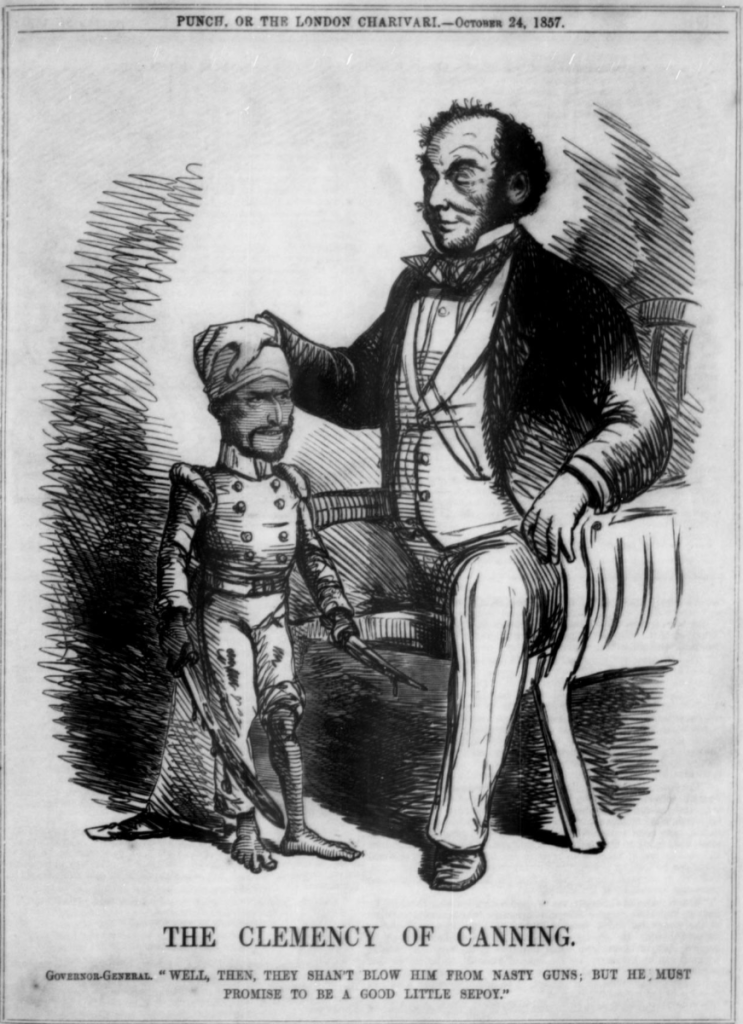
Canning, however, understood what the hysterical press and his vengeful critics did not: if the British were going to continue their rule in India or, indeed, win over the mutiny, they could not do so by alienating the Indians.
“As long as I have breath in my body, I will pursue no other policy than that I which I have been following – not only for reasons of expediency…but because it is just. I will not govern in anger.”
– Lord Canning in a letter to Lord Granville,11th December, 1857
We will see in later chapters just what Act XIV looked like in practice. But for now, we shall close the chapter on Calcutta and turn our attention back to the Districts.
Sources:
Cavanagh, Orfeur. Reminiscences of an Indian Official. London: W. H. Allen & Co., 1884.
David, Saul. The Indian Mutiny: 1857. London: Viking, 2003.
Great Britain Parliament. Appendix to Papers Relative to the Mutinies in the East Indies (Inclosures in Nos. 7 to 19): Supplement to the Papers Presented July 1857. London: Harrison and Sons, 1857.
Joshi, Priti. Empire News: The Anglo-Indian Press Writes India. Albany: State University of New York Press, 2021.
Kaye, John William, and G. B. Malleson. Kaye’s and Malleson’s History of the Indian Mutiny of 1857-8. Edited by G. B. Malleson. Vol. I (1914); Vols. II, III & VI (1889). London: Longmans, Green, & Co. / W. H. Allen & Co.
[Malleson, G. B.] The Mutiny of the Bengal Army: An Historical Narrative. By One Who Has Served under Sir Charles Napier. London: Bosworth and Harrison, 1858
Further Reading:
https://paperspast.natlib.govt.nz/newspapers/LT18571128.2.6
http://double-dolphin.blogspot.com/2017/03/garden-reach-metiabruz-nawab-wajid-ali-shah-calcutta-kolkata.html
https://barrackpore.net/history-of-barrackpore/
https://puronokolkata.com/tag/chowringhee/
 Mutiny Reflections
Interesting reference to “biting the bullet’ as a component of the unrest in that extract from piece from the June 1857 “Simachur Soodhartoursun”
And – as always – incredible research and detail. Thank-you.
LikeLike
Orfeur Cavenagh was one of my 3rd great uncles. I enjoyed your post.
Thanks for visiting my bog
Regards
Anne
LikeLiked by 1 person