The Last King of Oudh
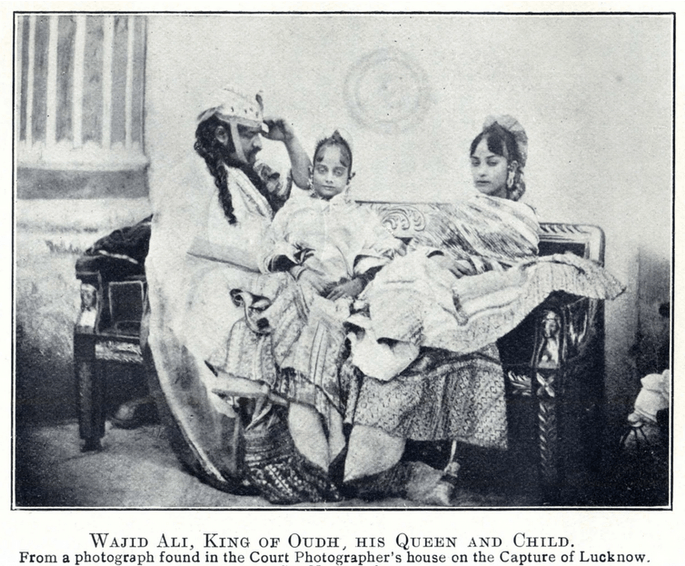
While Calcutta caught its breath and the great and good warily made their way back to the homes they had so readily abandoned, the last King of Oudh, Wajid Ali Shah, was about to get a visit.
On the morning of the 15th of June, the Foreign Secretary, Mr. Edmonstone, accompanied by a detachment of Europeans, went to Garden Reach, where the King held his court.
Informing him in no uncertain terms that his name had been used to stir up mischief in Calcutta, it was deemed a political necessity for him to be removed to a different residence – namely, the house of the Governor-General inside Fort William. Behaving with dignity, the King protested in quiet terms his innocence, that he had in no way been involved with the mutineers nor did he encourage their actions. However, he would do as he was told and “declared himself ready to go where ever the Governor-General might think fit.”
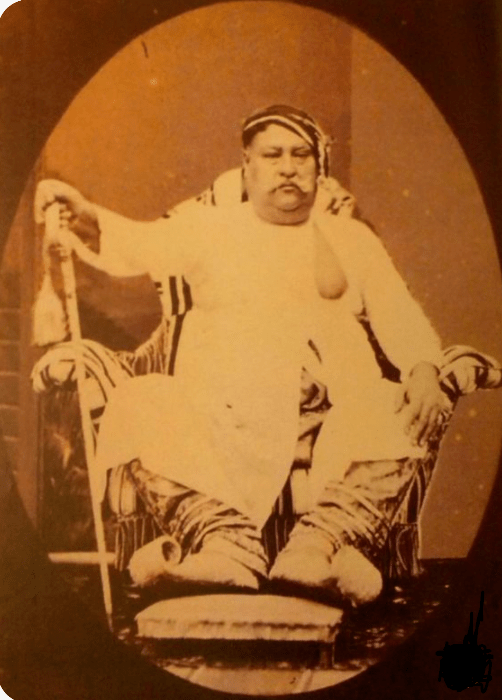
His prime minister, Ali Naki Khan and a few other nobelmen were selected to accompany him into this impromptu imprisonment, and although the action itself prompted no disturbance, it left the men who had been speaking in his name without any power. If anyone owed the EICo no loyalty, it was the wrongfully deposed king. His imprisonment in the Governor’s House would last until 1859. The mutiny dashed his hopes of ever regaining his thrown, and he would never return to Lucknow. Nawab Wajid Ali Shah died on September 21st, 1887, in Calcutta, at Garden Reach (Metiaburz), the small Lucknow he had created in exile.
“Shedding tears we spend the night in this deepening dark,
Our day is but a long struggle against an uphill path,
Not a single moment goes when we don’t bewail our lot,
Lo! we cast a lingering look on these doors and walls.
Fare thee well, my countrymen, we are going afar!
We wish you well, O friends, leave you to His care,
And entrust our Qaiser Bagh to the blowing air,
While we give our tender heart to terror and despair.
Fare thee well, my countrymen, we are going afar!
I am betrayed by my friends, whom should I excuse?
Except God the gracious, I have no refuge,
I can’t escape exile, under any excuse.
Lo, we cast a lingering look on the doors and walls,
Fare thee well, my countrymen, we are going afar!
I have been told this much too, ah! the scourage of time!
The servant calls his master ‘mad,’ a travesty of the mind.
As for me, I cannoy help, but rot in alien climes.
Lo, we cast a lingering look on these doors and walls,
Fare thee well, my countrymen, we are gong afar!
This is the cause of my regret, to whom should I complain?
What wondrous goods of mine are subjected to disdain,
My exile has raised a storm in the whole domain.
Lo we cast a lingering look on the doors and walls,
Fare thee well, my countrymen, we are going afar!
You cannot help but suffer, O heart, the sharp strings of grief,
They didn’t spare even the things essential for the mourning meets,
In the scorching summer heat, I’ve no cover or sheet.
Akhtar now departs from all his friends and mates,
There is little time or need to dwell upon my fate,
Save, O God, my countrymen from the dangers lying in wait!
Lo, we cast a lingering look on these doors and walls,
Fare thee well, my countrymen, we are going afar!“
-Nawab Ali Shah, writing under his pen-name Akhtar, from K.C. Kanda,”Masterpieces of Patriotic Urdu Poetry” p. 63-67
 Mutiny Reflections
Interesting reference to “biting the bullet’ as a component of the unrest in that extract from piece from the June 1857 “Simachur Soodhartoursun”
And – as always – incredible research and detail. Thank-you.
LikeLike
Orfeur Cavenagh was one of my 3rd great uncles. I enjoyed your post.
Thanks for visiting my bog
Regards
Anne
LikeLiked by 1 person