In the previous chapter, we have established what the military portion of the Meerut cantonment was doing. We now continue the story with a light on what else was happening in the calamitous city.
Church on Sunday
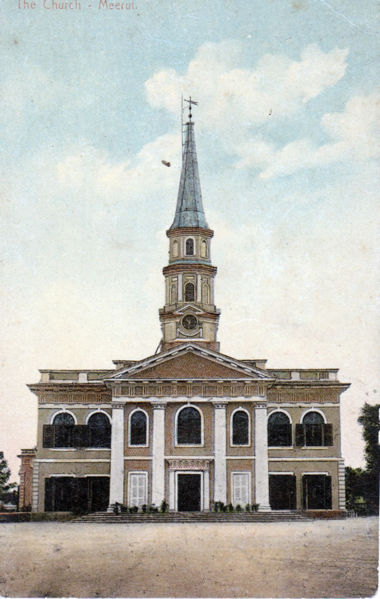
“Oh, madam, don’t go to church this afternoon!” This was the first intimation the wife of Reverend John Rotton heard from her ayah. It was an impassioned plea which caused the Reverend to take at least a little notice.
Why should Madam not go to church this evening?” I asked. The servant replied, “Because there will be a fight.” I asked, “Who will fight?” The woman answered, “The sepoys.” Of course, I could not give any credence to such a statement. In the next few hours, the Reverend would discover just how wrong he was.
To allay his wife’s fears, he consented at least to take the children along in the carriage, and just for good measure, he armed himself with a stout walking stick. He didn’t own any firearms. The faithful ayah accompanied them.
The church service, owing to the heat of May, had been postponed to the slightly cooler hour of 7 pm instead of 6.30. The morning service had been well attended, the Greatheds had come, as had Gough and young MacNabb. Colonel Finnis, Bible in hand, had stoically walked up the aisle and had taken his place in the front. Little did the Reverend know that by the next day, he would be burying some of his friends.
Setting out for the church and completely unaware that anything at all was amiss – the church is located well on the end of the European lines – he suddenly heard musket fire and became uncomfortably aware of “pillars of smoke ascending into the air, and proceeding from the burning bungalows….in the native lines of cantonment, forced upon me the conviction that mischief had already commenced.” Without warning, the Rifle bugles sounded the alarm and in quick succession, the assembly. It quickly became apparent that there was something terribly wrong in Meerut. The congregation, which was slowly assembling outside the building, was quickly dissolved, and everyone made their way to safety as best they could.
The Church Conspiracy
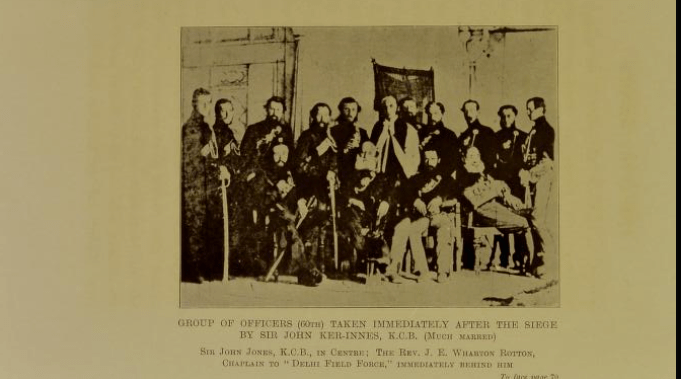
It is generally believed that the Mutiny at Meerut was the start of a wider conspiracy to overthrow British rule in India, and it is almost, without any argument, supposed that the idea of the sepoys had been to round up all the Europeans in the church and then slaughter them en masse when thus assembled. Troops did not attend church with their muskets and only carried their sidearms with them, so it would have been a relatively simple task. Churches would later be attacked in the scope of the mutiny with varying degrees of success, but this was Meerut and nothing as yet had happened anywhere else.
Normally, service would have begun at 6.30 pm, which means the troops would have fallen in at 6 pm. However, this evening, everything would happen 30 minutes later. The sepoys, if they were going to attack the church, would have done so at the regular time. If the plan had been from the very onset to attack the Europeans at the church, then the mutiny would have started an hour earlier than expected. It is not a plan that stands up to scrutiny. Nor does the location of the church bear up with a plan of conspiracy. This tale, which in time became accepted fact, gave the authorities the perfect excuse – if it was a conspiracy, then their previous actions – the shackling parade, for example- could not be used as a reason for the mutiny in the first place. So, the story remained in circulation. When we take the actions of the sepoys into consideration, their mad panic, the frantic behaviour, the wild rush to arms, they do not look like men wholly in charge of their senses, let alone ones who have been diabolically planning a conspiracy. Yet whatever the truth may be, nothing happened at the church in Meerut.
The Ladies
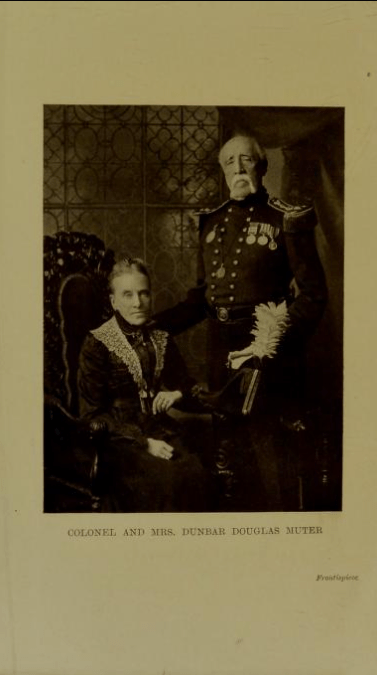
This photograph was taken close to the time of the colonel’s death in 1909, and nearly 50 years had passed since he had served with the 60th Rifles in Meerut and 55 years since his marriage to his wife. Yet this was all in the future, for now, Mrs Muter is sitting in her buggy as her husband, then Captain Muter, went off to parade his men for church. She was waiting outside the door of the church, expecting any minute to hear the soldiers marching up from the Infantry Barracks, but there was no sound of tramping boots. Instead, she heard “…a dull sound, very different from what I expected…but I little heeded the holiday making in the bazaar…” Without warning, but minding his manners, a gentleman came up to Mrs Muter, who said, “You need not be alarmed, but an outbreak has taken place requiring the presence of the troops, so there will not be a service in the church this evening.” Mrs Muter huffed a little – surely, a little holiday-making would not stop divine service! She decided to wait a little longer.
By 7 pm, no congregation had assembled, and she finally decided to ask the same gentleman if he would send word to her husband. What he thought of this, we don’t know, but he advised Mrs Muter to go home. Telling her driver to turn the pony carriage around, “Up to this, I was seated with my back to the cantonment, but the moment the horses’ heads were turned I saw the Native lines in a blaze and in some alarm…I gave the order to hasten home.” It was nearly dark, and as she entered the road leading to the bazaar, she saw a crowd of men chasing 2 soldiers of the European Artillery, pelting them with stones and brickbats. Fortunately, no one paid any mind to the captain’s wife, and she managed to get to the house.
Inside, her servants were in a panic. The butler brought her the silver, saying he could no longer bear the responsibility of her property and then declared she must hide herself! Mrs Muter could hardly conceal her outrage. To hide in her own house in the very lines of a regiment that had until now been nothing but staunch? It was nothing short of insulting. But she could now distinctly hear “the distant roar rolled up in a babel of voices nearly drowning the ceaseless rattle of musketry and above all came the heavy tramp of an English battalion on the march…”
Saving her from any more personal insult (hide, indeed!), a sergeant sent by Mrs Muter’s husband arrived to direct her to find refuge in the Quarter Guard. Escorted by her servants with their swords drawn, Mrs Muter walked away from the mutiny in Meerut. She spent the rest of the night on the veranda at Dumdhama, watching the cantonment burn.
Around the same time as Mrs Muter was indignantly waiting for church service to begin, Mrs Craigie and Miss Mackenzie had set out in their buggy with the same idea in mind. Lieutenant Craigie was busy with his men, and Lieutenant Mackenzie was savouring a moment’s peace, reading a book. His house guest, Cornet McNabb, was out visiting friends, so he had the place for himself. The ladies were blissfully unaware of anything happening in Meerut, but their well-trodden ride to the church was suddenly disrupted by the sight of a mob approaching. The terrified coachman swiftly turned the horses around, intending to hurry back to Craigie’s house. Although now in a great haste, the ladies managed to pick up a trooper of the 6th Dragoon Guards who came tearing out of a side lane, hotly pursued by rioters from the bazaar. The ladies ordered the driver to stop just long enough to pull the man in and then drive off again at full speed, the crowd slashing at the hood of the carriage with their tulwars.
Safely back in Craigie’s house with the Dragoon Guard prostrate and in a state of nervous collapse, the ladies tried to do something, anything. They gathered up all of Craigie’s weapons — three double-barrelled guns —and powder flask, bullets and caps, and then, not knowing how to load them, sat and waited. It was here that Mackenzie found them.
With a dozen faithful men in tow, he arrived at the bungalow. His first instinct now was to preserve the ladies’ lives by any means possible. He brought them down “to the door of the house, and calling to me the troopers, commended their lives to their charge…Like madmen, they threw themselves from their horses and prostrated themselves before the ladies, seizing their feet and placing them on their heads, as they vowed with tears and sobs to protect their lives with their own.” Reassured that the men were genuine in their faithfulness, he set them to patrol the grounds while he went upstairs to load the guns. One of the guns he set aside; if there would be no way out, he could at least still shoot his sister and his friend’s wife.
More than once, the house was approached by crowds from the bazaar, and Mackenzie had to stand on the upper veranda, gun ready. It seemed to be enough to send the looters in a different direction. This state of affairs could not last, and Mackenzie finally decided that retreat was a better option. A small Hindu shrine on the grounds would be easier to defend than a whole rambling house, so he determined now to make their last stand there. After all, it might not even come to that. The cantonment was full of European troops – surely they were on their way.
Lieutenant Craigie by now had realised that no amount of remonstrations would force his men to change their minds. He had already retreated to the European lines with the vague hope he would find his wife there, safe and sound. But she wasn’t, and the Mackenzies were missing too. So, for what might have been a mission of futility, he mounted his horse and dashed back to his own house, accompanied by a few faithful men who had never left him, expecting to find the worst. It was with some amazement then that he found the two women, the half-crazed Dragoon Guard and his friend, ready to make their flight to the shrine. The ladies were told to collect what little of their valuables they could carry, and, waiting for an opportune moment, the little group ran across the grounds to the shrine.
Once inside, it dawned on them that it was a very small space indeed, barely ten feet square, but it had slits in the walls like loopholes, and the doorway was very narrow, so as a place of defence it was quite commendable. Now and again, the troopers came and told the officers of the state of things on the outside – if only finally to report that the whole body of mutineers had left Meerut and was on their way to Delhi. All those who remained were the plunderers from the bazaar and the neighbouring countryside. Hour after hour passed, and there was still no sign of European troops coming to save the city. They weren’t coming at all.
A force, some 1500 strong, was idly standing by in the European lines, waiting in vain for any order to come from their completely paralysed leadership. Hewitt, in a moment of masterly inactivity, circled the wagons, so to speak and let the city burn. No one followed the mutineers into the night as they marched towards Delhi or stopped the looters and plunderers. A mounted party had been sent to look for survivors, led by a Staff Officer who obviously didn’t have any idea what he was doing. The men ended up marching about in the dark, in the wrong direction. At some point during the night, Wilson and Hewitt moved the troops onto the infantry parade ground and allowed them to let off some shots, but the only thing they nearly managed to hit was a furious Lieutenant Galway, who had earlier taken refuge in some outhouses which were now in their line of fire. By this time, Captain Rosser of the 6th Dragoon Guards was practically gagging at the bit to be allowed to do something. He assembled a small force of a squadron of Dragoons and a couple of guns and requested to be allowed to go in pursuit of the mutineers. All three of his requests were denied. Everyone was ready, but the General decided to sit out the fight. Only a small group of the Dragoons were eventually sent out into Meerut to pick up stragglers and survivors.
It finally dawned on Mackenzie and Craigie that no one was coming to their rescue. Around midnight, things were quieting down, and Mackenzie, after conferring with Craigie, decided it was high time they left their little shrine. Harnessing Craigie’s horses to a carriage and placing the ladies and the Carbineer inside, the carriage was driven by a boy who usually rode postillion and was now riding on one of the horses. Craigie and Mackenzie took their guard on either side of the carriage, riding alongside with swords drawn. They first rode through a group of men who were gathered on the road and then made for the European lines. Besides the men who had barred the road, they saw no one. Not until they saw the light of a portfire, which induced the two men to gallop forward, shouting “Friend! Friend!” did they realise they had made it to safety.
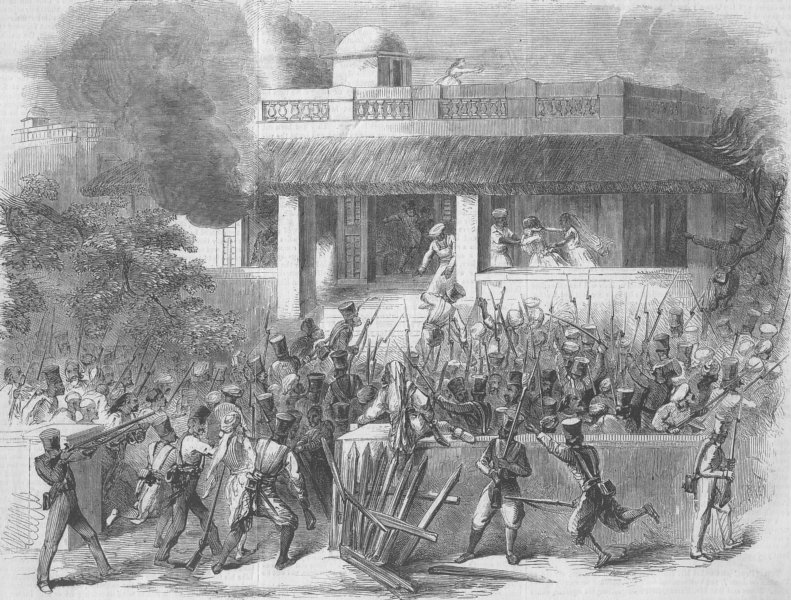
Mrs Cahill and Mrs Emma Markoe are the last ladies we shall see for now. Mrs Markoe was the wife of a pensioner, and Mrs Cahill was a widow who lived in Mrs Markoe’s compound. They lived close to Lieutenant Eckford and Dr Smith, towards the northern end of Sudder Bazaar. It was nearly dusk when a wounded rifleman made his way to the house of the Markoes. He, like others, was fleeing the mobs in the bazaar. The couple took him in. Unfortunately, the mob was not so easily dissuaded and broke into their house, determined to kill the fugitive. They began harassing Emma Markoe, demanding to be shown where the rifleman was. When she screamed, her husband came rushing out of a side door with a stick in his hand – the crowd scrambled out of his way. Emma and her husband managed to lock the compound gates, but both were cut with swords in the process. They returned to the house, battered and bleeding. Emma Markoe convinced her husband and the rifleman to escape through a window before the crowd could return, but it was too late. No sooner had they scrambled through the opening than the mob burst into the bedroom and proceeded to beat Mrs Markoe with sticks, demanding again to know where the feringhees were hiding. When she lost consciousness, they went off to plunder her house.
“I opened my eyes and saw the mob plundering my house, on their leaving the bedroom, I took the opportunity of getting out of the window. I could hardly walk, but went in search of my poor husband, and in the garden…I found his body, he had one leg hanging over the wall, as if he tried to get over, when killed by a severe sword cut, nearly dividing his neck.”
Mrs Cahill did not fare any better. Wounded by numerous sword cuts as the mob, in turn, plundered her house, she was finally helped over the wall by a blacksmith who lived close by. He hid her and Mrs Markoe in his house until they could make their way to the European lines. Others were not so lucky.
 Mutiny Reflections
I think I am learning and experiencing the Indian history happening right in front of eyes. Its much better created and the writing format takes off the boredom. Feels like you don’t need a history books or watch videos to know about a nations past, all you need to do is go through your works and feel the pain. Absolute Bliss.
LikeLike
That is exactly what I am trying to do with this history and am so happy you can see that. 1857 especially is a torrid subject so I try to bring it across in a way it is readable and especially visual. The next part is in the making, the conclusion to Delhi.
LikeLike