Meerut in April and May 1857
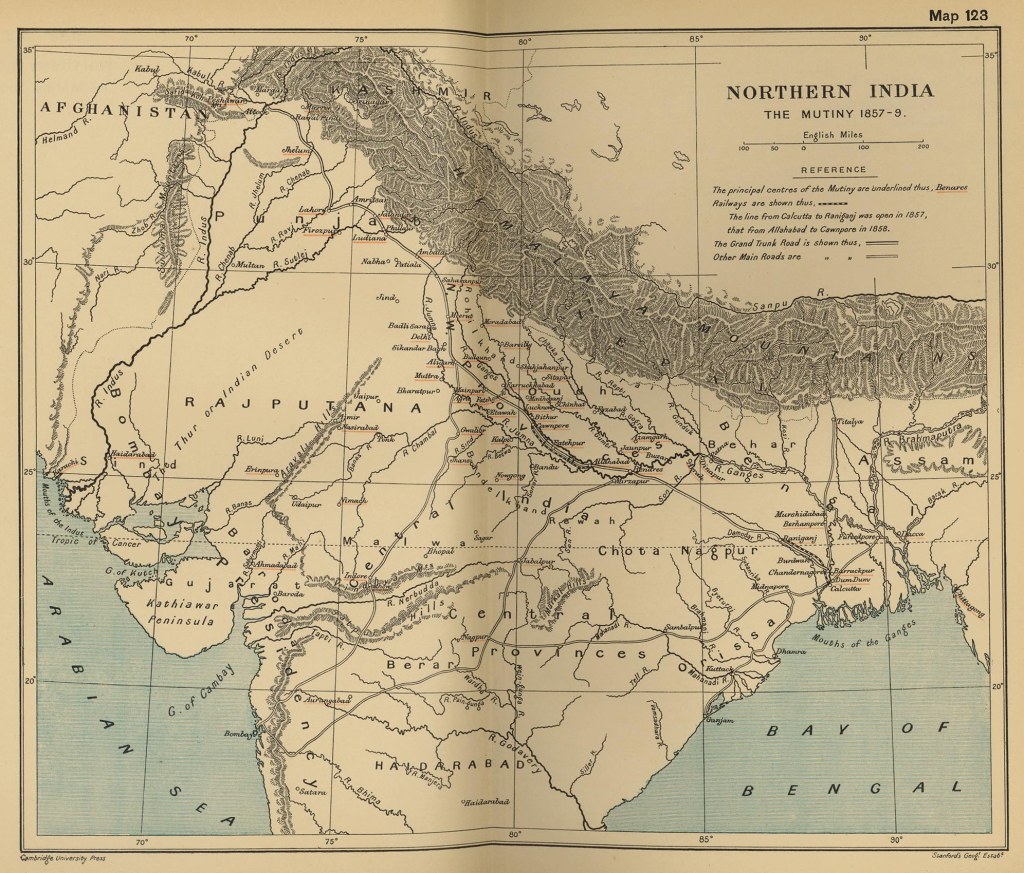
Signs of discontentment had been brewing in India since the early part of 1857. The disbandment of regiments in Bengal, Mangal Pandey’s lone attack on officers in Barrackpore and finally the stream of arsons in Amballa all pointed to a rising wind. The circulation of chapatis from station to station was still ongoing, though no one neither then (or even now) could satisfactorily explain the significance. The Commissioner of Meerut, Hervey H. Greathed, with 20 years of service in India, saw a widening gulf between the British the people they ruled over, and an army that was becoming increasingly
“…contemptible; their martial spirit as waned, as might be expected, from our treading all warlike propensities out of the people; and they have no longer the virtues of militiamen, and are neither formidable to foes nor useful as watchmen.”
The local postmaster did “hear a good deal of seditious language used by the orderlies of the different native regiments, who used to meet at the post-office two or three times a day when they came to fetch their officers’ and regimental letters, “ but when he reported it, he wasn’t taken seriously, In fact, except Greathed, it seems, thought anything was at all the matter despite the signs around them. The British felt secure in their power, the army appeared peaceful and, with the hot weather upon them, no one would consider starting a campaign at that time of the year. In other words, no one was paying attention.
REGIMENTS AT MEERUT
The Troops
Before we can look at what happened next, it is necessary to understand who was in Meerut in 1857.
At the start of 1857, there was a regiment of British infantry, a regiment of British cavalry, two regiments of native infantry and one regiment of native light cavalry. Meerut had recently gained the position of headquarters of the Bengal Artillery, and as a result, a troop of horse artillery with 6 guns, a company of foot artillery, a light field battery manning six guns, plus a number of recruits, were stationed here. The Bengal Artillery was manned by European and Indian gunners alike; the latter were support staff, known as Golandaz.
The troops present were:
1st Battalion of the 60th Queen’s Royal Rifles (known later as the King’s Royal Rifles), comprising 901 officers and men and commanded by Lieutenant Colonel John Jones.
The 6th Dragoon Guards (the Carabiniers), who had arrived in Meerut on the 11th of March. They had previously seen service in Crimea, had been unhorsed and sent home, took on 408 recruits in England and set sail for India in 1856. The 316 horses from Bengal light cavalry regiments and 305 from the government stud, which were not yet fully broken in. Their strength in Meerut was 652 officers and men, but their actual fighting force was only 350, as the majority consisted of recruits who had not passed drill and horses that were not ready for riding. They had also never seen service in India before, so they were unused to the heat.
The Artillery Regiment consisted of 225 men of horse and foot.
The 3rd Light Cavalry had been stationed in Meerut before the First Sikh War and had returned to the cantonment in 1854. It comprised 504 officers and men.
The 20th Native Infantry had seen service in Peshawar in 1853 and mustered 950 officers and men, by far the biggest infantry regiment present in Meerut.
The 11th Native Infantry had only arrived in Meerut on the 1st of May, having come up from Allahabad to replace the departing 15th N.I., which was relocating to Nasirabad. The 11th mustered 780 officers and men.
The Military Officers
Major General William Henry Hewitt
The Major General commanding the Meerut Division was Major General William Henry Hewitt, who, although he had the sobriquet of “Bloody Bill Hewitt”, had not seen an actual battle since the First Burmese War in 1824. His last command had been in Peshawar, where he had gained the rank of Major-General simply by climbing the ladder of seniority, and in January 1855, he was moved (or removed) to Meerut. In 1857, Hewitt was 67 years old, and although known to be a kindly officer, his main interest appears to have been a fondness for fine food rather than spirited soldiering. His girth had reached rather alarming proportions, and he could no longer ride a horse, viewing parades from a specially built carriage. In his defence, did mount a tour of inspection in his division, visiting Moradabad just before the outbreak; he had even intended to visit Delhi. Meerut would prove to be his undoing.
Brigadier Archdale Wilson
The senior regimental commanding officer and station commander was Brigadier Archdale Wilson of the Bengal Artillery. At 53 years of age, Wilson had served in the army since 1821. His experience with actual war was somewhat limited, having been involved in the siege of Bharatpur in 1826 and a few skirmishes in the Jullundur Doab in the Second Sikh War. Called by Lord Roberts “a soldier of moderate capacity”, the mutiny would be Wilson’s rise to fame and glory when he took over command in Delhi.
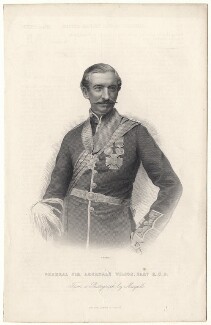
Lieutenant-Colonel George Munro Carmichael-Smyth
The most complicated officer in Meerut in 1857 was Lieutenant Colonel George Munro Carmichael-Smyth. His entire career had been spent in the 3rd Bengal Light Cavalry, having joined them in 1820. Like Wilson, he had been present at the siege of Bharatpur. Still, unlike Wilson, Carmichael-Smyth would then see service during the First Afghan War (his regiment had been sent back to India in 1839, so he missed the retreat), then he went with the 3rd to the First Sikh War, where they saw battle at Aliwal, and then took part in the battle of Sobraon. It was his interest in Sikh affairs that would bring him to the notice of his fellow officers and, particularly, his associations with a rather shady person named Alexander Houghton Gardner. Carmichael-Smyth wrote and edited with the help of Gardner, titled “A History of the Reigning Family of Lahore, with some Accounts of the Jummoo Rajahs, the Seik Soldiers and their Sirdars.” The book was not the problem, but his association with Gardner was. Once employed by the Sikhs as an artillery officer, Gardner’s own exploits had thrown him in a poor light with the British. Curiously, while Henry Lawrence had relied on Gardner for advice and intelligence during his sojourn in the Punjab, it was also Lawrence who would effectively throw Gardner under the proverbial cart.
Regarding Carmichael-Smyth, Palmer states:
“The figure which emerges from this darkened canvas is complex, and any judgement of him must be take that into account. His good record of varied active service proves his courage….He was not merely a stupid martinet as he is sometimes represented. He may have had too good a conceit of himself…he may not have been too popular, but a strong unpopularity is not proved against him. The impression which one has about him is that of a possibly disappointed and difficult character, a man shadowed by promise not fulfilled and certainly deficient in judgement; a deficiency which often ruins all.”
The fact of the matter remained, however, that one particularly liked the Lieutenant-Colonel, but no one could quite say why.
The Staff
The Deputy Assistant Adjutant Major at Meerut was Major John Waterfield of the 38th NI, who had seen service in the Afghan War, commanded a local force in Bundelkhand and had now been in Meerut on staff duties since 1855. Deputy Judge Advocate-General was a cavalry officer, Major J.F. Harriott, who had seen no active service at all, having been with the legal department since 1844, and in Meerut since 1852. The Brigade-Major, Captain G. Palmer Whish of the 60th N.I. had been in Meerut since 1855. His father was General Sr William Sampson Whish who had commanded troops at the siege of Multan and Bharatpur and had fought alongside Lord Gough at the battle of Gujrat.
The Civilians
Meerut had of course, its compliment of civilian officials, the first of whom was the Commissioner of the Meerut Division, Hervey Greathed, followed by the Judge, George Blunt (who may or nor may not have been in Meerut at the time, since he had retired on the 11th of April, 1857); The Collector and Magistrate R.H.W. Dunlop, then on leave in the hills. Although his book, “Service and Adventure with the Khakee Ressalah: or, Meerut Volunteer Horse, During the Mutinies of 1857-58“, cannot be considered a first-hand account of the events at Meerut, as Dunlop was not in Meerut on 10 May, it does nevertheless make an interesting read for other aspects of the mutiny. The Deputy Collector, Alexander Johnston, completes the summary.
Greathed would die in Delhi in September of disease, Johnston would be killed on 27 May while engaged in an attack on a Gujar village – though not through a gunshot but by his horse falling and dislodging his rider. Johnston died of a fractured skull.
 Mutiny Reflections