The Unfortunates
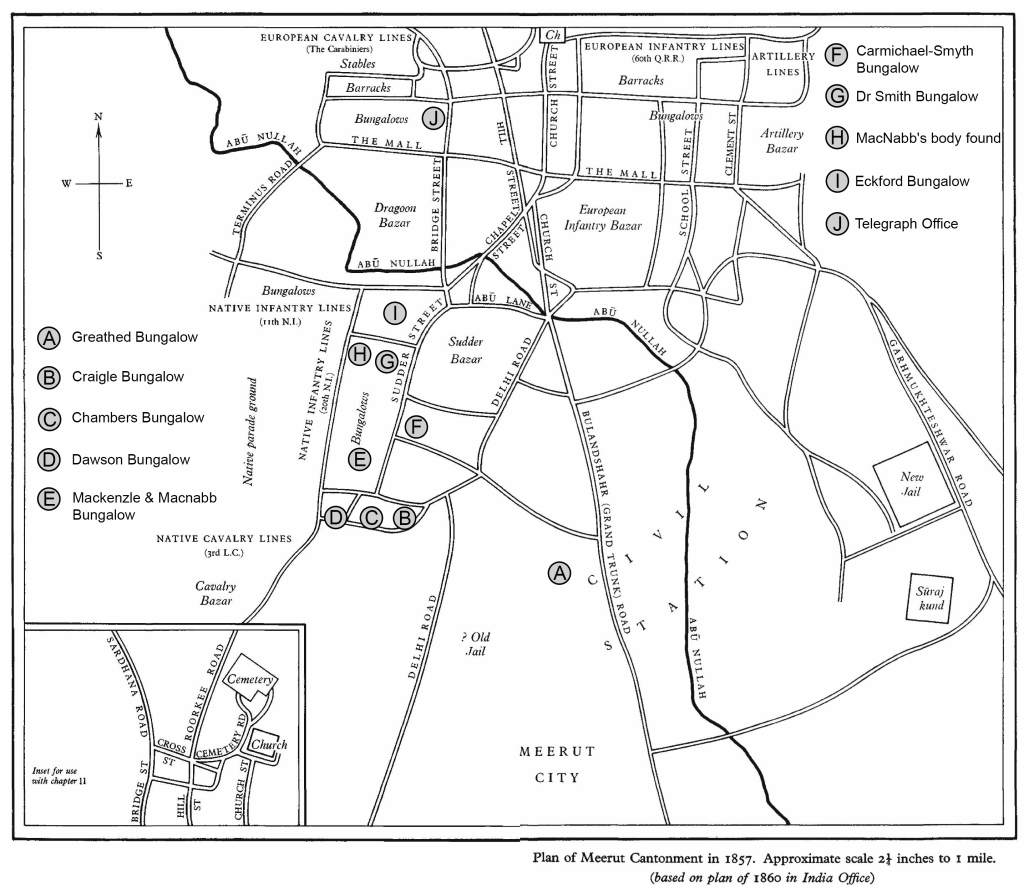
We left Mrs Macdonald at home with her husband buckling on his sword; just as prepared to leave for his regiment’s lines with Captain Chambers, he ordered his wife to gather up the children and go over to the Chambers’ house. For some reason, known only to her, Mrs Macdonald did not abide by her husband’s directions. She was still at the house when her servants informed her that her husband had been shot by his men. By now, it was too late to go anywhere, and a large crowd was gathering on the road. In sheer fury, the mob set fire to the thatched roof of the bungalow.
The ayah (nanny, maid) and the dhobi (washerman) sprang into action, deftly hiding the family in the bhisti’s (water carrier’s) hut. Meanwhile, the chowkidar, seeing that his employment was not worth sacrificing his life for, decided it was time to flee, but he could be persuaded to take the terrified family along. Dressed as natives, with Mrs Macdonald covered in a burka, the small group set off. Getting out onto the road, they were stopped by a crowd. Asked who she was, the chowkidar tried to explain she was his sister-in-law, but the ruse fell through when Mrs Macdonald unwisely chose to answer for herself. Her burka was ripped off, and within moments, she was slain. As Captain Earle would later write, she “…was so much disfigured from the cuts about her face, that although I had known her intimately for upwards of nine years, I did not recognise her.” The servants, however, were able to save the children and deliver them up to the European lines. They were later sent to England to be cared for by relatives.
Mrs Charlotte Chambers, too, was in her house, whether she was waiting for Mrs Macdonald or paralysed with fear, we will never know. Aged 23 and said to be the belle of Meerut, she was married to Captain Richard Wellesley Chambers. They had married in Wazirabad in 1854 and had only recently arrived in Meerut with the 11th BNI. She was also eight months pregnant with her first child. Their house was located just opposite the Craigies. Unlike Mrs Macdonald, who didn’t act on what her husband said, Mrs Chambers now didn’t have the chance to act at all. Mrs Craigie and Miss Mackenzie, as they stood on the first floor of her house, anxiously waiting for anyone to come and save them, recalled seeing Mrs Chambers.
“Bungalows began to blaze round us, nearer and nearer, till the frenzied mob reached that next to our own! We saw a poor lady on the verandah, a Mrs Chambers (lately arrived). We bade the servants bring her over the low wall to us, but they were too confused to attend to me at first. The stables of that house were first burnt. We heard the shrieks of the horses. Then came the mob to the house itself, with awful shouts and curses. We heard the doors broken in, and many, many shots, and at that moment, my servants said they had been to bring away Mrs Chambers but had found her dead on the ground, cut horribly, and she on the eve of her confinement!”
Mrs Chambers’ husband did not come for her. Instead, Lieutenant Le Champion Möller tried to save her. He was riding across the parade ground near the lines of the 3rd LC when “I had almost reached the house of Mrs Chambers, then in her verandah, and looking at me, when five or six Native troopers spread out to cut me off and forced me back.” The next day, her husband found her. Charlotte had had her throat cut, and her baby had been ripped from her body and placed on his mother’s chest. Evidently, a butcher whom she had recently reprimanded for selling her bad meat had taken his revenge. Lieutenant Möller found the man in the coming days and had him hanged. Her husband would carry his grief with him to Delhi, where he would often confide his sorrow to the only woman on the Ridge, Mrs Tytler. The authorities at Meerut had prevented him from dealing with the butcher and he never had the chance, he felt, to rightly avenge his wife. Charlotte and her baby lie buried in Meerut cemetery.
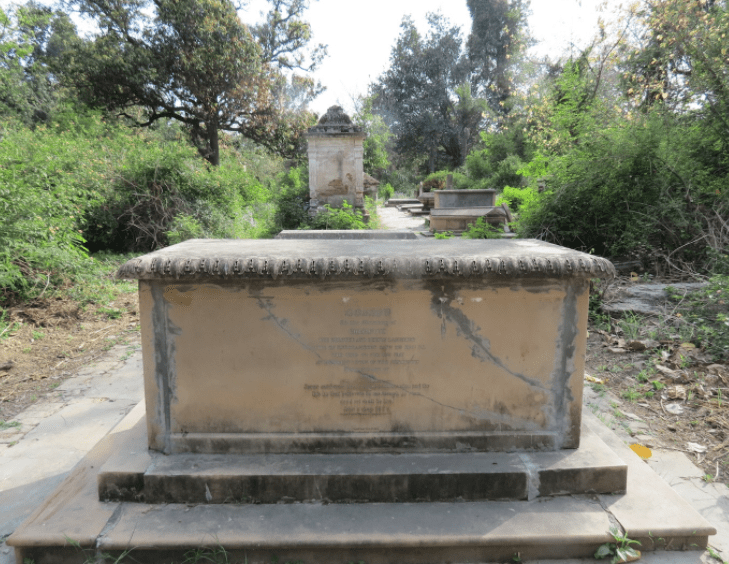
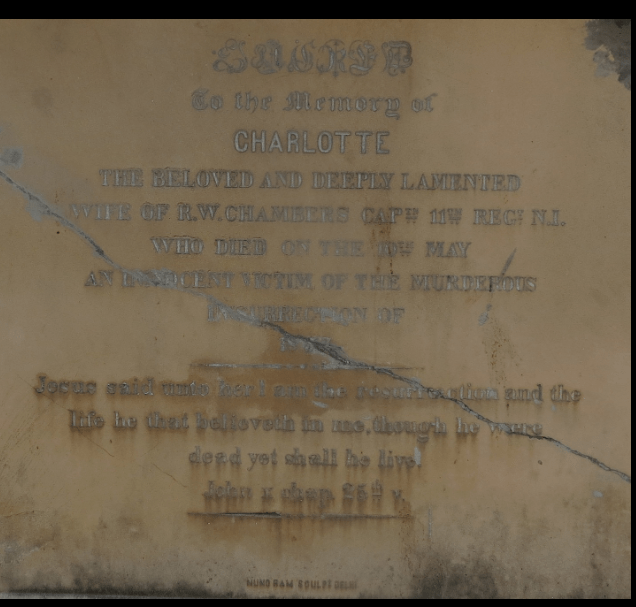
life he that believeth in me, though he be
dead yet shall he live.
John x chap. 25th. v.
Close by in another house, Veterinary Surgeon Dawson and his wife were sick with smallpox. Aroused from his sickbed by the noise from the streets, Dawson went out onto the verandah with his gun and fired at the coming mob. It was only a momentary respite as seconds later, he himself was shot. As for his wife, the mob threw torches at her until her nightdress caught fire, and she burned to death.
In the town, Mrs Courtney, wife of the hotel proprietor, had had an idea to get to safety and ordered her coachman to drive her to the city, her two children by her side. However, a crowd barred their way, so she now ordered him to drive her to the Deputy Collector’s house, which entailed driving through the Sudder Bazar. Pursued by the mob, they only managed to get to the house with the intervention of some men of the 3rd LC who held off the crowd long enough for her to reach the gates. The Muhammadan jamadar refused to open the gates and stood by as the coachman was knocked off his box by the mob, and Mrs Courtney, with her children, was killed.
In the lines of the 3rd LC, the seven-year-old daughter of Riding-Master Langdale was killed as she lay sleeping on a charpoy outside. This story was much exaggerated in later accounts, to include wanton details of barbarism, but in actuality, though no less sad, her death was swift with a single sabre cut. It is unclear what threat a sleeping little girl posed to an armed cavalryman.
Elsewhere
Elsewhere, the dithering of the commanders up in the European lines continued to cost lives. Wilson refused to let the Carbineers and the Artillery move any further than the Rifles Parade Ground. Had they been allowed to advance to secure the area between the Dragoon Bridge and Sudder Bazaar, it might have been enough to push back the crowds or even frighten them away. But his unwillingness to act or allow others, like Colonel Custance, to act in his stead meant that McNabb, Taylor and Dr Smith were served up to the mob. All the houses situated between the bazaar and the Abu Nullah were left open to plunder.
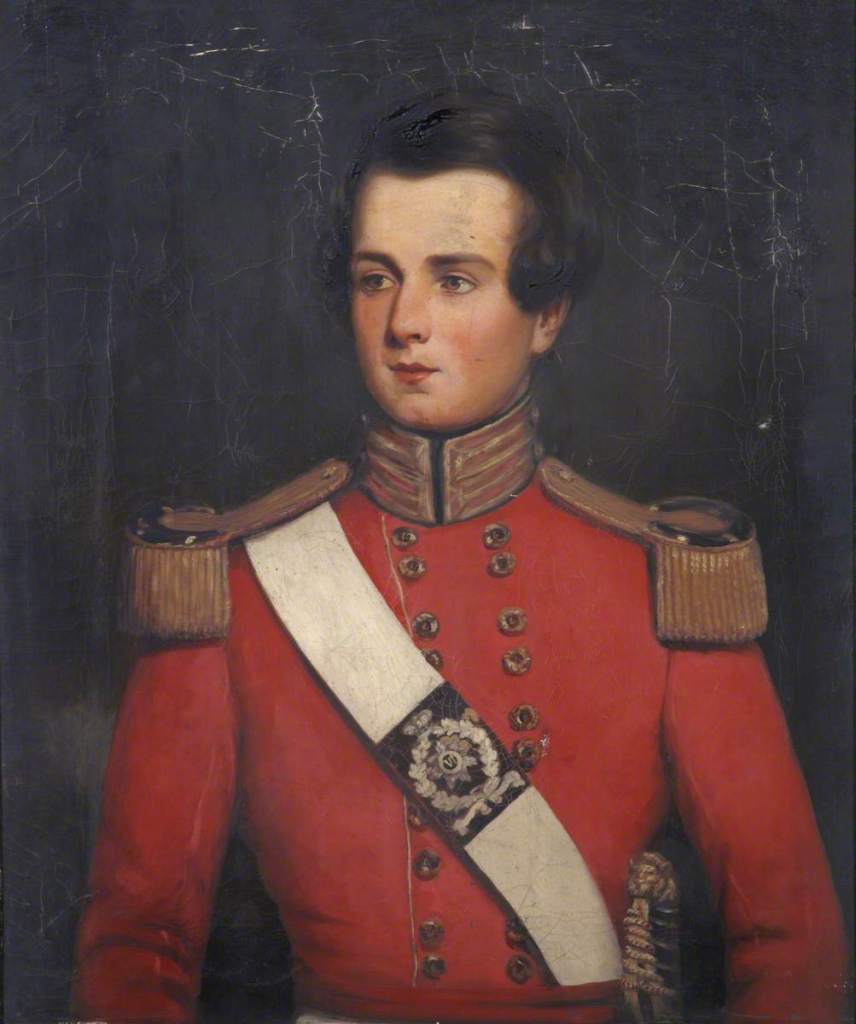
The houses of Lieutenant Eckford, Executive Engineer at Meerut and that of Doctor Smith of the Veterinary Establishment were located side by side near the north end of Sudder Bazaar. Eckford heard the sounds of musket fire and the growing din from the lines around 6pm and watched with trepidation as crowds began gathering in the bazaar. With growing alarm, he saw Europeans fleeing in any manner of conveyance to the European lines. With him was an old pensioner named Joseph Chapman, who was probably employed for office work by Eckford. It was Chapman who had come to him with the news that he had seen four Riflemen killed in the bazaar, not far from his own house. An hour later, the house of Dr Smith was set on fire, by which time the doctor was already dead. Now, the crowd turned their attention to the lieutenant and the pensioner, recently joined by a rifleman named Fitzpatrick, seeking shelter from the mobs. Eckford acted. He sent his wife, children and sister to the servants’ quarters, gave Fitzpatrick a gun and armed the pensioner with a spear. He then locked all the doors, closed the shutters and retreated to the portico upstairs.
“I saw an immense number of men, sepoys, troopers and bazaar people (in all at least 4 or 5 hundred) moving quickly towards the house. Whenever they saw me, they aimed at me with their muskets, but not a shot struck me.”
Disheartened but not yet defeated, the three men prepared to defend themselves, except another crowd, whom they hadn’t seen, entered from the back of the house and forced their way in. Alerted by the loud crash of smashed doors, Eckford ran downstairs and in the dining room, he found himself suddenly confronted by fifteen armed men.
“I had a double-barrelled pistol in each hand. I gave a shout and dashed at them. The room was rather badly lighted I knew and went at them, fired my right pistol (one barrel after the other) at the men on the right (each ball must have told in some way on them). They all, with one exception, turned and scrambled out. The man who remained – a trooper of the 3rd Cavalry by his dress – came at me. About 4 or 5 paces distant I let him have one of the left pistol barrels (he must have been very hard hit) – the other would not go off (The body of this man was afterwards dragged out by his friends from the burning house – my servants told me). He almost simultaneously gave me a severe gash across the head with his sabre. I attempted to close with him and we struggled for a few seconds – in which time I smashed my pistol on his head – a heavy blow for it broke the trigger guard and the swivel ramrod of the pistol which was found the next day. He in return gave me sundry wounds and sabre cuts.”
Saved by the timely appearance of Fitzpatrick, who dragged Eckford out of the room and back up to the flat roof of the upstairs portico, leaving the wounded sowar to stagger off. Fitzpatrick left Eckford with the promise to get help, as he was determined to flee before the house was completely surrounded. Giving Fitzpatrick his double-barrelled gun, Eckford heard several shots fired from downstairs and shouts and then nothing. With his wounds bleeding profusely, unable to move and expecting any minute to be attacked by the mob, Eckford didn’t realise that for a moment he was safe. He was under the shade of a large tree, and the mob, as they carefully came up the stairs, did not see him. Missing him on the portico, they cautiously continued to the house roof but thought better of it. Perhaps the bloodied sowar had given them something to think about. Instead, they retreated downstairs and set fire to the house.
Realising he had to move or be burned alive, Eckford managed to drag himself down onto a veranda, where he lost consciousness, only coming to when he realised the flames were scorching his body. Crawling along, he managed to get to the garden where his servant would later find him. The crowd dispersed as the building was so nearly consumed by flames that they presumed no one could be alive. Eckford was reunited with his unharmed family and with Joseph Chapman (who had fled to a gardener’s shed for safety). Chapman would later find his own wife alive. Carried in a litter to the European lines, Eckford survived his six wounds but never recovered his health, dying in 1872. As for Fitzpatrick, his naked body was found the next day on the road behind the Eckfords’ house. He had not even managed to take the rifle over the wall.
The dinner guests of Carmichael-Smyth, who had set out in a buggy shortly after the judge was sent on the road, did not fare any better. Philipps was shot dead, and Christie was so badly injured by a sword cut to the face that he was disfigured for life. Deputy Judge Advocate General Major Harriott escaped.
Not at Home – the Loyalty of Servants
Unbeknownst to Carmichael-Smyth and Hugh Gough as they banged away at the door of the Greathed’s bungalow, Elisa and Hervey not only heard their friends but saw them as well. Safely ensconced on the roof by the servants who had dissuaded the couple from going to church, they waited with trepidation for events to unravel. Anyone who came to ask was firmly told the Greatheds were not at home and that any entrance to the house was promptly barred. All around the bungalow, screaming mobs tore their way through the neighbourhood, setting fire to some houses and wantonly destroying all of them. It was not long before the mob smashed open the Greatheds’ doors and drove off the servants. Although the mob was calling for Hervey as they plundered his house, no one ventured upstairs. By and by, the house was set on fire. Seeing the situation becoming intolerable, their faithful servant ran up to the mob and declared himself as one of them. His plan was to draw them away so his employer could escape: he quickly told the mob that the house was indeed empty, but the feringhees were hiding in a haystack near the house. While so engaged, the Greatheds and two English women quickly scrambled off the roof and rushed through the burning house. A few minutes later, the roof crashed in behind them. They sat concealed in the garden, carefully kept out of sight under a tree with Mr Greathed standing watch, a loaded pistol at the ready. As dawn approached and the crowds finally disappeared, the party made their way safely to the dragoon lines. Their servants also survived.
The Bazaar
As mentioned before, it was a blisteringly hot Sunday in May when India gasped, waiting for the rains. The temperatures indoors as without would soar to unbearable heights, and any wind that chanced to blow is hot enough to scour the skin. It was no surprise, then, trying to escape the stuffy barrack rooms and endless hours of boredom staring at the ceiling, watching the punkahs lazily moving in the heated haze, many European soldiers sought a little respite in the Sudder Bazaar.
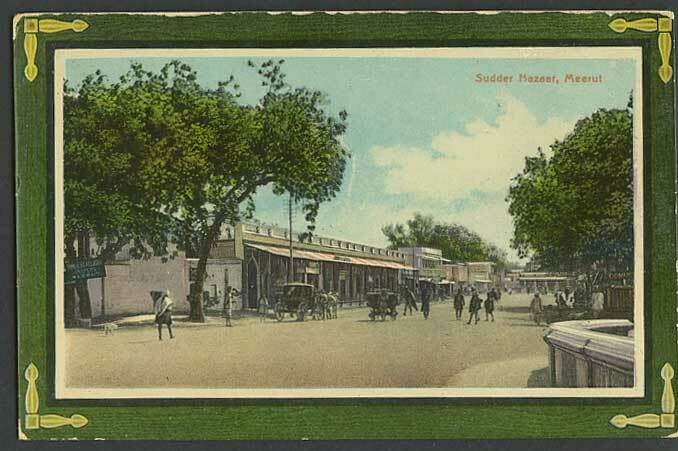
Initially, even after the first outcry, the bazaar remained quiet. The British soldiers continued wandering about in groups of two and three; others made their way to the “pop shop” where they could at least get a cold drink of ginger beer. Suddenly, everything changed, and the mood became hostile as if somewhere a switch had been flipped. The sepoys had begun rioting in their lines, and it did not take long for the people in the bazaar to catch the panic.
Initially, the British were unsure what was happening – they heard cries in the distance of fire -and, thinking something was going up in flames, they didn’t at first understand what it meant. When a trooper of the 3rd LC rode up and, rather surprisingly, told the men they really should get out of the bazaar, they realised something was up. At first, many of the men ran towards the local police station, still not aware that the danger was not just from the bazaar people but from the sepoys themselves. It was manned by a guard of sepoys, who, instead of giving the Europeans protection from an increasingly volatile crowd, fired at them.
Turning away from the police station, the British found they were vastly outnumbered by a quickly formed mob and being unarmed, they only had one choice, and that was to run through the crowd. Some darted down side roads, others charged straight ahead, pelted by stones and beaten with sticks. Gunner McCartney was one of those who made it through the cavalcade of brickbats, but two of his companions were killed, hacked to pieces by the bazaar crowd. It was this that the men were running from – some were picked up by quick-thinking people like Mrs Craigie, and others ran from pillar to post, hiding in different houses or setting out as best as they could back to their lines.
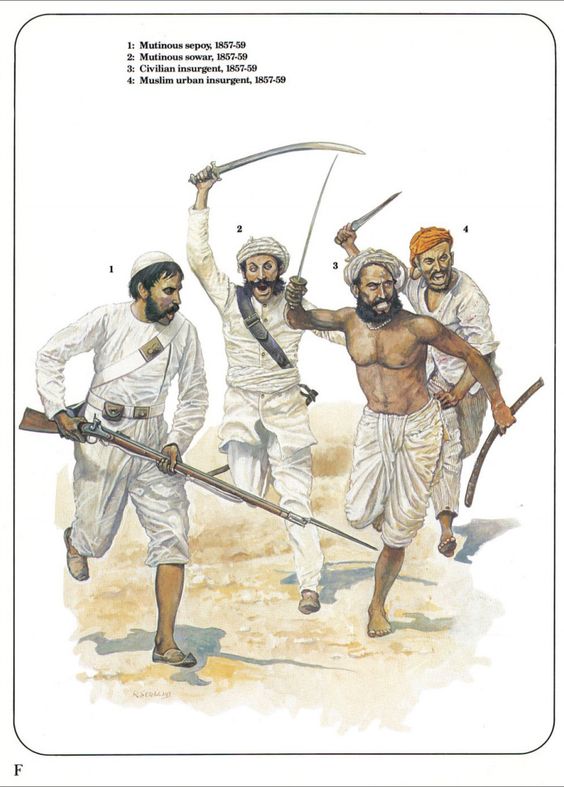
Not only was the rage of the mob directed at the European soldiers in their midst. Eurasians were also a target, as were Bengalis who worked for the British as clerks and writers. The crowds themselves were not strictly just bad elements from the bazaar. They were everyone who had a grudge and anyone else who was infected by fury. Tradesmen, artisans, labourers, butchers, cooks, tanners and house servants all took a part in the rioting and destruction, as did greengrocers, fishermen and watchmen. Later, elements from the outlying villages and notoriously difficult Gujars joined in, as did the prisoners from the now-opened jail. Before long, it had gone from being just a mutiny of the sepoys to a full-scale urban riot. Not just the British bungalows were plundered: everything was fair game in this increasingly lawless situation. Local butchers stole cattle, and Muslims turned on the Hindu moneylenders, plundering their shops. Whereas many of the wealthier inhabitants of Meerut did not take part in the mob violence, they still shut their doors tightly against everyone else, for it was a time when people could settle old scores. Until now, the notion that had started all of this was that the Europeans were coming. Coming to take the sepoys’ guns, coming to put them in fetters and send them to jail. Indeed, as the rioting got worse, some people could almost believe the Europeans had come, and this was the result. But they never came. And by morning, all that was left of much of Meerut was smouldering in ruins.
The Law family were blissfully unaware that anything at all was wrong in Meerut on the 10th of May. They were also among the last to be attacked that night. Their house was situated in the unoccupied Sappers and Miners lines, somewhat behind and to the south-west of the Artillery lines. At 10 pm, they were getting ready to go to bed when the rioters found their way to this side of the cantonment. They were the only people living in these lines, and could not have been more surprised when a large armed crowd burst into their house. As they surrounded her husband, Mrs Law managed to get away with her infant son, but she had to leave behind not just her husband but three other children.
“As I was escaping, two men, both chuprassies in Government employ, one the son of the man who supplied us with milk and butter, and the other, chowkeedar of the school, debated about killing me, the first man said, they had got quite enough in the house and was for allowing me to escape, but the other, who had on a red turban, was for killing me.” Eventually, they decided to let her go, but she ran into the next crowd. Severely beaten with wounds to her head and a sword cut in the arm, Mrs Law and her baby were found the next day by Sergeant Foster. Of her husband and children, only her young son survived his injuries.
 Mutiny Reflections
I think I am learning and experiencing the Indian history happening right in front of eyes. Its much better created and the writing format takes off the boredom. Feels like you don’t need a history books or watch videos to know about a nations past, all you need to do is go through your works and feel the pain. Absolute Bliss.
LikeLike
That is exactly what I am trying to do with this history and am so happy you can see that. 1857 especially is a torrid subject so I try to bring it across in a way it is readable and especially visual. The next part is in the making, the conclusion to Delhi.
LikeLike