On to Cawnpore
The party consisted of 28 people, of which 19 were children. One lady, Miss Sturt, had been convinced by her mother to join Probyn, much against her will. It was certainly a surprise when her mother suddenly changed her mind and decided to join her daughter after all. The intrepid Mrs. Sturt insisted on walking alone after the Dharampur boat, managing to catch up to them at Amrauli before the 8th of June.
It was no mean feat the trip back to Dharampur. After working their way up the Ganges for a mile, they then had another 20 miles up the Ramaganga through a maze of shallow channels and sandbanks.
In the last embers of daylight, the parties waved a final farewell, each now resigned to their fates. From here, it can only be conjectured what happened to the people heading to Cawnpore, and Hingun Ayah, who accompanied them, would be the main witness.
The Cawnpore party stayed docked at Meora Ghat until the sixth of June, using the time to reorganize themselves. They decided to leave most of their cargo behind, and Mr. Brierly’s boat now accommodated 67 passengers, half of them children, while the rest of the party divided themselves up into five boats, a 6th being used to transport their belongings and provisions. In all, 110 people pushed on towards Cawnpore: 25 men, 33 women and 52 children.
Their long halt on the 5th and the 6th had allowed for the presence to be made known to the surrounding villages. After struggling for seven miles, the boats made their way through a narrow channel, on one side a sandbar and on the other the shore. They were met by the inhabitants of the Beloi settlement who rushed out to meet them in their hundreds, shouting and firing their muskets into the air. They were not attacked per se, but the villagers surrounded their boats, now tied together at the shore, and kept up an unholy racket all night, beating drums and firing their guns. No one boarded the boats, but after a long and sleepless night, Brierly sent his servant Besant to find out what the local landlords intended to do with them.
Not long after, two Thakurs made their appearance, demanding 2000 rupees as ransom in exchange for safe passage to Cawnpore. After long negotiations, half the sum collected with the promise of the other half forthcoming at their destination, Mr. Brierly handed over the money to one of the Thakurs. Mr. Shiels’ boat was so damaged while being plundered by the other landlord and his men that it had to be left behind. Five villagers were assigned to act as escorts, though, needless to say, four of them jumped ship shortly after and swam to shore. The 8th of June passed without further incident, and by the 9th, Brierly’s party reached Bithur. Shots were fired at them from the river bank, and Brierly ordered the women and children below deck. Several of the men fired back, and shortly after, silence fell.
At 8 am, Brierly’s boat ran aground again, this time stuck fast on an island. From here, they could see Cawnpore, the smoke rising from the cantonment, and hear the guns blasting Wheeler’s entrenchment to smithereens. Still unaware of what was actually happening in Cawnpore, Brierly sent a letter to Hugh Wheeler via a watchman and 2 other servants to the town to ascertain the situation. The servants returned, saying the roads were closed and the garrison besieged. Still, no attempt was made to move off, Brierly hoping for any intimation of help from Wheeler. However, the watchman was seized by the rebels before he could reach the entrenchment, and Brierly continued to wait for a message in vain.
For the whole of the 10th, the party remained on the island. Brierly sent a message to the Nana Sahib himself but received no reply. The rebels, now well aware of the fugitives, attempted to entice the boatmen to deliver the boats to the shore. The boatmen refused, saying they were overloaded with 700 Europeans. Whether this was believed or not is a matter of speculation, but on the 11th, the boats were still on the island.
In the morning, things changed. Two cannons fired at them from the Oudh side of the Ganges with two balls striking Brierly’s boat. A third shot smashed the cabin roof, killing Mrs. Ives, a child and an ayah. In a wild panic, the occupants leapt into the river. Many found refuge behind a long sandbank close to the water’s edge; others tried to hide in the long grass and hollows in the ground. Brierly’s boatmen now threw in their lot with the rebels, and, setting the boats on fire, they charged the island, clubbing to death anyone they could find and ransacking the corpses. They did not remain long – a few more rounds of cannon shot and the boatmen fled.
Seeing that resistance was impossible, the party decided to surrender. The grass on the island burst into flames, fanned on by strong wind, thus killing two more women and a child. The rest were robbed by the local landlord of their remaining possessions and dispatched to the Nana Sahib.
The Final Stage
“Let us, before doing anything else, prepare to die.”
Prayer by Rev. Freeman, offered up on the island before surrender.
There is only one eyewitness who stayed with them till the very end. Mrs. Palmer’s faithful ayah Hingun watched as they were tied up. After a short boat crossing, they were marched off. Debi Din, one of the native Christians who was prevented from joining them, watched the refugees disappear from sight at Nawabganj and heard Mr. Campbell’s final farewell. Of all the missionaries of Fatehgarh, Mr. Campbell had vehemently opposed the flight to the boats; now, his was the last voice to be heard. The native Christians and most of the servants had already disappeared into the crowd.
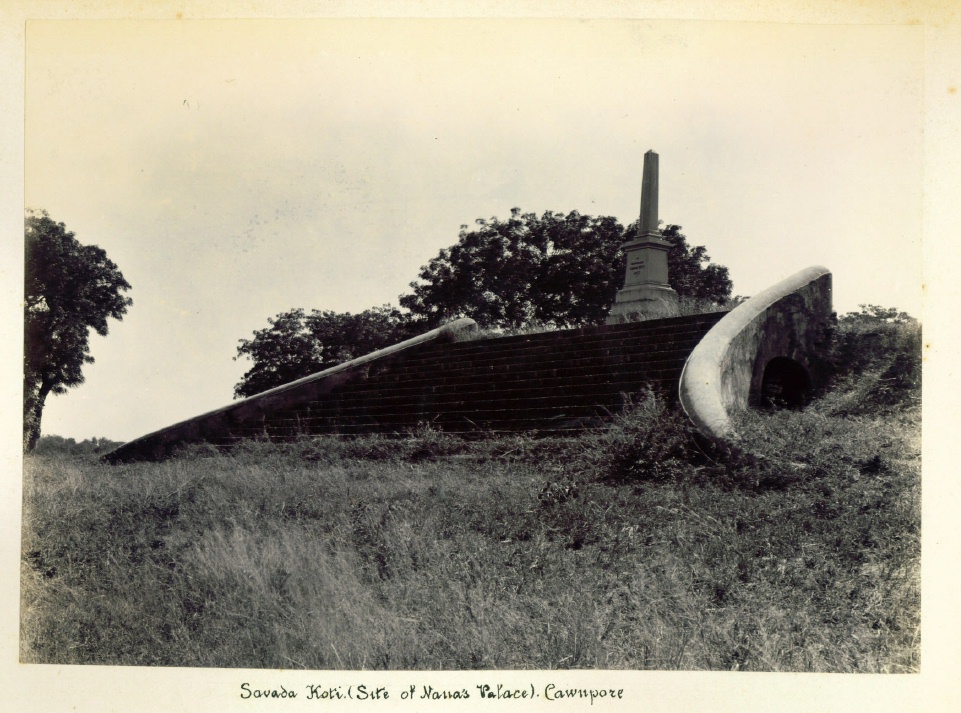
The party was stopped at Subadar Tank, given some water to drink, and here they stayed until morning. On the 12th of June, they were picked up by bullock carts and carried the rest of the way to Savada House and herded inside. Seated on the floor in the central room, they awaited their fate until 2 o’clock when summoned by Nana Sahib. Goaded by their guard, they were forced back out into the sun onto the bare plain between Savada House and the racecourse, where they were driven into a ditch and forced to sit on the ground. The men were seated in a row behind the women and children.
Nana Sahib came out to inspect the prisoners but wordlessly ignored the calls of Brierly and Maclean that killing them would do no good. He walked away back to his tent. Hingun was not privy to the deliberations that followed, but it would appear the Nana was not at all interested in murdering the captives, instead, he wanted to keep them as hostages. Overruled by his brother, his brigadier, his chief minister and cowed by his increasingly mutinous soldiers, the Nana relented. He did not watch the executions but remained in his tent.
As Bala Rao and his courtiers rode out to watch the slaughter, the sepoys forcefully dragged off the remaining ayahs who had intended to remain faithful to the little charges until the end. The ayahs could then only watch as sowars, sepoys, and badmashes from the town encircled the ditch. Bala Rao positioned himself on a platform so he could see the spectacle, while soldiers now chased away a growing mob of onlookers. Bala Rao then declared it was on the Nana’s orders that all Europeans were to be killed, and the soldiers opened fire. It took two volleys to kill most of the fugitives, and what the bullet did not do, the swords and tulwars of the jullads and sowars finished, hacking the remaining survivors and more than a few children to death.
Some of the bodies were buried, but most of them were thrown into the Ganges where their corpses were left for the dogs, vultures and for the elements to finish off.
Sources:
Danvers, Frederick Charles, ed. Memorials of Old Haileybury College. Westminster: Archibald Constable and Co., 1894.
Edwards, William. Personal Adventures during the Indian Rebellion in Rohilcund, Futtehghur, and Oude. London: Smith, Elder and Co., 1858.
Nevill, H. R., ed. Hardoi: A Gazetteer. Vol. XLI of the District Gazetteers of the United Provinces of Agra and Oudh. Lucknow: Government Press, 1904.
Sherer, J. W. Havelock’s March on Cawnpore, 1857: A Civilian’s Notes. London: Thomas Nelson and Sons, 1910.
Wallace, C. L., and F. R. Cosens. Fatehgarh and the Mutiny. Lucknow: Newul Kishore Press, 1933.
Walsh, J. Johnston. A Memorial of the Futtehgarh Mission and the Martyred Missionaries: With Some Remarks on the Mutiny in India. Philadelphia: Joseph M. Wilson, 1859.
 Mutiny Reflections