“In a few hours, we fly. The whole country is now up in arms. Farewell, farewell! Perhaps you many never hear from me again.”
Mrs. Johnson, writing to her sister from Fatehgarh, June 2nd 1857.
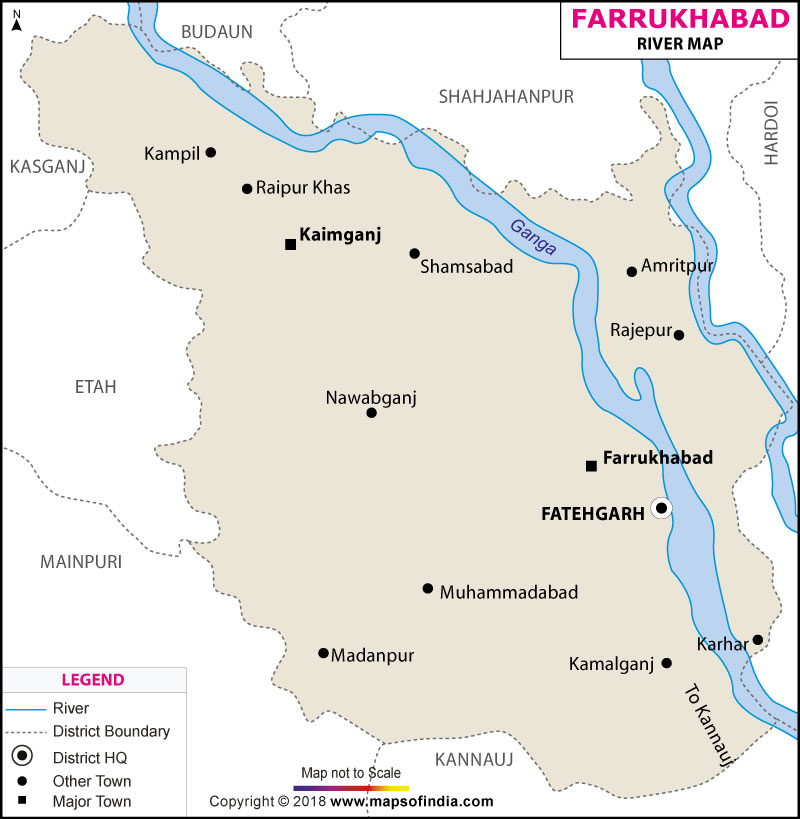
Mr. Probyn and Mr. Brierly, no longer content with the inaction of Lieutenant-Colonel Smith, set about arranging boats. Probyn further elicited the support of Hardeo Baksh Singh, a landholder from the Hardoi District who was personally well-known to Probyn. Hardeo Baksh Singh committed an escort of his own men for the boats, at least until they were past his district, some 12 miles away. The intention initially was to make for Allahabad.
By the 1st of June, a growing number of the Fatehgarh residents were sleeping on the 13 boats provided, too alarmed to spend the night in their own homes. These were moored by the Fort and the Hospital Ghat and were easily reached from most parts of the town. However, the number of boats proved inadequate, and not everyone could find a place. By the time they set off on the 4th of June, the poorer residents of the city were left behind, and unable to find boats of their own, they remained in Fatehgarh, thrown to their fates.
Following the report of cavalry descending on Fattehgarh on the 3rd of June- which proved to be only half as bad as imagined (a few sowars did ride into Fatehgarh, but it was by no means a raging army) – it was nevertheless enough to send the residents down the boats. Mr. Probyn himself settled his family and then returned to his duties. However, fate played a different card.
The flat-bottomed riverboats were of varying sizes and had been prepared for the flight from Fatehgarh – nearly all had deck cabins covered in thatch or planks, providing some shade from the sun. The largest of these boats belonged to Mr. Brierly. Ten were assigned to carry the fugitives while the remaining three were allocated for servants, provisions and baggage. Hardeo Baksh Singh himself and his trusted escort of 50 men had their own boat.
From Fatehgarh in the Mutiny by Lt.Col. F.R. Cosens and C.L. Wallace, 1933.
“By 10 pm on this stifling night of the 3rd of June, the company embarked in the following order:
Boat No. 1 – Mr. and Mrs. Probyn and four children; Mr. Thornhill, Mrs. Thornhill and 2 children; Mr. Jones, planter, Mrs. Jones and child; Mr. Gavin Jones, engineer.
Boat No. 2 – Mr. Lowis, Mrs. Lowis and three children; Miss Nancy Lang, nurse.
Boat No. 3 – Colonel Tucker, Mrs. Tucker and four children; Humphreys, manservant; Mr. Ahern and Mrs. Ahern; Revd. Mr. Fisher, Mrs. Fisher and one child.
Boat No. 4 – Mr. T. Churcher and Mr. D. Churcher, planters; Mr. James, Opium Officer; Doctor and Mrs. Maltby.
Boat No. 5 – Sergt. Roach, road overseer, Mrs. Roach and two children; Mr. Boscow, pensioner, Mrs. Boscow and two children.
Boat No. 6 – Mrs. Sturt and Miss Sturt.
Boat No. 7 – Mr Shiels, schoolmaster, Mrs. Shiels and two children.
Boat No. 8 – Mr. and Mrs. Ives, Miss Ives.
Boat No. 9 – Mr. J. Brierly, Mrs. Brierly and two children; Misses E. and F. Brierly; Mr. R. Brierly, Mrs. R. Brierly, and one child; Mr. Cawood and Mrs. Cawood and two chlildren; Mr. Joyce; Mr. Macdonald and two children; Mr. Faulkner and two children; Mrs. Jennings and five children; Mrs. Kew and three children, Miss Kew; Mr. and Mrs. Catania; Mr. Madden, Mrs. Madden and three children, two Misses Madden; Sergt.and Mrs. Hammond; Mr. Lows, Mrs. Lows and two children; Mrs. E. Shepherd and three children; Miss Mary Shepherd; Misses R.and E. Ray; Mr. Finlay, Miss Finlay; Mr. Alexander; Mr. Bellington.
Boat No. 10 – Mr. Maclean, two Misses Maclean; Mr. Elliott, Mrs. Elliott and five children; Mr. and Mrs. Guise; Lieut.Monckton, Mrs. Monckton and one child; Rev. J.E. and Mrs. Freeman; Rev. D.E. Campbell, Mrs. Campbell and two children; Rev. A.O. Johnson and Mrs. Johnson; Rev. R. and Mrs. E. McMullin; Mr. Palmer and Mrs. Palmer and nine children.
In the remaining three boats were fifteen servants, five of whom followed Mrs. Jennings alone. Accompanying their masters, however, were a number of sweepers and ayahs, and in Mr. Maclean’s boat, several converts of the Mission continued together with the missionaries. One hundred and fifty-seven souls made up the little band of fugitives. Thirty-five adults and twenty-seven children chiefly making up the officers and their families were left behind, Colonel Smith, of course not having countenanced this flight from Fatehgarh.”
Mr. Probyn had intended to stay in Fatehgarh, contenting himself with the fidelity of Hardeo Baksh Singh, under whose roof he knew he could find refuge if necessary. He had provisioned for himself a dingy with which to cross the river if needed. However, Colonel Tucker, Messrs. Thornhill, Lowis and Fisher would not hear of him remaining behind, arguing that as they were all government servants, it was Probyn’s duty to join them. After some persuasion, he agreed and went to inform the colonel, but Smith was not home. Leaving him a note, Probyn joined the boats. At 1 am on the 4th of June, they set off.
By daybreak, the flotilla had sailed 12 miles downriver and made anchor at a village named Dahlia. Here they stopped, and the servants prepared breakfast. Hardeo Baksh Singh left the party and returned to his seat at Dharampur, leaving behind his guard. Some hours later, they were greeted by a grim sight. A barge appeared in the distance, barely under control, careening in the current. It contained four officers of the 10th within it. They caught up with the party of fugitives and gave a brief account of events at Fatehgarh.
At the morning parade, when the treasure was being moved to the Fort, the disgruntled 10th, having heard of the flight of the civilians and declaring they had thus been dishonoured, turned on Colonel Smith, abusing him verbally and pointing a pistol at his head. A timely interference by a native officer prevented the colonel from being shot, and he wisely decided to ride off with all haste to the fort.
Five officers had been cut off from the Fort, and seeing no alternative, they made for the river bank. Here, they attempted, assisted by a Sikh havildar and a few faithful Sikhs, to find a way to get to the Fort by way of the water. The only officer who did make it there was Captain Phillimore, who had his own small boat. The other four did manage to find a boat, but it proved impossible to sail against the current and taking a change of course, by 10 am they had caught up with the fugitives.
The four officers found accommodation in the boats, and after waiting out the heat of the day, the groups pushed out into the stream again at nightfall. After fourteen miles, they were passing under the cliffs of Kusumkhor. This was not a particularly welcoming place, home to savage marauding bands of Rajputs who had converted to Islam. They were best known for plundering the neighbouring villages, and now, armed with matchlocks and pivot-mounted blunderbusses, they lined the cliffs, awaiting the arrival of the boats. The long sojourn of the day had given news ample time to travel, and the inhabitants of Kusumkhor were ready to give them a warm reception.
Bullets fell like hail among the boats, and the fire was directed enthusiastically at Mr. Brierly’s boat, which was now grounded on a sandbank. Hardeo Baksh Singh’s men, coming up behind, stopped to aid the vessel, which, after much exertion, could be coaxed back into deeper water. The firing continued unceasingly, wounding Mr. Brierly in the side, and the young son of Mr. Lows was cut in the thigh. They eventually joined the other boats 2 miles downstream, and it was only due to the darkness that no one else was injured.
By nine in the morning, the boats were once again all together. Weighing anchor at Meora Ghat, Mr. Brierly met one of his cargo vessels that was bringing wine upstream from Calcutta. The agent in charge, by the name of Kashi, joined the group, and Brierly grudgingly left his wine shipment behind. Wisely or not, it was decided to push on, despite the growing midday heat. Two miles further downstream, they were hailed by a man on the riverbank. His news was disheartening – a body of mutinous cavalry from Oudh was crossing the river just ahead of them. With no way to verify this, the boats stopped, and a servant was sent ahead to reconnoitre. Upon returning, he reported there was no cavalry, but by now, the leaders of the party were no longer unanimous about continuing the journey. Hardeo Baksh Singh’s men took part in the discussion and urged them to abandon the venture and make way instead to Dharampur. Again, indecision reigned. Some of the party doubted the landowner’s fidelity; others were unsure if the fort could hold that many people. In the end, it was decided to split the party into two groups.
The group heading to Dharampur was led by Mr. Probyn and Mr. Tucker. Since it seemed the odds of survival were with the Dharampur band, a number of families entrusted their youngest children to Mr. Probyn’s care. The rest of the fugitives trusted Mr. Brierly and pushed on to Cawnpore.
 Mutiny Reflections