“May God protect us all, or prepare us for the worst. “
M.I. Campbell, June 2nd 1857, Fategarh
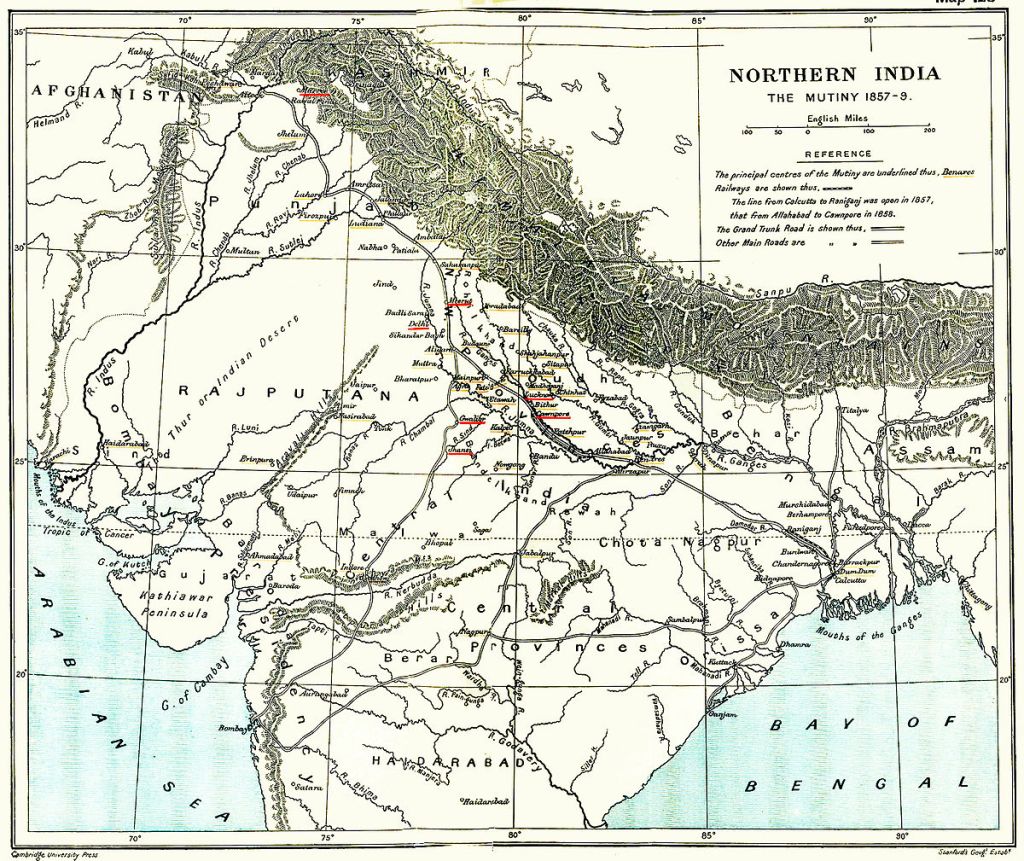
Fatehgarh (also written as Futtehgur or Futteguhr), situated on the left side of the Ganges and some 80 miles from Cawnpore it was the headquarters of the Farrukhabad District and a cantonment town. It was not known for being particularly important – in fact, it did not even boast of a strong military presence. Only one regiment was stationed here, the 10th Native Infantry. The 10th was an old regiment, having already been in existence at the time of Clive, some 100 years before the mutiny. It had fought at Buxar and Korah in the 18th century and had fought in Burma – from whence it had lately returned, in April 1855, to replace the 2nd BNI. Many of the men came from the surrounding district, thus putting them closer to home and their native villages.
However, belonging to the 10th was something of a curse. Having crossed the sea to attain Burma, they had effectively lost their caste and were contemptuously dubbed “The Christian Regiment” by other Indian soldiers. It was not perhaps the best homecoming. No muster rolls or personal records are known to exist of the 10th; everything was destroyed during the uprising. One of the last written records available is from The Army List for 1857, which was published before the uprising.
Their commander at the time was Lieutenant-Colonel Smith, and his 2nd-in-command was Captain (or alternately, Major) Munro. There were nine other officers attached to the 10th when the mutiny broke out, but not all of them were Fatehgarh at the time; seven of these were in staff or civil employ or serving with local battalions. Lieutenant Law, being away at the time, volunteered for Delhi, where he met his death. The ensigns Byrne and Eckford were in Fatehgarh.
An outpost of the Board of Missions of the Presbyterian Church, Fatehgarh was hailed as the centre of Christian missionary work. Bazaar preaching was rife, and the missionaries did not hold back in any aspect of the work, setting up schools and even a Christian village called Isaipur. The village was set up for a large number of converts – though this in itself is misleading. After the famine of 1837-1838, private orphanages had been set up to deal with many destitute children. When the orphanages were handed over to the missionaries, the children were Christianised – away from the influence of their own true culture and insulated in the world of the mission. As they grew up, the mission provided them with employment – a tent factory and a carpet weaving enterprise were established as they couldn’t integrate back into traditional Indian life. Owing to their upbringing, they were encouraged to marry each other and set up a home in the Christian village. This, in turn, gave them an incentive to stay and carry on the work of the mission. The missionaries themselves were of a different breed, hailing not from England but from America. They had very little regard for Indians themselves and showed hardly any interest in their culture or ideas. Their mission was very clear – convert as many as possible by any means necessary.
Fatehgarh itself was not considered a great stepping stone for a rising military career. It was a dead-end post, and its officers were better known for quarreling amongst each other than for actual hard work. The area outside Fatehgarh was considered unsafe even before the mutiny, and its foreign population was urged to not leave the confines of the cantonment on their morning rides for fear of being murdered.
The 10th itself was anything but an exemplary regiment. Having been induced to “cross the black water” by their then-commander, Major Lindsay, with promises of rewards and honors, they returned to India without receiving as much as a thank you, to be jeered at as the “Christian Regiment.” They were prone to rising in revolt over the smallest of issues, and their officers subsequently were relieved to flee the station as quickly as possible. Nor was the non-military population any happier than the 10th. The company’s settlement policy forced out families from their ancestral lands to make way for opium and indigo planters. A bevy of merchants descended on Fattehgarh, establishing in no time a gun carriage factory, timber yard, and clothing agency. However, nothing was done to actually improve relations with the native population, and the British in Fatehgarh did not even attempt to hide their contempt for Indians. Open abuse was commonplace, and nothing was done to hinder it.
With a figurehead Nawab in Farrukhabad, dispossessed landowners and a population that had every reason to hate the conquerors, it is then no surprise that mutiny eventually descended on Fatehgarh.
A Singular LAck of ForeSight
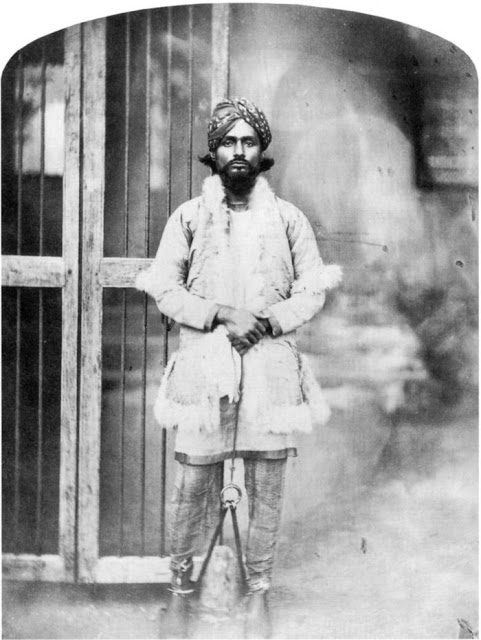
Even before the news of the uprising in Meerut was known to the population of Fatehgarh, the town was in a state of unrest. Stories were rife that the British were planning to grind bones into the local flour supply, thus rendering it impure for Muslims and Hindus alike, to break their religion, and a city banker asked Major Weller – who was on a tour of inspection to Fatehgarh in March – if it was true that the Government was going to issue leather rupees which had been silvered over to break the caste of any Hindu who touched them, going so far as to claim that he had some of these rupees in his possession. Although Major Weller offered to buy any of these if the banker could produce them, none were ever forthcoming. There was also a widespread belief that England itself was no larger than the Farrukhabad district and practically the entire population of England itself was in India. Suffice to say, by killing them the whole of the English race could be exterminated. The Nawab of Farrukhabad had his petition to the government to have his title of Highness restored it was first ignored and then denied. He was now waiting to see what Smith would do.
Turmoil was the order of the day.
News of the uprising at Meerut reached Fatehgarh on the 14th of May. At this point, there would still have been time to evacuate the women and children to Agra or Lucknow. The Fort of Fatehgarh, although now in use as a gun carriage factory, could have served as a point of refuge had it been sufficiently fortified and provisioned, there might even have been enough time to reconcile their differences with the Nawab of Farrukhabad. Instead, in spite of the urgings of the magistrate and collector Mr. Probyn, they chose, as it seems, to do nothing.
Several plans were made and each one was discarded. One day, it was proposed to prepare the fort, then it was thought better to fortify Colonel Smith’s house and it should serve as a rallying point for the population. Colonel Smith stoutly refused to doubt his regiment and in this, he was not alone. Ensign Henderson protested personally to the Collector Probyn of the aspersions cast on the regiment, while later, Captain Bignell would go so far as leaving his post in the belief he could turn back the four companies that absconded later with the contents of the treasury. Although Smith himself would later admit he did not have faith in more than 150 men in his regiment, he steadfastly refused to believe they could possibly mutiny.
Lieutenant Colonel George Acklom Smith had joined the army at the age of 16. Now, 44 years later, his last battle had been 38 years ago. Although an accomplished soldier, he was not known to the 10th N.I. His original regiment was the 47th N.I., which he had commanded for at least 6 years. Subsequently, although he professed his absolute confidence in his men, he nor they, actually knew or understood each other. His second-in-command, Captain Robert Munro, thirty years in the army and 51 years old, had never seen a conflict either from near or far, having managed to evade active service for his entire career. In the midst of the oncoming storm, Smith’s junior officers preferred to spend their time quarrelling amongst each other.
The two most masterful officers present in Fatehgarh that May were not even a part of the post – Colonel Andrew Goldie, the military auditor general on a tour of inspection and accompanied by his three daughters, and Captain Edmund Vibart of the 2nd Native Cavalry, on his way to Naini Tal from Cawnpore.
What the station did do plenty of in this time of crisis, was pray, and it seems it was all they could do. The orders from Smith were changing almost hourly – the residents no longer knew whether they should run to the fort, run to Smith’s house or flee to the ghats. That they should listen for 2 shots from the post guns was clear but where they should actually go, no one could say. Everyone seemed to come up with their own plans. The American missionaries thought it possible to escape Fatehgarh disguised as Indians and then hide in friendly villages while fleeing to Agra. Mr. Monckton, whose work on the Grand Trunk Road brought him more reliable information as to the general state of the district, talked them out of it. Captain Philott however thought better and did send his wife to Allahabad on the 23rd by road. She arrived safely. However, Mrs. Eckford sent on the same journey by her husband, Ensign Eckford, on the same day was never heard from again. Mr. Briant, a merchant, thoroughly distrusting the situation hired a boat and transported his family to Cawnpore. On arrival in Cawnpore and sensing the dissatisfaction there, some 36 hours before the outbreak, Mr. Briant packed his family off to Allahabad, where, by some miracle, he then rushed his family away to Calcutta, onboard the last steamer to leave the place, when the 6th N.I. was already rising in revolt.
The news arriving daily in Fatehgarh was anything but reassuring. In the cantonment itself, Probyn attempted to remove the treasure from the Treasury, only to be stopped by the 10th N.I. Smith was still determined to do anything to not upset his regiment and refused to press the issue. He had been told that mutiny was imminent, but his regiment was biding their time, waiting for other corps to arrive.
In the meantime, Hugh Wheeler in Cawnpore, Henry Lawrence in Lucknow, and the authorities in Agra were attempting to send bodies of irregular troops to Fatehgarh. Taking note of what he had been told, Smith could only sigh in relief when none of them actually reached him. However, news of the approaching troops was heard by the 10th N.I and, fearing they were about to be given the same treatment as other regiments- namely, “disarmed, disgraced and imprisoned”, they gathered, with their muskets loaded, on the parade ground on the 1st of June. Following the uprising at Shahjehanpore on the 31st of May, bands of released convicts and various rebels from Oudh made their way to Fatehgarh, encamping on the other side of the river. Sepoys of the 10th now openly fraternized with the rebels and even invited them into their lines.
Colonel Smith, standing in front of his troops on that hot June evening, after “strenuous exertions”, convinced his men to refrain from further fraternization with the rebels and to return to their huts. It was only the first of many such speeches. He then ordered the Grand Trunk Road to be barricaded and Probyn ordered his police to sever the bridge of boats. Fatehgarh was now cutting itself off from the outside. For the civilian population, things were looking grim. With no real plan or any idea of what Colonel Smith actually planned to do, many of the merchants and their families took to sleeping on boats that Probyn had organized – it seemed their only chance of escape now, was the river route.
“Perhaps you may never hear from me again…”
So wrote Reverand Johnson of the Presbyterian Mission to his family in America. The missionaries had made their final visit to their headquarters in Rakha, had collected their belongings and led their flock in prayer before setting off. It was the 4th of June and the civilians of Fatehgarh were preparing to flee down the river. The consistent inactivity of Colonel Smith, coupled with his determination to placate his regiment rather than disarm them, had finally convinced the civilians their lives were in serious danger. When on the 3rd it was reported that a rebel cavalry was descending on the city, they fled collectively to the boats. Smith ordered his officers and their families to remain – while pleading with the civilians to stay put, but they had had enough.
Sources:
Danvers, Frederick Charles, ed. Memorials of Old Haileybury College. Westminster: Archibald Constable and Co., 1894.
Edwards, William. Personal Adventures during the Indian Rebellion in Rohilcund, Futtehghur, and Oude. London: Smith, Elder and Co., 1858.
Nevill, H. R., ed. Hardoi: A Gazetteer. Vol. XLI of the District Gazetteers of the United Provinces of Agra and Oudh. Lucknow: Government Press, 1904.
Sherer, J. W. Havelock’s March on Cawnpore, 1857: A Civilian’s Notes. London: Thomas Nelson and Sons, 1910.
Wallace, C. L., and F. R. Cosens. Fatehgarh and the Mutiny. Lucknow: Newul Kishore Press, 1933.
Walsh, J. Johnston. A Memorial of the Futtehgarh Mission and the Martyred Missionaries: With Some Remarks on the Mutiny in India. Philadelphia: Joseph M. Wilson, 1859.
 Mutiny Reflections