“Go, You have Escaped”
The Story of Gavin Jones
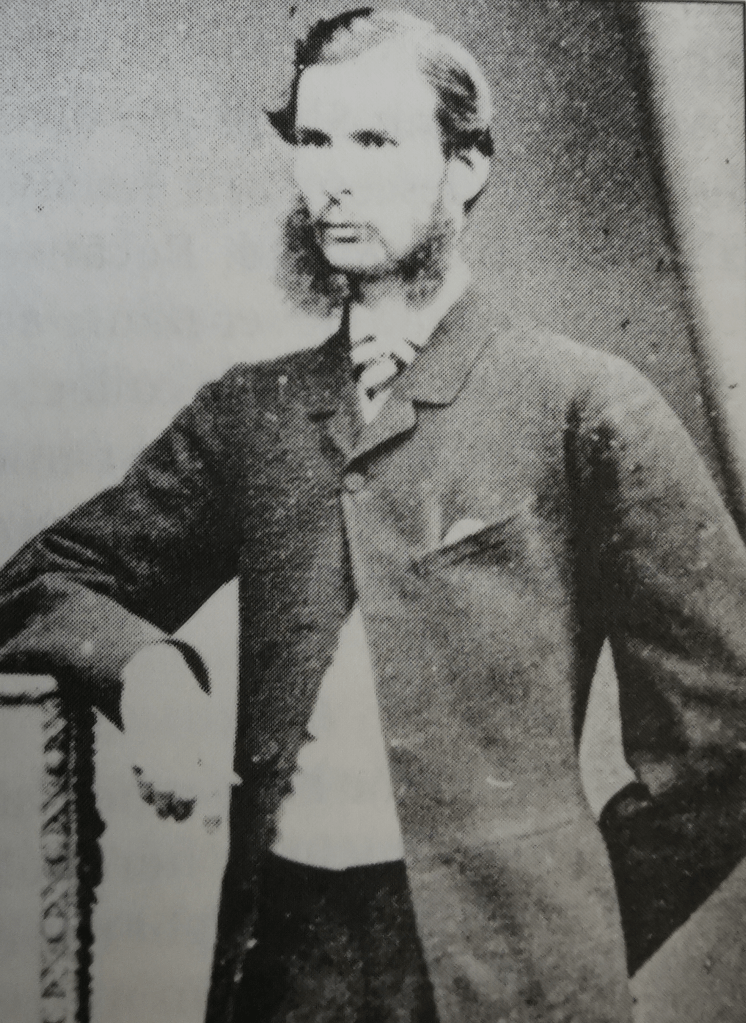
Gavin Sibbald Jones, like David Churcher, had been a part of both flotillas, the siege at the Fort and a survivor of Manpur. His brother was killed in the Fort, while his sister-in-law and niece, both injured at Manpur, were killed at the Parade Ground Massacre. Yet, his similarities with David Churcher end here.
The son of a Welsh planter, Gavin was 21 years old at the start of the Mutiny. Apparently, he was not very comfortable during the first disastrous boat escape and took the opportunity to join Probyn’s party in the relative safety of Hardeo Buksh Singh’s village fort. Unhappy with the accommodation provided, he chose to go back to Fatehgarh with his brother and family. Inevitably, he was part of the doomed defence at the Fort, bearing witness to all of the attacks and indeed taking a very active role as a rifleman. When it became clear that holding the Fort was impossible, it was on Gavin Jones’ suggestion that the party betake itself of the route by boat to Cawnpore. He was one of the men who attempted to get Major Robertson’s boat back into deep water, following its stranding on a sandbar, and he writes:
“All hands mustered in the water and, applying their backs to the boat, used every effort to float her, but the fierce current and a strong wind rendered all attempts abortive. The crisis had now come: yelling like fiends over our misfortune, the rabble assailed us with showers of shot and arrows…” Worse was yet to come. A boat, which when seen from a distance appeared inoffensive, suddenly unveiled, at twenty yards, its passengers of armed sepoys. “The surprise was complete… and poured a volley into us, killing and wounding several, and ere we could recover our self-possession, the current placed the boats alongside, sending death amongst us at every shot. Resistance was useless..” At this point, Major Robertson ordered everyone to jump into the water and save themselves as best as they could, and a scene of pandemonium ensued.
“The summons, however, was unnecessary, for the instant the rebels set foot onboard it became the signal for a general rush for the river, into which the fearless plunged, calling aloud on the Almighty to succour them...Groups locked in each other’s arms, besought God aloud, as they disappeared in the stream; whilst others, who still clung to life, rushed hither and thither in wild despair, in the hope of eluding the fire of the murderers, till, exhausted or shot, they were swept away by the flowing tide…Those who were unencumbered mingled with the assailants in hand-to-hand encounters and died fighting desperately.”
Gavin himself was “bewildered, and knew not how to act, for death appeared in every direction. Suddenly, I saw Bhyro (manservant to the Jones’ family) come from the side of the boat, holding my brother’s only child in his arms, and imploring the mob to spare the innocent girl and her mother, both of whom were severely wounded.” The sight of his family seemed to give Gavin the kick he needed to spring into action – he reached for his gun and revolver, but they were gone, so he tried to grab the gun of Mr. Fitzgerald who was still in the boat with his family – when this did not work, he “seized one from the hands of a Eurasian drummer boy, who was just emerging from beneath the boat, and dashed astern in time to see a powerful sepoy raise the thatched roof of his boat and support it on his arms. A dozen muzzles were simultaneously thrust forward within a yard of my feet, but ere a shot was fired, my musket, without being shouldered to take aim, was discharged at the monster’s breast. He fell with a heavy thud, and the roof dropping over his party, left me an interval to reload.” However, the moment was enough to convince Gavin he was fighting a losing bat,tle and, grabbing a gourd to use as a buoy, he decided to take his chances in the water instead.
“Then, casting a farewell look at the groups struggling in the water, I struck out with all my might till out of range of the shots…”
With a shot in his shoulder, he struck out in the direction of Colonel Smith’s boat, which, he correctly assumed, would eventually run aground on a sandbar. It still took him some hours to finally catch up with them – when he did, he was implored by the party to spare the ladies the news of the massacre at Manpur to avoid distressing them.
Sunburned and exhausted, he went to sleep on the roof of the boat, wrapping himself as best he could in the folds of an unused mattress. It was raining. Barely had he lain down when Gavin was asked by the assistant opium agent, James, to help him fix the tiler of the helm, thoughtfully providing Gavin with a bottle of porter to prop him up. Gratefully accepted, he was “nevertheless…utterly incapable of handling the adze, and after one or two abortive attempts was obliged to return to my mattress.” He only awoke again to the sound of Conductor Rohan’s body being thrown overboard.
By daybreak, aided by the rising tide, the boat floated on, unguided and drifting. An attempt was made to repair the helm, and a sail was improvised from two blankets tied to a bamboo stick, which helped at least to keep up some semblance of speed. Not enough however, for shortly after, they were hailed from the shore by Reverend Fisher, who, though injured in the leg, had managed to catch up with the boat.
They were now perilously close to the dreaded cliffs of Kosumkhor – and in their desperation to avoid them, Colonel Smith veered the boat into a deep channel, staying as close to the opposite shore as possible. By avoiding one danger, the boat landed in another and became grounded. For once, they had a little luck. The villagers who did see the party were friendly and provided the fugitives with some much-needed food. Gavin, who had spent most of the day at the helm in the blazing sun, finally decided he needed to give himself some respite. His wounded shoulder had started to fester, and his scorched back had come up in large painful blisters. He went ashore to search for a charpoy on which he might get some rest. He asked Lieutenant Swentenham to join him, but to no avail. Swetenham himself was painfully injured and could no longer move. If he had, there could have been a third survivor – instead, fate took that young man to Cawnpore.
Gavin proceeded on his own, and it was the last time he saw Colonel Smith and the fugitives.
Asking the help of the first person he met, Gavin followed the man to his village. When they arrived, Gavin was seated by a tree and, “..my host proceeded to make me welcome, and produced a thallee, or brass dish, of dahl and chupatties (lentil soup and hand-bread), which he set before me…” being a man of unusual sensitivities for his time, Gavin refused.
“I showed my reluctance to take advantage of his kindness by refusing to use the dish, which would have rendered it unclean to him until the subjected course of purification..the man was evidently pleased, and smiling at my consideration, observed, “The sahibs too, understand our prejudices,” a remark which was received with applause by the numerous bystanders.”
Having scored a point in his favour, Gavin proceeded to eat the meal from the leaves as he requested and then asked for a charpoy. One was brought to him, and after being given some grass to line it with, he went to sleep. Shortly after midnight, a messenger came, shaking him out of his slumber – Colonel Smith was requesting Gavin to join them in the boats.
“I found myself stiff and sore and barely capable of moving. Moreover, I felt callous, and at the time did not seem to care two straws what became of me. In that mood, throwing myself back on the charpoy, I bade the messenger to inform Colonel Smith that I was unable to join him.”
Evidently not believing Jones’ reply, the Colonel sent the messenger back two more times, finally with a note. Gavin replied – but the note never reached the Colonel, and they set off without him.
It was only in the morning that Gavin realised his predicament.
“I was among strangers and men whose insatiable love of money and thirst for blood had extinguished every nobler sentiment of humanity. Moreover, any reckless vagabond, wishing to gain favor with the Nawab, and reap a handsome reward, might with impunity strike off my head and convey it to that chief…” Like David Churcher, who was unable to reach the boat, Gavin Jones felt he had, in his weakness, ” thrown away the only chance at life.”
Finding him sobbing in a corner of the hut, his host took him by the hand and tried to assuage his fears.
“Weep not; no man dare touch a hair on your head while Balgobind has a drop of blood in his body,” he said.
During his time in the village, Gavin heard of the terrible fate which was meted out to the occupants of Colonel Smith’s boat, and he also heard of the escape of David Churcher and Major Robertson. He was also aware of the proximity of Probyn’s party but was unable to join them. He continued to live in the village in an old bullock shed, trying to find some way to get himself out of this situation but to no avail. Hardeo Buksh Singh had heard of Gavin’s situation but refused to take him under his wing. With a large sum on the head of any European found, it was risky for too many of them to be together. It was not until Havelock had secured Cawnpore that Gavin could join Probyn.
“Hurdeobuksh despatched a messenger to inquire of my welfare, the man returned a few days later to conduct me to Khussoura, where Messrs. Probyn and Edwards were…the arrangements were speedily completed, but I was resolved that Balgobind, to whom I owed my safety, and who was thoroughly trustworthy, should be apprised of the intended departure..” A ruse was arranged, Balgobind was to pretend to his people he did not know of Gavin’s departure and then if anyone showed an inclination to look for him, Balgobind was to send them off in the wrong direction. The ruse worked and Gavin went unmolested with his guide to Khussoura. It was a tense but uneventful journey. Shortly before reaching the place Gavin had scoffed at barely two months earlier, they were stopped by three men, armed with clubs.
“Who are you?” asked one as he approached us.
“Hurdeo Buksh’s sephai,” answered the guide.
“And who is this with you?” inquired another, as he deliberately walked up to scrutinize my countenance, removing my covering, as if unsatisfied with the response.
“Ha!Ha!Ha!” laughed out the impudent fellow, half in jest and half in sarcasm, as he discovered a white face.
“Is this the individual who was with Balgobind at Terah?” rejoined he, addressing the guide.
“The same,” I replied, finding it useless to maintain my disguise any longer. My promptness evidently pleased them and won their good-will, for the man immediately added, “Jah, butch gai” (“Go, you have escaped”), and good-naturedly tapped me on the shoulder, with sundry jocose remarks, bade us adieu.
The rest of Gavin’s story will be related in a following chapter, in the adventures of Mr. Edwards and the Magistrate, George William Probyn.
Gavin Jones himself never forgot the kindness shown to him by Balgobind and saw to it that the zamindar was amply rewarded by the restored government. In later years, when he was a successful mill owner in Cawnpore, Gavin continued to extend every courtesy to Balgobind, that when he visited, Gavin would seat him in his chair and would respectfully sit on the floor at the man’s feet. Today in Cawnpore, the legacy of Gavin Jones remains. The clock of the mill he owned continues to keep time over the city, long after he himself found a quiet grave in Southsea in 1913.

https://www.tribuneindia.com/news/archive/features/the-clock-still-ticks-867419
Sources:
Churcher, D. G. “An Episode of the Indian Mutiny.” Blackwood’s Edinburgh Magazine 167 (January–June 1900): 615–26.
Churcher, E. J. Some Reminiscences of Three-Quarters of a Century in India. London: Published by the Author, 1909.
Jones, Gavin Sibbald. “The Story of My Escape from Futtehghur.” The Cornhill Magazine 11 (January–June 1865): 100–111.
 Mutiny Reflections