“I was roused this morning before dinner by a noise in the enclosure, and on looking up, saw a tall and spectral-looking figure standing before me, naked except for a piece of cloth wrapped around his waist, much emaciated and dripping with water…” (Personal Adventures During the Indian Revolt,” p. 132, Edwards)
The figure that so startled Mr. Edwards, was Gavin Jones.
We had left Gavin in a village, lonely and despondent, though very kindly treated and cared for. It was decided, for his own safety, to move him closer under the protection of Hardeo Baksh Singh, and he was thus conveyed to the hiding place of Mr Edwards and the Probyns. It was now the 2nd of August 1857.
Budaon, a small field station in Rohilkhand, was where William Edwards had manned his post as Collector and Magistrate. Sensing danger, he sent his wife and child to Naini Tal for safety and then buckled down to ride out the unrest, determined to hold his post to the last.
Unfortunately for Edwards, the mutineers of Bareilly had other ideas, and in early June, they arrived at the station and broke open the jail, letting loose some 300 criminals into the surrounding countryside. Realising he could not stem the tide, much less do anything effective, Edwards was now determined to flee. Joined by the Donalds – a father and son who were planters in the district, Mr Gibson of the Customs Department and two of his own servants – an Afghan, Sultan Mahommed Khan (who disappears from the narrative) and a Sikh, Wuzeer Singh, they escaped Budaon on horseback. Crossing the Yar Wuffadar River, they started an odyssey of wandering around the province, searching for safety. Mr Gibson was murdered on the way. Eventually, they reached Fatehgarh in time to catch up with Probyn, fresh from the first disastrous boat escape.
George William Probyn was the brother of the celebrated Mutiny hero and all-around dashing soldier, Dighton Probyn. Unlike Dighton, George was a civilian collector of Fatehgarh. He was no less shrewd than his brother, having quite correctly distrusted the musings of Colonel Smith regarding the faithfulness of the 10th BNI, and trusting to his friendly ties to Hardeo Baksh Singh, whom he believed could protect him more completely than Smith ever could, Probyn managed to save not only his own life, but that of his family.
Colonel Smith, who at this point was still haranguing his troops to stay loyal, Probyn offered the Budaon fugitives the chance to join him under the protection of Hardeo Baksh Singh.
It was here that William Edwards first came across the rather unsatisfied Gavin Jones. With their nice homes so nearby, the entreaties of the Colonel to return, and with nothing but a mud fort and an increasingly gloomy Probyn to look forward to, the fugitives from the first boats made their way back to Fatehgarh. The Donalds joined them. Edwards, who from the onset believed he could protect himself better if he was alone, was glad when they decided to leave. It was his own prudence that led him to remain with Probyn.
Hardeo Baksh Singh and his uncle, Kesari Singh, did everything in their power to protect the Probyns and Edwards. They moved them from village to village as need be, and although some of the proposals might seem bizarre, the suggestion to split the parents from the children (the Probyns had four) was not greeted with any enthusiasm by the party, but the reasoning was sound. By dividing them up, they would be easier to protect. Ultimately, the family did stay together, but two of the children died as a consequence of the hardships they had to endure. The baby Elliot, aged 4 months and his sister Letitia, 18 months, are buried in the village of Khasaura.
For the next two months, attempts were made to move on to Agra or Lucknow, but, with the disturbing events in the surrounding area, the plans were quashed at the last minute. When news of Havelock’s capture of Cawnpore came to the party, the Thakurs finally decided that an attempt to send the fugitives by boat down the river should at least be attempted. It is from here that we take up the narrative of a last escape.
We Determine to Try the River
“May God in his infinite mercy go forth with us, and protect us, and bring us to our desired haven!”
-W.Edwards
On the 27th of August, it was finally decided that this small group of fugitives should be sent by river boat to Cawnpore. Probyn communicated with Major Roberston and David Churcher, requesting them to be ready to leave. The major affected a reply that he would try to escape with them if he could, but he was so weak that he fainted every time his wound was dressed, and he would wait for further news. David Churcher, on the other hand, “told us would certainly not run the risk, but preferred to remain where he was, hiding with the Aheers.” The messenger who had brought Probyn the major’s letter was in the employ of David Churcher, and he did his best to dissuade the party from the attempt.
The morning of the 30th of August was overcast, and a steady rain was falling. The Probyns, William Edwards and Gavin Jones gathered together for what they felt would be the last time to pray. They had had news from Havelock himself, entreating them to stay in hiding until his force could retake Fattehgarh and by no means attempt the river route. However, Hardeo Buksh was no longer certain he could protect them – the price on the collector’s heads was ever increasing, the sepoys from the now beaten regiments were amassing and with Havelock now in Cawnpore, there was no telling what would happen in the districts. With much sorrow, the gallant Hardeo Baksh himself conducted the group to the boat. It was 7am, and their attempt to reach Cawnpore was about to commence. Together they walked to the boats, escorted by the faithful Thakurs and the village headmen who had been in the habit of visiting Probyn and Edwards, giving them whatever news they could. The faithful Wuzeer Singh went with them as well.
They found the boats moored on the Ramgunga, opposite Dhurumpore, along with eleven matchlock men as guards, eight rowers and Hardeo Baksh’s brother-in-law, Thakur Pirthee Pal, the Thakur of Poorun and their guides Sita Ram and Rohna, their unflinching messenger.
Sita Ram was a Brahmin who had attached himself to the group sometime earlier, risking his life to bring messages to Havelock, and acting as a de facto spy – it was thanks to his knowing where the sepoys were positioned along the river that the attempt could even be made. Rohna had travelled to Naini Tal to Edward’s wife – he was now instructed to accompany them as far as Cawnpore and return to Hardeo Baksh with the news of their arrival. He also carried a letter for Mrs Edwards – for any eventuality.
“We remained for more than 2 hours at the boat, waiting for Major Robertson and Mr Churcher, and at the imminent peril of our lives; our safety mainly depending on expedition and secrecy…We could not bear the idea of leaving our poor countrymen behind, and yet if delayed any longer, we might lose our own lives without benefitting them.”
Just as their patience was exhausted, the servant of David Churcher finally arrived with the news that neither of them would take the risk. We already know why David would not go and what it cost him, but Edwards was more inclined to believe they had been deliberately dissuaded by the servant. No one in the party knew the major was dying. Though much delayed, they finally started their journey.
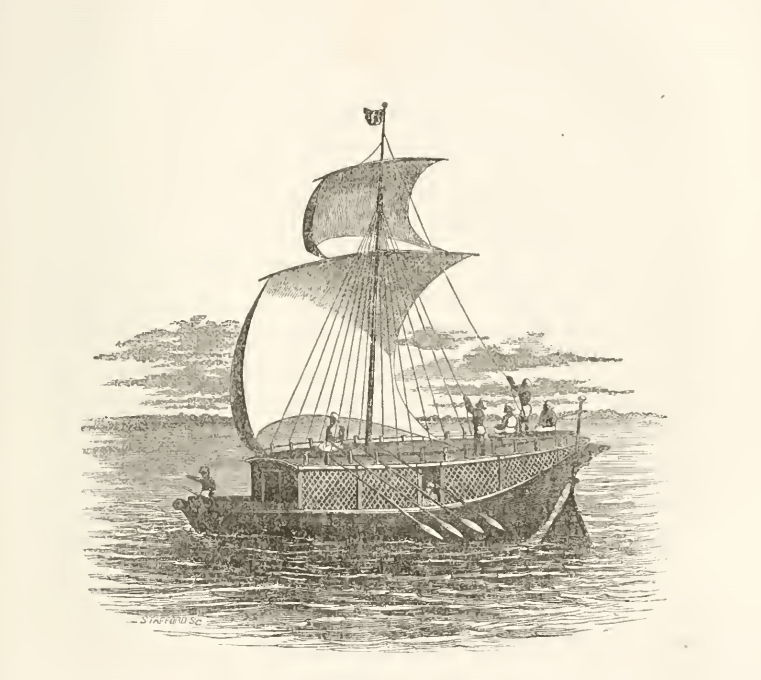
The ever-industrious Hardeo Baksh had, the night before, severed all communication with Farrukhabad, having seized all the boats at the ferry crossings within his domain, so at least for a short time, the news of their flight would travel more slowly. He was also holding the families of the boatmen hostage to secure their fidelity. Their release would only be secured if the party arrived safely in Cawnpore. He had personally selected the matchlock men from his own personal retainers, whose loyalty it seems only Edwards was ready to doubt. They were also “nominally conveying the female portion of the family of a relative of Hurdeo Baksh on a visit to their relations at a lonely place on the Oudh side of the Ganges called Tirowah Pulleeah, belonging to a Talukdar named Dhunna Singh. “ The plan left much to trust, and Hardeo Baksh placed most of it in Dhunna Singh.
A great friend of Baksh, Dhunna Singh, had considerable influence along both sides of the river, all the way to Cawnpore. It was left up to him to decide if the journey was safe from that point onwards – if not, he had pledged to protect the party until some other plan could be made.
Hardeo Baksh accompanied the boats for some miles along the banks of the river and then left them – his last words were that they should remain hidden and not show themselves. Wiser words could not have been spoken, as we shall see.
Obstacles and Resolution
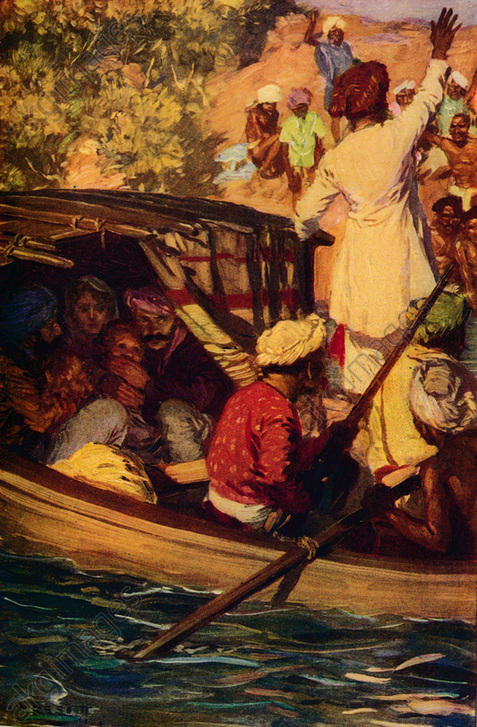
The first twenty miles on their course to Cawnpore, the land was under the influence of Hardeo Baksh – it was the last thirty where danger lay. However, as a part of this very elaborate plan, messengers met them at different points on the bank to warn them if it was safe to continue. A minor mishap that nearly ended in a grounded boat broke what, until now, was a seemingly placid journey. They even passed through Kusumkhor without even as much as a backwards glance – for whatever reason, this time, there was no one there; the village was deserted.
Kusumkhor safely behind them, they now approached the first ferry crossing. The sight of the boat, with heavily armed men on the roof and deck, was bound to attract some attention – no boats had been seen for months now, and the unrest had put a stop to all usual traffic. Without question, the challenge came. Writes Edwards,
“We were…asked who we were. The Thakoor replied he was taking his family to Tirrowah Pulleah, and could not stop. A voice called out, “You have Feringees concealed in that boat; come ashore at once!” Feringees on board,” was the ready answer of the Thakoor, Pirthee Pal, “I wish we had, and should soon dispose of them and get the plunder.” – “Stop and come ashore,” was repeated; but by this time, owing to the rapidity of the stream, we floated past.”
Shortly afterwards, the boat pulled over to the shore. It was a mile and a half from Tirrowah Pulleah, and they now had to wait for Dhunna Singh. There seemed to be nothing for it – the guard disembarked and started to cook. No one could say when Dhunna would put in an appearance – without him, they could not proceed.
Impatient, the Thakur decided to go and find the man – only one boatman actually knew where the fort was, but as it was night, he refused to show the Thakur the way, and the guards would not leave their cooking. At last, the Thakur grabbed the boatman, and after a forceful beating, he was sufficiently convinced to show the way to Dhunna Singh’s fort. The hours passed by in weary foreboding. The guards cooked gloomily, and the silence was only broken by the incessant croaking of frogs.
It was Probyn now who was on the verge of losing his patience, and determined they should continue without Dhunna Singh, the boatman or the Thakur. They were only safe as long as darkness covered them, he reasoned – by morning, any passing herdsman would know where they were, could inform any of the surrounding villages, and their deaths would certainly be assured. Edwards, on the other hand, felt sure waiting was a better option – he had no faith in the crew and was, for his part, quite sure that if the plan was not followed, they would probably desert them. So they waited.
Dhunna Singh, accompanied by the Thakur, the boatman and some of his own followers, finally arrived. He was “an old man, with a white head, but very wiry and athletic, and from his frank and self-possessed manner, I saw at once that he was the right sort of man for this work.” Lamenting all the time that had been lost, Dhunna Singh determined they must start at once. By ten o’clock, they were back on the river, floating rapidly towards Cawnpore. It became clear, both to Edwards and Probyn, that without Dhunna Singh, they would have been lost. The old man kept a constant watch, replying to the numerous challenges they received from the sides of the river, and it became apparent that his influence reached far. No one dared stop a boat with the Dhunna Singh aboard, and as soon as he showed himself, which he was obliged to do several times, the voices on the river edge lost any threat.
By one in the morning, as they approached (Mendee) Mehndi Ghat, Dhunna Singh suddenly became anxious. It was known “as a place of resort for the rebels”, and he was quite sure that detection was now inevitable. Providentially, “a bank of clouds covered the moon. Owing to the darkness and perfect stillness, we passed this critical point altogether unnoticed and unchallenged…”
Their luck, however, did not hold, and shortly after, the boat grounded twice. The first time was barely a snag, but the second time it nearly capsized and cost them valuable time they could barely afford to lose. As day broke, and after much heavy pushing and pulling, the boat was set afloat again. They were now ten miles from Bithur, and the morning was bright and clear.
All along the river, people were bathing and sitting on the bank. Some called out that further progress would mean their destruction; the Gora log (white people) had taken Bithur. Dhunna Singh, with “usual presence of mind, affected great alarm at this intelligence…eagerly inquired of those ashore where our troops were posted, and how far we could proceed down the stream with safety. He was taken to the exact spot, and then, saying he would avoid that point, and cross to the Oudh side of the stream, told the rowers to give way…” They sailed swiftly away. The boat was so close to the shore that Edwards and Probyn kept their hands over the mouths of the children to prevent them from making a sound.
By 11 am, they reached Bithur.
At first, it was congratulations all around. Dhunna Singh, relieved that his duty was nearly over, invited the party to come out of hiding, flinging back the curtain which hung in front of them. Again, William Edwards was not convinced. Grabbing Gavin Jones, who was just about to go on deck he entreated him to stay hidden a while longer, the curtain was suddenly replaced as a voice from the bank hailed the craft. Answering Dhunna Singh’s inquiry, the man said he was a sepoy of the Nana Sahib, they had retaken Bithur, and the British had withdrawn to Cawnpore.
“Then, indeed, with grateful and overflowing hearts, we stepped on shore, feeling that at last, were were saved.”
W. Edwards
As they left Bithur behind, and expecting any moment to be forced ashore by the gathered crowds of sepoys, it was with some surprise that they managed to sail through without any further incident. This was the last challenge – and Dhunna Singh, who had not slept all night, lay down under the cover of the boat and took a well-deserved sleep, reassuring the party that safety was now at hand.
Soon after, they came upon a picket of Sikhs near the old Magazine. Wuzeer Singh quickly hailed the men in their own dialect, telling them who was in the boat – fortunately, he did so, the picket, wary of anything unusual, was preparing to shoot at the boat. After receiving congratulations from the troops, the boatmen were instructed by the commanding officer to sail a little further. Within half an hour, the boat was safely moored alongside a river steamer.
They landed at 2 pm on the 31st of August, twenty-seven hours after starting out, during which they had traversed 150 miles of river – the only boat to survive an escape from Fatehgarh. Greeted by Sherer and Havelock’s men, the party was given rooms in the hotel so lately occupied by Nana Sahib – Sherer called them shabby, but to the Probyns, Edwards and Gavin Jones, it was a perfect luxury.
While in Cawnpore, Gavin Jones visited the Bibighar.
“I recognised, among the hats, shoes and articles of clothing that lay scattered about the enclosure and rooms, some of those belonging to the ladies and children of our party. It was too bewildering to realise, that I stood there alone, the sole survivor of over seventy souls of the boatload, to witness the ghastly scene of their murder.”
He had survived and would spend the rest of his life rebuilding Cawnpore.
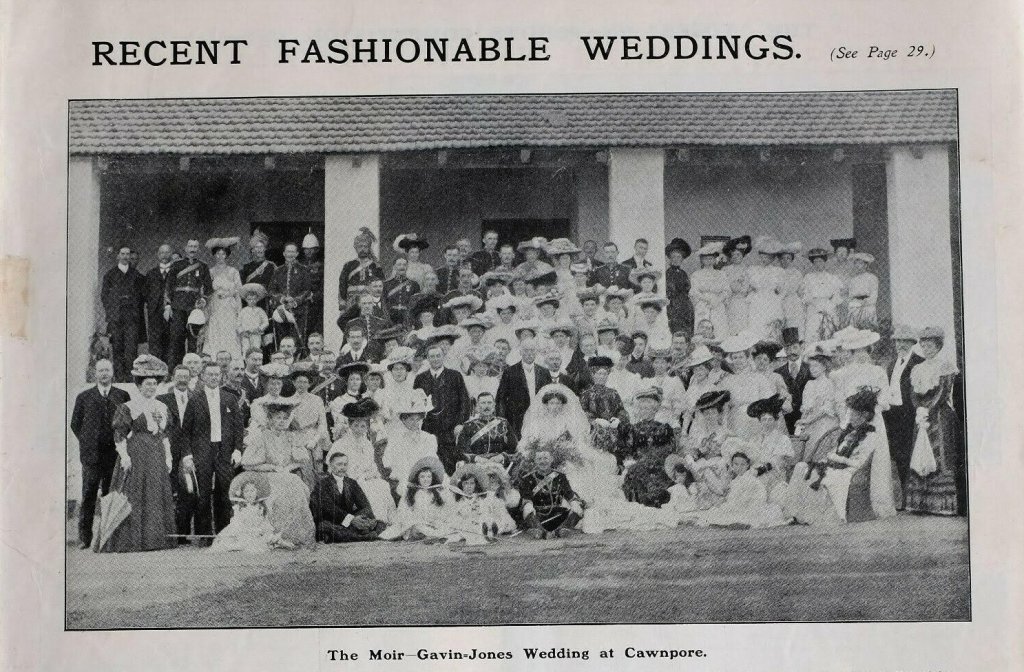
Willam George Probyn and his wife Charlotte stayed in India. Forgiven by Calcutta for abandoning Fatehgarh when he did, William was made magistrate of Futtehpore, “where he saw much service with various military Columns, notably at Khujwa, where the Dinapore Brigade was defeated by a force of 500 men under command of Col. Powell, H.M’s. 53rd Regiment, after a desperate engagement, in which Col. Powell and many others lost their lives; and with Col. Barker’s Column in the south and south-east of the district.” His final appointment was as Judge of Saharanpur, retiring in 1877. He and Charlotte were to have nine children in all.
William Edwards, following the arrival in Cawnpore, lost his health for a time. The constant stress he had endured for the past three months had been his elixir – without it, he fell apart. Although he remained in India for another ten years, his final post was as Judge of the Sudder Dewanny Nizamut Adawlut and High Court North West Provinces. He left India in 1867 and died at Petworth, Sussex, on the 3rd of December 1890.
Raja Sir Hardeo Baksh Singh of Katiari continued in his loyalty, bravely holding out with his feudal forces against Narpat Singh, Firoz Shah and other rebel leaders who were still active in the region. For his services, he was not forgotten, and he was made a Knight Companion of the Star of India, besides being given land revenue free and a permanent settlement of his other possessions. His name was among those of the five loyal talukdars in Lord Canning’s proclamation of March 1858. Dhanna Singh, Sita Ram and Wuzeer Singh, too, were rewarded – unfortunately, they have all passed out of history in all but name.
Sources:
Danvers, Frederick Charles, ed. Memorials of Old Haileybury College. Westminster: Archibald Constable and Co., 1894.
Edwards, William. Personal Adventures during the Indian Rebellion in Rohilcund, Futtehghur, and Oude. London: Smith, Elder and Co., 1858.
Nevill, H. R., ed. Hardoi: A Gazetteer. Vol. XLI of the District Gazetteers of the United Provinces of Agra and Oudh. Naini Tal: F. Luker, Superintendent, Government Press, 1904.
Sherer, J. W. Havelock’s March on Cawnpore, 1857: A Civilian’s Notes. London: Thomas Nelson and Sons, 1910.
Wallace, C. L., and F. R. Cosens. Fatehgarh and the Mutiny. Lucknow: Newul Kishore Press, 1933.
 Mutiny Reflections