March-April 1858, Camp Amorha
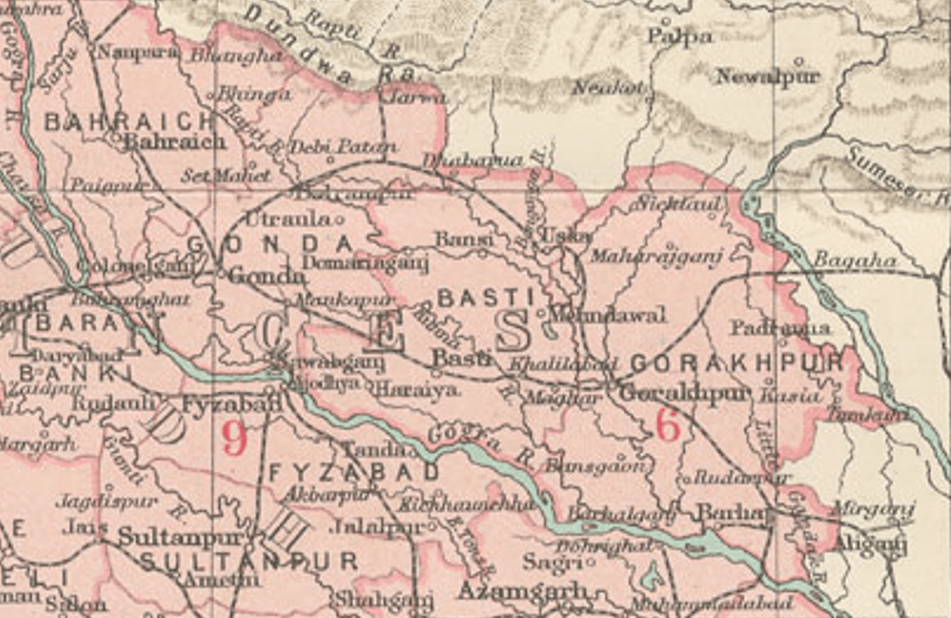
For the remainder of March 1858 and well into April, the Sarun Field Force remained in camp, not far from Belwa in the Gorakhpur District. They had routed the rebels, many of whom had high-tailed it towards Fyzabad and to Lucknow; Brigadier Rowcroft deemed it advisable to desist from any further pursuit. His camp was sitting on an open plain, surrounded by a trench – this he now had filled, and he removed his men to a small village not far from Amorha, which boasted of one brick building, the one- time tehsil or administrative headquarters. Being constructed of brick, it served as a dry place for their stores and as a hospital. The village and tehsil would form his fort, and he enclosed the structures behind a dirt wall to provide protection for his baggage and spare ammunition. It boasted of bastions, strong enough to withstand the weight of the three guns captured at Amorha on 5 March.
Those rebels who were still loitering in the vicinity launched occasional attacks on Rowcroft from their stronghold, Belwa Fort, but it was more for show.
“The fakir, or priest, would urge them to an encounter, and the troops were continually harassed by false alarms, which were as vexatious as a real attack, causing them to be kept out under arms in the sun half the day. Sometimes, from an early hour in the morning, they would be ordered to stand to their arms, the tents and baggage being packed and lodged in the fort; and forming line in front of the camping ground, they would await an enemy who never appeared.”
It all became so tiresome that finally the force no longer either struck their tents or packed their baggage; the men merely turned out, exchanged a few shots and retired. Although the reports continued to pour in of 1000s of rebels in the vicinity, the Sarun Field Force never saw them. It appeared, for all intents, that if there was an army of such proportions anywhere in the immediate field, they were most likely roaming about, leaderless. So the two forces – the rebels and the Sarun Field Force – remained encamped seven miles apart, staring at each other for weeks, with neither particularly interested in causing any mischief. Rowcroft felt himself too weak to take Belwa Fort. His guns were only 12-pounders, incapable of breaching thick mud walls. He further decided to follow the general order of Sir Colin Campbell that forts were only to be attacked with substantial artillery, of which he had none. As for the rebels, they were too disorganised to do more than launch ineffectual raids.
Shortly before the final taking of Lucknow, when Sir Colin Campbell was still gathering his force, a rebel army had begun to collect at Fyzabad. They passed Rowcroft by without a shot fired, although some cavalry loitered about long enough to take a good look at his fort, but there was still no engagement. Lucknow was waiting, and there was no time to waste on Rowcroft. The Sarun Field Force had not been called to Lucknow – they were to stay where they were and wait. On 26 March, 300 men of HM’s 13th Light Infantry – the left wing – under Major Cox joined the Sarun Field Force. allowing one Gurkha regiment to now proceed to Gorakhpur.
This enforced boredom soon began to tell on the men of the Sarun Field Force and their new compatriots of the 13th. A routine was still insisted upon -reveillée at daybreak followed by assembly and parade, after which the Naval Brigade retired for their ten minutes of daily prayers. An hour of ball practice or light-infantry drill followed, after which the gruelling heat (as one sailor noted – grill outside in the sun, or bake inside in the tent) and the blazing sun made it impossible to stay outdoors any longer. The men were dismissed to spend the rest of the day grilling in their tents, which had taken on a completely unmilitary appearance:
“In order to render our abodes somewhat cooler, the soil under our tents was dug out, and a pit was excavated, three or four feet deep, the superfluous soil being manufactured into a mud wall; and these pits, resembling a sort of mausoleum for the living, although slightly damp, possessed the advantage of a temperature a few degrees cooler.”
The Bengal Yeomanry Cavalry, who had likewise been detained with the Sarun Field Force, only occasional patrols broke up the monotony of their days as they too waited for something to happen. For now, there was nothing to look forward to besides meals, which appeared “tolerably regular, ” although some men would still mount their horses and take off for a gallop across the plain; many simply spent the days trying to sleep while they waited for supper. There were no new books to read, and the newspapers were months old. In the evening, as the officers stood about discussing the non-events of the day, their conversation was equally predictable.
“After all the affairs of the day are duly discussed—after it is decided that all the rumours of the enemy’s attack on the ensuing day is false—after the spies are all voted to be liars—after some argument is warmly kept up by two or more contending belligerents—and after both parties have succeeded in convincing themselves that his opponent is wrong, and that he himself is in the right,—they retire quite satisfied, and turn in for the night.”
On 17 April, all of this changed, and the Sarun Field Force, once again, sprang into action.
 Mutiny Reflections