The Battle of Amorha
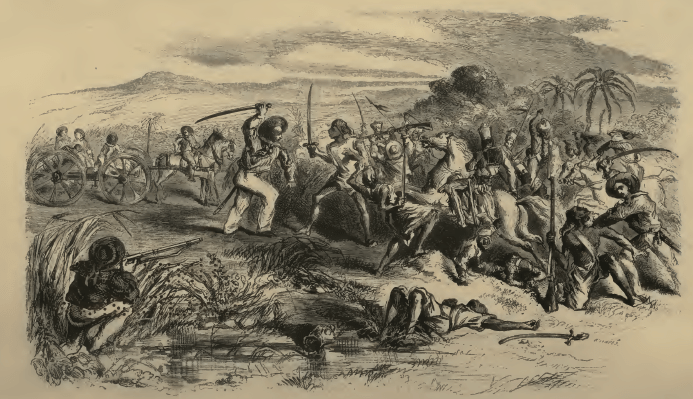
“It can scarcely be said that they made an attack: all their manoeuvres seemed intended to harass our men, and keep at a sufficient distance to make their escape when closely pressed. When urged to the attack by their leaders telling them that our ‘guns were small,’ they remarked that the ‘spice (shot and shell) was very strong,‘ and thought it safer to keep at a civil distance. If they only desired to allure our men into the sun, and thus weaken the force, the attempt was well managed: but even in this they were disappointed, few of our men suffering much after a night’s rest, although the thermometer was up to 105°.” (Williams)
Despite the eloquence of Williams of the “Pearl”, Brigadier Rowcroft might well have disagreed. He had found 25 April 1858 a singularly harassing day, and it had started off on bad footing. From late the last night until well before dawn, Rowcroft had been receiving a barrage of contradictory reports. The spies firstly insisted that from Belwa, two guns, one of them even a horse-battery one, 200 sepoys and a host of irregulars had made their way to Gonda, and their leader, Raja Devi Baksh (of Gonda) would follow on later in the day with the remainder of the force. Then, within the hour, the next spy insisted that a large body of sepoys, including some cavalry were loitering about to the left of Rowcroft’s camp but did not seem intent on mischief. Before Rowcroft could digest this last piece of news, another spy, now more breathless than the others, reported that the rebels were marching in three columns on Amorha. None of the reports was false, and the truth was slightly worse – the force that had commenced their march on Gonda had been recalled, and they formed one of those columns. Rowcroft had no definite idea as to how many insurgents or guns he would be facing, and as it was, he was going to have to throw his entire force at them.
The Sarun Field Force was not particularly menacing and consisted of:
Naval Brigade – 155
HM’s 13th – 246
BYC – 188
Gorucknath Gurkhas – 338
Bengal Police Battalion (Rattray’s Sikhs) – 45
— 972 (all ranks)
Besides this compliment, he had two 12-pounder howitzers, two mountain-train guns, and one 24-pound rocket.
Instead of reveille being sounded that morning, the men were jolted from their tents by the sound of the bugles calling the assembly. Servants, who had been aware that something was up, were ready with cups of tea and breakfast, which the men now attempted to gulp down as they dressed and rushed out. When they were ready, the officers informed them that the rebels were moving down towards the camp in three columns, information that this time proved to be quite correct. Rowcroft realised early on that the intention was to give him a fight on three fronts – the right, left and centre – leaving him little choice but to divide his force into two columns. The left would be under the command of Major Cox with one-and-a-half companies of HM’s 13th, Captain Sotheby with 100 men of the Naval Brigade, with two of the guns, a squadron of the BYC and 200 Gurkhas. He would command the right column, which consisted of the remainder of the force and the rest of the guns. Thus assembled, Rowcroft ordered the advance.
They moved out and marched up the road towards Jamoulee – the columns now separated, and the left column was the first to meet their foe.
The insurgents opened the proceedings by firing shells at Cox’s column, but the column continued its advance. On the right, the mass of rebel cavalry, not interested as yet in a fight, was hesitant to proceed. Rowcroft ordered Lieutenant Grant of the Naval Brigade to send a few rockers in their general direction. This discomfited the sowars, who quickly beat a retreat. On the left, Cox continued his advance, but the insurgents moved back in front of him. Their centre, however, with their two field battery guns, a 12-pounder howitzer, and a 9-pounder, now commenced firing, and as Rowcroft wryly noted in his dispatch, with “our own government shot.” He watched with some satisfaction as the column dispersed and made with all speed towards a tope of mango trees.
Major Cox sent a hasty message to Rowcroft, delivered by Dr Kirwan of the 13th, no less, that the rebels were now in force on his left and were inclined towards his rear. Rowcroft now retraced his steps to form a junction with Cox’s column. It was a march of some two miles over very hard ground, causing some delay as the guns now had to be dragged, pushed and pulled through ruts.
Major Cox had managed to drive the insurgents into two villages, and here they stood, the insurgents on one side grim and defiant, Cox on the other, lobbing shot and shell at them. As soon as Rowcroft reached Cox, he formed up in line on the insurgents’ right and sent forward his skirmishers from the 13th and the Naval Brigade. Captain Sotheby now advanced his two guns, and the left column now moved forward. The insurgents did not seem to like this perspective and began to retreat. However, Rowcroft was not out of the woods yet.
A villager brought him a report that he had seen a body of the insurgents advancing on the Belwa Road, which, to Rowcroft’s annoyance, would bring them in his rear and directly onto his camp. There was nothing for it but retrace his steps and move back to the right with the right column. He sent out a patrol of the BYC to keep him informed of any further developments and sent word to Cox and Sotheby that he now had to leave them to deal with this new and urgent crisis.
“I was obliged to leave with the loss of a part of the 13th Light Infantry, and my portion of the Naval Column, who had got considerably in advance, skirmishing, and at Captain Sotheby’s request, I left him the rockets. Lieutenant Burlton, with his party of 40 Seikhs, left by Major Cox, in his rear, as a support on the Belwa road, till I should join him. I attached to my column. While moving back across country, the cavalry patrol came back, confirming the report of the villager. As soon as I crossed the Belwa road I formed up in order our small thin line, with the two guns in the centre, and had just sufficient time for these gallant troops to rest and refresh a little on the- ground, and to get water after the great heat and fatigue, when the enemy moved into and occupied a wood and a village to their left in our front, and very shortly opened fire on our line from their two horse battery guns.”
The 9-pounder shot and shell first fell short of Rowcroft’s line, the shot merely rolling by – he ordered a few skirmishers of the 13th to take position in a small wood in the right front, and then, he proceeded around the wood with the rest of his men, intending to advance and threaten the insurgents on their left left flank, intending to “press them as close as possible and to charge whenever it was practicable.” After throwing a few more shells at them, and the skirmishers continuing to make holes in their ranks, the insurgents began to move back – Captain Jenkins with the squadron of the BYC rode to within a hundred yards of the insurgents, who moved back, turned, halted and once again opened fire, causing the BYC to turn and try again – it was turning into a deadly game of cat and mouse and neither side was winning.
Captain Sotheby, meanwhile, had moved his guns close enough to one of the villages and ordered the rockets, at some 2000 yards, to open up. One of the villages was soon in flames, but the insurgents still replied with shot and shell from their horsed battery, and now contented themselves with a “game of long balls,” keeping their horse battery well out of Sotheby’s range but close enough to be a nuisance, and the whole affair was becoming frustrating.
“They would not close, or permit our force to close with them; the line advanced, but, as it advanced, they retreated; it pushed on as fast as possible, but the sun was so fierce that the heat was melting. The horses were obliged to drag the guns over very bad, rough ground, enough to destroy more axles and gun-carriages than could easily be replaced…”
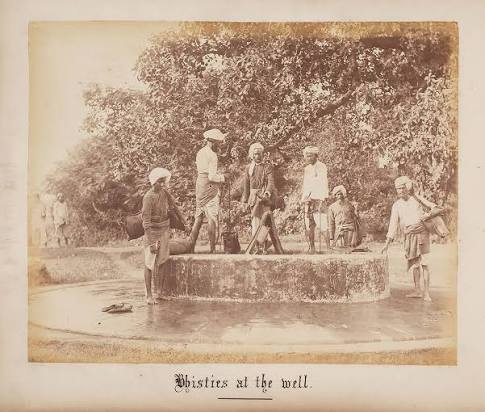
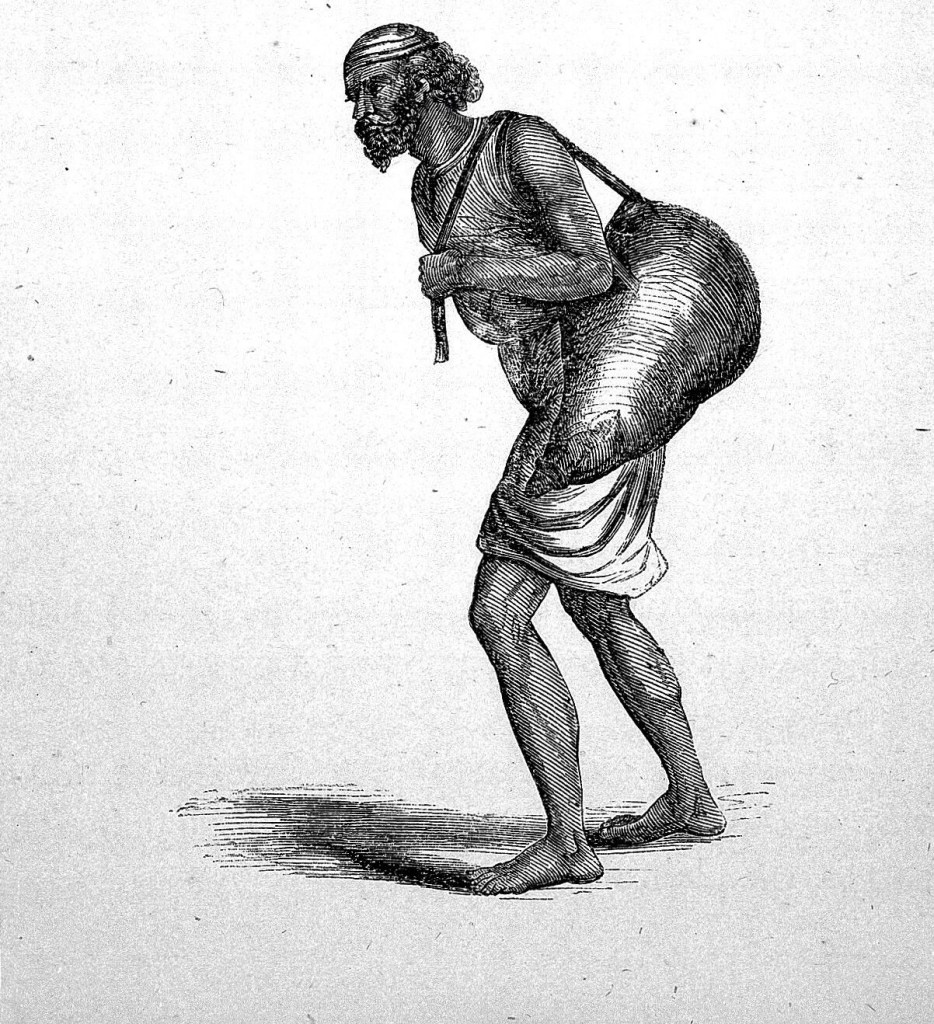
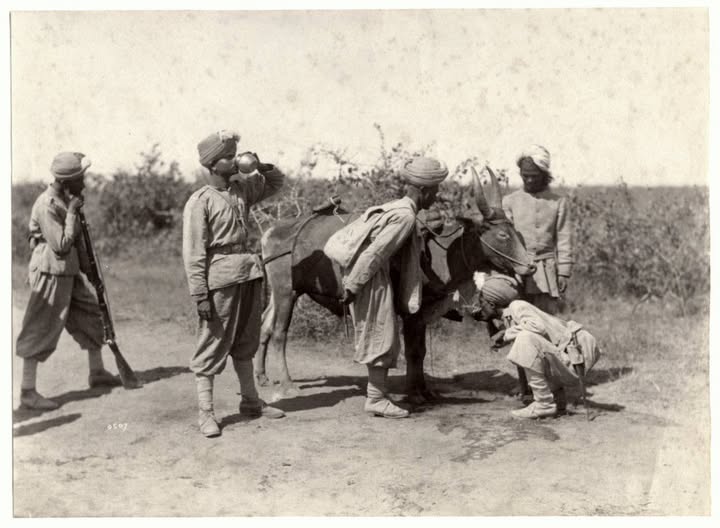
Rowcroft was numerically too weak to handle more than one column at a time – when one retreated, the other came on, and the same game commenced. The advance, the retreat, the renewed advance, the next retreat and this from 11 in the morning until sunset, when, for reasons of their own, the insurgents decided they had had enough and retired towards Belwa Fort, leaving Rowcroft to return to Amorha. He had sustained no battle casualties at all except for three horses wounded by shrapnel, but the doolies were filled with exhausted and sunstruck men, adding considerably to his growing sick list. The bhistis had elicited the help of the local villagers to bring water to the men, many of whom, English and Gurkha alike, had simply lain down on the ground, too weary to move. Without their tireless efforts, Rowcroft might well have had some dead to bury.
April was nearly over and there would be more battles to fight.
Sources:
Malleson, G. B. History of the Indian Mutiny, 1857-1858, Commencing from the Close of the Second Volume of Sir John Kaye’s History of the Sepoy War. Vol. 2. London: W.H. Allen, 1879.
Malleson, G. B., ed. Kaye’s & Malleson’s History of the Indian Mutiny of 1857-8. Vol. 4. London: W.H. Allen, 1889.
Nash, John Tulloch. Volunteering in India: An Authentic Narrative of the Military Services of the Bengal Yeomanry Cavalry During the Indian Mutiny and Sepoy War. London: George Philip & Son, 1893.
Rowbotham, W. B. The Naval Brigades in the Indian Mutiny 1857-58. London: Printed for the Navy Records Society, 1947.
Williams, E. A. The Cruise of the Pearl Round the World, with an Account of the Operations of the Naval Brigade in India. London: Richard Bentley, 1859.
To follow the Sarun Field Force and the Trans-Gogra Campaign, FIBIS has complied a modern day map which can be found at this link:
https://www.google.com/maps/d/viewer?f=q&source=s_q&hl=en&geocode&ie=UTF8&hq&hnear&t=p&msa=0&z=8&mid=15gZy_L1UvFXW6LR4B7wguNF3y9U&ll=26.423502737961396%2C83.0807882357232
 Mutiny Reflections