The Battle of Jamoulee
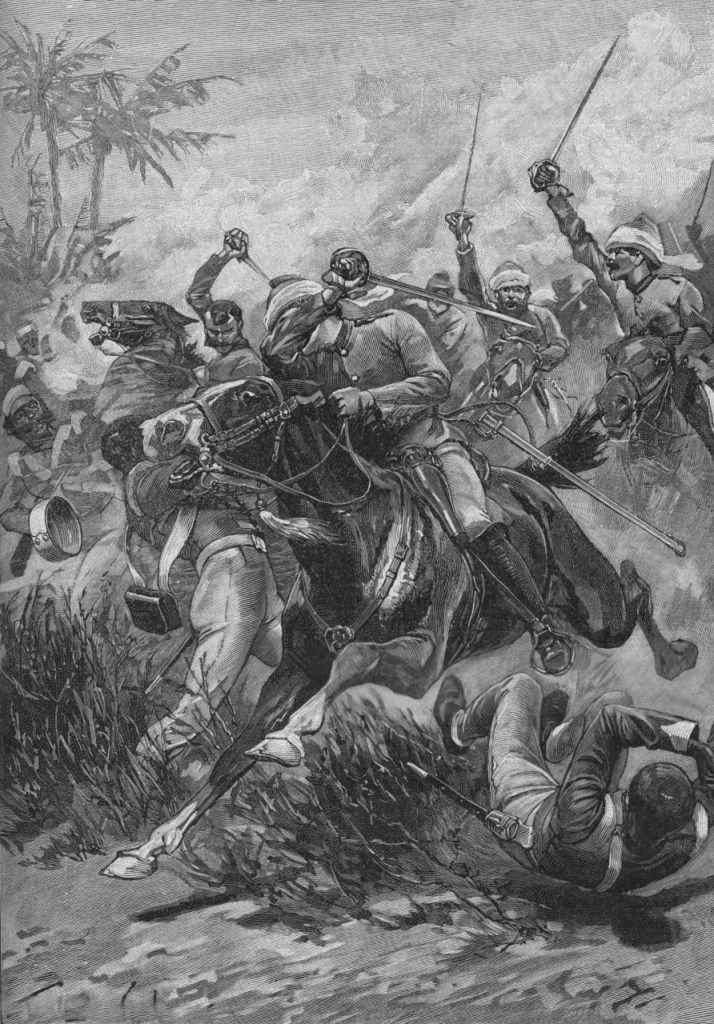
Early in the morning of 17 April, several villagers appeared in the camp and, with all earnestness, acquainted Rowcroft with their plight. Parties of rebels from Belwa Fort had turned their hand to plundering and were, that very morning, in force, putting to task all the villages between Belwa and Amorha. At that moment, they were no more than 3 miles from Amorha itself, and unless something was done, they would make off with not only all their grain but their livestock.
Rowcroft finally decided, after so many weeks of inaction, that he might as well use this as a good premise to teach the rebels of Belwa a lesson. He immediately ordered out a reconnoitring party to verify the villagers’ statements, which turned out to be true; there was little time to be lost, so Rowcroft quickly mobilised his men. A detachment of 100 men of the HM’s 13th, Chapman’s squadron of the Bengal Yeomanry Cavalry, 200 of Gurkhas, along with 100 men of the Pearl, and two guns prepared to march. At 9 am, they left the camp while Rowcroft quickly organised further detachments (a detachment of Sikhs, 2nd detachment of HMs 13th and 2nd troop of Bengal Yeomanry Cavalry) and guns to follow up in support.
To his surprise, he suddenly could hear the sound of guns in the direction of Belwa, not just those of the Naval Brigade but rebel guns. The first detachment had come upon the rebels at the village of Tilga, and they were in larger numbers than expected. The BYC attempted to circle round and take them in the rear, only to find the rebels had four guns, and these were already in position and firing. The BYC and the infantry now arranged to “keep them occupied,” with the seamen brought their two guns into action; fortunately, Rowcroft was able to move out at 10 – less than an hour later, he came upon the first detachment.
They had taken up a position in the village of Jamoulee, just three miles from the Amorah camp on the Belwa road. Captain Sotheby of the Pearl had prudently drawn his guns into a small tope of trees with some of the infantry, with the hope of bringing the rebels out into the open. However, these judiciously kept to their topes of trees and behind the village walls. A general fusillade was in progress with both sides peppering each other with shot and shell and musket fire – the immense clouds of smoke and dust made it difficult to see who was doing what, but it was clear this was not a raiding party. In all, some 2000 sepoys, 100 irregulars and a number of sowars and a battery of four guns had made their way to Jamoulee.
Major Cox managed to draw some of their infantry out by feigning a retreat, a trick that had worked in the past and one the rebels never seemed to understand. Seeing Cox’s men turning about, they “came out yelling and bellowing as if to inflate each other’s courage, and seemed disposed to make a desperate effort to drive our party back to camp. But when once out from under cover, the detachment halted, and gave them such a warm reception with rifles and shell, that they soon found themselves safer behind mud walls.”
As soon as Rowcroft appeared on the scene, Cox reported to him the state of affairs. He had spotted a large body of rebels off to the extreme right of Jamoulee, so Rowcroft now determined to move around to the right, leaving Sotheby on the left. With two small mountain train howitzers, a portion of the 13th and the rest of the troops he had brought up in support, Rowcroft moved to the right and advanced. The rebel cavalry and infantry, discomfited by this untoward move, fired three volleys and began retiring. Rowcroft pressed his advantage – “bringing up our right shoulders, the enemy on the left, in front of Captain Sotheby, finding we had turned their left and rear, ceased firing, and soon gave way and retired, getting a few shells from the small howitzers, assisted by the skirmishers with their Enfields and Minies.” They continued pushing them towards Belwa; Rowcroft, realising a body of rebels were breaking off from the main column and retreating with two guns, he called the BYC into action.
With Major Richardson at their head, 120 sabres of the Bengal Yeomanry Cavalry prepared to charge. Things might have gone a little better.
“The words March, Trot, Gallop, in rapid succession, had scarcely passed the lips of the leader, when on dashed the Yeomanry like greyhounds slipped for the chase. They sweep over the plain, they plunge into an intercepting ravine half full of water that momentarily checks their race into the jaws of death, they tear through the stream in the teeth of a shower of grape from the eighteen-pounder. Still out flew the squadron, with every nerve braced, every sabre gripped; knee to knee the onrushing wave of steel roared, as it were, “Now for the gun! Now for the gun!” as the scowling black monster from its gaping muzzle vomits for the last time another discharge of deadly grape into our faces; but with free rein, neck and neck, and outstretched strides the maddened and gallant horses fly, like the irresistible shower of the iron hail that had just flown
over their heads. Yet the mutineers, with muskets levelled from the shoulder, stand like posts, and draw not a trigger, a few strides more and bayonet and sabre would have crossed each other when lo! in an instant up sprang hundreds of Sepoys on every side as if out of the very ground itself. They had been crouching, in fact, like tigers prepared to spring from behind the village, and the thin line of their front ranks by which we were decoyed.”
While one man would bend on one knee, another would mark his target and open fire, but only when the trooper was close enough to the musket that the discharge set his clothes on fire. If this was not grim enough, the BYC suddenly realised that sepoys were lying on the ground – before they could swerve out of the way, up came the swords, slashing at the legs and underbelly of the horses. As it was too late to check the rush, Robertson shouted, “Charge!” And the next moment, a stream of musketry, like a sheet of fire, met us with terrible effect, and literally cut down a section of the squadron, and encumbered the spot where this withering volley was received, with men and horses struggling in dying agony. But nothing could daunt the remnant of that devoted band, and seeing their comrades fall, with wild enthusiasm and sabres flashing in the blazing sunshine, they plunged in among the enemy with an ardour that could not be resisted; and then followed a scene which to this day has not faded from the memories of those who saw it a scene of dare-devil enterprise, which my feeble pen would fail to describe with adequate force, and tragical effect.”
It was a scene almost too horrible to imagine. The dead and wounded lay crowded together where they had fallen; some of the men had been “blown” from their horses just yards away from the muskets and now writhed on the ground, their very shirts on fire, others covered in blood had managed to drag themselves up “into sitting postures” and were trying to shoot off their revolvers, ” … and others again, having escaped severe injuries and lost their horses, were standing over their helpless comrades, and shooting down the scattered Sepoys as they approached within revolver range of that gory spot. Indeed, in the tumult and hurry that prevailed, the black legs of these red-handed desperadoes were trampling over the bodies of our fallen as they rushed onwards to rejoin their main body, from
which they had been cut off by the violent shock of the charge.”
The men who were still on their horses rode straight into the centre of the rebel body and, with revolvers, commenced shooting down any of them who were still standing – the left squadron, under Chapman, realising their comrades were in significant trouble, now raced to their rescue and joined in the fighting. Desperate hand-to-hand combat with the “...clanking of steel, the rattling of musketry, the yells of the mutineers which might possibly have been heard a mile off supplemented by a wild chaos of sabres, bayonets, revolvers, and muskets, all mingled…” Lieutenant Troup and Trooper Brown were killed outright, but Trooper Kindred stood over Troup’s body, shooting any man who dared approach him, until the fighting was done.
The rebel gunners were killed where they stood, to the very end, defending the guns while the infantry rallied again and again, determined to fight to the death – it was only a cannonball from one of Sotheby’s guns that “startled them into retreat”, and they soon disappeared in the ravines and the deserted villages beyond them. The battle was over.
Among the dead on the field, a sepoy was found, gripping a Bengal Yeomanry Cavalry sword. He was the very man who, a few weeks previously, had been taken prisoner by a trooper, but while bringing him to camp, had grabbed the trooper’s sword and killed him. He had then run off, taking the sword with him. Now here he was, sword in hand, dead at the hands of the Bengal Yeomanry Cavalry, the circle closing on two lives cut short by war.
Rowcroft returned to Amorha, where, to his relief, he found his fort was still standing. As he counted up the dead and wounded for the day, he would find, despite the severity of this unintended battle, his casualties were low: Cornet Troup and Trooper Kindred had been killed, but he lost 4 officers, 7 NCOs and 8 rank and file wounded (including 2 of HM’s 13th).
Returns
Bengal Yeomanry Cavalry
Lt. H. B. Troup, killed
Lt. C. de Hoxar, wounded
Lt. Wm. P. Davies, wounded
Cornet W. Bridgeman, wounded
Cornet P.M.H. Wynter, wounded
Cpl. Jean Cuney, wounded
Tpr. Jas. Brown, killed
Tpr. Danl. Gillmore, wounded
Tpr. Hugh O’Donnell, severely wounded
HM’s 13th Regiment
Private Amos Powling – slightly wounded
The Battle of Jamoulee was just the beginning. This particular affair had not been planned – the rebels, ostensibly under the command of an advisor of the Raja of Gonda, had indeed been out on a plundering raid. However, Rowcroft’s advanced party had surprised them, and they, believing Rowcroft was launching an attack, had called for reinforcements from Belwa. Rowcroft, thinking the rebels were launching a full-on attack on him, had, in his turn, brought out the rest of his field force, and the action had escalated into a full-scale battle. Both parties, who had, until now, been satisfied in ignoring and avoiding one another, had now been made fully aware of each other, their strengths and the weaknesses – the time of sitting around in hot tents was over and the fighting season had well and truly been called to life.
Lieutenant Nash buried his bosom friend, Hugh Bedford Troup, in a lonely grave. Troup was only 22 years old, and Nash, who had known him in Calcutta in better days, as a city dandy, morosely now threw dirt over his cloth-covered corpse. There were no coffins to be had or indeed no carpenter to make one. In later years, long after Nash and the BYC had disappeared, a tomb would be raised over the grave of Troup and the others buried that day, and if it still stands, it can be found at the “4th furlong of mile 65” on the Gorakhpur-Basti-Fyzabad road.
 Mutiny Reflections