Progress
For Frere, roads and the post were hardly the end of his ambitions for Sindh. Where there were roads, he reasoned, there should be dak bungalows and traveller rests. This time, instead of an all-out assault on the Government’s senses, he decided a little guilt would suffice. He collected testimonials from travellers, both Indian and European, regarding the horrors of travel in Sindh without roadside amenities of any sort and sent them an impassioned plea instead.
“All that I have heard and seen of this, the principal line of road in the province, during the few months that have elapsed since I first wrote, the universal complaints of travellers of all classes, professions, and presidencies, instances of individual sufferings to invalids and women, fevers and severe sickness, contracted by the young and robust, and ending fatally, in at least one case, of a person previously in good health, and which sickness would not in all human probability have been incurred had the road been provided with ordinary Indian accommodation for travellers, all have tended to confirm my opinion that the expenditure I recommended was most advisable on grounds of economy no less than humanity.”
Within months of Frere’s arrival in Sindh, he had blasted them with letters, reports and statistics; the government retorted by complaining Sindh was costing them more to govern than it produced in revenue. Frere replied that as a freshly annexed province, situated as it was on a precarious frontier of their empire, much of the spending was not frivolous but indeed for defence. Without roads and rest stops, moving troops through Sindh would be nearly impossible and would cost them even more to send troops to the frontier using the longer route through the Punjab. Without investment, they could not expect revenue, and it would remain expensive to govern. After a year of grumbling, the government sanctioned the construction of three dak bungalows in 1852.
As the government was interested in revenue, Frere had to make Sindh profitable and interesting for investment. He wasted no time in establishing another rather novel idea – trade fairs. These would be held not only in Karachi but also in other parts of the province. He wanted to encourage merchants from Afghanistan, Persia, and Central Asia to come to Sindh overland, without having to resort to travelling by sea, so they could meet traders from Bombay and Southern India. In a letter to the Bombay Government, he once again appealed to their better senses.
“ August 21, 1851.
The Fair is intended to be to traders between Central Asia and Bombay what a ‘ Clearing-house ’ is to bankers, or an exchange or bazaar to merchants in general; a place where people who have wants which they can mutually supply to each other may meet and save time, trouble, and money, which would be otherwise expended by each individual going round to the others individually.
But where such meeting is arranged for the benefit of two classes, it will be of no service if one only attends, and unless the Bombay merchants will come with their hardware, piece-goods, and woollens, it will be of little use for the Affghan, Sindee, and Belooch traders to congregate with their wools, furs, dyes, drugs, and raw produce...
The Bombay merchant may ask, ‘ Why should I go to meet the Afghan, when the Afghan trader now comes to me?’
I believe that if an active Bombay merchant could meet the Afghan trader on the Coast of Sind, buy the Afghan’s wool with the piece-goods he had himself brought up, and carry the wool back to Bombay, he would find that after paying himself fairly for extra risk, trouble, and expense, he had got his wool cheaper than if he had bought it from the Afghan at the lowest price the latter would accept in Bombay, because the additional journey he takes himself and which he saves to the Afghan is a matter of comparatively less risk, trouble, and expense to him than it is to the Afghan, and, therefore, what is bare compensation for it to the Afghan is comparative compensation and extra profit to him. . . .
With regard to the steps I would propose to take, they would be all intended simply to clear away obstacles and none to force trade. Publicity as to time and place of meeting, order, and good police regulation for cafilas after they arrive, facilities for traders to meet and see each other’s goods, and whatever else may tend to save time and trouble…
The case of any Fair in Upper Sind is somewhat different, and I see no reason whatever why one should not exist there almost contemporaneously with one at Kurrachee.
The classes of traders who will meet at the two places will be in some respects different.
At Kurrachee, there will be on the one side Afghans, Sindees, and Punjabee traders; on the other, Bombay and other Western Indian merchants.
In Upper Sind, there will be on the one side the merchants of Khelat, Kandahar, the Punjab and Bawulpoor; on the other, those of Rajpootana and Sind.”
The Bombay Government forwarded Frere’s proposal to the Board of Directors in London, who, seeing an opportunity to make money, backed Frere; the first Karachi Fair was held in December 1852. Subsequently, as the roads improved and more dak bungalows were erected, Frere was able to attract merchants from as far off as China and Tibet. The fair stimulated local commerce, encouraged trade with Central Asia, and showcased regional agriculture and goods. As an added stimulus, Frere convinced the Khan of Kelat – the sovereign of Baluchistan – to suspend the heavy duties he levied on goods passing through his territories by offering him a subsidy as compensation. The wild tribes under his control were prevented from blackmailing the merchants themselves, and it was in his interest to stop them from looting the caravans.
The fair was a roaring success and continued for decades to come.
“As each December came round, crowds of merchants from far and near, in all the picturesque variety of Oriental costume, were to be seen encamped in gipsy tents, or sheltered by buildings erected for the purpose. There were Sindees in loose white drapery, with coloured sash, and yellow-and-red cap, shaped like an English hat, turned upside down, with the brim at the top. There were stately, unkempt Beloochees, their long tangled hair mingling with their beards, offering camels or ponies for sale; and tall, handsome, fair-haired Afghans, bringing horses, and fruits which grow in a temperate climate, apples, and apricots, and grapes; and there were Persians with cloths, and rich carpets, and dates, and with Russian chintzes, superior in colour, though not in texture, to the English chintzes—so that in Sind, to wear Russian chintz meant to be a well- dressed man. Even from Tibet and distant China, traders came with the products of their country to this Fair on the flat sandy plain by the sea—the sea which most of them had never seen before—where, in the background, rose the newly-built European-looking houses of Kurrachee, and beyond the tall masts of the ships in the harbour, cutting the blue outline of the distant Hubbee hills.”
Water to the Desert
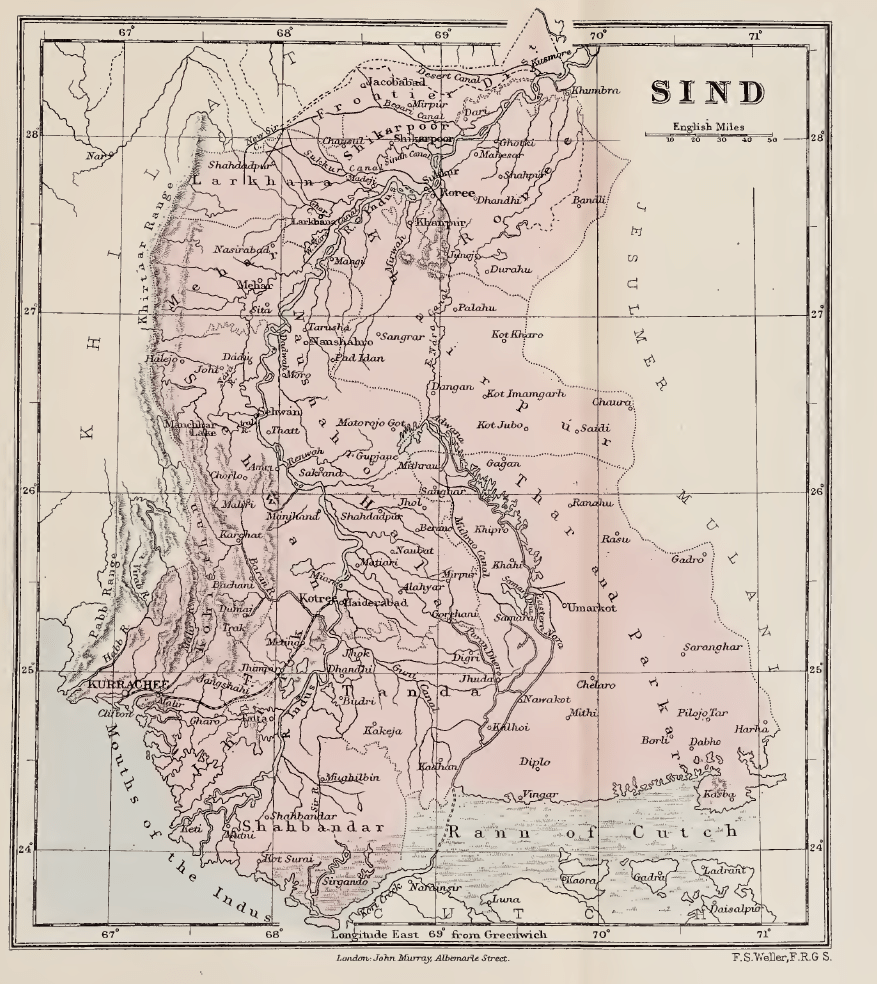
However, a trade fair would not be enough to satisfy the pockets of the East India Company, and Frere turned his attention to agriculture. The problem, as he could see, was that Sindh was, for the most part, devoid of rain, and if was not for the mighty Indus, it would also be a desert. The north-west monsoon did not make it any further inland than Karachi, and the rainfall was no more than eight inches in a good season. Agriculture, therefore, was completely dependent on the overflow of the Indus River or on artificial irrigation by means of canals. As the bed of the Indus was generally of a higher level than the surrounding country, there was no need for pumps, and all that was required was a network of channels – the Mirs had not been able to implement a successful irrigation scheme, and much of it was left to the farmers themselves to figure out. The canals the Mirs had constructed had not been maintained since their departure, and although Napier had organised a canal department, complete with engineers, they, being military men, had been called off for other duties during the Sikh Wars. Pringle subsequently abolished the department and entrusted the work to collectors and magistrates who had neither the skills nor spoke the local languages to actually get anything done. So the canals deteriorated, and the money that had been thrown at them was effectively wasted.
Frere already had a man who seemed to have more energy than humanly allowed, and that man was Major John Jacob. Jacob’s proposal was not to construct a new canal, but to widen and deepen the existing Bigarri Canal just north of Shikarpur. Frere sent the proposal to Bombay.
“The surface of this tract of country gradually slopes from the Indus, so that the water which, at the spot where the canal branches off from the Indus, is many feet below the surface, after running forty or fifty miles, comes close to, or on the surface.
Hence, the further the canal recedes from the river, the nearer is the water to the surface, and the greater are the facilities for raising it, till at length, near the borders of the desert, it may, during the height of the inundation, be allowed to flow over the fields, without the expense of any wheels or other contrivance for raising it...
It is not only in directly increased revenue that the benefits of the improvement will be felt. An extended and improved supply of drinking water for man and beast,, and better grazing of pasture will tell indirectly, but very decidedly, on the prosperity of the cultivators throughout the district.
Still more decided will be the moral effect on the people of the country: it will give the means of subsistence to many thousands, and thereby, like every such measure,, strengthen our Government, more specially the reclaimed tribes of the Hill Beloochees, whose colonies are all, with few exceptions, on the canals fed by the Begaree, will find their means of profitable cultivation greatly increased.“
For once, there was no objection from Bombay, and the canal project was completed in two years. By 1855, one year later, Jacob could report that, “…that one-third of this cultivated annually (the other two-thirds being fallow), brought in a revenue of seventy-five thousand rupees in the frontier district alone, the increase on the south bank being probably about half as much. New grants were being continually applied for which would further increase the revenue.”
New branches and channels off the Bigarri Canal would continue to be constructed, and in 1855, a new canal was constructed to serve the interests of the frontier district north of Sindh along the boundary between British-controlled and Kelat-controlled areas, bringing water from the Indus to 1500 square miles of land, which, due to the lack of water, had been impossible to cultivate with any success. With approval for this project given, Frere further managed to then gain the funds to restore the old riverbed of the Eastern Narra River, which was only fed by the occasional floods of the Indus. With a channel cut from the Indus to the Narra, with water gates to control the flow of water. By 1852, this too was well underway, and it was hardly the end of Frere’s ambitions.
“His advocacy and success with other irrigation works was equally great. There was no sensible proposal which came before him which did not excite his keenest interest and receive his warmest support. There was John Jacob’s improvement of the Bigarri Canal. There was Captain Ford’s Canal to increase the supply of water in the Gharr Canal, a work whose whole cost was covered by the first year’s increase of revenue. There were the Fullaile new supply canals, the Sukkur Canal, Jacob’s Desert Canal, Sir William Merewether’s further enlargement of the Bigarri, and a large number of smaller works too numerous to mention, all of which Mr Frere advocated with success. Indeed, more than advocated. It was not merely the advocacy of the projects when he sent them up to Government. His encouragement to the executive officers had the effect of inducing everyone to do his very utmost in the performance of his duties. . . .
 Mutiny Reflections