Sindh Awakens
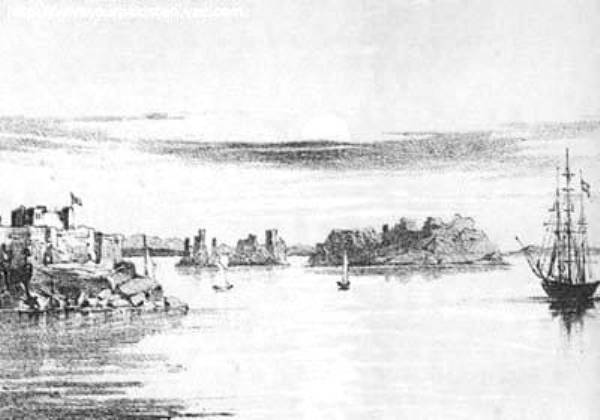
Two months after his arrival, Frere was already writing to Bombay earnestly soliciting the government for money to develop Karachi Port, where nothing had been done except building a small lighthouse and laying down a few buoys. A bar at the mouth of the harbour had never been investigated, and it was here that Frere intended to begin. Until they could ascertain the nature of it – was it rock, clay or sand? – no ship would venture into the harbour during the monsoons, effectively closing the port for months at a time. During this time, even the post had to go around by land to Bombay and across the flooded marshes of Kutch, and after the monsoons passed, passengers were still being transferred to small boats and brought to the dock only when the tide allowed. The Government proved themselves disinterested, telling Frere they did not have a geologist on hand, that there had never been a geologist in Sindh, and he would have to shift for himself. Frere found a report from Lieutenant Hopkins of the Indian Navy, then a port officer in Karachi, that detailed the depth of the water on the bar at all tides and every season, allowing Frere to ascertain that the bar was indeed not the great hindrance everyone was making it out to be. With only a few adjustments and correct precautions in place, a ship as heavy as 600 tonnes would be able to clear it safely. Although a troop ship did in fact clear it and dock successfully later that year, it was only in 1853, after Frere petitioned Dalhousie himself, that a project for Karachi Port was finally given the clearance and funds it needed. While the work would begin later that year, it would not be stalled, restarted, the plans redrawn, and drawn again, before it was finally completed in 1883.
In the same letter to Dalhousie, Frere had also proposed the construction of a railway line from Karachi to Kotri, but no actual construction would begin until 1858. In 1855, an offer by the Steam & Navigation Company to establish a fortnightly packet service to carry mail between Bombay and Karachi was rejected by the Bombay Government outright; Frere remonstrated vehemently, stating that they should consider just how expensive it was for mail destined for the Punjab was still being sent through Calcutta. He further pointed out that during the monsoons, the mail steamers from Aden destined for Bombay should, in fact, sail via Karachi, and they would save a full two hundred miles, making for a shorter passage.
The Problem of Roads and Rivers
When Frere was not arguing with the Bombay Government or sending petitions to Lord Dalhousie, he was concerned about the lack of roads in Sindh. In 1851, only four miles of road, suitable for a carriage, existed in Hyderabad. The local people complained of the problems they faced in bringing the goods to market, and in the case of a famine, Frere feared he would not be able to provide relief to anyone at all. What existed were well-trodden paths, apt to disappear in the rain, and roads of dust and clay, which habitually turned into swamps, making communication, even on horseback, difficult. Camels struggled in the mud, rendering them nearly useless, and while steamers did ply a trade from Lahore to Hyderabad, below that point, the river spread out into a many-armed delta that continuously shifted, making navigation nearly impossible as the course and depth of any such stream was difficult to ascertain from one day to the next. Heavy boats could only travel upstream with considerable effort, with some taking three months to travel 250 miles. The only option was roads -by the end of 1851, on Frere’s directive, 126 miles of road had been constructed, and a year later, he added another 206 miles. This project linked Upper and Lower Sindh over the Lukkee hills near Sehwan, thus making the continuous crossing and recrossing of the Indus River not only redundant, but the journey could be comfortably completed in a carriage and to the benefit of the traveller, was forty miles shorter. Frere’s roads were forty feet wide and ran in “perfectly straight lines from village to village.” Although none of them was metalled, all the brush and obstacles were cleared, and the surface levelled. A trench on either side allowed for water to run off and also prevented carts and cattle from “getting off the road.” By 1853, he could report that 159 bridges had been constructed of burnt brick, “with mud cement and semi-circular arches…All these roads and bridges have been made by such artificers and workmen as could be found in Upper Sind, without aid from any European except Major Jacob, or any native trained in an European office…”
Frere allowed Jacob much leeway, and Jacob did not disappoint, delivering roads and bridges well below the costs found in other parts of India; and although many of his contractors could neither read nor write, under Jacob’s careful management, they built some of the best bridges and roads Frere had ever seen. On the frontier, Jacob cleared and laid out 2589 miles of road between 1847 and 1860; between 1853 and 1860, 1872 miles were raised roads which allowed for the passage of carts and camels all year round; in the same time frame, 786 masonry bridges were constructed, of which 88 were “across navigable canals, passable by boats of the largest size.”
And the Post
Frere was not done yet, for where there is a road, there must inevitably be a regular postal service, and Sindh, up to the time of his arrival, was seriously lacking in one. He first substituted the dak runners with the Horse and Camel Dak between Hyderabad and Sukkur, saving a full 11 hours for postal delivery, and the gain of seven pounds in the weight of the mail carried in the distance of two hundred miles. However, it was not achieved without incentives, for Frere introduced the concept of “speed-money.”
For every hour that the mail was late, the time was put against the contractor, and every hour gained was added to his credit. At the end of the month, ” a balance was struck, and he was fined or paid ‘speed-money’, as the balance might stand, so much to his credit or debit.”
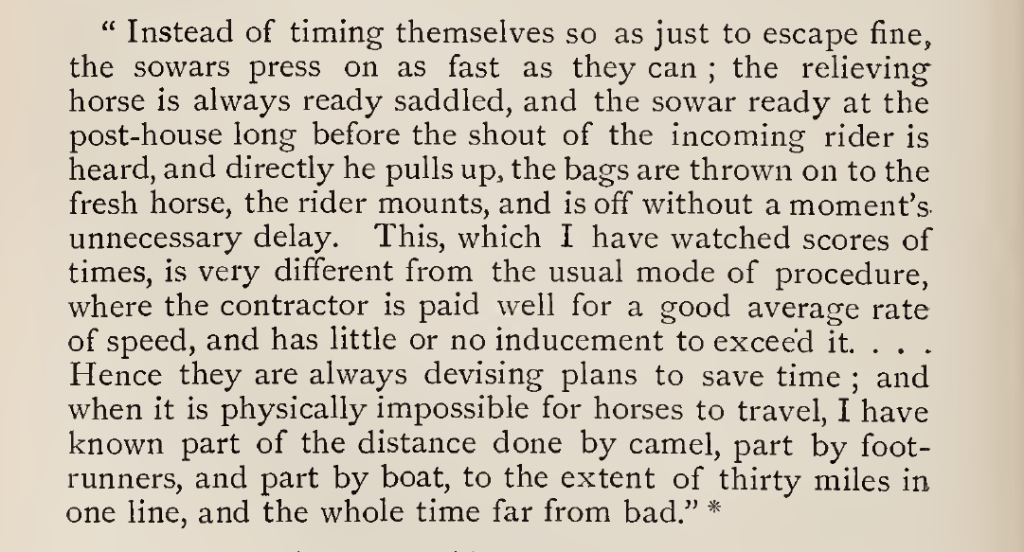
The Horse and Camel Dawk would eventually be commonplace in Sindh and Frere continued his postal revolution.
In 1852, he introduced the Scinde District Dawk stamp. Issued for the first time on 1 July 1852, it was the first adhesive postage stamp in Asia to prepay local mail delivery. Until now, all post was paid on delivery; if the recipient could not be found, refused the letter or simply could not or would not pay the fee, the postal service was left coughing up the costs. The exact amount due was calculated based on the total distance the letter had travelled and its physical weight.
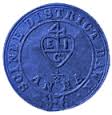
Valued at a ½ Anna (1/32 of a rupee), the stamp was first produced in embossed red sealing wax, blue on white paper or on uncoloured white paper and designed by Frere himself. The circular seal featured the EICo’s Merchant Mark and the text, “Scinde District Dawk.” Although this did spell the eventual end of dak runners in Sindh, the system proved to be a success. This was the first cheap and uniform rate for postage, totally independent of the distance travelled. All the post and government offices in Sindh were now connected seamlessly from Karachi to Kotri, and Hyderabad up to Sukkur way off in the north through the postal system.
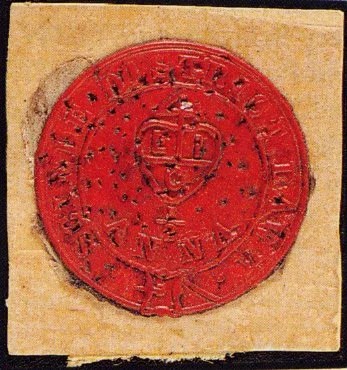
“Less than 100 brittle specimens exist now, and each is worth lakhs of Rupees.” – https://storytrails.in/history/scinde-dawk/
As the first stamps were of wax and thus prone to disintegration, they were replaced by a colourless design embossed on white paper, which had the disadvantage of being difficult to see in poor light; the last stamps were a blue embossing on white paper.

The idea was, in fact, not so much a revolution, but a smack at the Bombay Government. Frere had requested better and more post offices for Sindh in 1851, but he was told it was a poor province and therefore it was a waste of money. Undaunted, Frere continued to press the issue, and he was, “…reminded of our poverty, and told that when the Government of India could afford to spend money on Scind, there were many things to be provided before post offices could be thought of…”
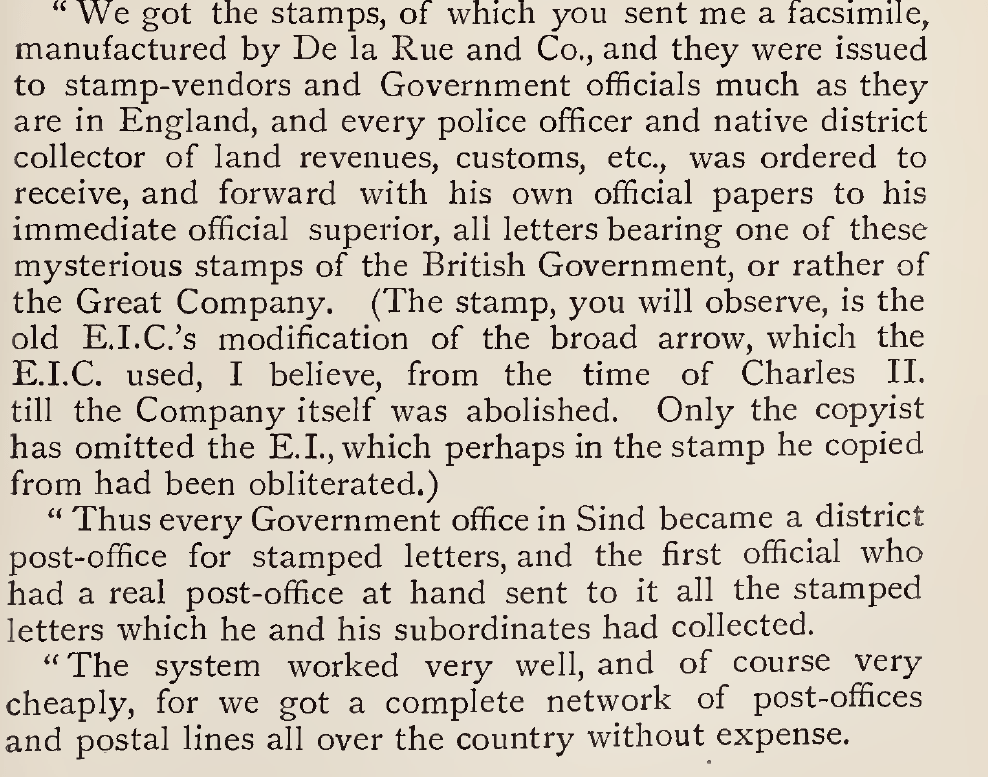
As Frere and his civilians believed post offices “were not luxuries”, they put their heads together to come up with a plan to make the post offices themselves profitable. It was the postmaster, Mr Coffey, who came up with the idea of stamps, and Frere who expanded on it.
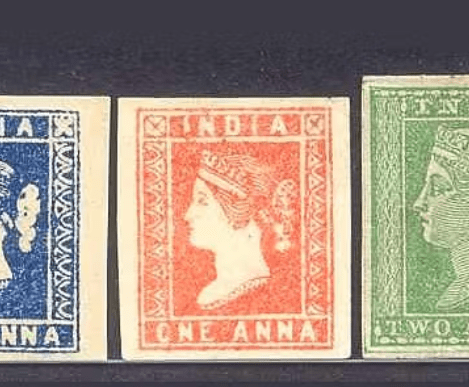
The Sindh postal experiment certainly was a thorn in the side of not only Bombay but Calcutta, for on 30 September 1854, the Scinde District Dawk stamp was discontinued for the EICo was finally capable of issuing stamps of its own for all of India. These were hardly flamboyant but, in keeping with the times, featured the image of Queen Victoria. However, how long it might have taken had not Mr Bartle Frere been annoyed with the government is anyone’s guess.
 Mutiny Reflections