Sindh and the East India Company
The British had tried, on three occasions, to find success in Sindh. Firstly, under the Mughals, they had received the right of trade at Thatta in Sindh in 1636, but the factory was hardly a wild success, and they closed it in 1662. They reopened it in 1758, only to close it again in 1775 when the interferences of Sarfaraz Khan had made the situation unbearable. When the Kalhoras had pleaded for assistance from the EICo before the Battle of Halani, the EICo had refused, stating Sindh was of no interest to them. However, suddenly things had changed, and the British were suddenly eager to establish themselves on a friendly footing with the Talpurs. Their problem was the French, whom the British, particularly Lord Richard Wellesley, then governor of Bengal, found threatening and the more realistic problem that was Afghanistan.
The French would be used by Wellesley to convince the Board of Directors of the EICo to re-establish contact with Sindh, but eventually to start the Fourth Anglo-Mysore War. However, considering the state of Persia and Afghanistan, the growing machinations of the Russians, coupled with the general designs by the French, Wellesley did have some reason for concern. In 1798, the British had a serious problem with Shah Zaman of Afghanistan, who had a penchant for invading India and had taken to launching incursions on the north-western frontier. He also had every intention of aligning himself with the French should he be on the course to invade India.
“To protect its boundary against Shah Zaman’s depredations, Lord Wellesley evolved a policy of checking the Afghan moves along two fronts – one in Persia and the other in Sindh. While the War of the Second Coalition was in progress, Harford Jones, the British Resident at Baghdad (1798-1806), suggested an Anglo-Afghan alliance rather than an Anglo- Persian one, because of the insecurity of Kajar rule in Persia. Wellesley decided to persuade the British government to opt for an alliance with Persia as a way of keeping Afghanistan weak. Wellesley also wrote to Jonathan Duncan, the then Governor of Bombay (1795-1811): the ‘Talpur Meers of Sindh have grown sick of Afghan overlordship. It would be worthwhile to establish a business factory in Sindh to keep an eye on the activities of Afghanistan, Iran, Russia and France in the region.” (Verma)
And all of a sudden, to make this plan work, they needed Sindh. In 1799, Duncan decided that a friendly approach was the way forward, so, through a Persian merchant, he sent gifts to the Talpur Mirs and a letter in which he expressed the EICo’s desire to re-establish trade with Sindh. The merchant was specifically told to omit any mention of Shah Zaman or a possible threat from Afghanistan; he was to simply point out the profits an alliance with the EICo would have for the province. The Mirs were not hostile to the proposition and, seeing it was indeed in their interests, as the members of the ousted Kalhoras were still plotting and planning their revenge on the Talpurs by eliciting aid from Shah Zaman, having a partner like the EICo benefited Sindh, so Mir Fateh Ali Khan issued three parwanas to the EICo which aligned with the previous agreements in place from 1761. Upon receiving the parwanas, a very pleased Mr Duncan sent Mr Nathan Crow of the Bombay Civil Service to represent company interests as political and commercial agent in Sindh. Crow’s mission was very clear – he was to establish firm relations with the Talpuris while keeping an eye on any overtures Shah Zaman and the French might make regarding India, and keep them in check. However, by the time Crow arrived, the Talpur Mirs had had a change of heart. Shah Zaman was no longer the problem they had believed he was, and their own mercantile community was soured by the very thought of having to compete with the British. The Mirs, in the meantime, left Crow stranded in Karachi, surrounded by hostile merchants. He wrote to the Mirs for permission to travel to Thatta. After a month, they finally conceded, and Crow arrived eight days later, only to find the merchants were as displeased to see him as those in Karachi had been. He made a quick inspection of the old Thatta factory and proceeded to Hyderabad to meet the Mirs. He finally had a meeting with Mir Fateh Ali Khan in July 1799. Crow came to the point as quickly as etiquette allowed, and requested the Mir for a parwana that included the points already granted in 1758 and requested the right to establish a factory in Karachi. While the Mir agreed to the Thatta factory with all the rights and privileges as before, he baulked at the idea of Karachi.
In a subsequent meeting with Mir Ghulam Ali Khan, things went a little better, for he agreed to Crow’s terms and even asked him to send a gunner and a surgeon from Bombay. It would seem that Mir Ghulam Ali Khan had words with Mir Fateh Ali Khan, for on 18 August 1799, Crow received permission to establish a factory in Karachi,
“…and sanctioned other privileges such as tax-free land for a garden; these privileges had been promised to Aga Abul Hasan, the Company’s Persian agent. It also instructed the collector of duties on trade to exact from the Company only one-third of the normal custom duty so that EIC trade could develop. Sindh’s rulers expected that, as a result of increased trade volume, government revenue would increase as well. Another parwana dated 22 August 1799 granted the Company the right to open a factory in Thatta with all the old privileges it had in 1761, except the monopoly of the saltpetre export trade. Most importantly, the parwana also declared that no other European trader was allowed to pass through or trade in Sindh; those rights were exclusive to agents of the English Company.” (Verma)
So the British now had the foothold in Sindh that they had coveted, and everything seemed to be going well. Crow, very aware that the Mirs did not wholly trust him or the EICo, did what he could to allay their suspicions. He organised military support for the Mirs in the form of artillery and tried tiptoe through Talpur politics as best he could. However, the Talpur Mirs were not as convinced by Crow’s performance. In August 1800, they issued a parwana to shut down the Karachi factory and leave Sindh in less than a week. The EICo had, as it was, failed to impress. Without anything left in their box of tricks to conjure with, the British complied and turned their attentions away from Sindh and towards other problems, which included not just Afghans, Persians and the French, but the Marathas.
However, it was not the last time they would hear from Sindh. In 1803, a new power emerged in Afghanistan by the name of Shah Shuja, who now set his sights on Sindh with the idea of collecting tribute from the Talpur court. Mir Ghulam Ali sent him Rs 500,000 with the promise of another Rs 500,000 if Shuja would go back to Afghanistan, where he waited patiently for the remaining money. Mir Ghulam, however, had other ideas. Instead of paying up as promised, he contacted Johnathan Duncan with a proposal for a treaty between Sindh and the EICo. As he believed Duncan needed a little encouragement, he also mentioned that the French were barking at the door of the province. For the British, however, the French threat was less menacing now, and they were also less concerned about Afghanistan, so they dragged their feet; however, when the Talpur Mirs began sending emissaries to the Persian court, the EICo suddenly sat up and listened, for the Persian court had signed a treaty with the French in 1807 and one of the points was the Persians would assist the French, should they decide to invade India.
For the Mirs, the Persians posed no threat, and they, in their turn, were not disappointed that Sindh had sought an alliance. With the promise to wrest Sindh from the chokehold of the Afghanis, the Persians did march with an army to do exactly that; unfortunately, before they reached Sindh, Shah Shuja had returned and demanded a tribute of Rs 130,000, thus nullifying whatever help the Persians had been willing to give. For their part, the Mirs played a very strange game. By writing to Duncan in 1808 that they were unable to prevent the Persians from entering Sindh (although they had offered to pay them to do exactly that a year before), they once again proposed an alliance with the EICo.
The British might have been deaf, but they were not stupid. In October 1808, they received intelligence that Sindh was planning an alliance with France. The French, in the meantime, had reached Turkey and, aided by the Turks, were marching through Persia on their way to India. To make matters worse, French vessels had been seen along the coast of Gujarat, a direct threat to British interests in Kutch and Surat. So, while the Persians could indeed provide support to Sindh in case of an Afghan invasion, the British were suddenly concerned about the security of their north-western frontier. So there was only one thing to do – to secure their frontier, they needed a permanent solution to the problem that was Sindh.
This time, the British countered with a proposal of their own – they wanted a factory in Sindh and compensation from the Mirs for the losses they had incurred by the ousting of Crow. The factory was not so much to promote trade but as a convenient post to spy on not just the French, should they walk towards Sindh, but also any army setting off towards India from Kandahar could either march through Sindh or the Punjab. Covering their bases, the British now sent their proposal to the Mirs through their agent, Mehr Ali. At the same time, Duncan requested that Colonel Seaton, then resident at Muscat, be deputed to Sindh as he was known to speak Persian. The mission was to be cloaked in the veil of a commercial venture, when in fact it was nothing more than political manoeuvring.
The problem was that Seaton was not as familiar with the Mirs as he believed he was. His mission failed firstly because the Persians got there first. Their proposal, directly from the Shah of Iran, offered, among other things, the governorship of Mir Ghulam Ali of Kabul and Kandahar. Seaton backed away from demanding compensation for Crow’s mission and instead tried to forge the EICo as a worthy partner both defensively and offensively, including a clause stipulating that if either side needed military aid, they were obliged to provide it. Seaton could not provide the Mirs with the Rajput territory of Umarkot, which they coveted as a trade route and then under the control of the Jodhpur State. As the Jodhpur State was in allegiance with the EICo, just such a clause would have caused no end of problems for the Company. The Mirs also wanted to be free of Shah Shuja and his meddlesome habit of demanding tribute, but here again, as the EICo was in the process of sending an agent to Kabul, they could not risk annoying the Afghans. Seaton also tried to open up the Thatta factory again, but here his own governors baulked as he had been unable to secure the terms the EICo wanted. So Seaton, although he did manage to wrangle a treaty out of the Mirs, it was the EICo itself that refused to ratify it.
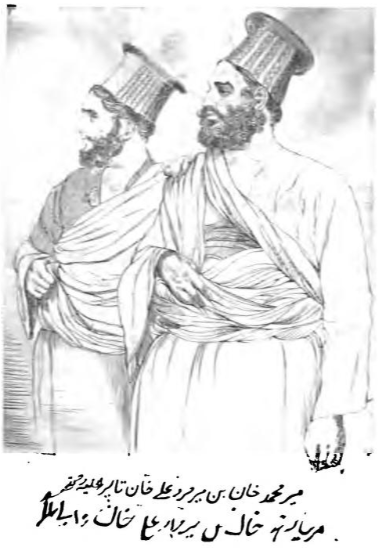
The Talpur Mirs, however, would soon see things differently. From Baroda, the Bombay Government was informed by their resident, Colonel Walker, that not all was well in the Talpur Court. A usurper was trying to get his seat among the four friends, ably backed by one of them; the court was in disarray, and to make matters worse, these internal squabbles were taking a toll on the governance of Sindh, causing suffering amongst the people. The EICo was not altruistic at the best of times, but they had found their loophole into Sindh – they would use the supposed suffering of the people as an excuse to declare the Sindh court as unfit to govern, setting in motion the long road to eventual annexation. However, before that time came, there were a few more loops the EICo would have to jump through.
In Afghanistan, Mountstuart Elphinstone was wading through Kabuli politics, securing from the friendly Raja of Kabul a promise that should the French and the Persians decide to invade, he would close the Khyber Pass; however, while this was comforting, there was something even more problematic than the machinations of two nations; it was Afghanistan itself. By now, Shah Shuja had been deposed by Mahmud Shah in the battle of Nimla in June 1809, and Shuja was in exile. While Mahmud was infinitely the better leader and much respected by the Afghans, the British, who were very much aware of all that, wanted a ruler in Afghanistan who would play by their rules, and they chose Shah Shuja.
“First of all, although the Afghans wanted the British to support them against Persia, the British found Persia more useful as an ally than Afghanistan. Another complicating factor was Ranjit Singh, the ruler of Lahore, who was hostile to Shah Shuja; the British judged that an alliance with Ranjit Singh was more valuable than an alliance with his rival, Shah Shuja. Ranjit had emerged as a paramount power in Western Punjab (close to British India); now he was extending his territory eastward into Eastern Punjab, and southwards towards the Sindh border. Ranjit Singh also controlled the frontier to Kabul. The only route for an army sent from Bombay to support Shah Shuja in Kabul was through the Bolan Pass in Sindh.96 So if the British were to achieve their aim of placing Shah Shuja on the Afghan throne, it was necessary to ally with Ranjit Singh, or at least win his consent for their project.” (Verma)
So into this fine web, the British sent another envoy to Sindh, Mr Nicholas Hanky Smith, and this time, the game would be played differently. Smith was told he was to obtain from the Mirs an agreement for permanent residency in Hyderabad and “to use any internal conflict” he found within the court to his advantage. The days of setting up factories were over; the British wanted Sindh as a part of the empire. Smith succeeded, but it took him over a month of negotiations to finally get the Talpur Mirs of Hyderabad to see things his way.
“The mission succeeded, however, in compelling the Mirs to reconstruct their ideas of the relative importance of themselves and the British Government, and a short treaty was concluded providing for the exclusion of the French from Sind and for the mutual despatch of vakils between Bombay and Hyderabad. The Mirs concerned in this treaty were those of Hyderabad only, Ghulam Ali, Karam Ali and Murad Ali. Ghulam Ali died in 1811, and a fresh treaty was concluded with the survivors in 1820. It provided that all Europeans and Americans should be excluded from Sind and that the subjects of either government should be permitted to reside in the territories of the other; also that the Mirs should restrain the raids of their subjects into Cutch and the neighbouring friendly states.” (Verma)
Although Smith did not manage to place a permanent Resident in the Hyderabad Court, the Mirs conceded to allow an Indian to serve as their representative. The man appointed, Munshi Muhammad Yusuf, was instructed to inform Bombay of any interesting developments inside the court and keep them apprised of any changes to the Mirs’ attitudes towards the French. For their part, the Mirs sent an agent to Bombay to act on their behalf. This exchange of envoys would be upheld until 1838, when the British finally established a Residency in Sindh.
Of course, things could not always turn out so well.
 Mutiny Reflections