Shahjahanpore 30 April – 2 May
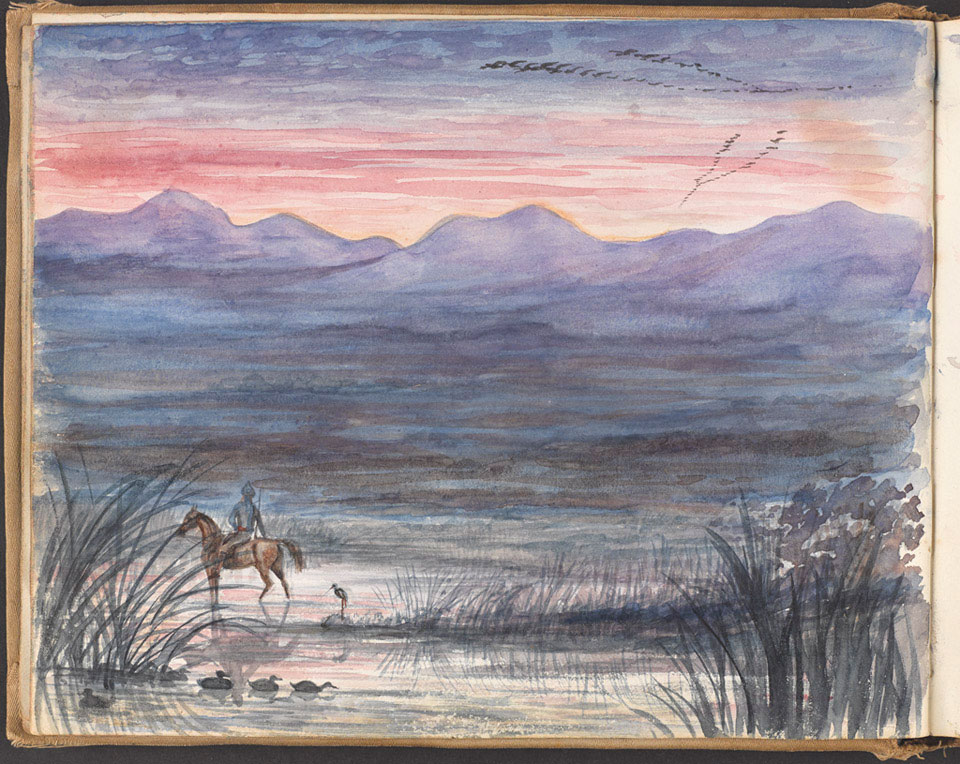
On Friday, 30 April, the column moved on from Kanth to Shajahanpore, known for the dreadful massacre at the church, some ten months earlier. All reports indicated that the place was occupied by a strong rebel force, and especially Russell, in his doolie, was on edge.
“…it was not pleasant to find myself at dawn this morning out in a wide plain, with only a cloud of dust in the distance to show where our column was marching. As the bearers, in compliance with a hint from a revolver, were turning towards the line of march, a body of eight or ten native cavalry came upon us out of a tope, shouting like furies, and brandishing their lances and sabres. I gave it up as a bad chance for life, but sat up in the dooly with pistols ready for action, and hoping that if I hit the leader, the others would think better of the matter and retire. The dooly bearers, to my astonishment, instead of dropping me and running for their lives, broke into a canter, but the horsemen soon came up with them; and just as I was about pulling the trigger on the leader, who had his lance point within a yard of the hindmost of the bearers, they swept by us towards our column, leaving two of their number to conduct the delinquent dooly men to their proper station. In effect, it was a patrol of Mooltanee horse, which had been sent out at night, and was now returning to the troops, and, in execution of their orders, they fell on the dooly, which was out of the line of march, and compelled the men to go to their proper place.“
Sir Colin Campbell would find that not only the Moulvie of Fyzabad but supposedly the Nana Sahib himself had, in fact, been holed up at Shajahanpore just mere days before he arrived; the last of their force had evacuated the day before and had made for Bareilly. It was, however puzzling to find the bridge of boats not only intact, but in perfect working order. Crossing over the river and through the stone gates of Shajahanpore, Russell was curiously reminded of frontier stations he had seen in Russia. That, however, might have been the effects of the copious amounts of belladonna that had been rubbed into his skin to dull the pain.
On the other side of the gates, there was another scene. The entire town had been ransacked, and every house which could be used to shelter troops was either razed to the ground or roofless. Only the jail was found to be partially habitable, but nowhere enough of it remained to provide sufficient shade from the relentless sun for so many men. Even the Shahjahanpore distillery was in shambles, but the few distillers who had stayed behind had managed to preserve the rum in the vats. To the delight of not only the men who were swift to declare the rum was indeed very good. The commissariat department was quick to add the rum to their stores before the entirety of Sir Colin Campbell’s column turned into drunken ruffians.
With camping in Shajahanpore out of the question, the column was moved back out into the open; the lucky ones found their tents pitched in a shady grove of trees on the other side of the river, but for the majority, they were left out on the bare plain under the tremendous sun. With temperatures regularly reaching over 100°F in the shade, the prospect of sleep during the day was merely a passing dream. Considering the destruction to the station, a fruitless attempt was made to fortify the grove of trees, but the proceeding was “so imbecile” that it was abandoned after a days work. The troops that would be remaining behind to garrison the place would have to do so from the ruined jail. At least the compound wall was still standing and when the rains started, the men would have enough shelter to stay dry. Some civilians had accompanied the force, those who had survived their sudden eviction from the district; they returned to the ruins of their homes and businesses, to see if they could salvage anything from the wreckage. One planter declared himself hopelessly ruined. Shahjahanpore, with its neatly tiled streets and pretty cantonments, had once been the belle of the Northwest Provinces. Now, there was nothing left. Most of the population had fled; the few that remained were “a few ill-looking, scowling fellows prowling about the streets, and some sweet-meat sellers at the corners.”
It was decided that the march would continue on 2 May. Staying behind in this ghost of a town would be Lieutenant-Colonel Hale and 500 men of the 82nd Regiment of Foot; remaining with them in their solitude would be De Kantzow’s Irregular Horse and a small artillery battery of two bullock-drawn 9-pounders and two 24-pounders. With every intimation laid before Hale to hold Shajahanpore come what may, the column pulled itself to its feet and turned its sights towards Bareilly.
The End in Sight
Russell, after his tussle with the horse, was still worse for wear. Instead of his leg showing signs of improvement, he was plagued with shooting and stabbing pain through his calf, which he found he could only alleviate if he placed his foot against the tent pole well above the level of his head. The doctors were somewhat mystified and treated him with leeches, blistering and more belladonna, a paste of which was smeared liberally over his leg. Whatever it was they were trying to achieve with these treatments appeared to have no effect; instead of lessening the lump in the hollow of his thigh, it grew in size and now spread from near his knee to within an inch of his hip. In dreadful pain, Russell once again resigned himself to his doolie to bear it and “ask no questions.” The weather had brought with it a low fever that was running rampant among the men, and one of the officers was laid low with smallpox. Both of Campbell’s ADCs were ill, and he had left a third in Lucknow acting as a prize-agent.
On 2 May, the column reached Tilhour. It was a “very ancient place, and we saw some fine old houses and mosques”, but once again, no sign of the rebels, who the spies had given out to be occupying the place in considerable numbers. However, as soon as the camp was pitched and Russell settled on his bed, there came the distant rumble of guns in the direction of Shajahanpore. The spies were obviously serving two masters, for as soon as Sir Colin was out of sight, the Moulvie wasted no time in attacking Hale at the jail.
“Hale, however, was strongly posted in the gaol; made excellent dispositions, and with two light and two heavy guns showed a front that held the enemy in check, and eventually he pounded them out of their close proximity to his position. The enemy, however, cut up some camp-followers and sowars, and captured hackeries and stores, &c.”
There was no going back, and as far as Sir Colin could ascertain, Hale was holding his own; he would have to continue to do so until Bareilly fell.
On May 3, they marched again, this time to Fatehganj; along the way at Miranpur Katra, as planned, they were joined by the Meerut Field Force, now under the command of Brigadier Jones. The next day, Sir Colin Campbell arrived at Faridpur, only one day’s march from Bareilly and the realm of Khan Bahadur Khan. Russell certainly treated this particular foe as newsworthy.
“There is great indignation expressed around me against Khan Bahadoor Khan, the rebel chief of Rohilcund. He is, it is true, a pensioner of ours, and a retired native judge, or sudder ameen; but he is also descendant and representative of Hafiz Hushmut Khan, the chief whom we slew in the battle which led to the overthrow of his rule in Rohilcund. We conquered the province for the Nawab Vizier of Oude, and now we have swallowed up Oude and the kingdom we gave the nawab. When he got an opportunity, he grasped at what he believed to be his own, and he did so in a way which no one can approve of, for his ways were treacherous and bloody. According to the lights of his faith and civilisation, the acts of which he has been guilty are not much worse than our own. He was appointed to his place years ago on the ground that, though unfitted for it, he could not, consistently with policy, be permitted to wander about before the people of India in a state of destitution.”
All the villages in the surrounding area were deserted; proclamations sent out in advance to soothe the villagers into staying in their homes had failed, and there was not a soul in sight. There were signs that the rebels were nearby, but across the vast plain towards Bareilly, there was no one to be seen, except the remains of their camps, and the sundry waste of a marching army. However, the spies were certainly working overtime as their stories were becoming more outlandish with every telling. Among the camp followers, there flew a rumour that the British would certainly be cut up to a man, for Khan Bahadur Khan was waiting for them with 30’000 infantrymen, 25’000 cavalry and three hundred guns. Bareilly was, they said, immensely well fortified, and not a mouse could pass the walls without being shot. Sir Colin Campbell had been told the same stories and only half-believed them. As a precaution, however, that evening his advanced picquet consisted of the left wing of the 93rd Regiment, with a squadron of the 9th Lancers and Tombs’ battery. As darkness set in, the men could see hundreds of campfires in the distance; as the night advanced, the rebels sent their patrols as close to the sentries as they dared but no one attacked. It was the quiet before the storm and it seemed everyone knew it.
Even Russell.
As I have resolved not to be cut up without a fight for it, and giving myself a chance, I had up my syce this morning, and warned him, under terrible pains and penalties, to lead my best horse always close to my litter, ready for mounting, with one revolver loose in the holster. I shall have a very miserable time of it. I am very weak, owing to starvation diet; to constant leeching and blistering. Today a huge, strong blister is applied from my knee to my hip, inside the leg. The heat tonight was very great. Sir Colin came into my tent to see how I was and told me, “Those fellows will fight tomorrow. All our reports declare they will stand. I’m sorry you’re not a little better able to be with us, and there’s Baird and Alison unfit for duty also.”
The fact is, we must get this work over, or the sun will become very deadly.

Sources:
Forbes-Mitchell, William – Reminiscences of the Great Mutiny (London: Macmillan & Co., 1894)
Gordon-Alexander, Lieut.- Colonel W. – Recollections of a Highland Subaltern (London: Edward Arnold, 1898)
Russell, William Howard – My Diary in India in the Year 1858-9 (London: Routledge, Warne & Routledge, 1860)
 Mutiny Reflections