Fatehgarh 23-27 April
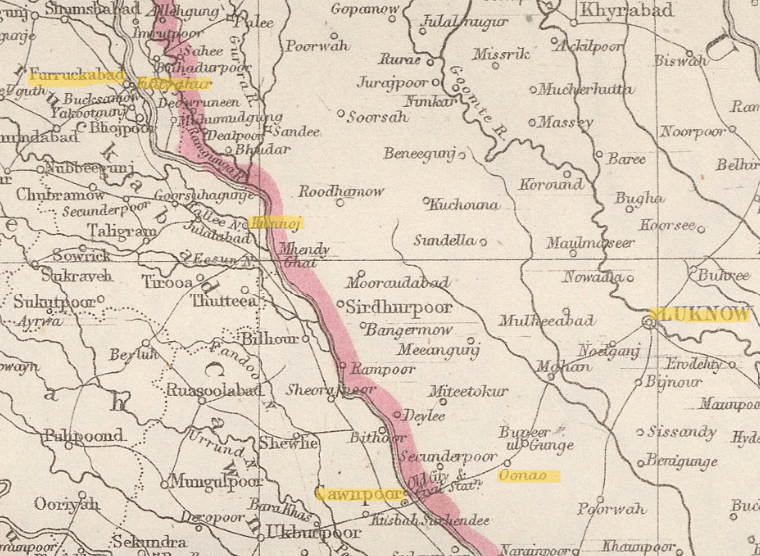
On April 23, they were on the road again toward Fatehgarh. They were now marching parallel to the Ganges, skirting past Kannauj (which Russell missed visiting as his guide never turned up, but several officers declared “it was a sham, nothing but old bricks and rubbish”), and onwards to Kamalganj. The road was “villainous to a degree,” but the suspension bridge over the Kala Nadi was intact, and by 25 April, they were in Fatehgarh. Here, Russell found his friends Baird and Allison quaintly drinking tea on the veranda of Legeyt Bruce’s bungalow, the very man he was carrying letters of introduction for and to his relief, Bruce offered him a room. After a leisurely breakfast, Russell, Baird and Allison delighted in the cool water in the ex-Nawab’s private swimming pool, examined the ruins of his palace and his once beautiful gardens. The scene might have been idyllic, but Russell rightly pointed out that the use of a Hindu temple as an impromptu officers’ club must have been disgusting to the people of Fatehgarh. In the courtyard of the temple, he was shocked to find a servant badly beaten and bleeding, lying out on a charpoy, his poor wife sobbing as she tended his wounds. He had been beaten with a bamboo stick by his employer, an officer with a particularly savage temper, who was above the current law. Besides a rebuke from his fellows at the mess table, he would receive no punishment for what was “… a savage, beastly, and degrading custom. I have heard it defended, but no man of feeling, education, or goodness of heart can vindicate or practise it.” The officer’s behaviour was merely put down to excessive drunkenness, and it was believed he would be right by morning.
While in Fatehgarh, Russell took time to speak to Colonel Seaton, “a very intelligent, smart, gentlemanly man, and in look and manner quite bearing out the reputation he has gained for decision, dash, and soldierly qualities.” Seaton had received a rebuke, albeit a good-natured one (“he shook his fist at ‘that little flourish of yours, sir,‘) from Sir Colin for his smart affair at Kunkur — it was, after all due to Seaton’s diligence that Campbell had arrived in Fatehgarh with “…nothing to delay his march, in the shape of blunders to correct, or reverses to retrieve.” Seaton, however, would not be going to Bareilly; that much was clear. It was not meant as a slight, and Seaton did not take it as such, for Sir Colin now needed him to be his eyes and ears across the land and river that would soon separate him from Oudh. On the 24th, General Penny rode into Fatehgarh for a final meeting with Sir Colin before he formally opened the operations in Rohilkhand. The intention was to give Penny command of Walpole’s column when the march to Bareilly was fixed, but as we have seen, fate had other plans in store for poor Penny.
At one in the morning, on 27 April, the march to Bareilly resumed. The column crossed the Ganges into Rohilkhand, with Russell now perched on the back of an elephant.
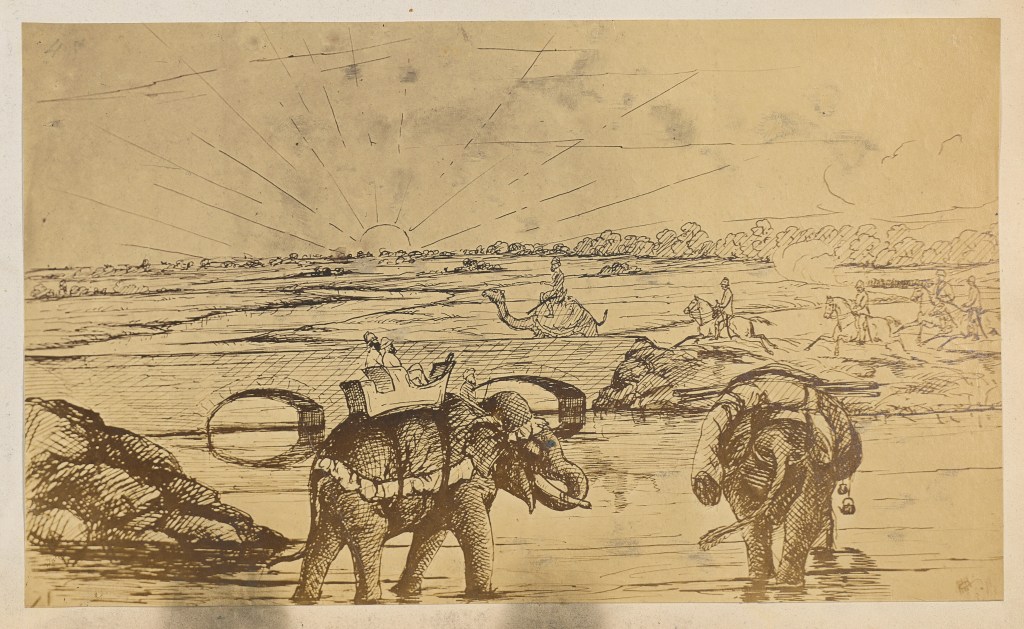
Colonel Macpherson, the Quartermaster- General; Major Stewart, Assistant Adjutant-General, and Maekinnon, formerly of the 42nd and myself, were told off to an elephant, which had something like the body of an Irish jaunting car placed on its back for our reception. I own that I mounted with trepidation, and had some doubts of the equilibre of the howdah. We passed out from the trees to the plain, which was peopled by ghosts flitting along in the moonlight. The scene was theatrical and strange-looking. The old fort of Futtehguhr, towering above the silvered flood of the Ganges, seemed the work of some grand canvassed Grieve, and it was only the dull roar of the multitude pouring over the bridge of boats which gave its real character to what was around us.
The wretchedness of this morning, this night and morning march! How one’s head went to and fro, at every jog of the beast in a sleep-compelling manner, which was irresistible. With what a jerk one caught himself up just as he was going to plunge head foremost fifteen feet to the hard sand! It was about o’clock when we crossed the Ganges and got into Rohilcund. Then for some hours we toiled over sands till we came to the Ramganga, a deep stream, which our elephant waded across, so that our feet nearly touched the water. The hathi (Hindi for elephant) nearly floated his driver off his neck. Higher up was a bridge of boats made by the rebels, which was taken the other day (23rd, I think) by Walpole, in a smart advance of cavalry and horse-artillery. The Commander-in-Chief was crossing it as we came up. Here our horses should have been waiting, but my syce was invisible, and I had to continue and jog on in the iron embrace of the howdah. For several miles, our course lay over fields strewed with horrid, bloated skeletons — the men killed in the pursuit from the Ramganga. Some of those who fell had white gaiters and other articles belonging to the Highlanders and Sikhs who were killed in the attack of Royea, so it is probable they were Nirput Sing’s men.
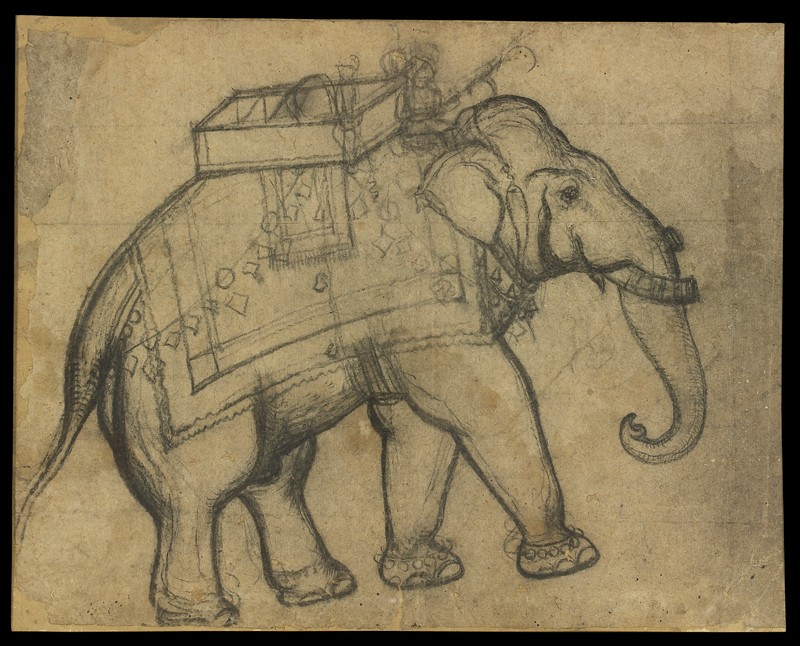
Oxford: Ashmolean Museum, Visions of Mughal India: The Collection of Howard Hodgkin, Andrew Topsfield, ed. (Oxford: Ashmolean Museum, 2012), no. 85 on p. 202, pp. 19 & 184, illus. p. 203
“The motion of the elephant made Stewart perfectly sick, so that he had to get down and mount Sir Colin’s carriage, which was near us at the time. I took up Colonel Pakenham and Norman, the Adjutant-General, whose elephant would not behave itself, and who were toiling on in the dust and heat of the sun, as their syces were also missing. The heat of this morning was beyond endurance. It seemed as if Tingree, for which we were bound, was inaccessible. At last, thank Heaven, we see our tents pitched and the bazaar flags flying, though the camp is in a sandy plain. I found everyone nearly as done up as myself; our mess tent not up. Breakfasted in Allgood’s tent; thirst, most distressing. Here we effected our junction with Walpole’s force.”
 Mutiny Reflections