28-30 April
At Aliganj, the objective of the day’s march, Russell found the officers of the 42nd and 93rd in a state of “furious wrath” at Walpole’s mishandling of Ruiya. It went beyond the death of Adrian Hope; their speech at mess bordered on violent, and Russell found it impossible to detail just what choice words they had for this most disagreeable commander. As for Walpole himself, Russell found his manners so unpleasant and the man so unpopular in camp that it was hardly surprising the men who served under him were on the brink of mutiny. To make matters worse, news arrived from Cawnpore that Captain Sir William Peel was dead. As if nature itself had taken objection to the day, she graced the camp that very evening with a ferocious dust-storm that blew down not just the mess-tent but several others and covered everything an inch of fine, powdery sand. It was hardly an auspicious start, but as usual, at 2 in the morning on 28 April, the force marched again, this time towards Jellelabad on the road to Shahjahanpore.
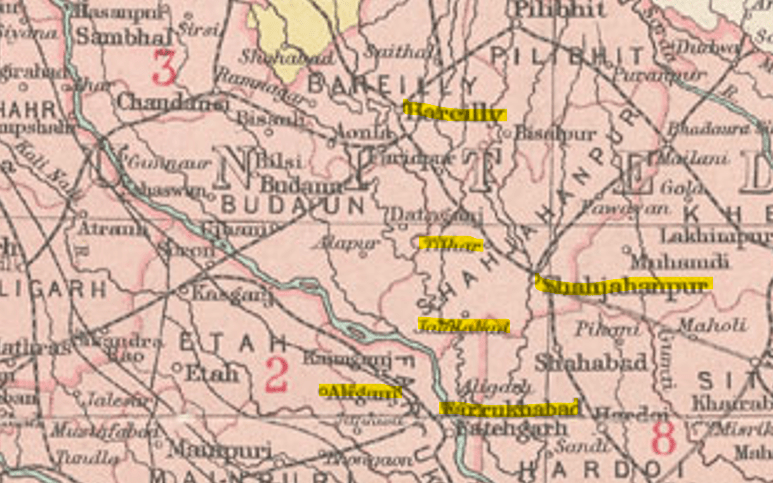
Russell had given up grumbling about the early starts, but on April 29th, he would have more than marching to be sore over, in more ways than one. Tired of riding next to Dr Tice, who was proceeding even slower than the rest of the column, Russell decided to push on before he fell asleep in the saddle, skirting along side the marching men, the carts and camels. His poor syce, who had been jogging along, trying to keep up, soon fell behind, and Russell found himself up to the guns of the advanced guard just as the halt was called. With his syce still not having caught up, Russell dismounted and gave his horse to someone else’s syce to hold, while he lay down on the ground and went to sleep on the side of the road. When the bugles sounded, Russell scrambled to his feet at the call of “Stand by your horses,” and found the syce who was supposed to be holding his horse had fallen asleep,
“…so that the other quadruped of which he was in charge had free access to bite, and kick, and fight with the only remaining horse I had available for a long march. All the stallions about us were squeaking and lashing out violently. I ran over to preserve my beast from being eaten alive, — but I was sleepy; my leg was stiff from the strain of the day before, — and, just as I was getting up to the head of my horse, a powerful Arab, belonging to Stewart, ran back to have a last go in at his enemy, and delivered a murderous fling, from which I could not escape, for my own horse was pressing hard against me. I saw the shoes flash in the moonlight. In an instant, I was sent flying along the ground under my horse’s belly. One heel had struck me just at the lower part of the stomach, but the steel scabbard of the sword I wore broke the force of the blow there, though the shoe cut out a small piece of skin; the other hoof caught me right in the hollow of the right thigh.”
Several men and officers rushed up, some grabbing hold of the horses and two officers helped Russell to his feet. They sat him down on the tumbril seat of one of the Horse Artillery guns of Tomb’s battery, and for the next three hours, sick, thirsty and in pain, Russell jolted along on the tumbril until they arrived at Kanth, the camp for the day. Russell was suddenly deposited with little ceremony onto the hard ground. Just as they arrived, the alarm was raised. The rebels, who had been keeping themselves at a distance from Sir Colin Campbell, had been sighted, too close for comfort, to the front. Tombs was ordered to gallop with his guns and horse to reconnoitre. While a dazed Russell sat on the ground, Sir Colin Campbell came up, dismounted and sat down near him – he was less interested in the sufferings of his chronicler but was venting his fury on one Mr Money. Money, a civilian very much in the same vein as “Hanging” Power at Fatehgarh, had taken it upon himself to hang a tehsildar who had surrendered himself in good faith to an officer on Walpole’s staff. The man had indeed gone over to the rebels, but more from necessity than actual conviction; he had communicated this openly to Captain Carey on Walpole’s staff and had offered good information about rebel movements in the immediate area. Carey promised him, for his good services, his life if he would come into camp and surrender.
That particular offer appears to have been lost on Mr Money, who had the tehsildar seized as soon as he set foot in the British camp and hanged him before Carey, or anyone else could intervene. Sir Colin was rightly appalled, saying, “Such behaviour will leave rebels no alternative but to hold out to the last.” Money was subjected to a very choice dressing down by Sir Colin and then, as soon as the story got about, to the anger of the other officers who declared he had sullied their names by forgetting that “the word of a British officer” should be held inviolate. It is only unfortunate that Lord Canning, upon hearing of the case, would take Mr Money’s side and declare his actions had been justified. By the time the case was before the government, Money had managed to twist the tale in his favour, declaring with some doubtful proofs that the tehsildar had, in fact, been a rebel ringleader, and the government would take him at his word.
As for Russell, after hearing the whole shameful tale of Mr Money, was offered a helping hand by Sir Colin, who put him on his feet and bid him hold the side of his horse as they made their way to camp. Russell staggered along, using his sword as a crutch, practically faint with pain. After breakfast, the doctor finally came in to take a look at him and found that he was, in fact, far worse off than first imagined.
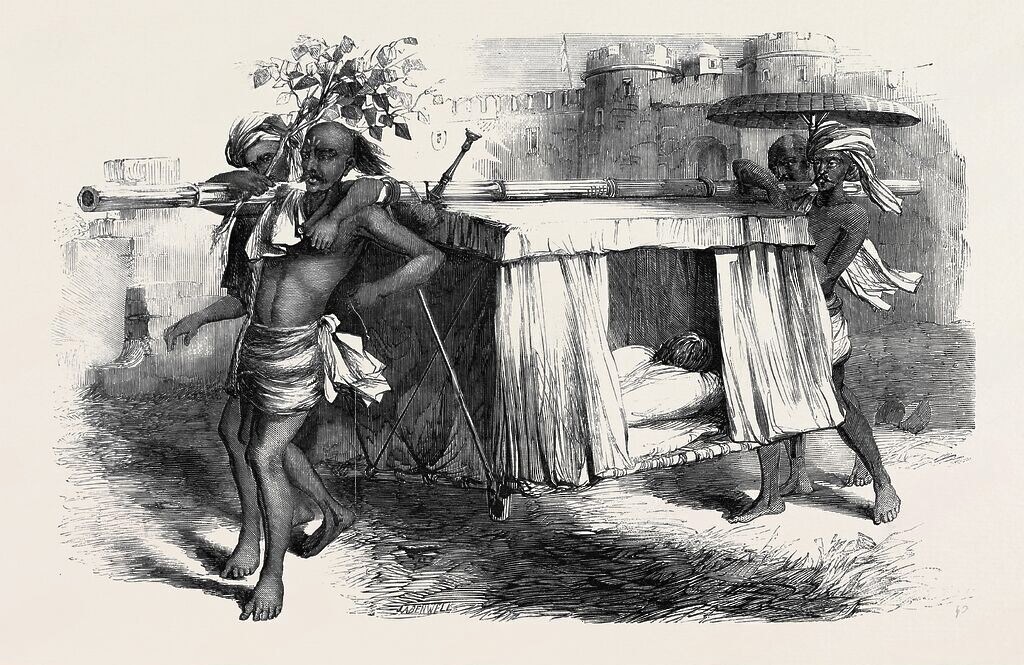
“A large, blood-coloured lump, the size and shape of a horseshoe, had risen up in the hollow of the thigh, and I was otherwise injured. Cold lotions ordered. I lay on my back all day in good Macpherson’s tent, listening dreamily to the hum-drum narratives of the endless spies who were coming in with all sorts of stories about the enemy, generally of a very poetical and unpractical sort. His tent was cool and airy considering the awful heat, and so in drowsy pain I lay all day. Tomorrow morning I must take my place in a dooly again. This is a bitter disappointment to me, but I have arranged that I may move
with the advanced guard, so as just to keep abreast of the guns; therefore, I shall not miss anything that is going forward.”
 Mutiny Reflections