The Brief Return of the Maulvi and Close of Operations in Lucknow
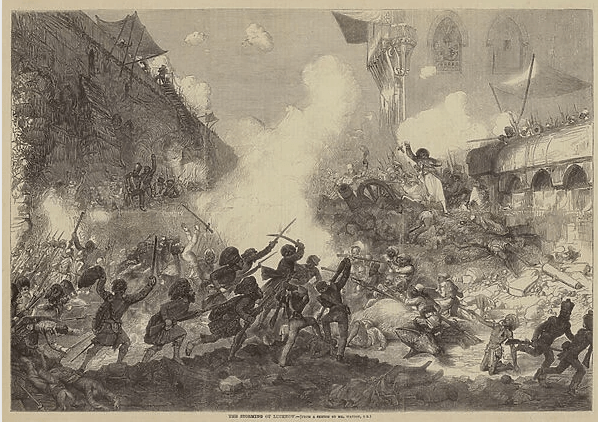
The British were certainly very occupied – so much so that no one noticed that Maulvi of Fyzabad had surreptitiously crept back into the city, bringing with him not just two guns but a large body of his most fanatical followers. He swiftly occupied a fortified building in the very centre of Lucknow, very much under the noses of every single British officer and trooper in the immediate vicinity. On the morning of the 21st, his presence was duly confirmed, and it was decided that without any further delay, he would be handed his marching orders. The right wing of the 93rd, the 4th Punjab Rifles and a detachment of sappers under Sir Edward Lugard were sent to deliver a strong message to the Maulvi and, with any luck, bring his head back to Sir Colin Campbell. What the Maulvi expected to achieve with this outright act of defiance was anyone’s guess, but he certainly was not going to wait for the British to capture him. The resistance, as long as it lasted, was “wonderfully fierce and violent,” and the 2nd-in-Command of the Rifles, Major Wilde, was one of the first to fall wounded. Eleven men of the 93rd, a further officer of the Rifles, along with several men, likewise fell wounded, but the insurgents, as soon as the force had managed to storm the house, got the worst of it. Those who decided they had had quite enough followed the fleet-footed Maulvi and escaped through the back of the building, but they left behind 150 men dead. This time, Brigadier Campbell felt compelled to take up the chase and did so for six miles across open country, cutting up stragglers as he went, but the Maulvi escaped.
The rebels put up one last stand on the 22nd of March at a small town called Kursie, 25 miles from Lucknow on the Fyzabad Road. Sir Hope Grant was sent against them, and at midnight, he set off with 2 troops of horse artillery, two 18-pounders, two howitzers, 4 mortars, 900 cavalry and four regiments of infantry. The 53rd Foot had been delegated to escort the heavy guns and mortars but got lost on the outskirts of the city, obliging Grant to wait for them to turn up. By the time they turned up, it was two in the afternoon and only after another two hours of hard marching did the force finally turn up in front of Kursi, to find the rebels were gone. However, perhaps out of idle curiosity, they sent a cavalry patrol of some 50 men to take a long, hard look at Grant, who immediately took the cavalry and artillery around the town, well out of range of fire, and saw the rebels he had come to fight with, well on their way across the countryside, their patrol following them with good speed.
Sending a few shots their way, two squadrons of the Punjab cavalry under Captain Sam Browne, a party of Watson’s Horse under Captain Cosserat, quickly took up the chase. Captain Browne was the first to spot the rebel guns and charged, riding five times clear through them, until 200 men lay dead on the ground, and their 13 guns and one mortar were captured. The rebel cavalry, for their part, charged three times, and though with each charge, their ranks thinned considerably, they never wavered. In the final charge, Adjutant Macdonald of the 2nd Punjab Cavalry was shot dead, and Captain Cosserat mortally wounded by a shot through the face. A Sikh sowar was shot through the stomach and fell off his horse. In severe pain, he managed to remount his horse and “galloped in the thick of the enemy, killed two of them and then dropped from his horse dead.” Brown finally called a halt to the proceedings – collecting the dead and wounded, and the captured guns, Hope Grant ordered the march back to Lucknow.
With this, the capture of Lucknow and the neighbouring areas was effectively concluded, but it would still be days before the last sepoys were expelled from the city. Some still managed to hold out for some more days, only making their presence known when temptation got the better of reason and they commenced shooting at people passing the houses they had chosen to barricade themselves in. In one of these last endeavours, it was the British themselves who nearly caused the death of the much-loved officer of the 93rd, Captain Burroughs, when the 97th Regiment, called up to make the same play, had decided to blow up the house from the other side, without realising Burroughs was on the roof.
“Burroughs, observing that there was a good deal of gunpowder in the vicinity of the house, decided to endeavour to blow the place up, and, ascending to the flat roof by an external staircase for the purpose of reconnoitring, suddenly observed a puff of smoke, and, rightly believing that it preluded an explosion, ran for the staircase. On his way down, the staircase was blown from under him, and a brick struck his right leg and broke it. In the fall, he broke it again and fell with the ruins of the wall on the top of him.”
Burroughs survived his ordeal with his leg intact.
The city of Lucknow, however, was not so fortunate.
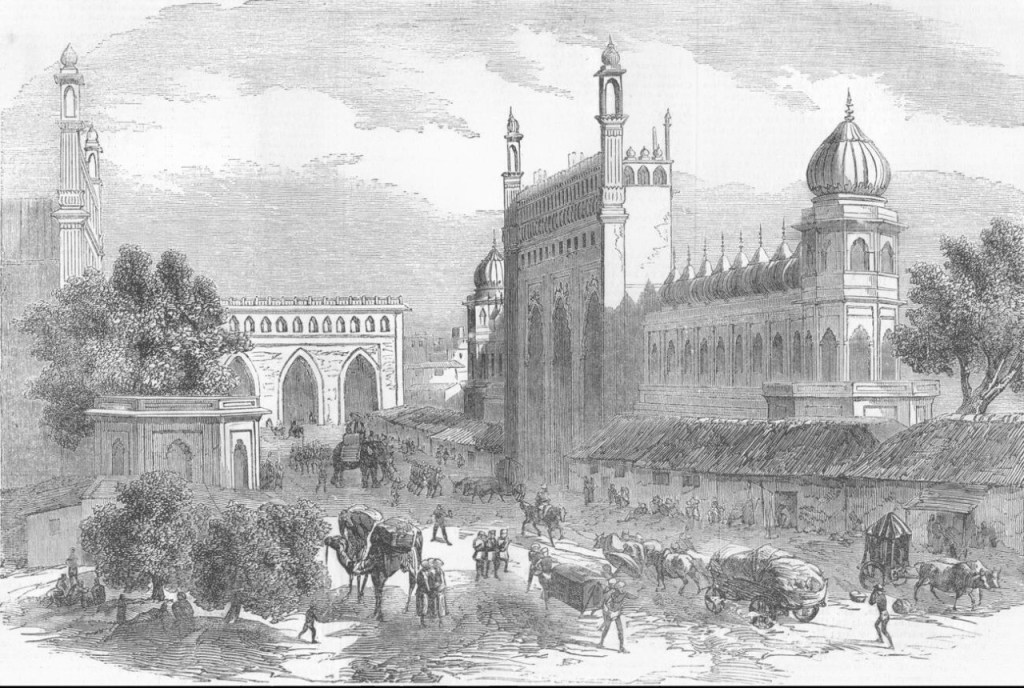
“Measures were now taken to invite the well-disposed citizens to return to the town, which the whole of the inhabitants had deserted, fearing, no doubt, the just vengeance of their conquerors, also the unwarlike section amongst them being also no doubt terrified into flight by the hail of round-shot, and especially shells, which had been showered on the city itself in the concluding week of the siege. These must have done considerable execution; for during the eleven days the 93rd occupied the main buildings there, we were continually discovering heaps of dead in courtyards and other open spaces, and I myself found, in a house near my post, several rooms full of dead in an advanced stage of decomposition. Many of the dead we thus found had, I believe, died of wounds received at the front, but there is no doubt that many also had been non -non-combatants, and were killed by our shells in the streets, and even in their own houses.” (Alexander)
The wounds inflicted on the city of Lucknow would take decades to heal, and some truly never would.
Sources:
Forrest, G. W. A History of the Indian Mutiny. Vol. 2. Edinburgh & London: William Blackwood & Sons Ltd., 1904.
Gordon-Alexander, W. Recollections of a Highland Subaltern. London: Edward Arnold, 1898.
Knollys, Henry, comp. Incidents in the Sepoy War, Compiled from the Private Journals of General Sir Hope Grant. Edinburgh & London: William Blackwood & Sons, 1873.
Lang, Arthur Moffatt. Lahore to Lucknow: The Indian Mutiny Journal of Arthur Moffatt Lang. Edited by David Blomfield. London: Leo Cooper, 1992.
Lieutenant-General Sir James Outram’s Campaign in India, Comprising General Orders and Despatches. London: Smith, Elder & Co., 1860.
Mackenzie, A. R. D. Mutiny Memoirs. Allahabad: The Pioneer Press, 1892.
Malleson, Col., ed. Kaye’s & Malleson’s History of the Indian Mutiny of 1857-58. Vol. 4. London: W.H. Allen & Co., 1889.
Rana, Pudma Jung Bahadur. Life of Maharaja Sir Jung Bahadur of Nepal. Edited by Abhay Charan Mukerji. Allahabad: Pioneer Press, 1909.
Roberts, Lord. Forty-One Years in India. Vol. 1. London: Richard Bentley & Sons, 1897.
Russell, William Howard. My Diary in India, in the Year 1858-9. Vol. 1. London: Routledge, Warne & Routledge, 1860.
Links:
https://reubique.com/00004258.htm#_edn17
https://www.news18.com/viral/why-cigarette-wale-baba-shrine-in-lucknow-is-worshipped-by-troubled-lovers-8447479.html
https://sites.google.com/site/littleshelfordhistory/famous-people-from-little-shelfords-history/frederick-wale
https://www.indiatimes.com/news/india/captain-wells-aka-cigarette-wale-baba-a-british-officer-whose-shrine-is-frequented-by-worried-lovers-610515.html
 Mutiny Reflections