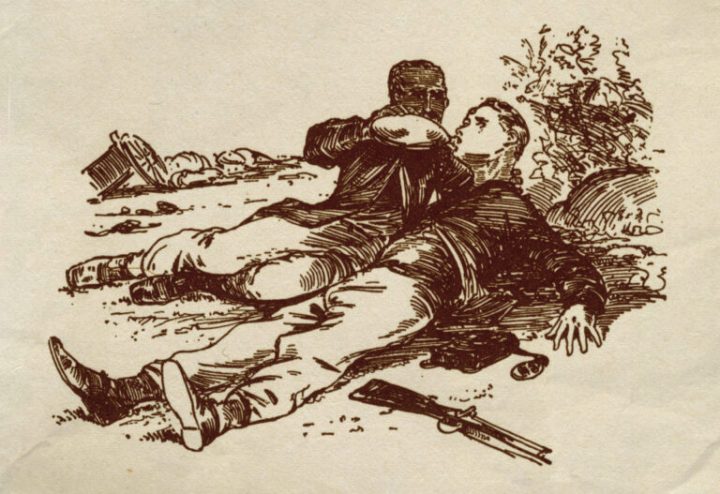
“During this morning’s work, I happened to come across a British soldier – I think of the 9th Lancers – who had been wounded, but not very seriously, though sufficiently to cripple him. He was lying patiently under a tree waiting for the hospital establishment to come up and find him; when I asked if I could do anything for him, he said he was suffering from the agonies of thirst and would give anything for a drink of water. ‘Would you prefer beer?’ I asked. ‘Oh, Sir,’ he replied, ‘ don’t make game of me.’ His face was delightful to see when I lugged out of my holsters a pint bottle of ‘Bass’ which I stowed in it according to my invariable practice, and knocked off its head by sliding my sword against it. The grateful fellow tried hard to make me drink half of it; but I could not resist the temptation of watching him swallow it to the last drop. When I presented him with a better Manilla cheroot than he had probably ever smoked in his life before, he began, I really believe, to think he was dreaming, and that such strange luck could not be real.” (Mackenzie)
The Fall of Lucknow – Part I and its conclusion in the first part of The Fall of Lucknow – Part II
12 March
3rd Company 14th Battalion, Royal Artillery
Gunner and Driver Henry Higgins – wounded severely
38th Regiment of Foot
Lieutenant Colonel W.J. Loftus – severely wounded
53rd Regiment of Foot
Private John Gavin – killed
1st Battalion, 20th Regiment of Foot
Private William Joyce – severely wounded
1st Battalion, 23rd Fusiliers
Colour Sergeant C.J. Lester – slightly wounded
Privates
Lemman, Joseph – severely wounded
Ragget, David – slightly wounded
Sumber, John – slightly wounded
Scott, William – severely wounded
2nd Battalion, Rifle Brigade
Private Joseph Lemman – severely wounded
2nd Punjab Infantry
Lieutenant P.W. Powlett – severely wounded
13 March
1st Battalion, 20th Regiment of Foot
Private Joseph Bead – severely wounded
1st Battalion, 23rd Fusiliers
Private Charles Davis – slightly wounded
38th Regiment of Foot
Private Robert Ball – slightly wounded
Private Michael Leaky – slightly wounded
79th Highlanders
Private James Logan – slightly wounded
90th Regiment of Foot
Corporal H. Adams – severely wounded
Private S. McDovett – slightly wounded
Naval Brigade
Able Seaman Edward Robinson – dangerously wounded
14 March
Staff
Lieutenant John Wall, D.A.Q.M.G. – killed in action. Shot in the spine.
Lieutenant Oglivie (Madras Sappers) – wounded
1st Battalion 10th Regiment of Foot
Captain John Cator – severely wounded
Corporals
Air, James – dangerously wounded. Died of wounds
McGarry, John – killed in action
Ryan – slightly wounded
Fennelly, Michael – wounded
Drummers
Cummins, Peter – dangerously wounded. Died of wounds, 30 March
Mahoney, David – killed in action
Privates
Akers, John – dangerously wounded. Died of wounds,16 March
Cleary, Michael – dangerously wounded. Died of wounds, 31 March
Connell, John – severely wounded
Connors, Cornelius – severely wounded
Connor, Bernard – dangerously wounded. Died of wounds, 23 March
Costello, Laurence – wounded
Cromey, Matthew – wounded
Crouch, James – wounded. Drowned 8 September 1858
Fogarty, Michael – killed in action
Hastings, John – dangerously wounded. Died of wounds, 16 March
Hennessy, Michael – wounded
Keyburn, Robert – dangerously wounded. Died of wounds, 28 March
Murphy, Thomas – wounded
Phelan, Patrick – dangerously wounded. Died of wounds, 16 March
Purcell, Thomas – dangerously wounded. Died of wounds 27 March
Shea, Patrick – killed in action
Sidey, J. – severely wounded
Sidney, David – dangerously wounded. Died of wounds, 15 March
Silk, Michael – slightly wounded
Sterling, Thomas – severely wounded
Teehan, Denis – wounded
Tinsley, Edward – dangerously wounded. Died of wounds, 15 March
1st Battalion 20th Regiment of Foot
Major W. Radcliff – wounded
Sergeant Jeremiah Buckley – slightly wounded
Privates
Abbott, George – severely wounded
Bannister, John – wounded
Cann, A. – slightly wounded
Cetfield, J. – slightly wounded
Chamberlain, Alfred – severely wounded
Doyle, John – slightly wounded
Fisher, William – slightly wounded by powder explosion
Farsden, John – killed in action
Halliday, Edward – killed in action
Head, Joseph – severely wounded
Hills, Charles – killed in action
Joyce, George – severely wounded
Lincoln, George – severely wounded
Marrow, R. – slightly wounded
Moore, N. – killed in action
Masterton, Hugh- severely wounded
Sullivan, Timothy – severely wounded
Walker, Edward – killed in action
Watson, William – killed in action
Webber, Thomas – killed in action
Winstanley, Thomas – mortally wounded. Died the same day.
1st Battalion, 23rd Fusiliers
Sergeant Jabez Carr – slightly wounded
Privates
Bungay, William – severely wounded
Clarke, John – slightly wounded
Gwatkin, Joseph – dangerously wounded. Died of wounds, 15 March
38th Regiment of Foot
Lieutenant-Colonel T.C. Kelly – slightly wounded
Captain E.J. Gloster – dangerously wounded. Shot in the abdomen.
Sergeant-Major Patrick McFadden – dangerously wounded. Died of wounds, 16 March
Sergeant Joseph Bell -severely burnt in an explosion of gunpowder. Died of wounds, 16 March
“One of the worst cases was Sergeant Bell…he was burned from the crown of his head to the soles of his feet. The doolies containing the sufferers stood in a row outside the back door of the palace, and they were taken in one by one, as fast as the beds could be got ready. Bell was one of those outside, and as his doolie was broken, and his body touched the ground – a circumstance which greatly added to his agony – I got him taken in before his turn.” (MacKay)
Corporal George Leadbeater- severely wounded
Drummer Thomas Grey – Killed in action
Privates
Alger, John – dangerously wounded
Allingham, William – slightly wounded
Bird, William – severely wounded
Boyce, Henry – dangerously wounded. Died of wounds
Cassidy, Patrick – dangerously wounded
Cripps, John – severely wounded
Henshaw, William – slightly wounded
Hill, Edward – severely wounded
Jones, Phillip – dangerously wounded
Mangan, John – dangerously wounded
Roach, George – dangerously wounded
Tippett, Henry – slightly wounded
Viner, William – dangerously wounded
90th Regiment of Foot
Corporals
Farrell, J. – slightly wounded
McMullen, D. – killed in action
Saunders, F. – killed in action
Privates
Canning, W. – severely wounded
Crompton, H. – severely wounded
Feeney, J. – severely wounded
Field, J. – severely wounded
Frazer, John – severely wounded. Aged 33, seventeen years service.
“…wounded by a musket-ball, which entered the left shoulder beneath the acromion, and passed backwards, apparently through the humerus, close to its head. March 2, 1859. There is now anchylosis of the shoulder joint. Much dead bone in fragments can be felt both from the anterior and posterior openings. General health good. 17th. The head of the humerus was excised, and it shows the track of the ball to be in a carious state. Numerous smaller pieces were also taken away by the gouge. Invalided.” (Williamson)
Godfrey, J. – severely wounded
Harper, S. – severely wounded
Jordan, H. – slightly wounded
Kilderry, J. – severely wounded
King, T. – severely wounded
McCann, O. – severely wounded
McKenna, F. – slightly wounded
Sharpe, D. – mortally wounded. Died of wounds
Smith, S. – severely wounded
Stewart, C. – severely wounded
Saunders, F. – killed in action
Ulph, J. – slightly wounded
Wager, J.W. – dangerously wounded. Died of wounds
Watson, J. – severely wounded
Wilson, J. – slightly wounded
Witchells, G. – slightly wounded
97th Regiment of Foot
Lieutenant-Colonel Thomas Onslow Winnington Ingram – killed in action. Aged 42.
Received the Order of the Legion of Honour, medal and clasp, and Turkish medal for highly distinguished service before Sebastopol; was killed in the Kaiserbagh in Lucknow, a ball passing through his head.
Born in 1816 to Reverend Edward Francis Winnington Ingram and Jane Onslow- their third son – Thomas was one of the 9 Rugby men, who at various times in 1857 and 1858 had served at Lucknow. He was commissioned to the 97th Regiment in 1836 as a cornet, promoted to lieutenant in 1842, captain in 1842 and major in 1854, followed a year later to Lieutenant-Colonel. His entire career had been spent in the 97th; for just over 20 years, he had served with the regiment in all their battles, including Crimea. At his death, he left behind his wife Jessie Maria (née Parsons), whom he had married in 1847 and their young son, Edward, aged 9.
He lies buried in the Lucknow Cantonment Military Cemetery.
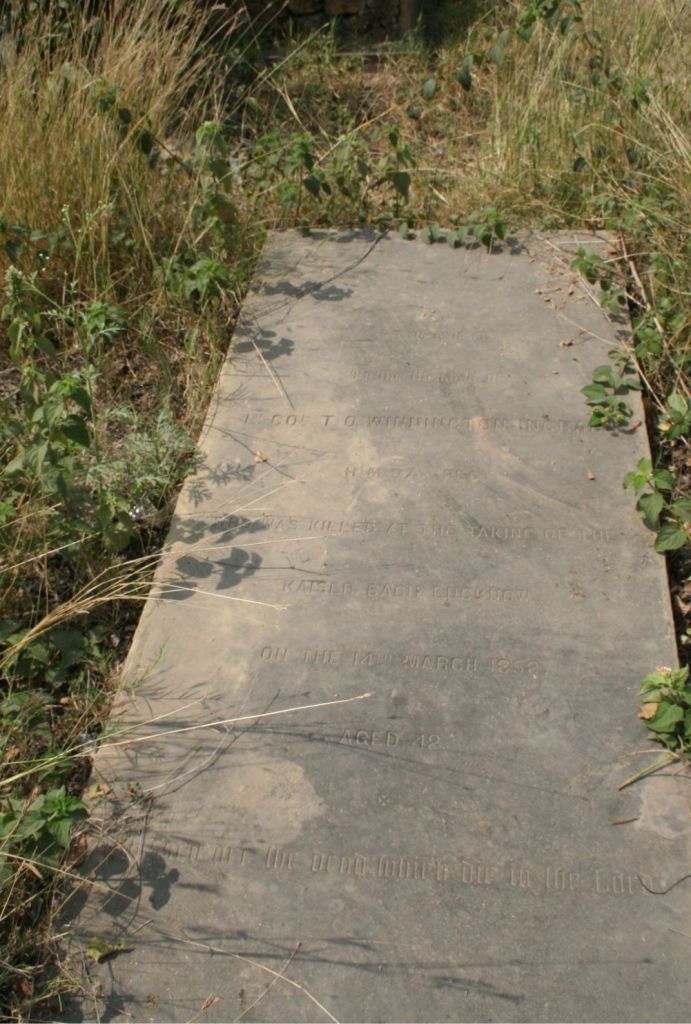
Blessed are the Dead which Die in the Lord
Sergeant Major T. O’Hara – dangerously wounded
Colour-Sergeant O’Keefe, D. – slightly wounded
Sergeant Thomas Fussell – slightly wounded
Corporals
Charnock, W. – slightly wounded
Singleton, T. – killed in action
Privates
Browne, E.P. – slightly wounded
Gunning, J. – severely wounded
Kelly, J. – slightly wounded
Meade, Joseph – slightly wounded
Ryan T. – wounded
Wharmby, John – severely wounded
“When returning by the Dilkusha, about sunset, I saw in the distance above the scene of our operations, in or near the Kaiser Bagh, the pillar-like cloud of smoke which indicates a great explosion of loose powder. The Dilkusha, at a distance of two miles, trembled, it is said, as if shaken by an earthquake. On reaching the Field Hospital there, I found that there had been a previous explosion and saw those who survived of the men who had been burnt. What an awful sight! The faces of some of those were black, and their bodies from head to foot were, in some instances, almost raw.” (Mackay)
Royal Artillery
Major W.W. Barry – severely burnt
Gunner & Driver Joseph Orr (3/8) – wounded
Naval Brigade
Able Seamen
Ahern, John – severely wounded
Green, Alfred – severely wounded
Bandsman George Hutchins – severely wounded
Private Henry Brummage – severely wounded
Regiment of Ferozepore (Brayser’s Sikhs) – 5 rank and file killed, 33 wounded.
Captain Lionel Gómez Da Costa (attached from the 58th BNI) – dangerously wounded. Died of wounds. Aged 34. At the time of his death, he was 2nd in Command of Brayser’s Sikhs. Born in 1824, he was the son of a merchant and had joined the service in 1841. His regiment, the 58th BNI, had been disarmed in Rawalpindi.
“At this moment, an officer, evidently dying, was carried past. He recognised me and gave a faint smile as he went by. Poor Da Costa! He had been persecuting the Head-Quarters’ people at Cawnpore to take him up to the front. He had plied every department with solicitations, used every stratagem; he had even extended his supplications by telegraph to Alumbagh for leave to get to Lucknow. At last, he came to me and begged that I would put him ‘on my staff!’ His regiment was gone in the mutinies, and he was nearly mad with anxiety to strike a blow at Lucknow for certain reasons. If I could take him, the tempter said—and at this time I was indeed in a fair way to fall before such temptation—he would ask my acceptance of that thorough-bred charger which he was riding as he spoke. Somehow or other he managed to become attached to a Punjaub regiment, and he fell early in the day’s work.” (Russell)
2nd Punjab Infantry – 4 rank and file wounded
Punjab Pioneers – 4 rank and file wounded
Delhi Pioneers – 1 rank and file wounded
Siege Artillery – 1 rank and file wounded
Sources:
Blunt, E. A. H. List of Inscriptions on Christian Tombs and Tablets of Historical Interest in United Provinces of Agra and Oudh. Allahabad: W.C. Abel, 1911.
Cope, William H. The History of the Rifle Brigade. London: Chatto & Windus, 1877.
Forrest, G. W., ed. Selections of Letters & Despatches & Other State Papers. Vol. 3. New Delhi: Asian Educational Service, 2006.
Gray, Robert. Reminiscences of India and North Queensland, 1857-1912. London: Constable & Co., Ltd., 1913.
Jocelyn, Julian R. J. The History of the Royal and Indian Artillery in the Mutiny of 1857. London: John Murray, 1915.
Mackay, Reverend. From London to Lucknow. Vol. 2. London: John Nisbet & Co., 1859.
Mackenzie, A. R. D. Mutiny Memoirs. Allahabad, 1892.
Munro, Surgeon-General. Records of Service and Campaigning in Many Lands. Vol. 2. London: Hurst & Blackett Ltd., 1887.
Munro, Surgeon-General. Reminiscences of Service with the 93rd Highlanders. London: Hurst & Blackett Ltd., 1883.
Russell, William Howard. My Diary in India, in the Year 1858-9. Vol. 1. London: Routledge, Warne & Routledge, 1860.
Verney, Edmund Hope. Shannon’s Brigade in India. London: Saunders, Otley & Co., 1862.
Watson, Edward Spencer. A Naval Cadet with H.M.S. Shannon’s Brigade in India: The Journal of Edward Spencer Watson. Kettering: W.E. & J. Goss, n.d.
Williamson, George. Notes on the Wounded from the Mutiny in India. London: John Churchill, 1859.
 Mutiny Reflections