At Lucknow
It was obvious Sir Colin Campbell was up to something, and only a blind man would not have seen that he was preparing to take Lucknow. Outram’s belligerent refusal to leave the Alambagh was proof of that, and as such, ever since December, the rebels had been reinforcing their citadel.
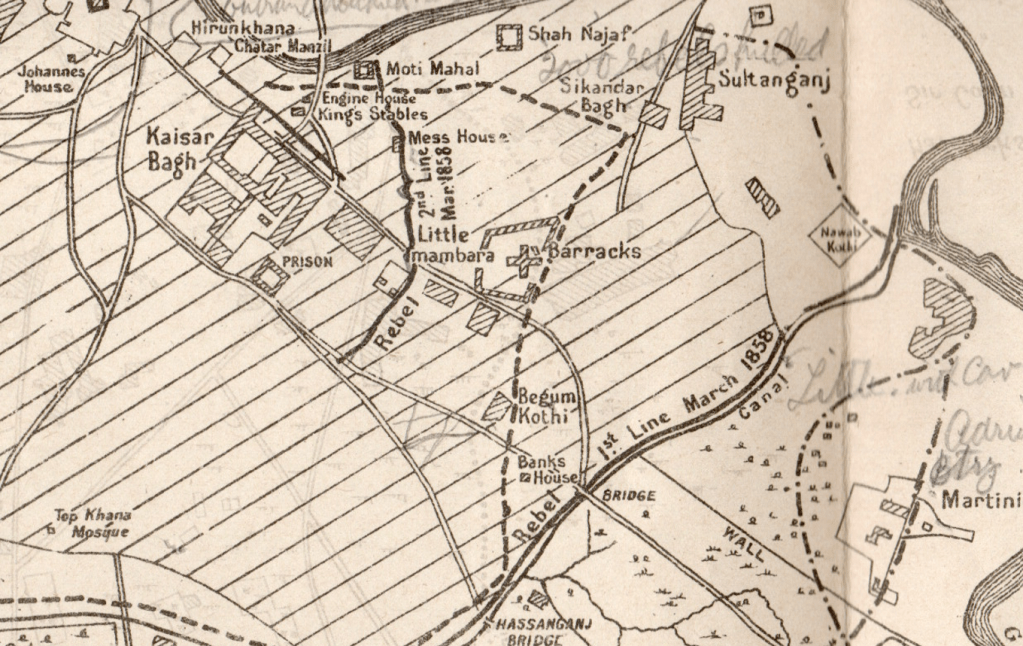
They now occupied the entire city and all of the buildings on the right side of the Gumti River. Defensively, the river provided cover on the north face. The east was covered by the canal, which ran to the river, forming a junction at right angles to the Nawab ki Kothi. The third side ran from the Char Bagh Bridge on the canal to the southern side of Lucknow. This was guarded by very strong posts, which included Banks House, a mosque, the Begum Kothi, Hazratganj, the Chota Imambara and the Kaiser Bagh. While they had taken great care to fortify these positions, the fourth or northern side of the city was left relatively open, but since the Bara Imambara and the Musa Bagh were here, it was considered to be of lesser importance.
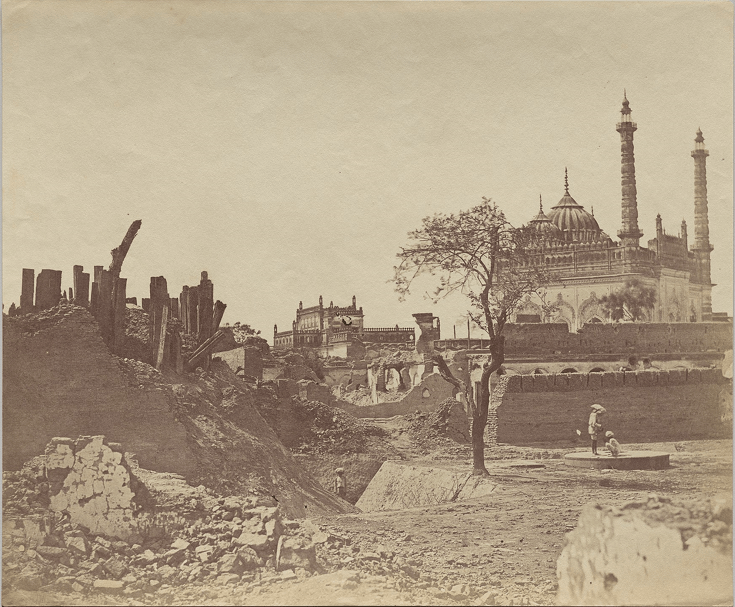
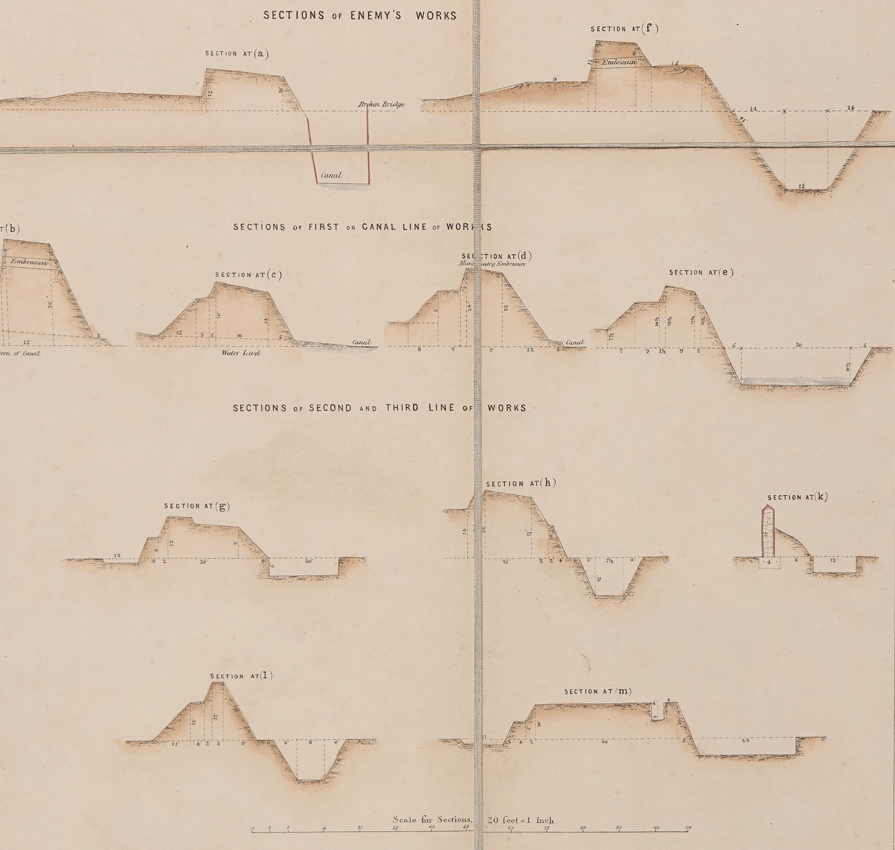
Employing thousands of workers, the rebels had taken on the task of making Lucknow nearly impregnable. The canal from Char Bagh Bridge until it met with the Gumti had been deepened considerably in some parts and the lower end strengthened by a deep and straight cut to supersede the “shallow and torturous bed near that point.” All the bridges had been destroyed, and then, scarping the banks of the canal, it could now serve as a wet ditch. From the canal’s junction with the river to the Char Bagh, they constructed, on the inner bank, a formidable rampart of earth and bastions. This completed their first line of defence.
The second line began at the river and passed in front of the Moti Mahal, encircled the Mess House and stretched the entire length to Hazratganj, where it joined at the Chota Imambara. They had further raised impressive earthworks barring the approach to the Kaiser Bagh – the British had been unable to take it under Havelock, and Campbell had refused to attack the palace complex outright in November, and it was now the key to the entire rebel position. At right angles to the Kaiser Bagh was possibly the most impressive of their works. A mass of buildings enclosed the rear of the palace complex, and these were put to good use, for here the rebels had mounted no less than 131 guns of all sizes. Meanwhile, if Sir Colin intended to rush up Hazratganj, he would be greeted by a strong battery of three guns, further supported by bases at the junction of the three main roads. To complete their defences, the rebels had also loopholed nearly every house and enclosure in Lucknow, every single gate to and from the city was defended by strong counter-guards, stockades and traverses had been built across all the main streets, and isolated batteries were ready to sweep a dreadful fire along them.
Unfortunately, for all their plans, and they were undoubtedly good ones, they had made one cardinal mistake and had simply thrown up stronger defences on grounds already well-trodden. Havelock had crossed over the Char Bagh Bridge in September, and Sir Colin had crossed the canal in November and attacked them from the Sikandar Bagh. They were presuming that either of these would again be the point of entry – unfortunately, no one seemed to think that the northern side was of any interest. Yet it was of great interest to Robert Napier, who was busily drawing plans for the assault. What the rebels failed to understand, Sir Colin had no interest in merely holding key positions in Lucknow, nor had he any need to engage in long and cumbersome street fighting to achieve his goal. He was planning to take Lucknow, and this time, he would keep it. With no women and children to save, he was also at leisure to take his time. Furthermore, he had enough men at his disposal to risk dividing his force.
The plan to take Lucknow was complicated, but also the most logical Robert Napier could have drawn up. By dividing up Campbell’s forces, a strong division would be sent across the Gumti, which then, marching up the river, would take the rebels’ position in the reverse, and by putting his artillery in good use, render it untenable. Simultaneously, his main force would cross the canal, and he could then turn their position and move via Hazratganj to the Kaiser Bagh.
“Whilst a strong force should hold the base of the triangle, Outram’s force would occupy one side of it. Rather more than one-half of the opposite side would be held by the Alambagh force and the Nepalese. Neither the remaining part of that side nor the western side could, with the troops at his disposal, be hemmed in, but it was to be hoped that as Sir Colin advanced his base, Outram might move round the angle on one side, whilst the Alambagh force and the Nepalese might close up round the corresponding angle on the other. Should the execution equal the design, the entire rebel force would be reduced to extremities.”
Although Sir Colin Campbell was obliged to wait with the final assault on Lucknow until Jung Bahadur arrived, he was not by any means sitting still. On the 10th of February, the very day he returned from Allahabad, a General Order was issued announcing the formation of the Army of Oudh into brigades and divisions. Major General Archdale Wilson, who had recovered his health, was nominated to command the artillery; to Brigadier Robert Napier was assigned the engineers, and Brigadier-General Sir Hope Grant retained the cavalry division. The infantry was divided into three further divisions, the first under Major General Sir James Outram, the second under Major General Edward Lugard, and the third under Brigadier-General Robert Walpole. This did not sit very well with some of the senior officers who had come explicitly from England for service in the field, and Sir Colin Campbell had to endure several insults and a measure of criticism for his choices of divisional commanders. In his opinion, however, for a man who had no previous experience serving in India, it was
“…quite impossible for him to be able to weigh the value of intelligence. In like manner, he cannot judge what are the resources of the country, and he is totally unable to make an estimate for himself of the resistance the enemy opposed to him is likely to offer…What is more, the state of things at the present does not permit of trusting anything to chance, or allowing newcomers to learn except under the command of others.”
While his reasoning was sound, he deliberately side-stepped Brigadier Franks and chose Walpole. Franks had displeased Sir Colin Campbell in his handling of the Dhowrara affair and, as such, would now have to bear his disgrace. With ruffled feathers all around, by 23 February, “on the sandy plains between Unnao and Banni were massed engineers, artillery, horse, foot, commissariat wagons, and camp followers…”
 Mutiny Reflections