“She was a woman of great energy and ability. She has excited all Oude to take up the interests of her son, and the chiefs have sworn to be faithful to him. The Begam declares undying war against us, and in the circumstances of the annexation of the kingdom, the concealment of the suppression of the Treaty, the apparent ingratitude to the family for money lent, and aid given at the most critical times, has many grounds for her indignant rhetoric.” (Russell)
The Administration of Lucknow
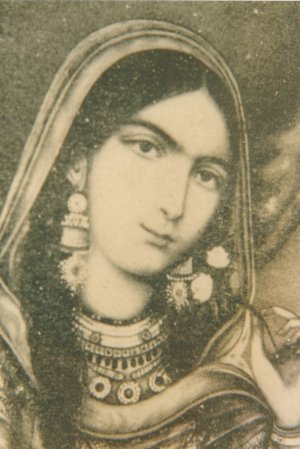
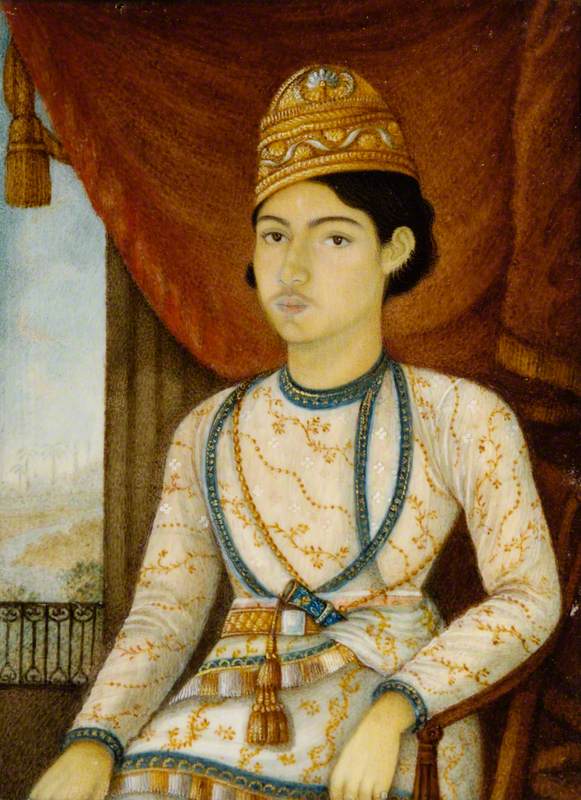
There had been some changes in Lucknow since the start of the mutiny in the previous year. The East India Company had been effectively shown the door, and a new government had taken its place, and leading it was Begum Hazrat Mahal, a former wife of Wajid Ali Shah, the last ruler of Oudh. She had refused to accept exile in Calcutta in 1856 and had remained behind. For ten months during the mutiny, she would rule Lucknow as an independent regent in all but name.
At the start of the uprising, she declared her minor son, Birjis Qadr, as the ruler of Oudh, but due to his age, it was clear that until he attained adulthood, his mother would be holding the reins of power. However, all orders henceforth were issued in her son’s name, and she even sought legitimation of his rule from the Mughal emperor of Delhi, which was duly given, and Bahadur Shah Zafar granted Birjis Qadr the right to rule Oudh in his name. Recognised as a legitimate government, the new rulers soon gained widespread support in the province. However, while the rebels recognised the minor ruler, they also had conditions of their own for Hazrat Mahal.
1. That orders from Delhi were to be obeyed and that whatever orders were received should be final.
2. That the Wazir should be selected by the army.
3. The officers of the Regiment should not be appointed without the consent of the army.
4. Double pay was to be issued from the date of the sepoys’ leaving the English service.
5. No interference should take place respecting the treatment and disposal of those who are friends of the English.
It was clear that the army intended to keep its autonomy from the start, a division which, as time passed, would become increasingly difficult for the overall cohesion of the rebellion. It must be remembered, the mutinied regiments had, for the most part, given their allegiance to Delhi and while the Mughals were in fact very much done and dusted by 1857, in the eyes of the rebels, the ambition to return them to power was the only viable option for they wanted a return to “old traditions, following an antique drum.” The reinstated court at Lucknow, on the other hand, wanted to be legitimately recognised by Delhi, but not necessarily under its yoke. They wanted to return Oudh to its position as an independent state as it had been before the annexation in 1856. The ambitions of the rebels and Lucknow were similar, but not always reconcilable. Although they respected the traditions of the Mughals of Delhi and needed their recognition, it was purely a political motivation to legitimise them in the eyes of the rebels who had thrown in their allegiance now with Lucknow.
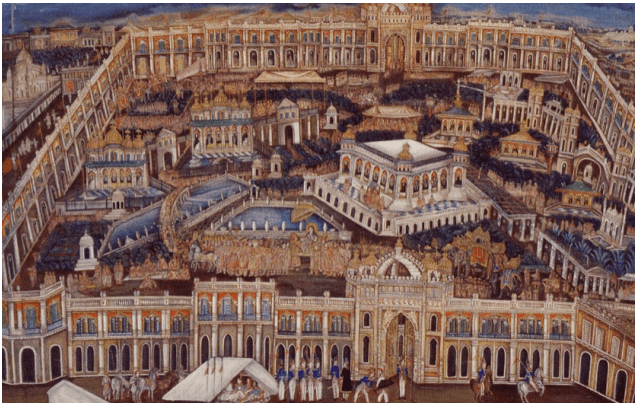
Hazrat Mahal, however, also recognised she could not run a government and an army single-handedly. Two independent bodies were therefore set up, one to deal with the details of administration and the other to handle the military. The first was run mostly by old courtiers and bureaucrats who had previously served in some position in the old Oudh court.
Shurufuddowlah Naib
Mummoo Khan Darogah Diwan Khana (in charge of the Hall of Audience)
Meer Wajid Ali Naib of Diwan Khana
Meer Kasim Ali Darogah in charge of the Magazine
Maharaja Bal Kishan Diwan (Finance Minister)
Munshi Thakur Dayal Household Munshi and Paymaster
Meer Mehndi, Chief of the Intelligence Department
Ahmed Hussein Darogah of Nazul (Land Settlements)
Sewak Ram Naib of Thakur Dayal
Munshi Amir Hyder Sahib-e-Duskut (Royal Letters, purser)
Muzaffar Ali Khan General
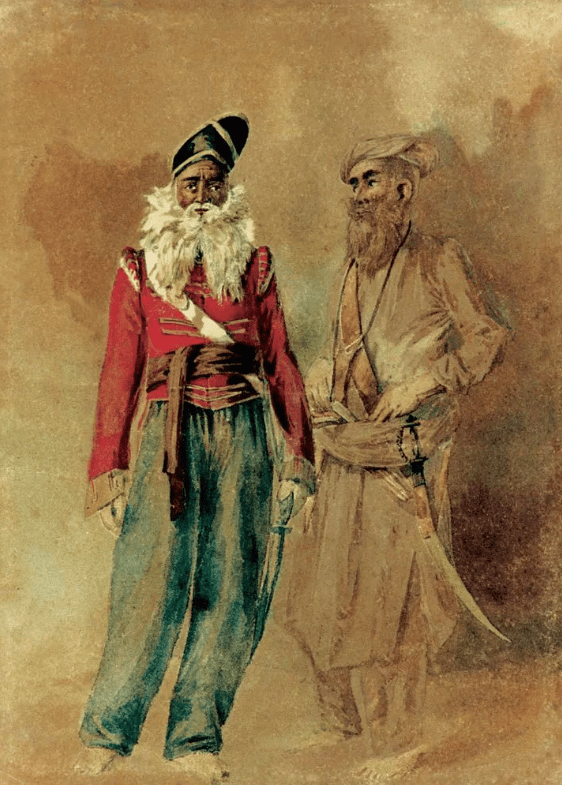
The military department, which was in charge of daily operations, such as attacks on the Residency or the deployment of troops, was composed mostly of sepoys and rebel soldiers with a smattering of the officials listed above.
Sheikh Sukun Rissaladar Weston’s Horse
Wajid Ali Khan Rissaladar 1st Oudh Irregular Cavalry
Jehangir Khan, Captain Artillery
Ghamandi Singh, Captain Orr’s Regiment
Rajmund Tiwari, Bole Regiment
Raghunath Singh, Captain, Police Battalion
Umrao Singh, Police Battalion
Burkat Ahmed, Rissaladar, 12th Irregular Cavalry
Mummoo Khan
Muzaffar Ali Khan
Mir Kasim Ali
Sangam Singh, Captain of Begum’s New Regiment
Surjoo Singh
Raja Jai Lal Singh
Of these, Raja Jai Lal Singh assumed most of the military command of the rebels at Lucknow. The one-time Nazim of Azamgarh was a close confidant of Hazrat Mahal, and he held a key position on her military council and took part in all major decisions, including the procurement and coordination of supplies and planning of operations. Nothing happened without his consent, and he oversaw everything from the digging of entrenchments to the organisation of scaling ladders and the distribution of labourers. He was often seen superintending the attacks on the Residency himself, and without his approval, no assault was allowed to commence. He also had the mammoth task of acting as the spokesperson for all the troops in their dealings with the Lucknow government, something Bakht Khan had attempted at Delhi, with middling success. However, Raja Jai Lal Singh did fairly well, at least for the first six months. Bakht Khan was beset with shortages in food and pay for the troops almost from the very beginning; he also had the daunting task of booting the British off the Ridge. In the beginning at Lucknow, amply supported by the local talukdars and zamindars of Oudh, supplies were forthcoming from the outlying districts to feed the army that was gathering in Lucknow, and there was still money to be had.
Shortcomings in Lucknow were quickly remedied – percussion caps and ammunition were produced locally, and artisans from Delhi were sent to assist in their manufacture. Similarly, following the evacuation of Lucknow by Sir Colin, 3’000 nine-pound and 2’000 eighteen-pound shot were recovered from the wells in the Residency, where they had been tossed for lack of carriage. The lead the British had left behind at the Dilkusha, too, was repurposed and turned into bullets. Meanwhile, at Faizabad, a workshop was set up to repair heavy guns. A rudimentary rule of law was set in place – although the Residency was besieged, the rest of the city was expected to go about its business. Unlike Delhi, newly arrived regiments were prevented from plundering the city; at the same time, anyone found dealing with the British would face death. Courts were in session, and the Begum regularly held darbars. She was known to visit the soldiers in camp and showed an active interest in their needs.
While all of this was undoubtedly a sound way of running a war, in reality, there were problems. The one factor necessary for a cohesive army is obedience, and unfortunately, many of the talukdars who joined the Lucknow cause continued to act independently and in accordance with their own views. Many of the rebel leaders were loath to follow Lucknow blindly and would need to be forced to by bribery or other means to tow the line. Their natures were also somewhat fickle.
“Loni Singh, the rebel talukdar from Mithauli, handed over Captain Orr and Mr Jackson (whom he had sheltered) to the Lucknow court on pain of a heavy fine and the loss of his ilaqa to Man Singh. He had paid no heed to the earlier hukamnama issued to him. Yet he was a well-known rebel leader who fought against the British till the very end and had welcomed the coronation of Birjis Qadr with a gun salute. Similarly, Harprashad, the chakladar of Khairabad, another rebel leader who fought till the very last, disregarded orders to surrender the belongings of some Englishmen that he had with him.”
And then, of course, there was the Maulvi of Faizabad. It seems, wherever he went, discord and strife were not far behind. On his arrival in Lucknow in December 1857, he demanded that Hazrat Mahal and her son relinquish power to him, claiming he was led by divine right. He would set himself up as a king, and the Begum and his son could remain as his disciples. This idea did not sit well with Hazrat Mahal or her followers, who constituted the Oudh regiments, the contingent corps and the Najibs, but it seemed like a fine idea to the sepoys from Delhi and the inhabitants of the city. The two factions managed to come to some kind of an agreement, but by January, the Maulvi was up to his old tricks, and this time, the situation led to blows.
“The exact cause is not clearly known. Some say that the Maulvee commenced to form a bridge of boats across the river near his residence at Ghaoghat and that Mummoo Khan sent a force to compel him to desist. Others again state that the Moulvee issued a ‘hidayah Namah’ to the boy King, whose mother then desired the soldiers to declare either for him or for the Maulvee and on their declaring for him (i.e. Birjis Qadr), she ordered them to seize the Moulvee and hence the origin of the disturbance…a fight did take place and that a large number of men, probably not less than 200, were killed and wounded.”
He could not resist meddling in the Begum’s orders and was instrumental in stopping twelve regiments from marching to meet the advancing Gurkhas in open battle. He used his old tactic of sowing discord in the ranks, and in a carefully worded letter, he stopped the regiments dead in their tracks. The intention of the Begum, he said, was not to stop the Gurkhas, but to get the regiments out of the way, so she could surrender Lucknow to the British, whose rule she was most anxious to re-establish. Furthermore, her advisor, Shurf-ood-dowlah, was nothing more than a base traitor to the cause, and he should be put to death. The regiments returned to Lucknow in blatant disobedience of the Begum’s orders. Meanwhile, when Sir Colin Campbell marched into Lucknow, the Maulvi was free to state he had only accomplished it because Shurf-ood-dowlah had obviously let him, and the man was put to death by his own men. When it was clear the fight was all but lost, the Maulvi was one of the first to scarper and continued his personal revolt around the Oudh countryside for some months to come.
Begum Hazrat Mahal retained control of her government until the very end, even when she was forced to flee. Interestingly, although her seat of power was gone, her authority remained, and she managed to keep at least some administrative order among the men who followed her on her flight. Everywhere she went, orders continued to be issued in her son’s name, and a new body of administrators, called the Parliament, had taken the place of her old courtiers. Unfortunately, suspicion and hostilities were running rife between the sepoys led by Bakht Khan and the administration that the Begum was trying to maintain. She enlisted the help of several religious leaders to “whip up flagging zeal”, and as late as September 1858, guidelines for sepoys and the commanders were issued in the name of Birjis Qadr, proving that even without a court, the Begum still had power.
“Every man should … now try to do his best to maintain the authority of the Sircar in the Country …It is therefore the wish of the Sirkar that the 22nd Suffer [1Oct. 1858] every Sirkaree fauz which is close to the British troops shall make an attack on them at the fixed time and give them no quarter. During the engagement, every Sepoy shall follow the advice of his Officer and act accordingly. . . .
Every officer should also not act selfishly and should obey the orders of the Officer in Command, whether the latter be a Nazim, Chukladar, Sipah Salar or Markh Salar and making it one common cause would commence operations on the fixed day.
They should be very careful that no mistake or misconception occurs regarding the day fixed for the campaign, and the Troops, Nazims, Chukladars, Talooqdars and Zemindars should all commence at once.”
Paying an Army
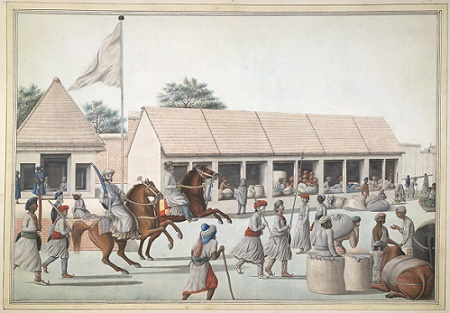
While the coffers of the Lucknow court were by no means empty, they were also not inexhaustible and as more and more regiments arrived demanding to be paid, it became imperative to generate money. The question was, how. Revenue had all but ceased despite officials sent from Lucknow to collect it, and no one from the districts was paying anything to anyone; likewise, taxation had vanished. For a time, gold and silver jewellery were melted down and turned into coins to pay the sepoys, but it was hardly enough and desperate measures were resorted to:
“Mummoo Khan and Rajah Jeylal Singh went and dug up rupees etc., from Aly Nukee Khan’s House, and brought them into the expenses [exchequer] and disbursed in pay whatever was absolutely necessary… Once Jeylal Singh, Meer Hussoo, a Mutsuddi and Chobdar of the Dewan Khana . . . went to the Arghai’s house in Narkass and dug up l,000 gold Mohurs, and 29 or 30,000 rupees, one khasdan, 1 gold spitoon. “
Two wealthy merchants of Lucknow, Chandi Shah and Dinanth Mutsuddi, donated to the cause to the tune of five lakhs and two lakhs rupees respectively. In December, it was arranged for the talukdars to receive the remission of revenue in order to pay their troops.
The problem, however, was also in the army itself. The old sepoys of Oudh regiments received 12 rupees a month, but the Delhi sepoys received Rs. 7, which could be one of the reasons they were more interested in following the Maulvi, who promised them all a better rate of pay at Lucknow. To keep the army happy as a whole, it was deemed that the family of every sepoy killed in action would receive a pension of Rs. 100 while a wounded sepoy would be given Rs. 50. Unfortunately, this was fine until money began to run short and the complaints started coming in, as this example from Rana Beni Madho, addressed to the Lucknow government, points out:
“The troops stationed at Salon demand their arrears of pay from the Chakladar, Muhammad Fazl Azim Khan Bahadur and the Taluqdars, who make professions of loyalty, harbour designs of the non-payment of half of the government dues as allowed to them by the Sarkar. Under such conditions, it is not possible to pay the daily allowance to the troops, as sanctioned by the Government …The affairs here being all topsy-turvy, there is every likelihood of the enemy’s intervention. I, therefore, out of my anxiety beg to submit that if the persons at the helm of affairs in this Sarkar intend to continue the administration of this ilaqa in the hands of Muhammad Fazl Azim Khan, they should issue an order of censure to the army strictly enjoining upon them not to demand anything more than the daily allowance from the Chakladar, nor to disobey him but to discharge their duties faithfully. They should also issue letters of remonstrance to the Taluqdars holding out threats of punishment in case of failure to pay up the Wasil Baqi of 1262 Fasli …. Another letter confirming confidence in him be issued to Muhammad Fazl Azim Khan stipulating therein that after realising the arrears from the Taluqdars and making the payment of daily allowance to the troops, he should send the balance to the Sarkar and that he should do all he can to curb the power of the wicked. But if the men in authority there think of entrusting this work to someone else, immediate orders may kindly be issued to the Taluqdars and to the army, pending which the ilaqa is likely to lapse into chaos.”
Although it does show that every effort was being made to maintain order and control, it did not prevent many of the rebel leaders from overcoming the problem of cash independently, by plundering. This would be a feature of the mutiny right up to the very end, with bands of rebels regularly looting villages, waylaying travellers and robbing merchants. One leader went so far as levying a tax of Rs. 1 for every house still standing in the hamlet of Kursi. Although much of the rebel army was being fed by landowners, they had long since resorted to collecting their arrears in pay by any means possible. It was not a case of Robin Hood who stole from the rich for the benefit of the poor; it was instead, the desperate, robbing the poor to help themselves. Benevolence did not feature much in the story of the mutiny, on either side. Ultimately, the court of Lucknow was financially bankrupt, and it spelt an end to their already dwindling monarchy. This does not mean there was not wealth to be had in Lucknow – the loot carried away from the city after its fall was proof of that – but it would have been beyond anyone’s ability to pay the sepoys in silk cloth, fancy items such as Chinese vases and European porcelain, and precious stones when these could not be commuted into anything useful. The sepoys wanted money, not trinkets, no matter how valuable.
The Army of Lucknow
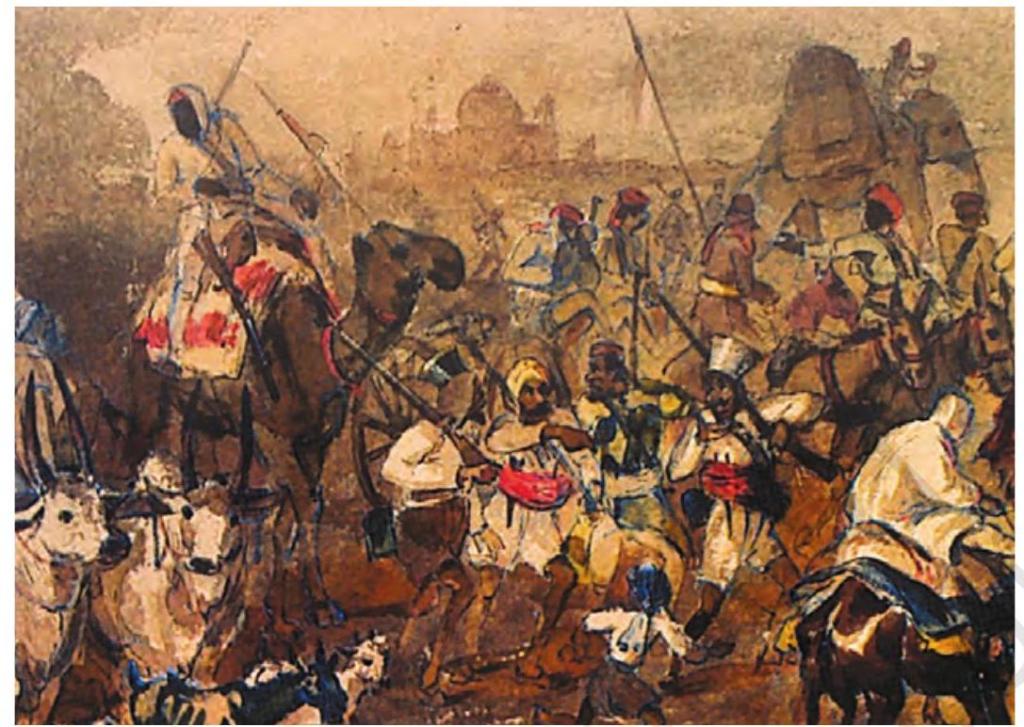
Following the fall of Delhi in September, many of the rebels who had fought there made a beeline for Lucknow. Still out of the hands of the British, with money, food and shelter to offer, it seemed like the best place for the outcast rebel regiments to find an anchor. From around October 1857, no less than 12 infantry and three cavalry regiments were fighting in Lucknow. They were reinforced by the local levies raised by talukdars – although there are no accurate figures, it must be considered that nearly every talukdar in Oudh had thrown in his lot with the Lucknow rebels.
“Man Singh, Hanwant Singh, Bishwanath Baksh, the son of Sangram Singh of Allahabad, the raja of Amethi and Davi Buksh were the chief talukdars who were personally fighting in Lucknow. Rana Beni Madho with 2,000 men, Raghunath Singh of Khajurgaon with 2,000 men, Dishon Singh of Simerpaha with 1,000 men, Bhagwan Baksh of Nain with l,000 and Sahajram of Pakhramow with l,000 men were also entrenched in the city and received khilats (dresses of honour), binding them to attack the English in Alambagh. The intensity can be assessed from the fact that early in October, 5,000 rebels were either killed or wounded in an encounter outside the palace gates when 200 Europeans were trying to reach the Residency.” (Mukherjee)
Right into November, rebel regiments were still flocking to Lucknow. 200 men of the Sappers and Miners, 300 sowars and eight guns made their appearance in Lucknow and on the 19th, as Sir Colin Campbell was evacuating the Residency, a further five Delhi regiments arrived, dragging along six more guns. Although they did join in the fight, they were unable to prevent the evacuation or destroy Campbell’s army. However, it was one of the reasons why Sir Colin determined the Residency was a false position – with the city insecure and daily reinforcements pouring in, with no food forthcoming from the city as merchants were either unwilling or unable to supply the British, without the possibility to either repair his guns or make sufficient quantities of ammunition, much less clothe and shelter his army, Campbell knew retreat was the only option left to him. It would have taken a much larger army to dig him out of Lucknow had he chosen to stay; the months of preparation this would have taken would most likely have doomed those remaining in the Residency long before it set foot in Oudh.
The rebels, too, had objectives. Firstly, the Alambagh was a thorn in their side from the very day Havelock had taken it from them in September. To add to their annoyance, the British held the road to Cawnpore. However, they proved unable to oust the British from the Alambagh, no matter what they threw at them and the Cawnpore Road, too, remained mostly out of their hands. It was not for a lack of trying:
“The Moorchabundee of the forces surrounding the Alumbagh is as follows:- 1st at the Talab, Futeh Allee, Rajah Madho Singh with 1,600 men and 4 guns, also Rajah Rambuksh Pokrawallah with 700 men and 1 gun and 500 sowars of 15th Risala. 2nd – at the Jumel Bagh, talab Dwarakadas Rao Dorrgabuksh, commander with 2 Regiments, the ‘Jurrar’ and ‘Burk’ and 1 gun, also Raja Suhujram with 1,000 men and 3 guns. 3rd at Husnapoor 1 Regiment of 500 men, 4th, at the Fort of Jullalabad, 1 Regiment (the 7lst), also 500 Nujeebs and 1,200 sowars of the 12th and 15th Irregular and 2 guns. 6th – at Julalpoor, Mullo Singh Zamindar of Nara with 500 men. 7th at Tipra Khairah, the Regiment of Toorum Baz Khan, 700 men. 8th at Gurh Kuniarpoor, the Regiment of Wazeer Khan, 500 men and 1 gun (kalanag). 9th at Jhangeers Regiment Nasir Beg 400 men and I Goorda gun. 15th 200 Nujeebs and 1 gun(the numbers omitted are not mentioned in the letter).”
When Outram took over the Alambagh in November, the existing troops surrounding the position were strengthened with a further three regiments, 500 sowars and five guns; and Raja Man Singh joined up, giving 2000 men of his force of 7000 to the cause.
Similarly, when the British advanced to take Lucknow in November, they upped the stakes.
“The disposition of the troops now is on the west and east sides of the English; in the centre surrounding the Palace, the King’s army; in the Satara Peshwa’s house, the Moulvie; in Hauatgunge, the mutineers and the Talooqdars’ men. Access by the Goomtee is closed except by the Stone Bridge. The rebels, now reinforced by the Delhi Regiments, have sworn to die in Lucknow, and further reinforcements are pouring in from the districts, and all are now of one mind.”
What Campbell faced on his advance was not a mindless, badly led rabble and many he would face again in March. Over 60% was drawn up, not from sepoy regiments, but directly from the areas surrounding Lucknow.
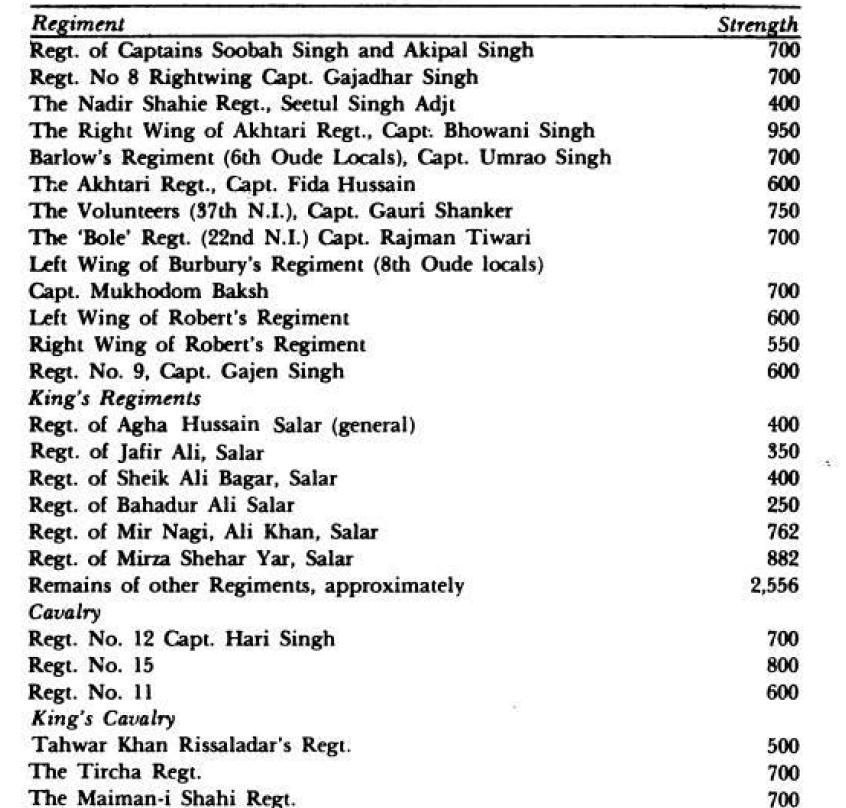
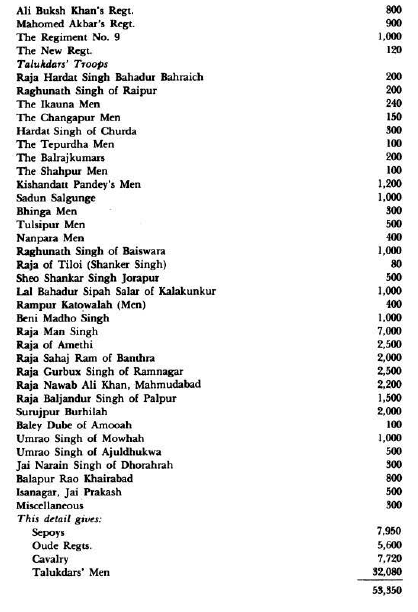
As soon as Campbell had disappeared into the distance and Lucknow was firmly in their hands, the number of fighting men increased again. By January 1858, it was estimated to be a little under 100’000 men of all arms with 12 of the 14 Delhi Regiments, though incomplete, now accounted for at Lucknow.
However, Hazrat Mahal and her advisors were wise enough to not concentrate their entire army in one place, and as such, instructions were sent out to the nazims of Sultanpur and Gorakhpur to collect their own levies, while the talukdars in southern Oudh were ordered to stop the British advance at all costs. The talukdars of Gonda-Bahraich similarly reinforced the Nazim of Gorakhpur, and in Dariabad, the brother of Raja Man Singh prepared an army of 5000 men and three guns to act as reinforcements wherever needed. In Faizabad, as early as September, a regiment was assembled, consisting of sepoys and najibs. The Nazim of Sultanpur, Mehndi Hussain, was certainly a man of some ability, and he managed to gain the support of all the talukdars in the Sultanpur and Faizabad districts (bar one, Rostum Shah). Hussain’s personal army was estimated to be between 8’000 and 10’000 men.
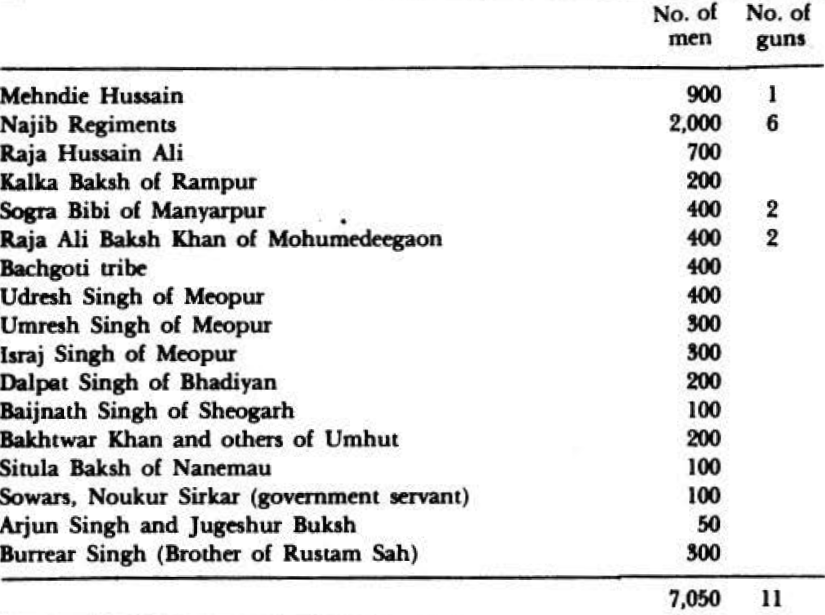
None of these forces moved to Lucknow but remained in their districts for the sole purpose of preventing the British advance through the borders of Jaunpur and Allahabad, and they would certainly put the field forces of Rowcroft, Franks and Jung Bahadur Rana of Nepal to the test.
The Beginning of the End
Unfortunately for the rebels, the tide had begun turning against them as their defeats overwhelmed their successes. They had singularly failed to stop Havelock’s advance to Cawnpore and his subsequent march to Lucknow; Delhi had fallen in September, Greathed and then Grant had fought them with success at Agra and on the march to Cawnpore. In November, they had been unable to prevent Sir Colin Campbell from evacuating the Residency or Outram from remaining in the Alambagh. Although Windham had made a hash of things at Cawnpore, Sir Colin Campbell put things back to rights and thrashed not only Tantia Tope but the Gwalior Contingent in December. He then took Fatehgarh. Meanwhile, the road between Calcutta and Allahabad was carefully guarded, so much so that the railway was back in operation between Allahabad and its end point, only 70 miles from Cawnpore. The Sarun and Jaunpore Field Forces, too, had done their duty.
To make matters worse, Sir Hugh Rose was bringing in victory after victory in Central India, and while it would take somewhat longer in Bihar (where Kunwar Singh would keep everyone on their toes until April 1858), by March it was clear the net was gradually closing in around Oudh. Already in December 1857, Begum Hazrat Mahal had summed up her mounting displeasure to her council:
“Great things were promised from the all-powerful Delhi, and my heart used to be gladdened by the communications I used to receive from that city but now the King has been dispossessed and his army scattered; the English have bought over the Sikhs and Rajahs, and have established their Government West, East and South, and communications are cut off; the Nana has been vanquished; and Lucknow is endangered; what is to be done? The whole army is in Lucknow, but it is without courage. Why does it not attack the Alumbagh? Is it waiting for the English to be reinforced, and Lucknow to be surrounded? How much longer am I to pay the sepoys for doing nothing? Answer now, and if fight, you won’t, I shall negotiate with the English to spare my life.”
She had been quick to realise that her army, though grand in numbers, was poorly led, riddled with inept commanders and inexperienced leaders. The sepoys had been trained by the British to fight; they had not been trained to command. Only a few, such as Bakht Khan, could handle an army in the field, which was a far cry from the smaller companies they had been used to ordering about while serving the EICo. The sepoys themselves were trained as a cohesive force under their own officers, but these had to be ever-present and always in front. Although their new commanders had styled themselves as colonels, majors and captains, none of them had the experience to pull off what a single British officer could on the field. This had not been a mere oversight – the British deliberately undertrained their native officers and now, in the mutiny, this was proving to be the bane of the rebels. The sepoys undoubtedly fought well and on many occasions proved they had not forgotten what they had been taught, but it was all for nought when there was no one to lead them to victory.
The problem was compounded by the fact that the local levies were loyal to their own headman in battle, and while they were valiant fighters, they lacked discipline. If their leader left the field, so did they. Very few had ever faced the artillery fire of the British or a bayonet charge. Their antiquated matchlocks were hardly a match for the Enfield. Considering the types of arms that were routinely found on the battlefields, it was clear to the British that they were not only fighting sepoys, but peasants whose sole weapons were bows and arrows, shields, spears and swords, like men from another age. The rebel cavalry, too, could rarely be brought to engage on the field – they were more often seen hovering about on the sidelines and, if opportunity presented itself, pilfered the baggage in the rear, but even this they achieved with middling results.
Missing too, from the army of Lucknow were notably Kunwar Singh, who had returned to Bihar intending to free it from the British once and for all, while the last Marathas, the Nana Sahib, was being chased from pillar to post, and Tantia Tope had thrown in his lot with the rebels in Central India. Ideological differences, too, were starting to make their play – the Marathas were still nowhere near rebuilding the empire they envisioned and were disinterested in assisting the Oudh government in reaching their goals, which were not of empire but the permanent re-establishment of Oudh as an independent state on Mughal lines. Everyone could agree they wanted to be free of the British, but their personal ambitions were now taking centre stage, dooming what was once a united cause to ultimate failure.
While the rebels at Lucknow still had the will to fight, they no longer possessed the ambition to be victorious, as their cause crumbled into the dust with every passing loss. It had turned into a “desperate fight against all possible odds and of surrender and reconciliation before a superior military power.” Their only option was to die fighting or hang on a gibbet. By February, many of the talukdars had had a change of heart about the whole thing and began withdrawing from Lucknow; Mehndi Hussain was facing the same problem of desertions. In the face of the advancing Gurkhas, others simply decided that was one army they did not want to face and went home. Even the ever-shifty Raja Man Singh, who had been so staunch to the rebel cause, now changed his mind for good. He gathered up his men and retired swiftly to his fort at Shahganj. In March, before the final fall of Lucknow, he tendered his submission and full surrender to the British. His defection opened the first breach in relations between the rebels and their leaders: Man Singh’s men now had a choice; continue fighting on their own, or bow down with him. Many of them chose the former and would continue their struggle against the British to an uncertain end.
All this said, however, the rebels would still put up a fight at Lucknow, whether for the Begum, the Maulvi, their own leaders or for themselves; Sir Colin Campbell would soon find out that desperation is possibly one of the greatest motivators for men who have nothing left to lose except their lives. In March 1858, all eyes, rebel and British alike, turned to Lucknow.
Sources:
Chaudhuri, S. B. Civil Rebellion in the Indian Mutiny 1857-59. Calcutta: The World Press Private Ltd., 1957.
Hibbert, Christopher. The Great Mutiny: India 1857. London: Penguin Books, 1980.
Majumdar, R. C. The Sepoy Mutiny and the Revolt of 1857. Calcutta: Firma K. L. Mukhopadhyay, 1957.
Mukherjee, Rudrangshu. Awadh in Revolt 1857-1858: A Study of Popular Resistance. Delhi: Oxford University Press, 1984.
Russell, William Howard. My Diary in India, in the Year 1858-9. Vol. 1. London: Routledge, Warne & Routledge, 1860.
Sen, Surendra Nath. Eighteen Fifty-Seven. New Delhi: Publications Division, Ministry of Information and Broadcasting, Government of India, 1957.
 Mutiny Reflections