Cawnpore, which Sir Colin Campbell had designated as the rendezvous for the regiments destined for Lucknow, was a hive of activity. Officers scurried about, haranguing tailors with impossible orders for thousands of summer uniforms, and others scrambled to procure wicker helmets for their men. Horsemen proceeded to the bazaar to try and catch a good price on a new steed while the leather works busied themselves with all the accoutrements that just a horse would require.
The great siege train, that now included two 56-pounders, rattled its way over the Bridge of Boats, while elephants, camels, baggage, infantry and cavalry pressed into Cawnpore. A vast canvas town had sprung up on both sides of the river, and daily new tents rose and fell as regiments destined for Lucknow made way for those who had just arrived. Vivian Majendie watched the spectacle with some awe, for it was,
“…one constant in-pouring and out-pouring of Highlanders with big legs, of line regiments, and riflemen, sailors, and artillerymen, of bronzed and bearded soldiers in astounding cap-covers, and with a certain tough look about them, more satisfactory, I should imagine, to the eyes of an Englishman than a Sepoy. The glittering bayonets of regiments on the move caught the eye at every turn; the inspiring airs, such as ‘Cheer, Boys, Cheer,’ ‘Far, far upon the Sea,’ and that well-beloved march of the Rifle Brigade, ‘I’m Ninety-five,’ with a variety of other pleasant familiar tunes, which had a joyous, careless life in their every note, rang in your ears till you almost wearied of the sound, or came faintly from the far distance, so far off sometimes they sounded, that I half fancied they must have been wafted to us straight from home across the wide sea; bodies of Sikh irregular cavalry, composed of big-whiskered, swarthy, stalwart men, each one a picture down to the waist, but with something wrong about their legs which are decidedly of the broomstick order- spurring about in every direction; sailors in the baggy- est of trousers, and with a rollicking air, not to mention certain mysterious lumps in their cheeks, possibly having some connexion with ‘pig-tail,’ were polishing up black monsters of siege guns till their lacquered surfaces glistened and shone again, or, patting the breeches of 10 – inch mortars, in playful and encouraging anticipation of their services against ‘them there black rascals;’ officers and others in the commissariat department were proving the ‘existence of perpetual motion’ in their own persons. All was life, bustle, and excitement, and no light task must his have been those who had the management of this vast machine, swelled almost beyond all bounds by the enormous staff of camp-followers, indispensable to an army in India.”
If it all seemed strange, all this coming and going had a purpose. Sir Colin Campbell would not take Lucknow in a rush – indeed, there was no reason to do so, for the Residency had long been relieved – for most of February, he was placing the regiments at his disposal along the route to Lucknow, like chess pieces, to line the road. When the time came, they would all advance to Lucknow.
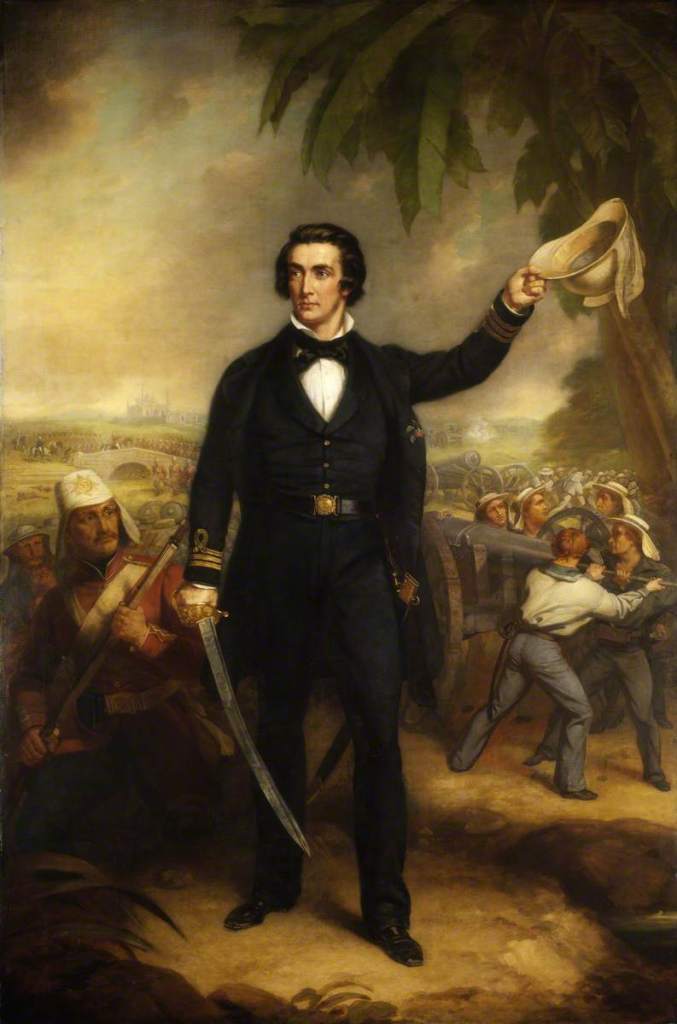
One of these regiments was Peel’s Naval Brigade. Having marched up from Fatehgarh, they arrived at Cawnpore on 7th February. For the next two days, the sailors of the fatigue party busied themselves mounting guns in the entrenched camp – by the 12th, they were on the move again. They recrossed the Ganges and made for Unnao, where they would remain until the advance to Lucknow began. Joining them was the right wing of the 93rd Highlanders, and on the 14th, the Royal Artillery. If Cawnpore was busy, Unnao was no less so.
“February 14th, Sunday – The Royal Artillery with their guns are encamped close to us. Their guns are
mostly 24-pounder siege train ones. We formed a square with the Royal Artillery and 53rd Regiments this morning and had church. We have got a good open space for a parade ground, close to our tents, and where we have packed our guns. Great care is always taken after the march in packing the guns, which is forming them in a good line, and sometimes in a square, with their tumbrils and ammunition wagons in the rear of each gun. If this is done well and orderly, it looks neat, and tends to the credit of the corps to whom they belong.”
And it was certainly a sight more exciting.
Unnao had been the scene of one of the many victories of Sir Henry Havelock, and as such had not lost its importance in the eyes of the rebels, who would have dearly liked a chance to have it back. Although hardly in numbers large enough to attack the place, there was no one to say they could not spend their time in mounting punitive and irritating raids on the areas surrounding the town. The men in camp were told to never venture out without their arms and never go alone. Alarms were not uncommon with the regiments continually having to turn out, the artillery prepared for action for an enemy who was then more than once chased off by the 9th Lancers. The rebel cavalry was often seen hovering in the distance, almost like spectres, keeping a close eye on Unnao but never venturing close enough to engage in a skirmish. However, the alarms continued, and Majendie was not opposed to looking at these continued annoyances with some humour.
“Stand to your arms! the Saypoys is a coming!”
A hideous clatter, a rushing of men past your tent, a shouting, a neighing of horses, who possibly imagine that the noise is in some way connected to feeding – an unwonted hurry and confusion, and ringing again and again through the camp of “Stand to your arms, the enemy are coming!” You are in a sort of summery dishabille of pyjamas (loose cotton trousers) and shirt sleeves, and you find as difficult to collect your ideas, which have travelled with you from Dreamland, as it is to collect to your luggage at London-bridge station…pyjamas, shirt sleeves or mental aberration, when you are going out to get shot very possibly?
Away you rush, buckling on your sword as you go, and meeting more men in shirt sleeves, who also cannot collect their luggage – I mean their ideas, – and buckling on swords very fast, and swearing gutturally – but I fear earnestly – to themselves, or mounting their steeds in the hottest of hot haste; and as you pass a tent door, you catch a glimpse of a wretched mortal a la belle nature, or very nearly so, (he having been employed in the operation of ‘tubbing’ when the row commenced), now engaged in the impossible feat of getting into a pair of trousers hind-side before, and fastening around his waist a revolver at one and the same moment, and vociferating madly for his bearer and of course, swearing desperately. Elsewhere is another wretched mortal trying to get on a boot, tumbling and hopping about on one leg in a manner stupendous to behold, very red in the face, and using exceedingly strong language,consighing all sorts of people and things, and himself among the number, to perdition and elsewhere, in a by no means Christian spirit.
Everyone says the enemy are coming, some men swear they can see them, or very nearly, but they are not quite sure in which direction, nor, in fact, are you. Conjecture is at a loss; officers are still galloping to and fro…A dead silence pervades the camp now, almost oppressive after the noise and confusion, and one could not help thinking, that ‘Jack Sepoy’ would be a sad fool if he chose this moment for making his attack; and I suppose, ‘Jack Sepoy’ thought much the same, for he did not put in an appearance that day, and, indeed, I believe he had never had the slightest intention of doing so…We returned to our tents, cheroots and pyjamas and heard nothing more of the matter till evening, when Sir Colin Campbell appeared on the subject of alarms generally, concluding with a request that on similar occasions, staff officers would not ‘gallop wildly about, vociferating to regiments to turn out, and thereby cause panic.’ whereat we who were not on the staff chuckled not a little.”
The other sizeable encampment was at Banthera, only a few miles from the Alambagh – it was here that Sir Colin Campbell would once again assemble his regiments before the final advance on Lucknow. However, much to his irritation, he was now delayed.
During his interview with Lord Canning at Allahabad, Campbell had been instructed to wait for the arrival of Jung Bahadur of Nepal and his Gurkhas before advancing on Lucknow. It was a gesture of friendship, said Canning, and he did not want to risk insulting Jung Bahadur. He had marched to India of his own free will and offered his men to Canning, and it would hardly do, then, to go to Lucknow without him. It would, Canning’s words, “drive him wild to find himself jockeyed out of all share in the great campaign…I am convinced he would break with us and go back to his hills within a week. The loss of this help would be very inconvenient, but to find ourselves on bad terms with him would be more so.”
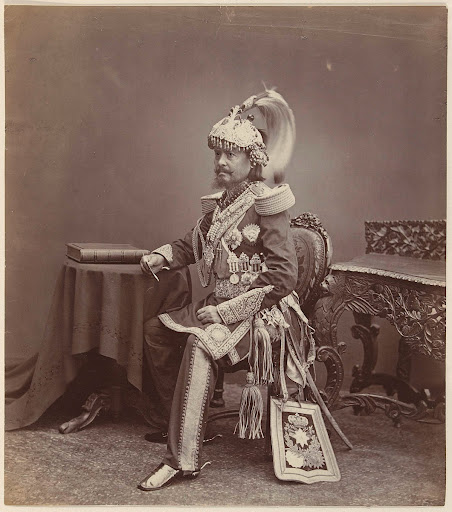
The problem was, Jung Bahadur was taking his time arriving, and no one could say for sure how long it would take him to march to Campbell’s camp. Having left the Sarun Field Force on 23 February, and should have formed a juncture with the Jaunpore Field Force shortly after it was estimated they would arrive, along with Franks, no later than the 1st of March. However, Franks faced problems of his own, and while he and a detachment of the Gurkhas arrived on 5 March, Jung Bahadur and the remainder of his force would not arrive in the vicinity of Lucknow until the 10th.
Contrary to popular opinion, Jung Bahadur had not been taking in the sights of Oudh. After leaving two regiments of infantry to guard Gorakhpur, he had crossed the Gandak and marched towards Ambarpur. However, he was waylaid by rebels at the Berozepur, where they had rooted themselves in a small fort. Although the force itself was of little consequence, it was imprudent to ignore its occupiers, who were more than capable of causing a nuisance to any force following in Jung Bahadur’s wake.
The fort itself was small but surrounded by three rows of bamboo thickets and ditches, one behind the other. Inside these defences stood a loopholed mud wall. The rebels were somewhat astonished, for instead of a steady attack from the front, the Gurkha surrounded the fort and attacked it from all sides, making escape impossible. It was still a tough nut to crack, and until a breach was made in the wall, it looked for a time that the Gurkhas would have to abandon this idea. Undaunted, the cannonade continued, and as soon as the breach was barely large enough to allow a man through, Jung Bahadur called the attack. He had underestimated the rebels, for they were ready. As the Gurkhas rushed through, they opened a murderous fire on them, killing seven and wounding a further 46 before every single rebel was killed, bravely defending their post. Intelligence had not been very good on this day, for the Nepalese were under the impression that Berozepur was being held by a force of well over 500 men. When the dead were counted, however, there were only 32 in the entire garrison.
With the reduction of this seemingly unimportant fort, there fell, in the vicinity, another that was better garrisoned and would have been harder to capture. Upon hearing of the fate of their colleagues, the entire garrison simply upped and left before it came to blows.
A fortnight later, on the 5th of March, Jung Bahadur was opposed by no less than 7000 rebels who had planted themselves resolutely on the banks of the Kandu River. While they had strength in numbers, they lacked artillery (one gun) and had no cavalry. The Gurkhas overran their position and chased this small army into a nearby grove of trees, thickly wooded and dense. Here they made another stand, but General Kharag Bahadur dashed at their very centre and in very short order, chased them off, capturing their single gun while his men helped themselves to their swords and muskets. The rebels left 650 dead on the field while the Gurkhas buried one of their own and tended to only 16 wounded men in their ranks. Sir Colin Campbell could say what he liked – the forces of Jung Bahadur and Brigadiers Rowcroft and Franks had scattered pockets of rebels so far and wide, they would never gather enough strength to make their way to Lucknow. Yet until the Nepalese arrived, Sir Colin Campbell was forced the bite his tongue and wait, watching with trepidation as the days became hotter, the winds fiercer, and his force impatient. The longer he delayed, the more time the rebels had to prepare a warm welcome for his return.
 Mutiny Reflections