The 10th & 11th March
The advance on Lucknow was now entering its final phase – the events of 10th March would prove, once and for all, if the elaborate plan for its capture, so skillfully drawn out by Robert Napier, was as promising as Sir Colin Campbell believed.
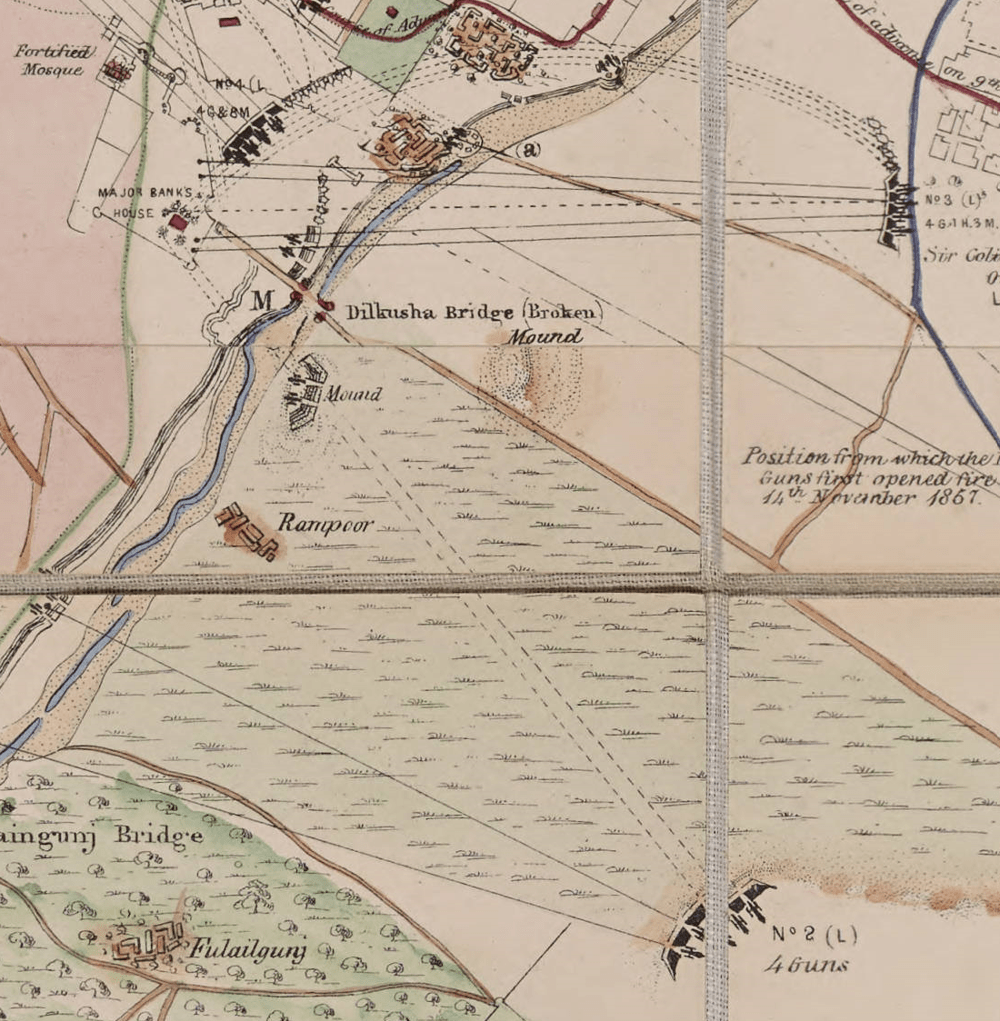
Early on the morning of the 10th, the 93rd Highlanders were called up. A subdivision of Lieutenant Alexander’s company would serve as the covering party for the sappers who were hard at work constructing a further battery, under the cover of the Martiniere Park, destined, with another battery on the left flank, to breach Banks’ House. They had plenty of work to do – when completed, it would house four guns, one howitzer and three 8-inch mortars. The rebels were quick to the mark and tried their utmost to pick off the sappers, but Alexander and his men were there to return the compliment. As soon as the battery was complete and had commenced the work of smashing a breach in the wall surrounding the house, Alexander returned to his regiment.
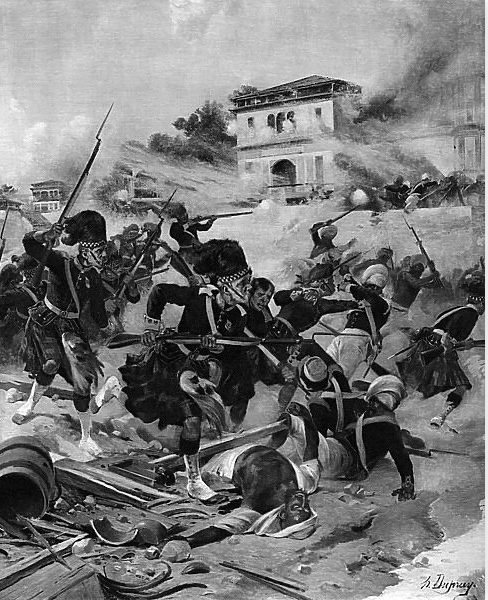
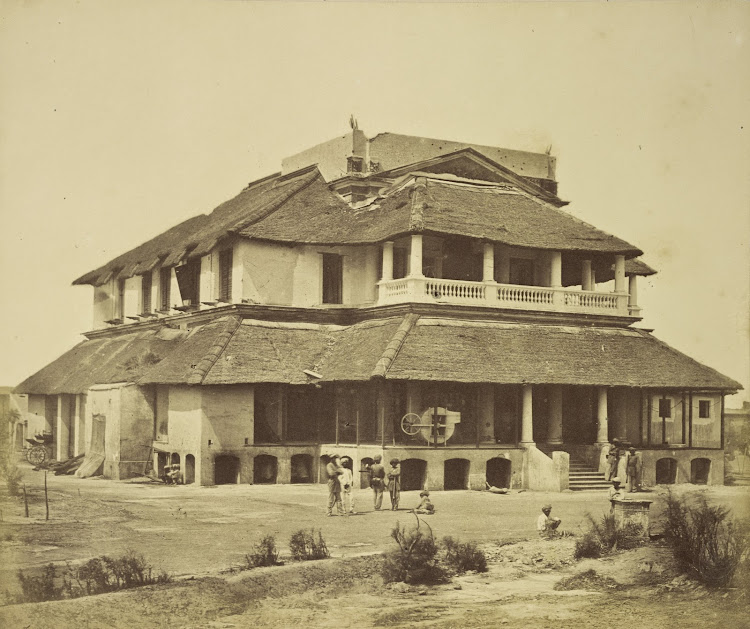
With a serviceable breach at Banks’ House, the 42nd Highlanders and the Brayser’s Sikhs were sent forward to capture the position. In their usual style, the Highlanders and the Sikhs made a race of it with both parties vying for first place. No one could say for sure who reached the breach first, but one thing was clear – the house had already been abandoned by the majority of the rebels. All that was left was to clear off the remnants, and Banks’ House fell to Sir Colin Campbell.
Originally known as the Hayat Bakhsh Kothi, the house had once belonged to Nawab Saadat Ali Khan but had been purchased by the EICo in 1801. Following the annexation of Oudh in 1856, it became, for a very short time, the residence of Major John Sherbrooke Banks, the first Chief Commissioner of Lucknow and assistant to Sir Henry Lawrence, the Commissioner of Oudh. Banks was destined to never see his house again – on 12 July 1857, he was shot dead in the Lucknow Residency.
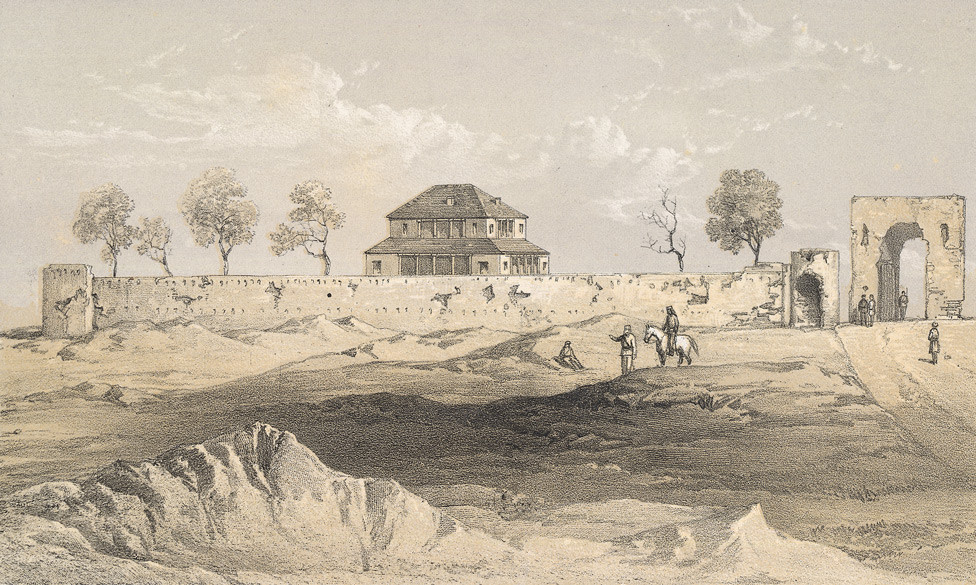
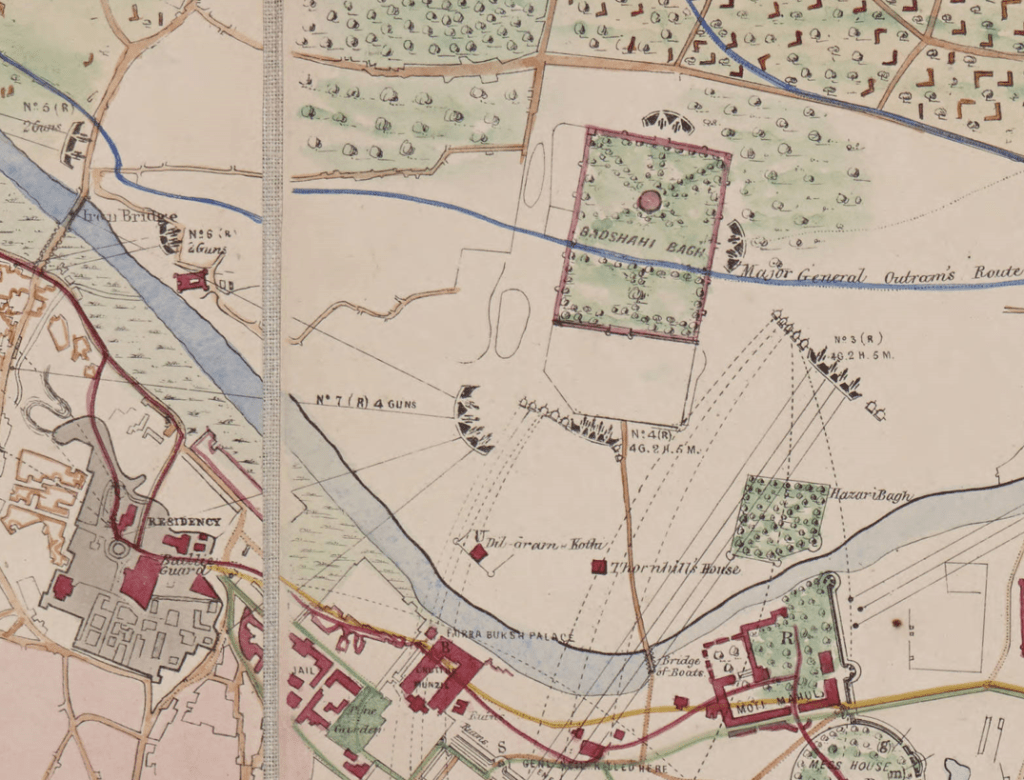
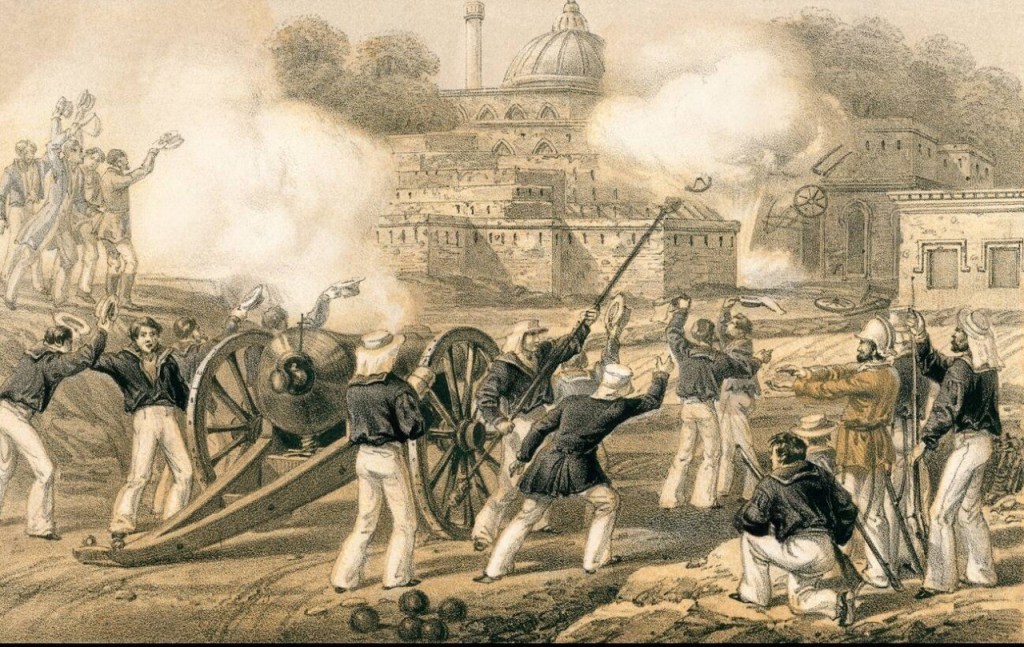
The first line had fallen on the 9th, and all that had been remaining of it was Banks’ House – they were now pushed back behind their second line; the question was only how long they would be able to hold it. Banks’ House was swiftly converted to a military post, and another battery was constructed, this time to breach and bombard the Begum Kothi, “a large pile of buildings” and enclosures directly in front and covering the Kaiser Bagh. To complement the battery, two additional guns of the Naval Brigade and six 51/2 inch mortars were placed in the destroyed European bungalows directly to the right of Banks’ House. From their position, they too would fire against the Begum Kothi and take on the bastion in front of Hazratganj. To achieve this, the last rebel sharpshooters were cleared from the bungalows at the point of the bayonet by the 42nd.
Sir Colin’s camp was now reorganised – several regiments were moved into the park in front of the Dilkusha and the Martiniere, which would now see service as a hospital. The headquarters of the camp was likewise moved to the Dilkusha. In front of the chief mess, preparations were made for the long-anticipated arrival of Jung Bahadur and his Gurkhas. A large canopy was erected to house a formal reception, while a battery of guns would provide needed protection. Sir Colin Campbell had been informed that the Nepalese would arrive the next day, no later than four o’clock in the afternoon. As such, all officers, who would be part of the greeting party, were told to don the best their uniforms still had to offer; a party of the 9th Lancers would draw up on the flank, and the 42nd Highlanders, with their pipes and drums, would form a guard of honour. Amid the battle anticipated for the next day, Sir Colin Campbell would be hosting a party.
At sunset, No. 6 Company of the 93rd Highlanders under Captain Burroughs went out to relieve a company of the 42nd who had been posted, quite uncomfortably, in some mud huts, not 250 yards from the walls of the Begum Kothi. Having spent the day exchanging fire with the rebels to the tune of one officer and 15 men wounded, they were not displeased to hand over the guard to the 93rd. For the remainder of the night, the rebels made good their musketry fire, shooting at anyone who moved, taking particular care to harass the officers as they visited the outlying sentries and the men sent to relieve them. Until they were withdrawn the next day at 3 pm, there would be some “exciting shooting” for both sides, but it was curious work.
” We were in front of the spot where the left breach was being hammered by the heavy guns of the Naval Brigade in the wall of the Begum Kothi, while opposite to us there were one or two breaches in a wall to its left, which the rebel Sepoys kept passing and repassing all day to and from other points in the city, giving us opportunities for shooting them down at that short range of which we largely availed ourselves. Yet it never seemed to occur to them that by hanging canvas screens across these openings, they could have rendered our aim mere guesswork, but all they did was to rush singly across the two openings at speed; even then, we managed every now and then to knock some of them over. Our picket did not lose a man the whole time we were there.”
 Mutiny Reflections