The 10th of June
Yet how quickly the tide can change. As in Allahabad, where on the morning of the mutiny, the sepoys were cheering their officers, hand on heart, bursting with pride at Lord Canning’s praise and by dinner time, they were murdering every European in sight.
So in Nowgong.
Throughout the day, neither Kirke nor Scot noticed any appreciable change in their men. Scot had been 10 years with the 12th had he never before seen them “show so much good feeling as they had at all times since the 23rd of May…I believe that in the majority of the men, sincerity and fidelity existed…” Even the Artillery Company was cheerful and well-disposed. That is, until sunset.
At sunset, as the guard was being paraded, several men started loading their muskets, and three Sikhs stepped forward together. One of them, a man named Kana, a sepoy of No.1 Company, shot acting Havildar-Major, Abeem-aun-Singh of No. 4 Company through the head, killing him instantly. The Sikhs then made a rush at the guns, which were drawn up on the parade ground. The Artillery Sergeant attempted to stop them, but none of his men would help him, and he barely had time to flee for his life.
The Sergeant-Major of the 12th was fired at but saved by the quick actions of a sepoy of No.3 Company, Dursun Singh, who pushed the barrel aside. He was one of the few who would stick to the officers to the last. The Sergeant-Major did not need another invitation – he quickly ran to the Mess House. In the meantime, the quarter-guard started firing at the mutineers but were stopped by Jemadar Moharuck Ali, who asked them, most seriously, why were they firing without orders? He then made his way over to the mutineers to take charge.
The mutineers now had command of at least some of the guns. They loaded one with grape and fired it purposely into a tent the officers used close to the quarter-guard. They then took the treasure tumbrils which happened to be in the quarter-guard and placed them between the guns.
Ensign Franks was the first to bring news of the mutiny. He had been in the lines at the time, and he saw the guns seized – he immediately went to Major Kirke to report. The rest of the officers were in the Mess House when they were startled from the dinner by the sound of shots from the lines.
Second Lieutenant Townsend was the first to reach the lines, but he found to his dismay, all the guns were now in the hands of the mutineers. Lieutenant Ewart and Captain P.G. Scot were the next. Before leaving, Scot took a moment to survey the situation from the top of the mess house.
Scot and Ewart entered the lines through a crossroad to avoid as much attention as possible. A few sepoys joined him from their huts, but none of them would move against the mutineers. They had great difficulty moving at all – some of the men held the officers’ horses by the bridles, preventing them from advancing. Not everyone wanted Scot and Ewart dead – they earnestly pleaded with them to leave. Hints need not be given thrice, so ordering Ewart to follow him, Scot went to the Magazine.
At the Magazine, he found all four sentries saddled on their horses. They appeared not to be terribly surprised by the commotion and looked at Scot with some indifference. He watched as some sepoys left their lines while others gathered in panic-stricken groups in the Magazine. Scot tried to rally his men, first by extolling them to advance on the guns and then by calling for a bugler to sound the assembly. The one that came was in no state to perform even this task, so Scot grabbed the bugle from him and sounded the assembly himself. After several calls, it became evident to the captain that, indeed, no one was listening to him. The sentries around the Magazine would not open it for him – though they did not outright refuse, he understood they were not going to let him in.
“I had been trying for some time to move them, when a leading man came up and made a sign to me to be off, with a wink that shewed me he was in the secret, but that they would not touch me, so I went back to the mess-house; but before I got far, the mutineers sent a shower of grape over the lines to terrify waverers, by shewing that they had the guns. I saw the vagabonds in the square with the guns drawn up.”
Scot and Ewart had no choice but to return to the mess house.
From around Nowgong, the civilians made their way to the mess house. Dr. Mawe and Mr. Smalley had prudently been staying close to the lines in some sergeant’s bungalows and providentially had kept their buggies at the ready, horses harnessed. With their wives and children, they now hastened to the mess. The son of Major Kirke, young Henry Kirke, had returned home only to find the house surrounded by armed sepoys. A Sikh stepped forward to shoot him, but a naick pushed the barrel down, allowing Henry to run over to the mess.
All the servants were rounded up by the mutineers and taken prisoner; not a single one was allowed to join their employers, many of them induced by no subtle means to disgorge information as to where the officers meant to go and, above all, where they kept their money. Mutiny without plunder is, after all, unheard of.
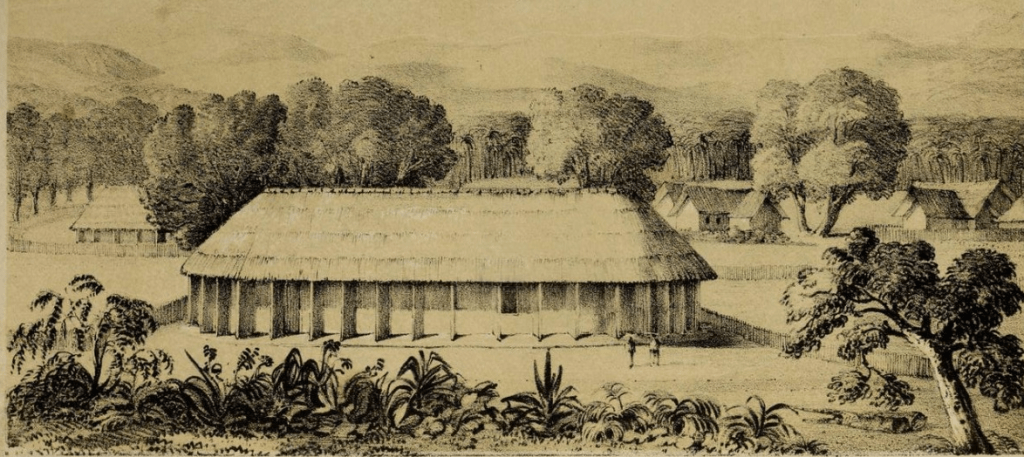
Back at the Mess House, a very downcast Kirke explained he and Lieutenant Jackson had not been able to get even one man in 100 to follow them, and they had been forced to retire from the lines. Kirke initially insisted they could try to hold out in the Mess – after all the building had a flat roof and was made of solid bricks but it was quickly pointed out to him the mutineers had guns and they, the besieged, had besides their personal weapons, absolutely nothing that could withstand a concentrated attack. As if true to their word, a quick glance out the window showed Scot the mutineers intended to do just that; they were rapidly drawing up in the front of the mess house, dragging one gun with them.
Sources:
Chick, Noah Alfred, comp. Annals of the Indian Rebellion, 1857-58. Calcutta: Sanders, Cones and Co., 1859.
Great Britain Parliament. Further Papers (No. 4) Relative to the Mutinies in the East Indies. London: Harrison and Sons, 1857.
Scot, P. G. Personal Narrative of the Escape from Nowgong to Banda and Nagode. Edinburgh: Thomas Constable, 1857.
 Mutiny Reflections