The Gonds
In the Chanda country three distinct nationalities meet,— the Gond, the Teloogoo, and the Mahratta; and every town possesses a proportion of the three. Still, intermingled as they are, the great mass of each may be broadly said to inhabit different tracts; the Gonds lying chiefly east of the Wyngunga and the Pranheeta; the Teloogoos along the east, centre, and south; and the Mahrattas in the northern and western Pergunnahs west of the Wyngunga.
The numerous castes included in these great divisions are described in Sir R. Jenkins’s Report on the Nagpore territories, and it will be sufficient here to note the races of the Chanda District that are believed to be quasi-aboriginal.
These are —
- — The Gond, Purdhan, Kolam, and Hulbah, — of the Gond type.
- — The Koholee and Manna, — of the Koholeo type.
The first are famous for the construction of tanks, the second ap agricultures.
- — The Golkur and Gowaree,— -of the Goulee typo.
The Chanda Gonds are divided into four tribes, —
- — Raj Gond.
- — Durweh Gond.
- — Khutoolwar Gond (who wear the Janeo).
And 4. — Mareh Gond.
All claim descent from the Pandoos, and all worship one great god, called by them Phersa Pen ; but while one class acknowledges as minor deities the five Pandoos (Bheem and his four brothers), their wife Dropudee, and Krishna; a second class leaves out Krishna; a third dispenses with both Krishna and Dropudee; and a fourth retains only Bheem, and three of his brothers, — excluding the eldest. ( The Central Provinces Gazetteer)
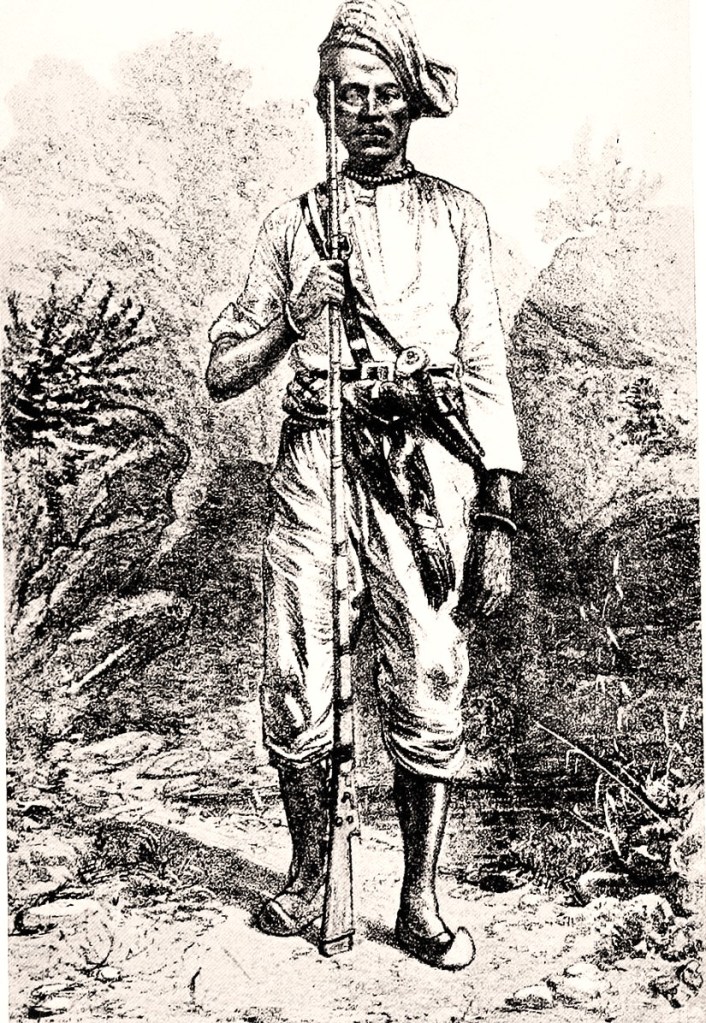
Nuttall was not fighting mutinous sepoys; his adversaries were tribal Gonds.
Located today in the Chandrapur and Gadchiroli districts of Maharashtra, then known as Chanda District in the Central Provinces, the region had been brought under British rule by the Doctrine of Lapse in 1854, when the Raja of Nagpur died without an heir. The British took charge and appointed R.S. Ellis of the Madras Civil Service as the first District Collector of Chanda. There were several zamindaries in the district under the control of Raj-Gond families, some of whom predated the arrival of the Marathas in the 18th century. Between the 14th and 18th centuries, the Raj-Gonds ruled vast territories. Notable kingdoms included the Garha–Mandala (in the present-day Mandla district) and the Deogarh dynasty (in the Chhindwara region). Their kings frequently adopted Rajput or Mughal titles (like Shah or Singh) to legitimise their rule. They traditionally practice a mix of animism, pantheism, and indigenous faiths, heavily revering supreme deities like Parsapen alongside their distinct clan gods. Their society is strictly structured into patrilineal clans known as phratries or sagas. In the 1740s, the Marathas attacked the Gond rajas, causing both rajas and subjects to flee from the plains to the forests and hills. Some were forced to pay tribute to the Marathas, while the Marathi people themselves rushed to replace the dispersed Gond populations. After the Third Anglo-Maratha War, the British took control over the remaining Gond zamindaris and began revenue collection. The British regarded the Gonds as “plunderers” and “thieves” before their takeover, but began to view them as “timid” and “meek” by the mid-19th century.
Usurped and infinitely distrustful of the British propensity for stringing up telegraph wires through their lands, which they saw as nothing less than a diabolical instrument of enslavement, with resource exploitation and heavy taxation added to their long list of grievances, it should not have surprised the British that the Gonds were angry and ready for rebellion, and they chose the troubled times of the mutiny to do so. In 1858, the Gonds, together with the Rohillas, began to collect themselves into an army.
As noted in the Gazetteer:
“The swell of the great wave of rebellion which swept over India in 1857-58 A. D. was felt in Chanda; and the wild nature of the country, the predatory habits of the Gonds, and the proximity of the Hyderabad territory, combined to render the management of the district during this period a task of peculiar anxiety; but Captain W. H. Crichton, (the then Deputy Commissioner) prevented any out-break, until March 1858 A. D. when Baboo Rao, a petty Chief of Monumpullee, in the Aheree Zemindary, commenced plundering the Rajgurh Pergunnah, and was shortly afterwards joined by Yenkut Rao, Zemindar of Arpeillee and Ghote. These two leaders then openly declared rebellion, and, collecting a mixed force of Rohillas and Gonds, withstood the troops sent against them. On the night of the 29th April, a party of the insurgents attacked Messrs. Gartland, Hall, and Peter — Telegraph employees who were encamped near Choonchgoondee on the Pranheeta, and killed the two first. Mr Peter escaped into the Aheree keep, and as soon as possible joined Captain Crichton, who was in the vicinity directing operations. Subsequently, when it was desired to communicate with Luchmee Baee, the Zeinindarin of Aheree, Mr Peter disguised himself as a native and safely delivered to her Captain Crichton’s letter.
The rebels made a stand at several points, but never with success; and at length, by the exertions of Luchmee Baee, Baboo Rao was captured, and was immediately sent in to Chanda, where he suffered death on the 21st October 1858 A. D.
Yenkut Rao escaped to Bustar, but in April 1860 A. D., he was arrested by the Rajah of that dependency, upon being handed over to the British authorities, was sentenced to transportation for life, with forfeiture of all property.
There were two prominent Gond leaders – Ramji Gond, who operated out of the Nirmal forests in Adilabad in the Princely State of Hyderabad. He allied with Rohilla Muslims (led by Haji Rohilla) and mobilised an army of nearly 1,000 fighters. His forces successfully captured the Manikhgarh Fort and temporarily made Nirmal their sovereign capital. They would keep up their insurrection until 1860.
The other was Baburao Sedmake, the young Zamindar of Mollampalli.
Baburao Sedmake, with his mixed force of Gonds and Rohillas, captured the Rajgad pargana of Chanda district. Crichton, alarmed by this development, dispatched an army, in this case likely the Nagpur Irregulars, to have it out with Baburao Sedmake. In the first encounter at Nandgaon-Ghosari on 13th March 1858, the British were sent off with a flea in their ear, losing much camp equipment in the process. Sedmake’s positive result bolstered other zamindars to join his cause and now amassed an army of some 1200 men. It was here that Nuttall made his appearance: according to local lore, Sedmake was the victor in all his encounters with Nuttall. This can be disputed by all camps; in any case, Crichton would rely not on an army to capture Sedmake, but on Lakshmibai, the Zamindari of Aheri, to do the work for him. It was the usual threat – bring in Sedmake, or Crichton would raze her zamindari to the ground and her rule would be forfeit. While she did manage to capture him, Sedmake escaped and would only be caught by her again in September 1858. This time, he was brought in chains to Chandra, where Crichton ordered his trial.
From the evidence produced, the prisoner (Baburao) is found guilty of the rebellion against the British Govt, of having collected armed men and opposed the troops of the Government at the villages of Ghot on the 10th of May 1858 and at Bamanpeth on the 27th of April 1858, of having caused his armed followers to make prisoners of two troopers in the service of the British Government, and after they were brought before him, robbing and keeping them as prisoners for about 12 days, of having caused his armed followers to attack the camp of Mr Gartland & Hall at Chunchgundi on the 29th of April 1858 and receiving the stolen property of the above Gartland & Hall, well knowing that it had been acquired by the murders of both Gartland & Hall.
2. The court, having found the prisoner guilty as above and taking into consideration he was the leader of the disturbances in the district and that he hadno cause for acting as he did, proceeds to trap in him the following sentence.
3. That you, Baboorao, son of Poolaisur Bapu, be hanged by the noose until you are dead and the execution thereof is ordered to take place this afternoon at 4 o’clock in the gallows, in front of the jail at Chandah.
4. The whole of his estates or property of whatever description is hereby ordered to be confiscated by W H Crichton off. Dy Commissioner & Commissioner of the District, Chandah, under Act XIV of 1857.
It only remains to be said that this uncharted and ignored part of the Indian Mutiny has found no great authors such as Malleson, who chose, quite clearly, to steer away from this particular theatre of war. In our modern times, with so little evidence to work from, it is difficult to portray an actual picture of the war with the Gonds and much of it is taken from folklore. However, it does have its place in this history, as one of those many mutinies that occurred on the periphery of those turbulent times.
Sources:
Gazetteer of the Central Provinces in Five Parts – Part II: Chanda, Chindwara, Chutteesgurh. Nagpore: the Chief Commissioner’s Press, 1867
Behan, T. L. Bulletins and Other State Intelligence for the Year 1858. Part 3 of 4 parts/vols. London: Harrison & Sons, London Gazette Office, 1860.
Forsyth, Captain J. The Highlands of Central India: Notes on their Forests and Wild Tribes, Natural History and Sports. London: Chapman & Hall, 1872
Shakespear, Major Henry. The Wild Sports of India. London: Smith, Elder & Co., 1862
Links:
https://www.reubique.com/SHAKESPEAR%20J.H.C..htm
https://www.livehistoryindia.com/story/people/baburao-sedmake-adivasi-hero-of-1857
https://www.trijharkhand.in/en/gondi
https://www.memeraki.com/blogs/posts/the-gond-community-an-overview?srsltid=AfmBOoo4bqrt9QeZeSmYS_hVpvYcb01ntPdqPIBnNcQkuiA-7Jp7TF7y
Administration of the Nagpore Province by Mr. G. Plowden, Commissioner, from 1855 to 1859. [Nagpur], [Govt. Press], [1920?], 1920. JSTOR, https://jstor.org/stable/saoa.crl.26422470. Accessed 6 July 2026.
Deshpande, Y. K. “FRESH LIGHT ON THE HISTORY OF THE GOND RAJAS OF DEOGARH.” Proceedings of the Indian History Congress, vol. 13, 1950, pp. 231–33. JSTOR, http://www.jstor.org/stable/44140920. Accessed 6 July 2026.
PRASAD, ARCHANA. “Military Conflict and Forests in Central Provinces, India: Gonds and the Gondwana Region in Pre-Colonial History.” Environment and History, vol. 5, no. 3, 1999, pp. 361–75. JSTOR, http://www.jstor.org/stable/20723114. Accessed 6 July 2026.
 Mutiny Reflections