Somebody’s Irregular Horse
“Cavalry, to be really effective, must be as rapid as possible in execution, fearless, and enduring under privation and fatigue.”
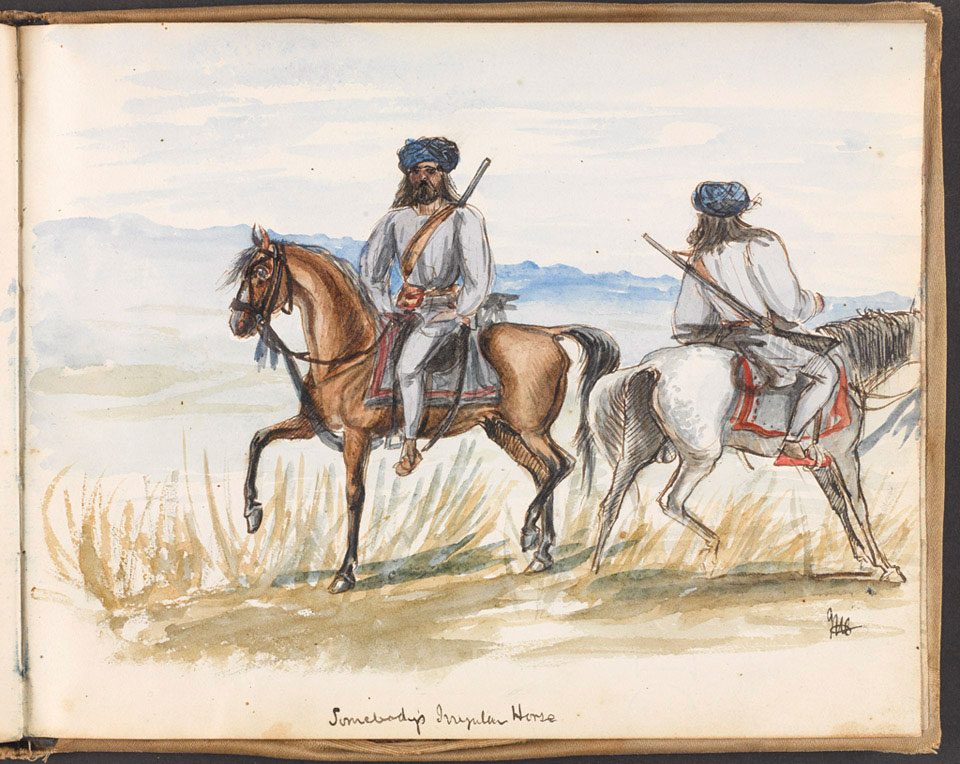
Lieutenant John North Crealock, like many others during the mutiny, were faced with a befuddling amount of irregular cavalry units, to the point that his rather sardonic caption for the picture was about as close to anyone could come to naming any given party.
Although the list is not exhaustive, it includes:
Alexander’s Horse – raised in 1857 by Captain Alexander for work in the Agra District
Beatson’s Horse – raised in 1857 by William Ferguson Beatson, comprising of two irregular cavalry units. In 1860, they became the 2nd Corps, Mayne’s Horse.
Christie’s Horse
Cureton’s Multanis: Raised during the 1857 uprising, they were principally recruited from the Punjab
Haldane’s Horse
Hodson’s Horse
Leeson’s Horse
Mayne’s Horse
Murray’s Jat Horse – raised in 1857 as The Jat Horse Yeomanry
Watson’s Horse – raised in 1858 as the 4th Sikh Irregular Cavalry by Lieut John Watson VC
Wale’s Horse – raised in 1857: they would be renamed the 1st Sikh Irregular Cavalry (Probyn’s Horse) under the command of Major Dighton Probyn in 1860
The irregulars were raised as needed and primarily bolstered the strength of regular cavalry. To make the raising of such units as uncomplicated as possible, the British used the silladar system, which was neither unusual nor foreign to the men they were recruiting. According to the silladar (from the Persian, “bearer of arms”) system, a recruit provided his own horse and everything that went along with it – a stable attendant and forage, he further provided his own camp equipment, clothing and weapons. He was entitled to compensation if his horse was killed in action, but if the animal died of disease or became “unfit due to carelessness”, he would have to replace the horse out of his own pocket. The horsemen were generally paid more than the cavalry of the regular army, but received nothing in the way of support from the Commissariat. Their uniforms, accoutrements generally followed no particular fashion of the time, although Hodson did dress his troops in khaki, with scarlet puggrees and sashes which gained his men the moniker, “The Flamingos.”
The recruits themselves were mostly from the landed classes, and Indian officers were “men of birth and standing”. More often than not, the troop commander held the asamis of all his men, making his word the veritable law. This contributed to a higher level of discipline, and crime in the irregulars was unheard of, considering that the shame would not only be borne by the man himself but by his dependents; any failure of character reflected not just upon the offender himself but on the entire regiment.
“Every Silladar owned his ‘place’ or ‘berth’ in the regiment. This was called ‘asami’ and was regarded as property of the Silladar. Asami could be handed down from father to his son or used as a form of subsistence for the widow or the family of the dead Silladar. Owner of the asami was free to sell it or hire it out to any soldier wishing to be recruited, but did not own a mount of his own. Such recruits were called Bargeers or Bargirs. Bargeers would receive one-third of the wages and two-thirds of the portion would go to the owner of the asami. Skinners’ horse regiment had as many as 400 Bargeers. In 1841, in Scinde Irregular Horse regiment, 20 asamis were owned by people not serving in the regiment, and three were owned by a Bhisti (water carrier). This system continued till World War I, but its substitution part was abolished in 1861.”
In 1861, the silladar system was extended to regular cavalry of both the Bengal and Bombay armies, but some significant changes were made. The army now paid for the horse and provided equipment, but the asami continued to exist, although according to different rules. Upon discharge after his service was over, the asami would be repaid by the army in exchange for the return of the horse and equipment – any dismissal on behavioural grounds led to the forfeiture of the asami. During their term of service, the soldiers did receive a monthly salary, but as before, had no provisions given them from any of the ancillary services. However, it did have its drawbacks:
“The main problem of this system was lack of uniformity, substandard horses and equipment, which eventually became main reason of its abolishment. The system was modified in second half of the 19th century, and regiments started providing recruits with a horse, equipment and uniforms for their value in money. On his retirement, sowar retuned these items for their market value in cash.…It became impossible for the regiments to provide regimental pattern equipment for all the theatres of war and to return asamis of the dead and injured sowars whose count was increasing rapidly due to the Great War. After World War I, the Indian Army was reorganised and the Silladar system became part of history.“
The silladar system certainly had much to say in its favour as Major Shakespear (he served 22 years in irregular cavalry units, and commanded for a time, the Nagpore Irregular Force) pointed out, it could just as well be applied to young wastrels in England, who, had he not enlisted in a cavalry regiment would be, “…scaring his father’s colts, or getting the old man into trouble with the squire, from his having been seen with a gun near some favourite pheasant preserve.” It would be better then to send him off into irregular cavalry, where just such a man could bring his daredevil nature to full fruition.
“Now, here is the very material required for a sillidar horseman. His father can afford to mount and equip him, and he himself has pluck and courage for all the rest. He is ready, if required, to go to the world’s end, on his father’s horse and with his own spurs; for the thirst of adventure is very strong in men of this temperament, and they are only wild in youth, because their love of excitement and adventure cannot be gratified in the sober old country.”
In 1857, the Bengal Army had 10 regular cavalry regiments and 18 raised according to the silladar system. It was certainly not a safeguard against mutiny – all ten of the regular and a further ten of the silladar regiments mutinied; in 1861, those who had remained loyal were renumbered to form the 1st to 8th Bengal Cavalry. However, during the mutiny, the system continued to be met with much approval – expenses were kept at a minimum, the units generally had fewer British officers, which in turn appealed to the recruits. The officers themselves were cavalrymen of some standing and, above all, experience. They dispensed with lengthy drills and did not attempt to mould their irregulars along the lines of regular units. Many of them spoke the local language and freely relied on their Indian officers for assistance and advice. The British officers ingrained themselves with their men; when Hodson was killed at Lucknow, one of the fears was that his men would not fight for any other leader; they did eventually accept Henry Daly, who was sent over from the Corps of Guides, but Daly himself was unsure he would be able to handle them. However, the irregulars who had ridden down with John Nicholson refused to fight for the British after his death; his cult of personality was of such magnitude that they packed up their belongings after his funeral at Delhi and left, stating they had come for Nicholson alone.
While we could of course, explore the adventures and exploits of the irregulars and indeed, we have either already met some of them in the course of these writings, there is one unit which shows up briefly in despatches and then vanishes.
Called the Moolkee Horse, they served in conjunction with the Nagpur Irregular Cavalry that had been raised in 1854 as part of the Nagpur Irregular Force. The force and its cavalry element (in part) did not mutiny and were used for local policing in the Nagpur district. Between January and June 1858, they saw action against insurgents along the western frontier of the Sambalpur district and patrolled the Chanda zemindaries; the Chanda Field Force was another auxiliary of the Nagpur irregulars and was, for a time, under the command of Major Henry Shakespear.
It is difficult to pinpoint the Moolkee Horse for the term Moolkee (mulki) simply means a local district, irregular cavalryman. During the mutiny, these local horsemen were raised hurriedly by district magistrates and military officers to guard treasuries, provide intelligence, and hunt rebel bands and did not operate under any specific moniker of their own. As such, this particular unit operated under Lieutenant John Nuttall, who signs himself as ” Commanding Detachment 2nd Regiment, Nagpore Irregular Force.”
 Mutiny Reflections