Back in Fatehgarh
Back in Fatehgarh, Seaton had, in February, set the engineers to work. While they had been successful in blasting bits of the Farrukhabad Palace to their heart’s content, they now had the daunting task of setting the ramparts and parapets of the old Fatehgarh fort into a serviceable state. The fort itself had a circumference of 1500 yards, ten bastions and a dry moat. Built by the founder of Farrukhabad, Nawab Mohamed Khan, in the early 1700s, by 1777 had fallen into disrepair, and as the nawab of the time had no use for it, it was converted into a magazine and eventually an arsenal by the British. Fatehgarh Fort would go on to supply Lord Lake’s Grand Army for the 2nd Maratha War and would continue as a magazine for nearly a century. During this time, it also gained other uses – the Cawnpore Timber Yard was moved within its walls as was the Gun Carriage Factory – the main portion of the Fort was occupied by these long, narrow factories or workshops, which included blacksmith’s shops and even a steam engine. Even the mutineers, after they ousted the British from Fatehgarh in July 1857, made ample use of the fort to manufacture cartridges.
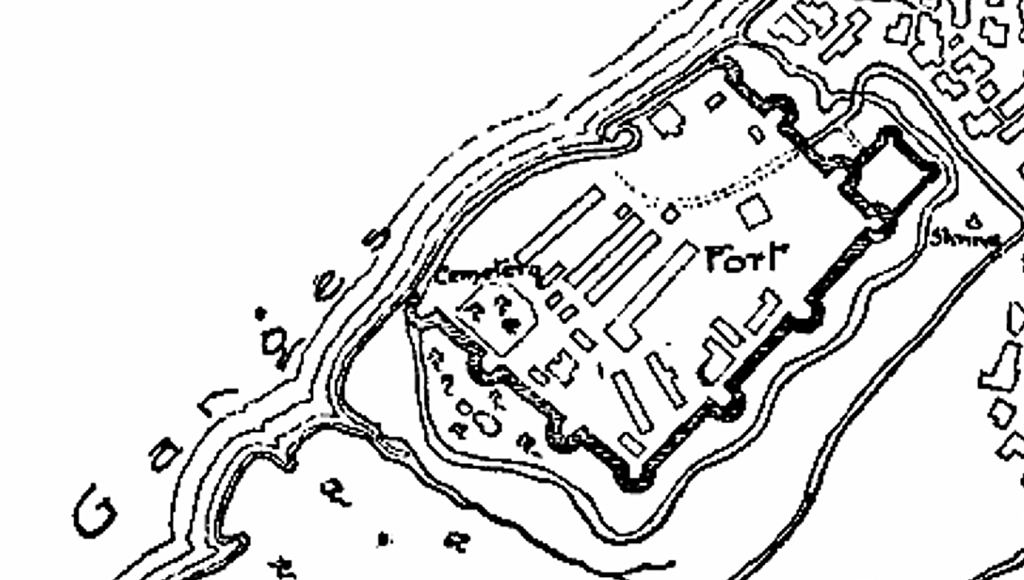
While all of this was certainly practical, it was of no use to Seaton, who had to face the very real problem of being besieged at Fatehgarh. On closer inspection, it was found that the fort, though formidable enough at first glance, was hardly built for defence.
“The ramparts and parapets were all out of repair; the interior of some of the bastions could be seen from the high ground outside, being seven or eight feet lower than the others; the parapets were all too low, and far too thin to resist even a nine-pound shot; there were no platforms for the guns, and to some of the bastions there were no ramps. On the river-face of the fort, there was neither rampart nor parapet —nothing but the high steep bank of the river, on which the fort was built.”
Outside the fort, between it and the city, was a large grove of mango trees, coming to within one hundred yards of the fort. This grove was in turn enclosed, “by earthen walls of such thickness that half an hour’s labour of a few men would have turned them into batteries and trenches.” The men of the HM’s 82nd were formed into fatigue parties and, armed with axes and other implements of destruction, were set to work demolishing the grove and the walls.
The bazaar too had encroached up to the southern walls of the fort, and was filled with strong, well-built houses, all in easy musketry range. “At the back of this bazar there was a deep wide ravine running into the river parallel with the south face of the fort, and as it was within easy musket-shot, and would form a grand parallel and place d’armes for an enemy, it had to be opened out as much as possible, and all the houses on its bank knocked down and levelled. Then there was no accommodation for the soldiers, so the vast carpenters’ workshops and store-rooms belonging to the gun-carriage manufactory had to be converted temporarily into barracks.” The bazaar was only partially levelled – without much ammunition to spare, much of the work had to be done by hand as the engineers were loath to waste their powder on levelling houses.
However, Seaton was not so short-sighted as to concentrate his efforts on making the fort defensible. He wisely moved the Bridge of Boats from its place near the city and rebuilt it under the very walls of the fort; he then ordered all boats twelve miles up and downstream of it to be brought in and anchored under the walls. While this would have been exceedingly uncomfortable for the rebels had they decided to make use of Seaton’s bridge, he was equally at a disadvantage – having no parapet or rampart on the river face, he could not make use of his seven heavy guns on that front. The rebels would most likely leave off attacking the fort directly, as Seaton believed, and could comfortably shell him from the other side of the river, a distance of 1700 yards, and there was very little he could do about it. He hoped the ammunition he ordered from Agra would arrive sooner rather than later – if the rebels did mount an attack on Fatehgarh Fort, they would soon realise he currently only had 20 rounds of ammunition for his heavy guns.
Seaton ordered 100 men of the 82nd to be trained up as gunners. When the ammunition finally arrived, to his relief, the rebels had not. The new gunners were instructed with blank ammunition, and finally, when the report of their progress was deemed sufficiently advanced, Seaton allowed them a ” little ball practice.” It was, thanks to this, that he made a startling discovery.
“On the farther bank of the river, and exactly opposite the fort, was a small village, and outside, towards the north, a large white boundary pillar. I made the mark for our heavy guns. Then, selecting a day when the wind was blowing from the fort towards the rebels in Alagunge, I sent a party of horsemen across the river, turned the people out of the village for a couple of hours, and commenced, first with the 12-pounders, going on in crescendo style, and ending with the 32-pounder. Of course, we took care to note the range of the guns and the elevation required. Next day, at ten o’clock, a man walked up to my quarters with a 32-pound shot on his head and dropped it at my feet.
“Huzoor, your highness, cherisher of the poor, your slave was working yesterday in his field (naming a village about two miles off), and whilst your highness’s guns were firing, your slave heard something rushing through the grass, and immediately the ball jumped over his head and lodged in the bank. I am a faithful ryot of the Sicar Angrez, and I have brought the ball to your highness.”
“Very well, ” replied Seaton, “You shall have a present, but tell me, do you think the rebels at Alagunge heard the sound of our guns?”
“Your highness, yes, their livers melted with fear, and half of their army ran away last night.”
Seaton soon found that the man, despite his embellishments of livers turning to water, had told the truth. A sizeable number of men had joined the rebels the previous morning but had decided against the venture and promptly disappeared as soon as Seaton’s guns opened fire. Spies had been actively at work reporting Seaton’s actions at Fatehgarh to the rebel camp, and they were well aware that the Agra ammunition had arrived. The ball practice had served to scare off anyone interested in the rebel cause, but for reasons known only to themselves, the rebels still did not attack Fatehgarh.
By the end of February, the news of their movements was giving Seaton considerable anxiety. They had sent a small party to take up a position between the Ramganga and the Ganges and began “to forage around.” By March, their numbers at Aliganj had increased and “they foraged about with great boldness, and from day to day, assumed a more threatening attitude.” Spies informed Seaton, on 10 March, that the rebels at Koochla Ferry, close to Khasganj, had finally crossed the river, but they had been read the riot act by General Penny, then marching down from Delhi. Meanwhile, reports arrived in Fatehgarh that the elusive Nana Sahib had tried to make a dash for Central India; however, Seaton was more concerned about the small parties that continued to elude his posts on the river and were making their way into Rohilkhand. The rebels at Aliganj, while seemingly disinterested in Fatehgarh, sent a body of troops to Bangaon, three miles from the Ganges ferry crossing and 24 miles above Fatehgarh – Seaton sent a detachment of the 82nd and the 7th Punjab Infantry under Lieutenant Mason to keep an eye on them. Their orders were to prevent them from crossing and to send daily reports. Unfortunately, “Headquarters” got wind that Seaton had sent a detachment out into the field, and he was ordered to immediately withdraw it. With much reluctance, Seaton did so, but he sent a few police horsemen in the vicinity of the ferry so he could still receive daily reports of the foraging rebels. The withdrawal elicited the reaction Seaton had hoped to avoid – as soon as the detachment was out of sight, rebel sowars began crossing the river; they visited a few villages and then returned to Bangaon. Rumours, when they finally reached Seaton’s ears, all said the same thing – his inaction and the sudden withdrawal had emboldened the rebels, and they, with Tej Singh, the rebel Rajah of Mainpuri in their camp, had finally decided to bring the stalemate to some sort of conclusion.
Seaton was in a bind – he could not send troops back to the ferry, nor could he pack up house and home and encamp opposite the rebels “waiting their good pleasure”; he was also not at liberty to call for reinforcements from Mainpuri without plunging that district into considerable discomfort. However, he also could not allow the rebels to cross the river: Sir Colin Campbell had finally decided to open the Rohilkhand Campaign, and he would hardly be pleased if the whole country from the Ganges to the Jamuna was full of mutineers. He would be considerably angrier if Seaton lost the Grand Trunk Road. If Seaton was going to do something, it would have to be now.
Seaton ascertained correctly that the rebels held three positions – Aliganj, seven miles from Fatehgarh; Bangaon, three miles from Ganges ferry and 24 miles above Fatehgarh and a third at Kankar, 22 miles away. He knew he would eventually have to move against the rebels; however, Seaton was not about to show his hand in haste. He ascertained correctly that Aliganj was too well defended for his small force to handle successfully, and Bangaon was too far to reach in a night’s march. As Kankar was situated opportunely between the two, if he “knocked out the middle post, the upper one would collapse on the lower.”
How he knocked down the posts, we shall now see.
Sources:
Behan, T. L., ed. Bulletins and Other State Intelligence for the Year 1858. Parts 2 and 3. London: London Gazette Office, 1860.
Jervis, Thomas Best. Historical Record of the Eighty-Second Regiment; or, Prince of Wales’s Volunteers. London: W.O. Mitchell, Military Publisher, 1866.
Malleson, G. B. History of the Indian Mutiny 1857-1858, Commencing from the Close of the 2nd Volume of Sir John Kaye’s History of the Sepoy War. Vol. 2. London: William H. Allen & Co., 1879.
Pitt, F. W., ed. Incidents in India and Memories of the Mutiny: With Some Records of Alexander’s Horse and the 1st Bengal Cavalry. London: Kegan Paul, Trench, Trübner & Co., Ltd., 1896.
Seaton, Thomas. From Cadet to Colonel: The Record of a Life of Active Service. Vol. 2. London: Hurst & Blackett, 1866.
Wallace, C. L. Fatehgarh Camp 1777-1857. Lucknow: K. D. Seth, 1934.
Wedderburn, William. Allan Octavian Hume, C.B., ‘Father of the Indian National Congress’ 1829-1912. London: T. Fisher Unwin, 1913.
 Mutiny Reflections
These stories are always so amazing.
LikeLiked by 1 person
Things are about to get quite interesting, in 1858.
I have finished reading “Under Canvas” and have all sorts of ideas of how to bring his story into mutiny reflections. It is an amazing book and I am so happy to have been able to find it.
LikeLiked by 1 person