The Battle of Anutram – 7 February 1858
If Seaton did not have enough work to do, he received, amid his concerns for the defence of Fatehgarh, a letter from Captain Alexander, commanding the Irregular Horse at Etawah and another from Allan Hume, magistrate of that station, requesting his instructions. Rebels had once again put in an appearance close to Etawah, and Hume was understandably concerned. It was their sincerest hope that Seaton would sanction their plans to attack them. Seaton, aware that if the venture went badly, it would be a serious loss to his already thin force and as such, sent a letter in return, stating that under no circumstances were Hume and Alexander to begin launching attacks of their own.
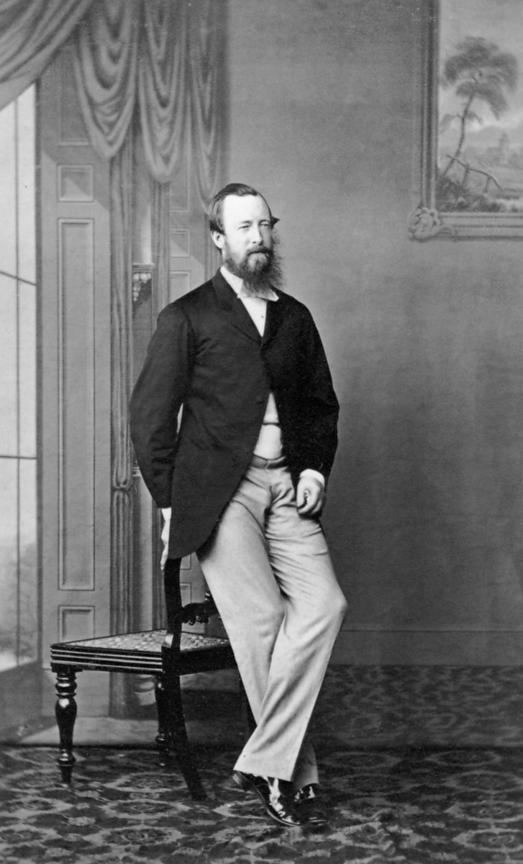
Allan Octavian Hume was something of a force to be reckoned with. He had held on at Etawah during the early days of the mutiny until circumstances had finally forced him to retire to Agra – here he had remained, fighting with some note as an artilleryman at the Battle of Sucheta on 15 July, and continued to do so until cholera gave him other worries. When he was sufficiently recovered, Hume began drafting plans to return to Etawah; however, with the mutiny in full swing, it would not be until December 1857 that Hume, accompanied by his deputy, Mr G. B. Maconochie and an escort of 50 men of the 2nd Punjab Infantry (under Lieutenant Sherriff) to retake Etawah. It was with some relief that this was accomplished without any losses, and Hume was soon back in his old position as Magistrate. However, the mutiny, as he knew well, was hardly over; calling on his friends among the local zamindars, Hume raised a decent local army of his own, comprising 200 infantrymen and 150 cavalry, with five guns and fifty gunners. By the end of January, they were drilled into a reasonably efficient fighting force. Strengthened shortly after by a detachment of Alexander’s Horse (later, 1st Bengal Cavalry), Hume felt he could hold Etawah. However, the rebels were quick to show they were not impressed with Hume’s return, and after one attack on Etawah, Hume decided something had to be done; fortunately, help was at hand.
Captain William Alexander, like Hume, had spent much of the mutiny in Agra Fort. Around the end of October 1857, he had been ordered to raise a levy of cavalry for duty in the Agra District; he had little trouble recruiting; by December, now called Alexander’s Horse, they were 500 strong, and consisted equally of Hindus, Muslims and Sikhs. However, Sir Colin Campbell, instead of taking Alexander’s Horse to Lucknow, ordered them to Etawah. Detained for a time at Mainpuri to keep roving bands of insurgents in check, Alexander could hardly ignore the messages from his old friend Hume and, taking a detachment with him, Alexander rode to Etawah, to find Hume was right to be worried.
If the intelligence was to be believed, the rebels were amassing 25 miles from Etawah – as such, both Hume and Alexander wrote to Brigadier Seaton, firstly to apprise him of the situation and secondly to request his instructions. They then allowed a day or two to pass for his answer – when none arrived, they decided to take matters into their own hands. Alexander rode out to his outpost at Bukewar and ordered the 30 rank and file of his regiment and 80 sowars of the Etawah Local Horse to proceed with him, Hume and Mr Maconochie (Deputy Magistrate, Etawah) to Anutram, where it was believed the rebels had set up camp. It was with some relief that the first men they met on the road were not sepoys, but 700 matchlock men in Hume’s employ. They were contributed from various local Zamindars and Rao Jaswant Rao, who thoughtfully also provided a 13-pounder brass gun with a compliment of gunners.
“We moved on at once to the enemy’s position, which was about a mile from Anuntram, and found them very strongly posted, stronger than we were led to believe from reports. Their right resting on the Cawnpore road, occupied a large tope of mango trees with a wall of six feet all round, and a small ditch in front; their left on a village (Phoolpore), and every grove and field between occupied by them. Their right was the chief position, and looked most formidable, the enclosure swarming with the enemy, and one gun facing down the road towards us.“
Being singular men of action, both Hume and Alexander decided that since the rebels had seen them, they felt that it would be bad form if they retreated now without “attempting something,” and that something was quite simple – they would attack the enclosure before the rebels could come to the same conclusion. Alexander formed up the cavalry into three troops; his own men he took to the opposite, right rear of the enclosure and called a halt at 300 yards; one troop he then directed to go off to the right, and the third was to remain to support their only gun. In all, their force was 440 men of all arms.
For their part, the rebels were quick to their feet and concentrated themselves in two enclosures, sending out some 100 men as skirmishers into the field immediately surrounding their main position.
“As the banks surrounding the enclosure were not less than six feet high from outside, as there were no entrances, and the branches of the trees came down to within two feet of the top of the bank, Captain Alexander, finding that his cavalry could not attack them with any reasonable chance of success, halted them… After consulting him, I posted the Local Horse, and then leaving them there with orders to cut up any fugitives, drew the men up in a sort of line, with the gun in the centre.”
The 700 matchlock men were not very convinced that Hume had all his marbles in order; when he called the advance, which was uncompromisingly straight towards the entrenchment, only 350 marched forward – the rebels opened up a “smart fire”, and the battle began. Hume’s matchlock men “were no cowards; they fought bravely, a little later, hand to hand, but they were new to the system of going straight a-head at our enemy, were immensely outnumbered, and were obliged to advance under a very heavy fire, which, as they could, under the most favourable circumstances, see only the heads of their opponents, they could not return with any effect….By degrees, taking advantage of a number of small ridges intervening between us and the point which I had chosen for the attack, I pushed the men on to within twenty yards of the entrenchment, keeping up, as we advanced, a fire from the Rao’s gun in answer to that of the enemy. I then ran the gun up to the little knoll, which, distant about five yards from the entrenchment, gave me the command of the interior.”
For reasons only known to them, some 300 rebels ran out the opposite side of the enclosure and directly into the waiting swords of Alexander’s men. “The word ‘charge’ was given by me, and in a few seconds we were in the midst of them, sweeping round the rear of the entrenchment to the village on the enemy’s left. Many of the enemy escaped owing to the great height of cultivation and the villages, where it was impossible for cavalry to follow, and, had the Local Horse acted on the right, when they saw my troop coming round, the victory would have been most complete; but they rendered no assistance at first.”
The problem with the Local Horse, in Hume’s estimation, was their lack of a European officer at their head, and they were waiting for Hume’s instructions. Hume was, however, rather busy. He had managed to get the upper hand of the entrenchment.
“…we fired one round, and, all the men lining that particular portion of the ‘moorcha’ beginning to run, the matchlock men made a rush, and to the number of 150 or 200 got in. Just as they did so, the enemy fired their gun in our faces, doing, however, no damage, and then, for the most part, throwing away their guns, both parties went at it with swords. In less than a minute, the main body of the enemy, some 600 strong, ran out… a few still stood by the gun. These, in a very short time, were dispersed, and, as I thought, either cut up or driven out; but in this I was mistaken (without uniform it was difficult to distinguish foes from friends), and we had not proceeded fifty yards in pursuit, when we were stopped by shouts from the rear, and found that the enemy had retaken and loaded the gun. We retook it, however, before they could fire it. Lutchmun Sing and I then pushed on with some half dozen sowars, but the rebels were too far ahead, and we picked up only a few stragglers. Captain Alexander then returned from the pursuit; the Local Horse came up at last, the enemy was pursued some three miles, and a number more accounted for; one and all, however, fighting to the last. Nine prisoners were also taken, of whom six were hanged. I ought to add that the enclosure was evacuated directly we took the gun.”
It was ascertained that this force of 440 men had in fact attacked a rebel force of no less than 1200 men; their losses were 125 killed, along with their gun and its limber. In their flight, they left behind their entire baggage, which included not just their spare clothes but a collection of matchlocks, swords, ammunition and their baggage ponies. On the side of Hume and Alexander, the losses were negligible.
Killed—12 matchlock men.
Severely wounded—2 sowars. Alexander’s Horse.
Severely wounded—3 horses. Alexander’s Horse.
Slightly wounded—1 horse. Alexander’s Horse.
Slightly wounded—1 sowar of Local Horse.
Severely wounded—4 horses of Local Horse.
Wounded—15 matchlock men.
Missing—2 horses
By nightfall, having ridden 50 miles and fought a battle in just over12 hours, Alexander and Hume were back in Etawah, ready to write their reports to Seaton – during their absence, his reply had indeed arrived. Whatever Seaton might have privately thought of their action, his official observation was carefully measured to elicit only the highest praise.
“The despatches speak for themselves, and I need not bring to the notice of his Excellency the great gallantry and judgment displayed by Messrs. Hume and Maconochie, or Captain Alexander’s nerve in consenting to the attack against such odds.
I think Captain Alexander could not have received a letter I sent him, prohibiting an attack on these people; but, as it has turned out, the victory will be most useful and tend in a great measure to ensure the tranquillity of the Etawah district.”
During the next six months, Allan Hume would be kept busy chasing rebels escaping from Oudh, fighting two more actions in April and May; by the end of the year, the Etawah District was reported to be free of mutineers and, as the language of the day was wont to say, “pacified.” Hume resigned from his duties to the government in 1882 – the same year he formed the Indian National Congress.
 Mutiny Reflections
These stories are always so amazing.
LikeLiked by 1 person
Things are about to get quite interesting, in 1858.
I have finished reading “Under Canvas” and have all sorts of ideas of how to bring his story into mutiny reflections. It is an amazing book and I am so happy to have been able to find it.
LikeLiked by 1 person