Jessore
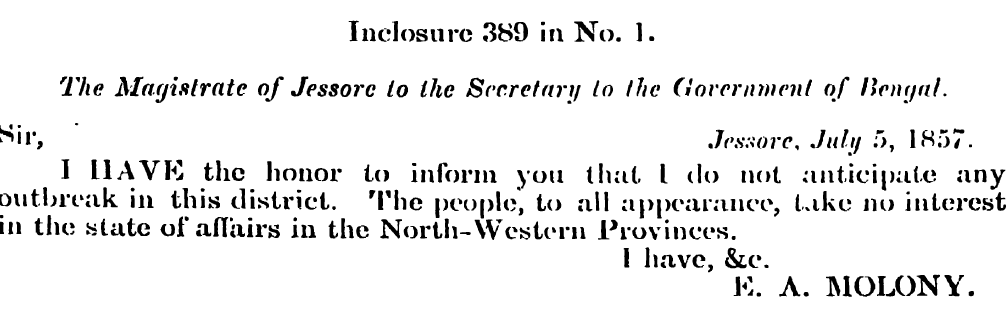
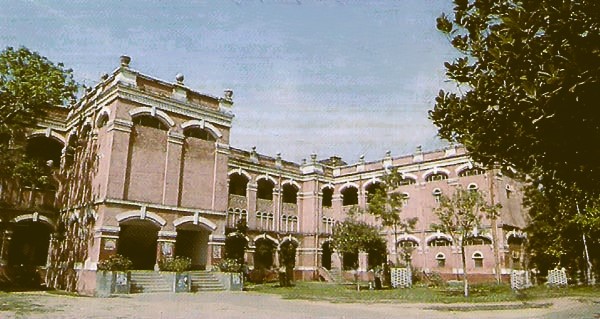
At Jessore, a large and populous district with its headquarters at Kasba, trouble was brewing. Situated 80 miles northeast of Calcutta, it was home to important factories held not only by enterprising English and Scotsmen but also by the occasional Frenchman, and their main profit was in that highly profitable crop, called indigo. The cultivation of it was left to rich and powerful Zamindars, who, after the miserable exploitation of their poor farmers, rubbed hands with the factories. On the whole, the people of Jessore itself were “peaceful and unwarlike”, but they had interesting neighbours in the adjoining district of Faridpur, the Ferazis.
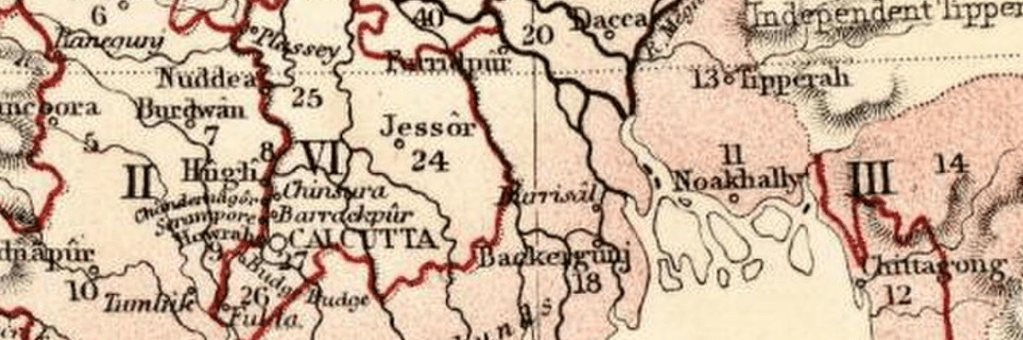
This Muhammedan sect had already proved themselves something of a nuisance in 1832 as they “held very questionable and wild doctrines about the non-payment of rent to infidel Zamindars.” While it was not considered they would organising an uprising of their own, they continued to engage in “outrages on Hindu functionaries of a very violent character” which led to some of them being imprisoned; their leader, Dudhu Miyan, irritated the officials of the district enough to have him arrested and thrown into jail towards the end of 1857. Subsequently, following another ruckus in 1863, it would be discovered that the sect had indeed engaged in correspondence with the Wahabis during the mutiny and would even be found to be funding the Ambelya campaign on the northwestern frontier that same year. However, in 1857, the Ferazis, though outspoken and rather worrisome, were initially not under anyone’s particular spyglass, though had they gathered momentum, there might have been a different history told.
Jessore, although financially important and positioned precariously, had no sepoys at all, nor indeed did any of the bordering districts. To maintain peace and order, a military police, under the control of the Commission of the Suppression of Dacoity, had been established and in Jessore District consisted of 30 Najibs, all men from the North-West Provinces and Oudh. The head of the commission at Jessore was a Bengali, one Babu Guru Charan Dass a man of much experience and decidedly sharper wits than the Civil and Sessions Judge, Mr. Seton-Karr, the Magistrate, Edmund Weldon Molony, F.C. Fowle, the collector, J.P. Grant the Assistant Magistrate and Collector, J. Elliott, the Civil Surgeon and C.B. Skinner – in charge of the local jail. While these men continued in their ordinary fashion of work, riding and shooting, Dass was watching the Najibs with an increasingly suspicious eye. At the end of July, Dass received a report from a “reliable subordinate” that not all was well with the Najibs. Their Jemadar had been holding meetings in which he told his men and anyone else who would listen of “the events that were daily occurring in other parts of India, foretold the downfall of the Company’s rule, and informed some Bengalis, natives of Jessore, that they might soon look for a great political change.” It was, for all intents, treasonable talk and, unfortunately, at a time when sedition of any nature was liable to be viewed from a completely different perspective.
Charan Dass waited until he was certain the Najibs were settled down for the night. At 11 pm, he slipped out the back door of his bungalow and went to Molony’s house. Explaining to him the reason for this rather late arrival and told him the following story.
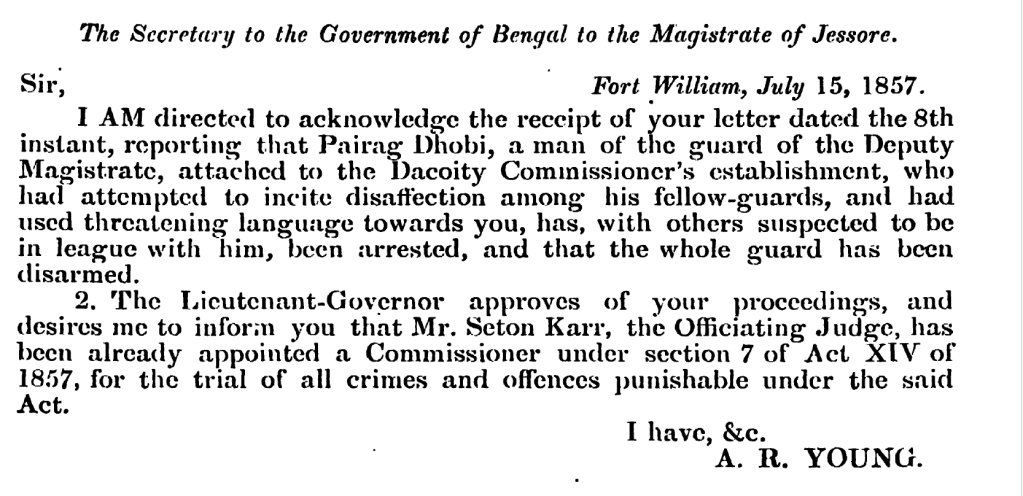
A man of his guard, Jemadar Pairag Dhobi had been trying to incite rebellion and had made use of
“seditious and threatening language,” directed at Molony himself. As Dass had brought his informant, named Bechu, with him, his deposition could be recorded at once. Bechu reported Pairag had tried to elicit information from him regarding the supposed murder of one Mr. Ward by the Nawab of Murshidabad. When the informant told Pairag the rumour was false, Pairag refused to believe him – in a later conversation with another man of the guard, Govind Singh, Pairag told him he intended to leave the service with 10 other men and kill Molony before they left Jessore.
Molony listened with some shock, realising quite suddenly that the Najibs were most likely plotting under his very nose, something he found highly objectionable. Without hesitatin,g he called for Fowle, Elliott, Skinner and Grant – they left Seton-Karr asleep at home and they did not bother to disturb the slumber of a planter who happened to be sleeping at the Planter’s Bungalow, directly opposite the house of the Najibs. The five of them, armed with pistols, walked resolutely to the Najibs – the sentry on guard in his surprise made some kind of “flourish with his sword” and was immediately disarmed along with two other men. The band of Europeans then entered the house and arrested four Najibs – Ram Singh, Pairag Dhobi, Ganesh Tewari and Shubek Dhobi – and marched them off to the jail after disarming the rest. There was no resistance, and even Seton-Karr was ignorant of the raid until morning when he discovered his two pistols were missing – Grant had requisitioned them for his own use as he did not have any of his own. Molony then informed Seton-Karr of the events and set off an administrative nightmare.
“Perhaps it was as well that I had not been made one of the capturing party, as it fell to me to hold the
trial under a special and summary Act passed to meet the crisis. On being informed by Molony of the
night’s occurrence, I at once wrote to the Lieutenant-Governor ( Sir F. J. Halliday), officially and demi officially, to vest me with powers of life and death under a new and special Act. These powers were at once given. I did not allow the correspondence to pass through the office, and no native official or other person had any idea of my extended powers till the Sessions trial was concluded.”
Molony committed two men initially for trial, the charges being sedition and incitement to rebellion. Seton-Karr found he did have enough evidence, as Govind Singh had corroborated Bechu’s initial story, to sentence the men to transportation for life, but he was not satisfied that the affair was over. The ringleader had not been presented to him, and the only way he could achieve the result he needed was to arrest the remaining Najibs and press them until one of them “volunteered to give evidence.” As such, Pairag Dhobi was quickly implicated and brought to trial.
“It was clearly proved that this man, with others, had deliberately planned an attack on the house of the native Treasurer of the Collectorate, who was known to have by him no less than ten thousand gold mohurs. With this money, the Najibs were to have gone off right across the country, to Murshidabad, after setting fire to the bazaar and liberating the prisoners in jail. The Jemadar had been in correspondence with Sepoys both at Murshidabad and at Allahabad, at which latter station the officers were shot down at their own mess table. He had also talked openly of a time coming when the native Raj would be restored and when those who knew English would be turned out of office and only those who knew Persian would get any employment. Sitting as judge of life and death, without any appeal from my decision, I considered that words and intentions derived their significance from surrounding circumstances; and that what might be loose and idle talk, or evidence of the speaker’s insanity, at a time of profound peace and security, assumed a very different aspect if spoken when rebellion and mutiny had occurred over a large part of the empire.”
It was interesting to note that two of the men arrested, Ganesh Tewari and Shubek Dhobi had both been sepoys, the former had belonged to the 19th BNI when it was disbanded, and the other claimed he had been discharged some eight years previously from the 43rd BNI but had could no longer present his discharge papers.
Without a jury or assessors to assist him, Seton-Karr would be obliged to act in what he felt was best for the district to keep the peace during these troubled times, and the decision weighed heavily on him. Convinced that under normal circumstances he could have let him off with a slap on the wrist, it irked Seton-Karr that he now needed to set an example. The native population he found were “uneasy rather than excited”, but the Najibs that had taken to hovering about the court had worried him sufficiently that he sat, during the trial, with two loaded pistols at his side. Worried that otherwise loyal members of society might get ideas in their heads if action was not taken, Seton-Karr ordered the Jemadar executed.
“I was convinced that unless a prompt blow was struck, we might have a disturbance of which no one could predict the end or consequences. Isolated planters might naturally take the law into their own hands. Englishmen at a distance from each other, in charge of valuable properties, were, of course, looking to the regular authorities to maintain order and quiet. I did not think it necessary to order the Jemadar to be hung that very evening under the nearest tree.”
As such, the sentence was proclaimed on Saturday evening, and the execution was ordered for Monday morning. Jemadar Pairag Dhobi, a man of “fine physique” who had fought for the English at Maharajpore and against them at Sobraon, walked to the scaffold with a firm step and straight back. The kerchief was tied around his face, and he was hung, not in the quiet grounds of the court but on full display in front of the police station in the bazaar. “All the Englishmen in the station, except myself, attended on horseback and well armed, but not the slightest sympathy was shown by any of the population.” As it was market day, Molony ordered the corpse to remain hanging in full view of some 3000 people until sunset. Whatever Seton-Karr’s misgivings were about the execution, his action prompted a sudden quiet in Jessore and the rest of the year passed without incident.
 Mutiny Reflections