A Regrettable Regiment
The 34th Regiment, Bengal Native Infantry (Bradshaw Ka Paltan)
- 1798 raised as 1st Btn 17th Regiment of Bengal Native Infantry following 1796 reorganisation when previous 17th became 2nd Btn 12th Regt. Raised by Major Samuel Bradshaw
- 1824 1st Battalion became 34th Regiment of Bengal Native Infantry under Major E F Waters
- 1844 -Disbanded for refusing to march to Sind due to the disallowance of batta. Their number was subsequently erased from the lists.
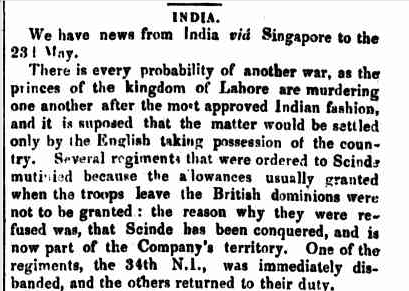
- 1846 Raised again as the 34th Regiment of Bengal Native Infantry
- 1857 mutinied at Barrackpore on 29 March. Seven companies disbanded, Sepoy Mangal Pandey and Jemadar Ishwari Prasad, hanged for mutiny.
The 34th BNI had not had a satisfactory history. Following their behaviour in 1844 and subsequent disbandment, the 34th was raised again in 1846 to fill the gap, but as history showed, the results with the second raising were hardly any better. By 1857, they were positively sullen and insolent – a small escort of them, sent to Berhampore from Barrackpore in February 1857 had been so worked up already with stories of tainted cartridges and rumours of forcible conversions to Christianity, their talk inflamed the feelings of the 19th BNI so much, the 19th mutinied on the 25th of February, more out of fear than actual discontentment.
The 19th BNI was marched to Barrackpore to be disbanded, where they once again met the 34th. By this time, the 34th were all out ready for mutiny, and proposed to the 19th they should rise up, murder their officers and then join the 34th and march to Calcutta – the 19th, already disgraced, were not in the mood to listen to more warmongering from the 34th. It was left up to Mangal Pandey to start his one-man rebellion on the 29th of March, but during the entire scuffle, only one man of the 34th stepped forward, alone, in an attempt to hold back Pandey. The rest hung back, and some even struck the wounded men with the butts of their rifles as they lay on the ground. Following the disbandment of the seven companies at Barrackpore, many of the men joined the army of Nana Sahib and were found with the rebel force at Bithur at their defeat by Sir Henry Havelock on the 16th of August.
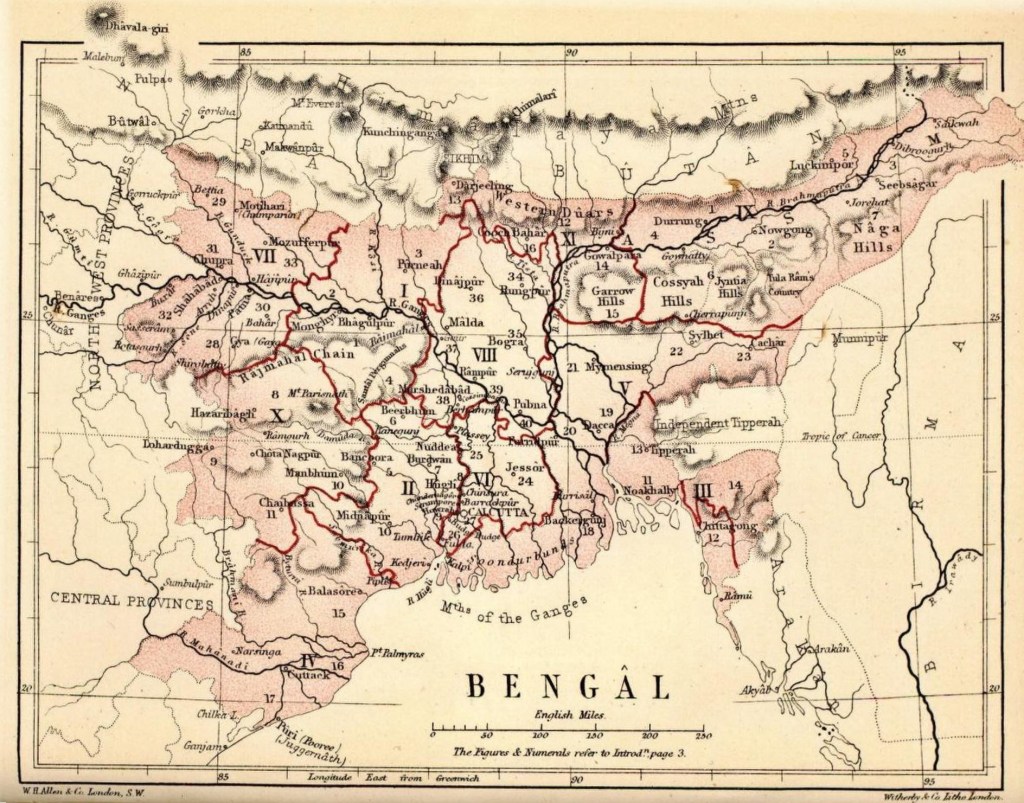
Three companies of the 34th, however, had been spared the fate of their comrades at Barrackpore – they were safely ensconced at the port town of Chittagong and, to the relief of their officers, showed no signs of discontentment. Their men went about their duties cheerfully and with good grace; the behaviour of the comrades, the men said, had saddened them; their officers, they said, had nothing to fear. The men of the 34th even sent a petition to this effect, stating the behaviour of Mangal Pandey was disgraceful,
“…they knew well that the Government would not interfere with their religion, and they would stay faithful forever.” By June, they were pleading to be led to Delhi, as noted by C. Steer, Commissioner of Chittagong. As it was, Steer was not convinced.
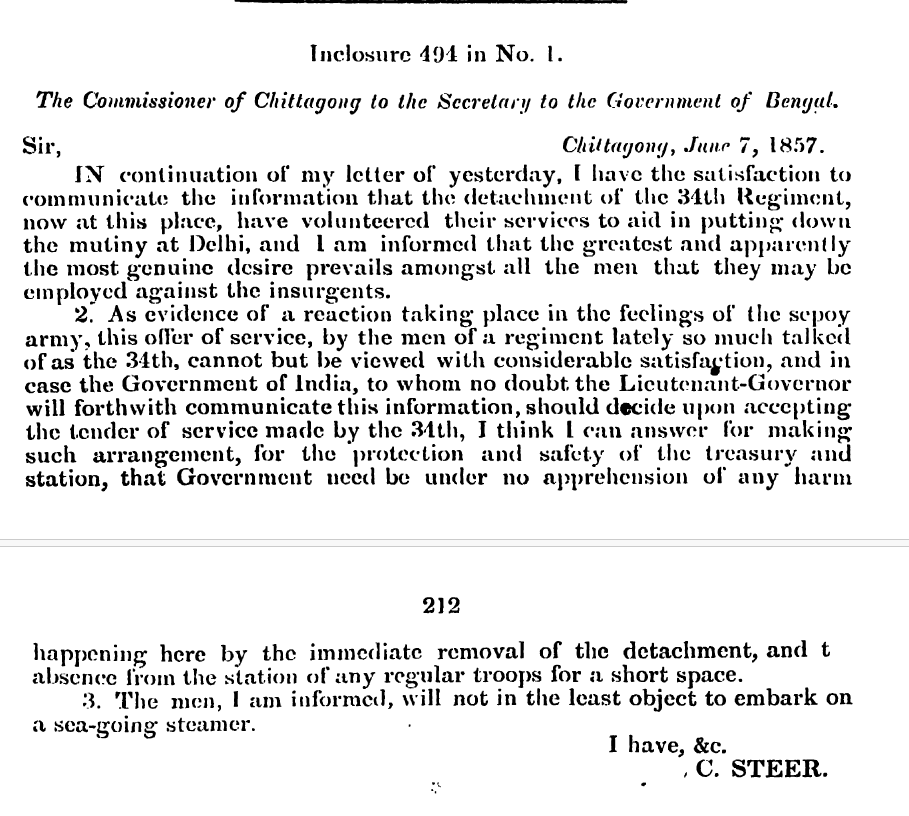
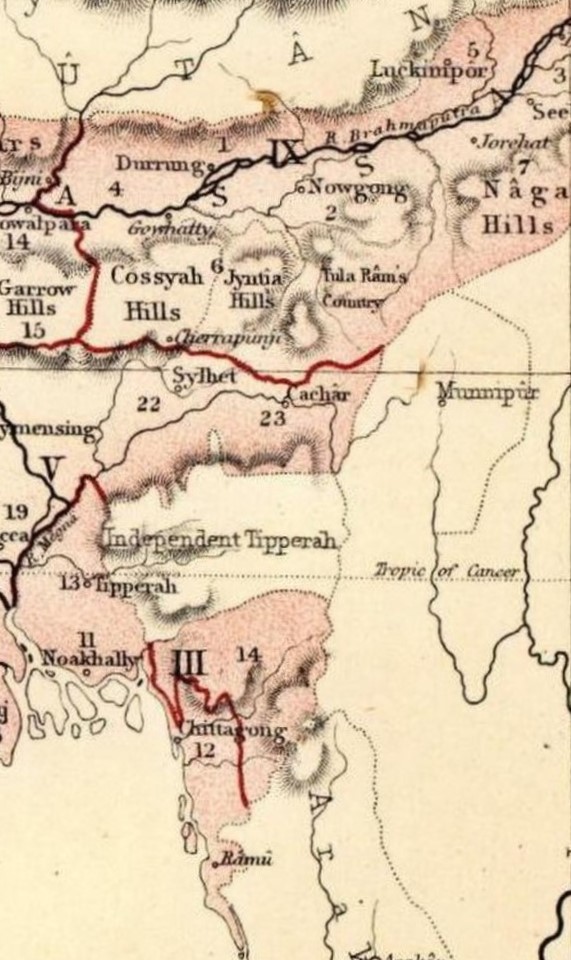
In his next letter to the government, Steer reported, while the petition by the 34th had been met with considerable satisfaction by the people of Chittagong and had aided to calm the more frightened of them, the general belief was they hoped the government would “take the detachment at their word, and remove them.” For now, Steer and the officers of the 34th decided their best option was to trust the men – they were placed in charge of the Treasury and as patrols around the city. They had done nothing to warrant anyone’s distrust. With this, Steer left Chittagong on sick leave and handed the reins over to Mr. Chapman.
By 20 June, six days after Steer reported Chittagong was calming down, Chapman was painting a completely different picture. The station was in a state of “apprehension and anxiety”, and news from neighbouring Tipperah was hardly any better. The European inhabitants were more terrified than those in Chittagong, having been sent into panic by the continued reports of disaffection from Chittagong – these reports, those baseless, were also fuelled by news of the panic at Dacca and at Calcutta. As such, the officiating magistrate of Tipperah, Mr. J.M. Cockrell, wrote to Mr. Chapman that he would apply to the Raja of Tipperah for 200 of his men to be sent down to watch the banks of the Fenny River to prevent any disbanded or mutinous sepoys from Chittagong into Tipperah. For his part, Chapman found this unnecessary, as there was nothing at all happening in Chittagong.
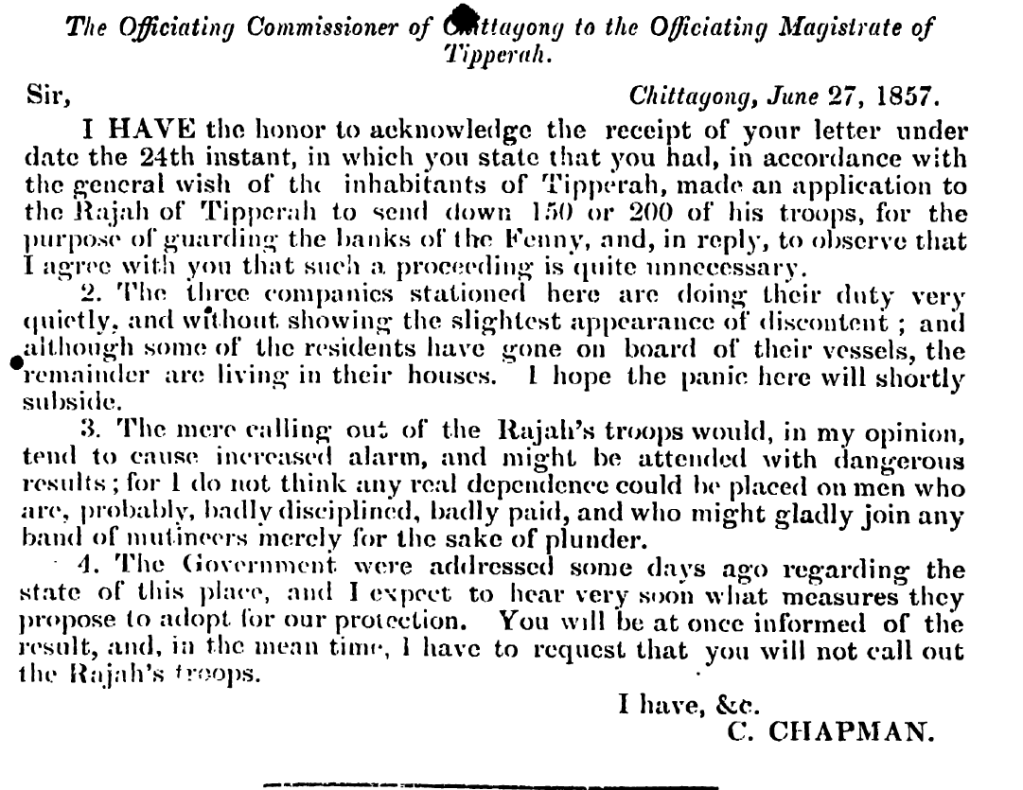
Business, however, proceeded as usual. Treasure from the Chittagong treasury was transferred to Calcutta by steamer without any incident, and Chapman reported that the sepoys, like those at Dacca, who lived in dread a European regiment was coming to disarm them, were pleased no Europeans had arrived with the steamer. They proclaimed they were happy the authorities of Chittagong had, once again, displayed their full trust in the sepoys of the 34th. Yet, the situation was far from perfect.
Men of the 34th, many of them who had their homes in the Chittagong district, were continually harassed as they tried to proceed on leave to visit their families. They were arrested by the jittery officials as “mutineers and deserters” even after they produced papers signed by their European officer; they were simply going home. The situation became so fraught with misunderstandings, the European officers were told to inform the magistrate of the district the sepoy intended to visit before the man left his lines; furthermore, they were told to prevent their men from travelling in their uniforms as that might lead to them being shot by accident.
The alarms and panics continued, even when there was no cause at all.
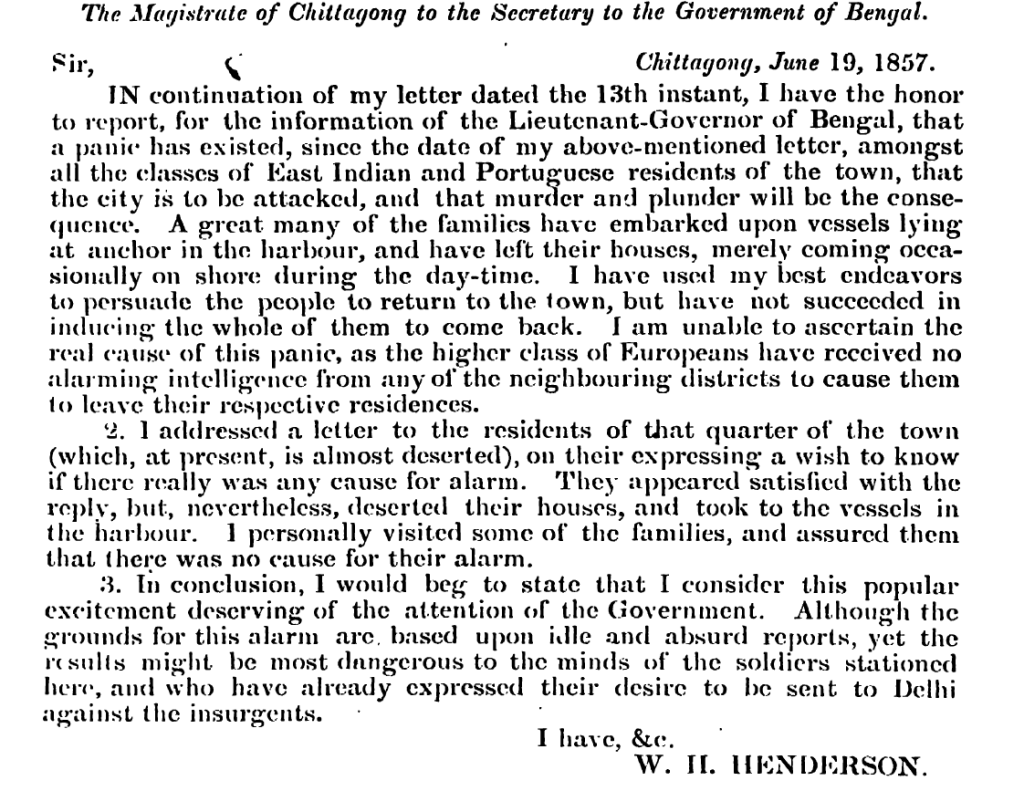
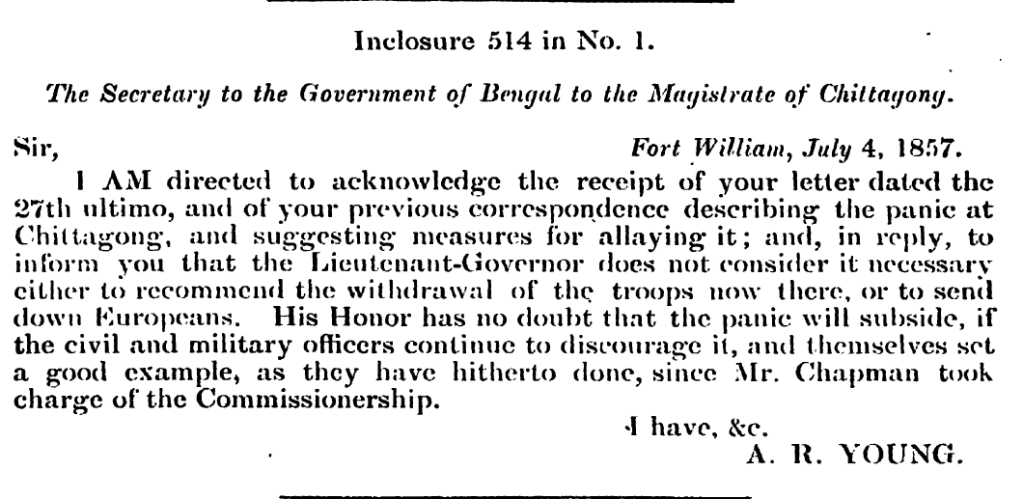
The Portuguese and the East Indians were not to be pacified by anything Henderson said – frustrated by their continued intention of living on their boats, he begged the government to intervene and asked Calcutta to withdraw the 34th BNI – if not all three companies, then at least the men who had volunteered to fight before Delhi. He further suggested a party of the naval brigade, as allocated to Dacca, might be sent down to take their place. Calcutta disagreed.
Then came the case of the Magh.
The word “Magh” or “Mugh” was coined in the 1500s by visitors to Burma to describe the Marma and Barua peoples – the etymology is supposedly derived from the word Magadha, the name of an ancient Buddhist kingdom but had, in effect, no relation to the people the word was denoting! Only Tripura some Marma people would describe themselves as Maghs – the rest considered it derogatory as it implied they were pirates.
On the 4th of July 1857, a Magh was caught in the lines of the 34th BNI at Chittagong and was supposed to be “tampering with the sepoys.” He was found to have papers in his possession, all written in Burmese characters. These papers, when handed over to the interpreters, set off a linguistic firestorm and none of them could agree what the papers actually said, with each one producing his own translation. It was finally decided to send the papers to the Akyab authorities (now called Sittwe) where it was hoped translations could be made into English and Hindi. The Magh was held in custody until the translation arrived. It turned out the papers held nothing of importance and were in fact of such a bland nature, the Magh was released and sent on his way. It was however, another example of a very nervous administration.
The Strange Story of Murder and Sedition in Darjeeling
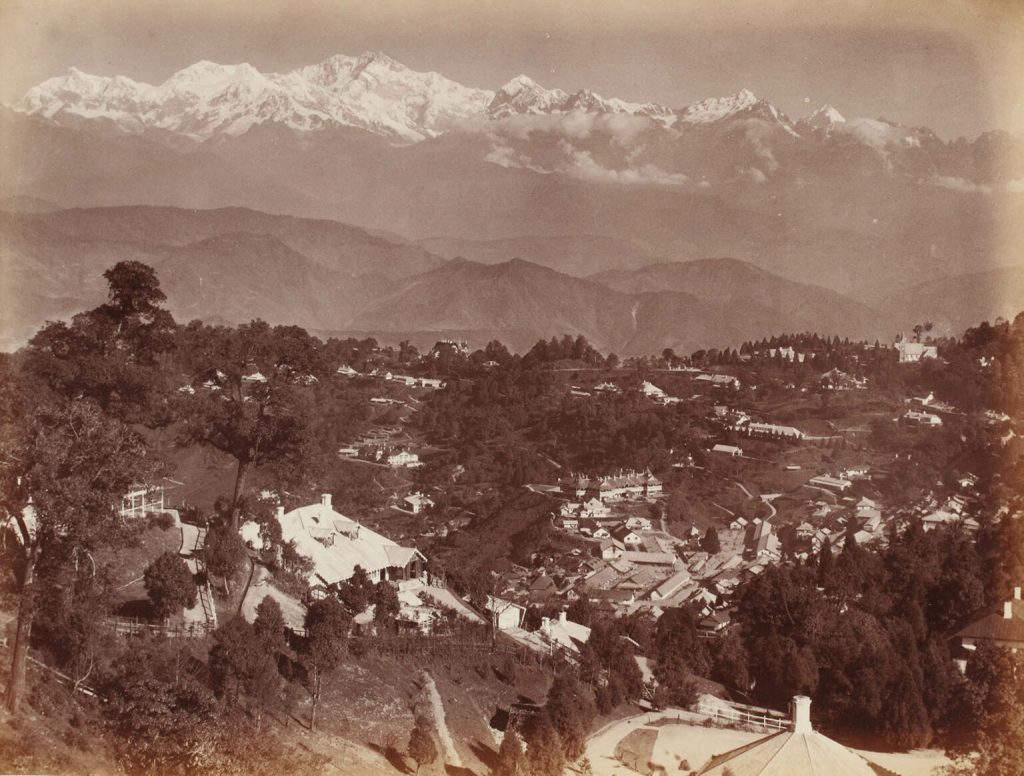
As if dealing with sullen sepoys, wandering mutineers, and disbanded men was not enough, panic at the hill station of Darjeeling caused some consternation in June and July.
It all began with two murders – one of Lieutenant E. S. Whish of the Invalid Establishment and the other of an unnamed woman. Whish was murdered, by a fatal stab to the neck, on the night of 15 June, in his house. The house was ransacked and property stolen – 300 rupees in cash, a pair of pistols and a telescope. The superintendent of the station, Mr. A. Campbell, prudently treated this as a robbery, but the murder caused such a panic, that he was compelled to extend police patrols to calm the nervous citizens. Unfortunately, the same stories of imminent peril soon pervaded the drawing rooms of Darjeeling, and by the end of June, it was generally believed there was to be an “uprising of a dangerous nature,” though by whom was unclear. Campbell himself could not find any basis for the rumours but ordered all the grog and junja shops closed at sunset, and everyone, including Europeans, was ordered to be indoors by 9 pm. Anyone caught without a pass was arrested and obliged to spend the night in lock-up.
Then, turning his attention back to the ongoing investigations of the murders, Campbell was able to detain three men – two for the murder of Lieutenant Whish and another, a sepoy of the Sappers, who had murdered a native woman. All three were executed – the first executions in Darjeeling since the founding of the station in 1838. However, while investigating the murders, Campbell was astonished to find another sepoy of the Sappers, one Mattadeen, had in fact most probably been the cause of the rumours in Darjeeling, and he began to unravel the plot with the help of a most unlikely informant.
On the 27th of June, one Diaram Dhobi of the 73rd BNI stationed at Jalpaiguri who had come to the station escorting a lady (from Jalpaiguri) had presented himself in the lines of the Sappers and Miners for some idle chatter before he left back to his station. During the conversation, in the house of Mattadeen, the talk turned to “cartridges, the present mutinies, the downfall of the English government, the murder of Europeans…”, something which Mattadeen had perhaps too much to say about. The conversation had been most eagerly listened to by the sappers’ havildar Ram Dass and Sepoy Ram Sahai. Concerned by their talk, Diaram Dhobi reported the matter to the station’s staff officer, Captain Curzon. Curzon immediately ordered the arrest of Mattadeen, Ram Dass and Ram Sahai and handed them over to Campbell, who ordered a Court of Inquiry.
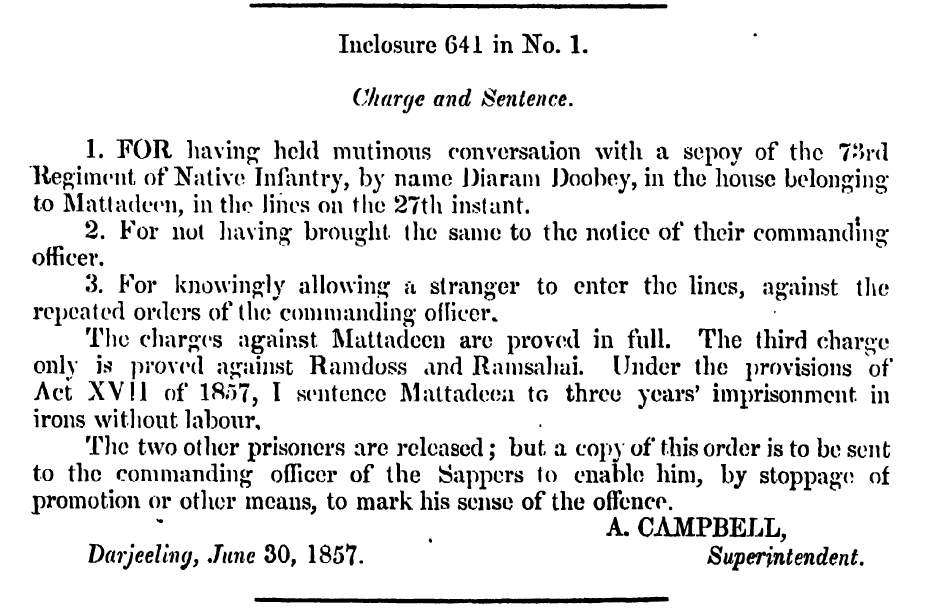
The court found that the havildar and the sepoy Ram Sahai had indeed been listeners – they had done nothing seditious, mutinous or otherwise, but Mattadeen was not so lucky. The informant alluded to the fact that three 6-pounder guns were in the hands of the Sappers – Mattadeen thought it was high time those guns were turned on the Europeans. As such, Campbell insisted now the guns and ammunition be removed from Sappers forthwith – while he did not doubt the regiment as a whole, he could not allow the words of one man to go unnoticed; it would serve as a lesson to the regiment that they could no longer be trusted to the full extent they probably deserved. He also changed the Treasury guard – it would consist of three men as always, but only one would be a Sapper. As for Mattadeen, Campbell had a few things to say before proclaiming his sentence of three years in irons, without labour.
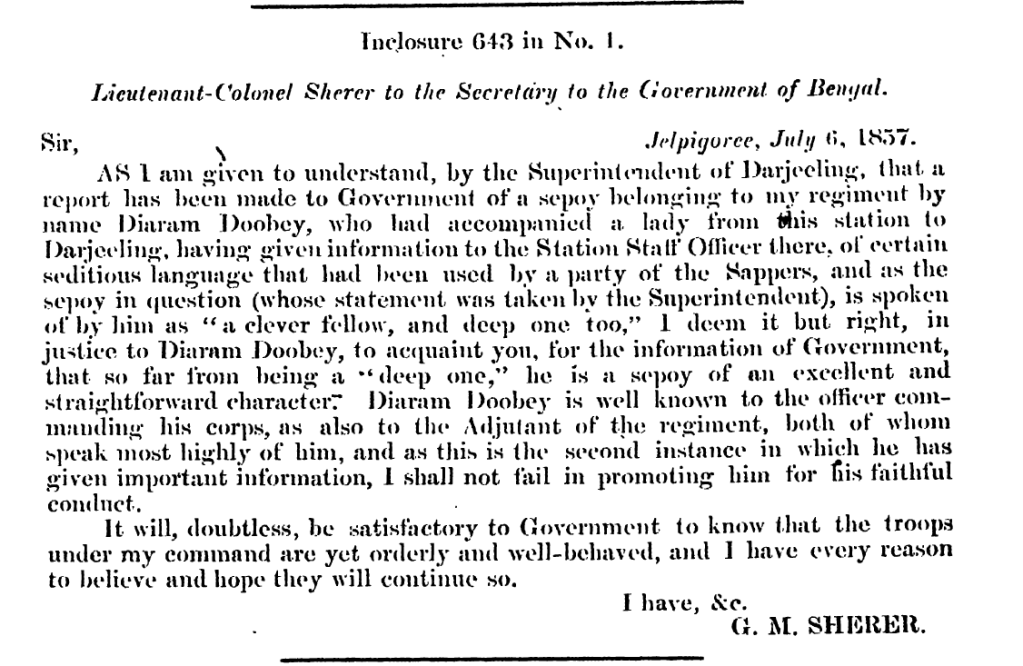
For Colonel George Moyle Sherer, the conduct of Sepoy Diaram Dhobi was the very assurance he needed that his regiment was staunch and true.
Reports from Chittagong, Dacca, Jessore, Tiperah and Jalpaiguri suddenly became quiet. The country, it seemed, had fallen into a slumber. The authorities continued to detain wanderers and the occasional “dreamy fanatic,” such as the one who distributed a most bizarre letter to the people of Jessore, in which he proclaimed he had seen the downfall of mankind in a vision – the man was questioned and, after a brief detention, released. The letter, after being translated, was thought strange but did not warrant any further investigation. Occasionally, a sepoy from one of the mutinied regiments was captured. One sepoy of the 37th BNI had fled from Benares – if he had simply gone home, as he intended, all might have been well, but the man, unaware that informants in East Bengal were rife, insisted on relaying his adventures (embellished with lavish praise for the mutinied regiments) to a sowar of the 11th Irregular Cavalry, who promptly arrested him. The sepoy was given a very harsh sentence – “imprisoned for life, in transportation beyond the sea, with labour in irons.” Yet these incidents were hardly premonitions of what was to come. East Bengal was starting to breathe a sigh of relief in September, Delhi had fallen, and the backbone of the mutiny was essentially broken. Reports were still issued, but the stations were now stating, “all quiet” and “nothing new to report.”
Yet, just as Sir Colin Campbell secured the relief of Lucknow, and the rebels were beaten back in Central India and at Narnaul, the 34th Bengal Native Regiment at Chittagong decided to mutiny on the 17th of November.
Sources:
Allen, Basil Copleston. Eastern Bengal District Gazetteers: Dacca. Allahabad: Pioneer Press, 1912.
Behan, T. L. Bulletins and Other State Intelligence for the Year 1858. Parts I & II. London: Harrison & Sons, London Gazette Office, 1860.
Bradley-Birt, F. B. Dacca: The Romance of an Eastern Capital. London: Smith, Elder & Co., 1914.
Great Britain Parliament. Further Papers (Nos. 5 and 6) Relative to the Mutinies in the East Indies. London: Harrison and Sons, 1857–1858
 Mutiny Reflections
Eva,
I am trying to put together a short Bio piece for HE Iremonger of the 21st BNI. Unfortunately the writing things seems to take me much longer than it seems to take you. I will let you know when I have finished a draft.
Dave
LikeLiked by 1 person
Hello Dave!
Perfect!
Have a lovely Christmas and a joyful New Year.
Best wishes
Eva
LikeLike
Love these articles, can’t wait to hear more about 21st NI. They were one of a handful that weren’t disarmed. I have a gr great grand father that served with them and I love to know of their movements in 1857.
LikeLiked by 1 person
The 21st NI were indeed a very loyal regiment.
I can give you brief history of Neelwar Ka Paltan, or Naylor’s Battalion
Thomas Naylor had quite a colourful history:
He was appointed on the 26 Sept. 1777 to command. one of the battalions raised for the Nawab-Wazir o f Oudh on its transfer to the Company’s service. This battalion, which was numbered 30th, was called after him “ Neelrwar-ki-Paltan.” 1 He was still commanding this Corps (which had now become 23rd Regt. of Sepoys) in Aug. 1781, and on 8 Oct. o f that year he attacked with his regiment and totally defeated a body of 10,000 rebels in the Nawab-Wazir’s dominions.
1776 raised for the Vizier of Oude as 30th Battalion
1777 commanded by Captain Thomas Naylor
1778 Incorporated in HEIC service as the 29th Battalion of Bengal Native Infantry
1781 became the 23rd Regiment of Bengal Native Infantry
1784 became the 29th Regiment of Bengal Native Infantry
1796 became the 2nd Battalion, 9th Regiment of Bengal Native Infantry
1824 became the 21st Regiment of Bengal Native Infantry.
Their battle honours were Laswarrie and Bhurtpore. Later, Burma 1885-87 was added.
In May 1857 they were one of 5 regiments stationed in Peshawar, of these 4 were disarmed, the 21st was exempted. Due to their loyalty and for never having shown any signs of disaffection, they were given, in 1861, the title 1st Regiment, Bengal Native Infantry.
In 1901, they became the 1st Brahman Infantry
1903 became the 1st Brahmans
1922 united with 62nd Punjabis, 66th Punjabis, 76th Punjabis, 82nd Punjabis, and 84th Punjabis and became 4th/1st Punjab Regiment
1931 disbanded.
Their badge, before 1903 symbolised the fish of the Awadhi court and can be found here:
https://www.britishempire.co.uk/forces/armyunits/indianinfantry/1stbengalinfbadge.htm
Your g.g. grandfather would have worn it.
Do you have any information about your g.g.grandfather? It would be wonderful to add it!
Thank you for reading my site, I am always very happy to hear from readers!
Best wishes
Eva
LikeLike
Eva,
As far as more information about the grandfather serving with the 21st, I can definitely give you more information. His name was Henry Edward Iremonger 1826-1888. I found a “history” that I have posted in my blog “Bartzone”.
Now my blog is nowhere close to your postings, but it has served to help me keep track of my research till I can do something better with it.
Anyway, if you have time, take a look at the post: https://wordpress.com/post/dbartone.wordpress.com/946.
It tells a bit about HE Iremonger and has a linked/attached PDF that I found on the National Archives, call Henry and Emma. It details much of his service history of 28+ years in India.
It is interesting to me that although he was in India at that time, (1857) serving with a NI regiment that did not get disarmed, the details of what he did do are very limited. It seems to me that he would have “seen” some of the action. Like some of the actions around/at Murree and Neemuch and “blowing from guns” at Peshawur.
Let me know if you get a chance to review the PDF “Henry and Emma” or if you have any interest in any of the materials I have collected. I would love to see what you think or if I could help your research in any small way
Dave
dbartone@yahoo.com
LikeLiked by 1 person
I am sorry for the late reply! Thank you for sharing your site, I have spent hours and hours reading it! Have you thought of writing it up into a book? I think it makes fantastic reading & perhaps Barnthorn Publishing would be interested to take it on. The book, Henry& Emma is wonderful. Amazing work.
I have never had a guest writer on my site, but I think, if you would like to write an article about Henry Irenmonger, it would fit wonderfully.
LikeLike