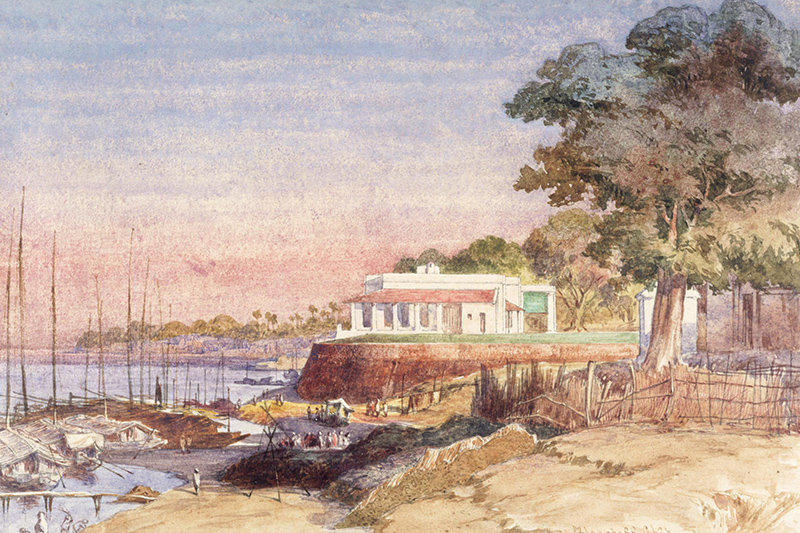
Dinapore is situated midway between Calcutta and Allahabad, the only military station with any substantial force in the area and home to three native regiments – the 7th, 8th and 40th BNI, numbering nearly 3000 men, along with one company of European and one of native artillery and H.M.’s 10th Regiment of Foot. Ever since June, there had been calls from the mercantile community in Calcutta to disarm the sepoy regiments in Dinapore, but their calls fell on deaf ears. Tayler and Rattray had done their best to convince Lloyd that simply having the 10th Regiment watching the three sepoy regiments was hardly enough to dissuade them should they choose to mutiny, but the officers of the regiments were adamant that their men would never mutiny. General Lloyd was old and disabled with gout – although gout is an ailment of the foot, he appears to have been suffering from some debilitation of the mind. News of Lucknow, Cawnpore, Benares and Allahabad did not sway the man; in his mind, the men were staunch until proven otherwise.
In Calcutta, Halliday and his compatriots clung stubbornly to the thought that there was absolutely nothing wrong in Bihar, and Tayler was suffering from an overactive imagination, seeing conspiracies everywhere. They simply refused to order Lloyd to disarm the native regiments. In their estimation, such a move could lead to further panic not just in Bihar but in Calcutta itself.
The calls from the merchants in Calcutta to disarm Dinapore grew louder; they appeared to be the only men who understood it was imperative if reinforcements were to be sent to Awadh or Bihar, the station of Dinapore must be secured. Canning saw himself forced to do something.
He raised a yeomanry cavalry under Major J.F.Richardson for the immediate protection of the vicinity of Calcutta. He then directed similar corps to be raised, consisting of unemployed sailors, to meet any threats in Bengal and Bihar, while, at the same time, he negotiated with Jung Bahadur of Nepal for the dispatch of Gurkha troops to Gorakhpur and Azamgarh. So far, Canning had done well, but he still had not managed to provide reinforcements to Havelock, who was desperately trying to relieve Lucknow but was stuck in Cawnpore. Canning could not send the 10th from Dinapore without weakening the road to Allahabad, nor could he risk sending the 53rd from Calcutta, as he would have depleted himself of European troops. So, the only answer was to wait for reinforcements from elsewhere. These came in the form of the 5th Fusiliers, some 800 strong, who landed in Calcutta from Mauritius. They were quickly dispatched from Calcutta on the 12th of July, intended to reinforce Havelock. They would pass Dinapore and Patna around the 22nd of July. Instead of being sent with clear orders to assist in the disarming of the sepoys at Dinapore, vague instructions were sent to General Lloyd by Sir Patrick Grant.
“If, when the regiment (the 5th Fusiliers) reaches Dinapore, you see reason to distrust the native troops, and you entertain an opinion that it is desirable to disarm them, you are at liberty to disembark the 5th Fusiliers to assist you in that object.”
General Lloyd, by his admission, was not up to the task. He was ill and frankly did not know what to do. On one hand, his officers swore to the loyalty of their men, but Tayler and Rattray were doing everything to convince him otherwise; now, Grant, instead of telling him what to do, had left him with a choice he simply could not make. It might seem harsh to judge the man in his difficulties but the last thing India needed was another Hewitt, who like Lloyd, was one of those “respectable old gentlemen who are found in Divisional and Brigade Commands all over India, and who excite little complaint, or notice of any kind, in the weak, piping time of peace when a parade…is the operation of vital importance. But let an emergency come; let there be a demand for decision…The good old Brigadier is then found lying on his back on the parade ground, entreating the next senior officer to take the responsibility or allowing the enemy to get beyond reach before he can make up his mind what is to be done…” As it is, Lloyd did do something, but it was not what anyone expected.
When the 5th Fusiliers arrived in Dinapore on the 22nd, Lloyd sent them away. Two days later, two companies of HM’s 37th, recently arrived from Sri Lanka and sent in haste by Canning from Calcutta, made their appearance in Dinapore on the 24th, and Lloyd insisted they disembark.
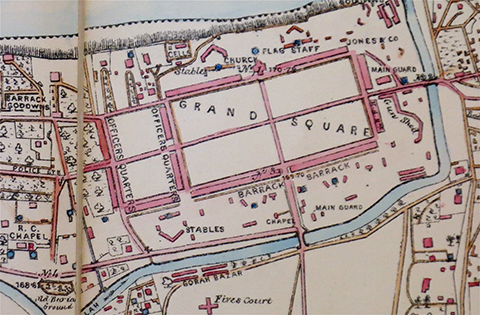
However, Lloyd had changed his mind again about disarming the sepoys. Instead, he ordered a parade of the European troops for the next morning, the 25th, and made arrangements for all the percussion caps to be removed from the magazine. With dawn being the hour appointed for this apparent show of force, the European troops and the Artillery were drawn up in the barrack square, and two bullock carts were ordered to the magazine to collect the percussion caps and bring them to the English barracks.
Lloyd, in his muddled mind, apparently forgot that the carts would have to pass through the sepoy lines to reach the Europeans, and the sepoys would now be able to conjecture what their fate would be.
As the carts crossed the lines, a cry went up among the sepoys of the 7th and the 8th Regiments; the 40th held them back from rescuing the ammunition. The 7th, who were being paraded for guard duty at the time, raised the loudest shouts, threatening openly to murder their officers while vowing most fervently the ammunition would not be carted off. Their officers quickly went among the men and pacified them with any explanation they could think of – the tumult died down, and the officers retired to the mess for their breakfast.
The caps were safely stored in the lines, and Lloyd dismissed the European troops. He issued, as something of an afterthought, buoyed by his triumph of the morning, a supplementary order to remove all the caps in the possession of the sepoys, which would be effected at a noon-day parade. The idea was to have the Native officers explain to the men that this was but a precautionary measure, “to save the well-disposed from being led away to commit themselves by the evil machinations of designing scoundrels,” and then the caps would be collected. Or so thought Lloyd.
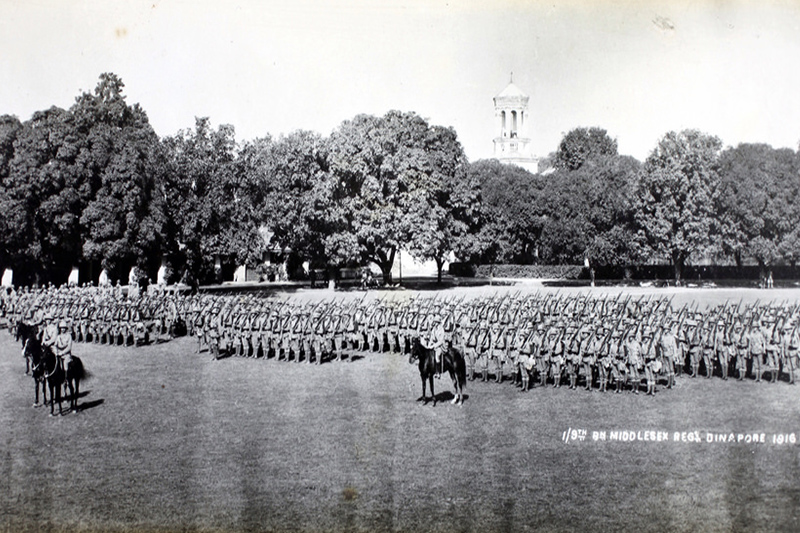
Noon came, and the men were assembled on the parade ground. The Native officers began, as instructed, to explain what was going to happen, using the “soothing explanations” Lloyd had conjured up. When the order came to surrender their caps, the 7th and the 8th broke into open mutiny.
Rushing to the bell-of-arms and seizing their muskets, they opened fire on any European within sight. Then, grabbing their regimental colours and regimental treasure, they made ready for flight.
The 40th, however, still hesitated. Instead of joining the other regiments, the native officers, NCOs and some sepoys formed and marched into the square with their colours and treasure showing every intention of defending them – it is possible, had this been understood as their intention the regiment would have stood fast, but the Europeans of the 10th, stationed on the hospital roof did not understand and they opened fire on them. In the ensuing panic, the men of the 40th en masse deserted their posts and, taking their arms and accoutrements with them, followed the 7th and 8th regiments out of Dinapore.
The European troops were immediately called out, but there was no one to give them any orders. General Lloyd was onboard one of the steamers, and his officers, suddenly placed with a burden of responsibility, did what the Government of India had done all along in Bihar – they did nothing. The mutineers, in the meantime, had managed to get away, scot-free. By the time the Europeans were in any order to march against the sepoys, they were gone. A feeble chase was made and a few shots fired, but of little use. So the Europeans contended themselves with setting fire to the native lines and then waited for Lloyd to do something.
Lloyd, however, was swift to present excuses. He was old, he was afflicted with gout, which made it impossible for him to walk, and his stables were two miles away, so he could not ride. He had taken his position on the streamer not 200 yards away because it was convenient. He had given orders for the men of the 10th to fire at the regiments from the roof of the hospital if they saw fit to do so, while the other officers should make up their own minds how to best pursue the mutineers on land. In other words, he knew what he would do, but he refused to take responsibility for the inabilities of others. His officers, not him, had failed.
As for the mutineers, some made the poor choice of trying to escape across the Ganges – their boats were fired into and run down by the steamer Lloyd happened to be on; some were shot, and others drowned. However, the bulk of the force made their way to the Son River. A plan had been put in place to remove the boats to the other side of the river in case of an uprising in Dinapore, but it was only half finished. The officer in charge, Mr Palin, had neglected to destroy them “as he had promised to do,” and as such, when the mutineers arrived, the boatman had no objection in ferrying them across. They did not have to worry about the Europeans following them – they were still in Dinapore, wondering what to do next.
Lloyd had little imagination, and according to Halliday, Tayler had too much. Bihar stood on the brink of disaster.
 Mutiny Reflections