The Next Few Days
Back in Patna, William Tayler received the news of the Dinapore Mutiny with some surprise. Expected as it was, he could hardly believe General Lloyd had let the mutineers escape. Something had to be done. No one could tell him if the mutineers were heading in force to Patna or if they were still in the vicinity of Dinapore – he suspected the latter.
On the evening of the 25th, he called a meeting at his house. Intelligence had been brought to him that the English soldiers had been incapable of following the mutineers at any great distance overland, and thinking it might be possible to intercept any stragglers of the regiments, Tayler planned a night movement from Patna, which he put in the capable hands of the Assistant Magistrate, Mr Lindsay. Mr H Whitcombe, the resident Railway Engineer, and Mr V. Taylor, a young as yet unplaced civilian, volunteered for the party. They would be accompanied by 50 of Rattray’s Sikhs, 50 Najibs and a new force of troopers recently raised. Their objective was Phoolwaree, some eight miles from Patna, where it was rumoured some mutineers had taken up a position – but the information was uncertain, all General Lloyd could say is “It was uncertain which road they would take. or they might have taken all three and visited all three places.” In other words, they might be Phoolwaree, they could be heading for Patna, or perhaps they were on the road to Arrah.
Tayler instructed the volunteers to proceed to Phoolwaree and then with some haste, proceed to Dinapore and by whatever means possible, induce General Lloyd to give them a detachment of the H.M.s’ 10th so they could effectively take charge of the road and pick up any mutineers who happened to be crossing between Dinapore and Patna.
However, even the best-laid plans sometimes must be changed.
Around dawn, Tayler received a note. “By the imperfect light, I could just distinguish the words, ‘Major Holmes and his wife. I felt at once what it was, and I shall never forget the sensation of pain and horror with which I read the announcement of this gallant and chivalrous officer’s murder.”
Tayler had lost one of his best friends; fighting his personal grief, he suddenly realised he was quite alone and felt some of the blame was on him as the “constant and cheering communications…all served to prevent the least apprehension of danger to him personally.” Tayler immediately recalled the volunteer detachment. With the death of Holmes, there was no longer a 12th Regiment and in light of the danger they presented, he could not risk his only volunteers.
That afternoon, General Lloyd wrote to Tayler – he proposed Hewitt style, to entrench himself in Dinapore. He could only say for sure that mutineers had made off in the direction of Arrah and believed they would join forces with Kunwar Singh before returning to attack his station. Tayler had had about all he could take from the general. At any rate, Lloyd sent a small detachment to Tayler with two guns, leaving 500 men and four guns for himself.
Tayler was not impressed.
Tayler now had in his possession letters and information from the other stations. At Arrah, they were making ready for a siege; from Muzufferpore, Robert Forbes wrote to Tayler of the “great apprehension and feeling of insecurity and danger, both among the European and Native communities in the district and station…” the Europeans were thinking of bolting for Dinapore and Forbes begged Tayler, “We earnestly hope that you will kindly take into consideration, both the unprotected state of the place and the great difficultly of getting away from it and afford us some protection.” If there would be no help coming, Forbes would see himself forced to abandon his station to save his life. At Gaya, Alonzo Money boldly declared he could hold his own, but actions would, as we shall later see, speak louder than words.
The indigo planters at Tirhut also wrote a letter to the General of the Division. Their position was worse than Forbes’. They had some protection, but it was not the kind they could trust – it was made up of a small party of the 12th Irregulars who had not mutinied and 100 Najibs of doubtful fidelity. They tried to make Lloyd understand that if these men rose, the treasury would be looted, the houses destroyed, and above all, the indigo factories would be ruined and most likely, they and their families murdered. They implored Lloyd to send them “fifty or even thirty men, Europeans” to preserve the “tranquillity of the district…” Failing that, could he at least spare a few to escort their families to Dinapore. If the planters themselves had to do that task and thus abandon Tirhut, there would be no possibility to save the station. With their families out of the way, the men could resolve to hold the station themselves, come what may.
More letters poured into Tayler’s office. Raikes had already abandoned Champuran – an action for which he took sole responsibility, and Tayler approved after the fact; at Chupra, Lynch and McDonell had escaped by the skin of their teeth and barely made it to Dinapore. Tayler decided it was time to visit Lloyd. His calls for action had fallen on deaf ears; he now had the mutinous regiments on one side and Holmes’ 12th Regiment on the other, and a very wily landowner, Kunwar Singh, to contend with.
Lloyd continued to satisfy himself with more half measures – he had sent a small force out on the 26th up the Son River, expecting there would be enough water to float the steamer – he was wrong and the steamer could not proceed high enough to do any good. They returned to Dinapore in the evening without firing a single shot.
Reinforcements were wanted in Buxar; the steamer started the next morning with some men of the 5th Fusiliers, lately arrived from Calcutta. In the evening, the steamer Horungotta from Patna arrived in Dinapore. She was sent on the 28th with a detachment of the 37th to a landing point some 9 miles outside Arrah, the intention being the 37th would then march to the station and bring away the civilians. But the vessel stuck fast on a sandbank shortly before achieving its destination and could not return to Dinapore. General Lloyd was all for calling the 37th back, but he would have to contend with Tayler first. There was another solution.
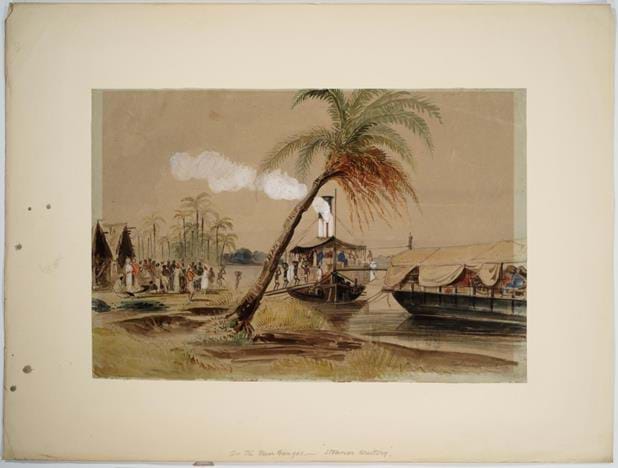
Another steamer arrived in Dinapore on the evening of the 28th. It had just come from Allahabad and was full of passengers bound for Calcutta, mainly women and children from that station and others. Under Tayler’s insistence, the vessel was requisitioned as a troop ship: he then ordered the Protestant Church be turned into a camp for the fugitives. This vessel would then be used to not just relieve the stranded Horungotta but also carry a relieving force to Arrah. To supervise the proceedings, Tayler went up to Dinapore, accompanied by Ross Mangles, the assistant at Patna, and Mr. E. McDonell, magistrate of Chuprah. Both men had a sincere desire to accompany the relief force, and although it saddened him to think that these two young men might be sacrificed in a folly, he did not have the means to stop them.
They slept that night in Tayler’s carriage and, before dawn, went down to the ghats to see how Lloyd was getting on. Expecting to see H.M.’s 10th embarking the ship, they were most surprised to find the passengers had not disembarked as ordered. They were still tucked up and fast asleep. General Lloyd fretted on the edge of the ghat while the captain complained it was disgraceful to wake the passengers. Colonel Fenwick appealed to Lloyd to give the order, which he did, but it was then passed on to the non-commissioned officers and from them to some privates. The captain protested his vessel could not tow her flat (NB: that what is commonly described as a “steamer” consists of a flat, or large pinnace, with good accommodation, towed by a steam vessel) as well as that of the Horungutta so only half the force originally told off could go. Colonel Fenwick retired in obvious disgust, and command was now delegated to Captain Dunbar.
As yet, no one had told the passengers to get off the boat, and they continued sleeping.
“As Civil Commissioner, I had no authority in matters purely military… but I could not quite refrain from interference. I saw the man, apparently a sergeant, to whom the order for turning out the passengers was given, but who, after Colonel Fenwick’s departure, had done nothing in the matter. I went up to him and suggested that if he would send three or four hard-hearted men to turn the passengers out “neck and crop” if necessary, it would be a beneficial move, and they would never get off if he didn’t; he had just said, “All right sir,” with much alacrity, and was telling off the men to set to work, when somebody called out to him, “Hallo! You may knock off, you’re not to go!” The man, a splendid specimen of a soldier, turned shortly off, muttering, and with several others, went away in no good humour…”
The absurdity of the situation cost valuable hours, and until someone could be found to take charge, hours had passed. Only one-half of the original force, some 200 men, could finally leave Dinapore at 9.30 in the morning after a delay of nearly four hours. What happened next was worse than anyone could have imagined when Captain Dunbar took to the field.
Sources:
Cochrane, J., comp. Narrative of the Indian Mutinies of 1857, Compiled for the Madras Military Male Orphan Asylum. Text prepared by William Thomas. Madras: Military Male Orphan Asylum Press, 1858.
Great Britain Parliament. Appendix (A) to Further Papers (No. 5) Relative to the Mutinies in the East Indies. London: Harrison and Sons, 1857.
Malleson, G. B. The Indian Mutiny of 1857. London: Seeley and Co., 1891.
Tayler, William. 38 Years in India. Vol. II. London: W. H. Allen & Co., 1882.
Tayler, William. Brief Narrative of Events Connected with the Removal of W. Tayler from the Commissionership of Patna. Calcutta: Privately printed, 1858.
Tayler, William. The Patna Crisis; or, Three Months at Patna During the Insurrection of 1857. London: James Nisbet and Co., 1858.
Wilson, Minden. History of the Behar Indigo Factories; Reminiscences of Behar; Tirhoot and Its Inhabitants of the Past; History of Behar Light Horse Volunteers. Calcutta: Calcutta General Printing Co., 1908.
 Mutiny Reflections