Sagauli, 24th of July
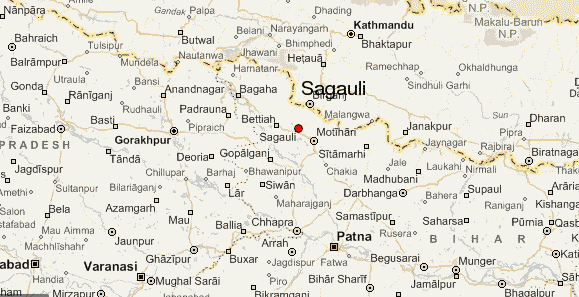
On a clear day, wrote Lieutenant-General John Alexander Ewart in 1879, one could see the mountains of Nepal from Sagauli. This small station in the East Champaran District has had a varied history – in 1816, it was the scene of the signing of the treaty between the EICo and Nepal, but for all intents and purposes, nothing much ever really happens in Sagauli. Strategically, being so close to the Nepalese border, it was in 1857, above all, necessary to keep Sagauli under the British, as a direct route from Nepal to Bihar for the troops of the Nepalese king, and to make it impossible for mutineers to use it to flee north. The district was also home to hundreds of planters, and their indigo factories were of vital importance to the EICo.
Given the task of keeping Sagauli quiet was Major James Garner Holmes (of the 59th BNI) and the men of the 12th Irregular Cavalry. He acted as William Tayler’s eyes in Eastern Bihar and supported the commissioner where he could. It was Holmes who sent his irregulars to guard Patna on the 8th of June before Rattray arrived, and it was he who had managed to convince the nervous planters to stay put. Holmes was not a novice to war and strife. He was now 38 years old and had been in India since 1836, when he joined the 59th BNI. He had fought his way through the 1st Afghan War and had been present at the disastrous retreat from Kabul in 1842. Subsequently, he saw duty again during the First Sikh War. By 1857, he attained the rank of major. His regiment, the 59th BNI, would be one of the few that did not mutiny in 1857 and still exist today in the ranks of the Indian army.
According to Kaye, James Garner Holmes was an officer made of the “right heroic stuff.” He was of “an ardent temperament, eager, impulsive, and bold as a lion, he shrank from no responsibility, and was ready, in the hour of difficulty, to assume authority…” Even if it ruffled feathers in Calcutta, Holmes preferred to act first and ask for permission after. From the first signs of disaffection in May, Holmes placed himself in direct communication not with Halliday, but with Lord Canning himself, and his correspondence shows a man who had little for politic niceties. Unlike Tayler, who tried his best to please everyone, no matter how ridiculous it may seem, Holmes preferred bold talk.
” If everyone,” he wrote on the 25th of May to the Governor-General, “is true to himself and to the Government, and does his duty with smiling cheerfulness, all things will go well. I have endeavoured to impress this on the civilians of the district. I have also pointed out the necessity of their informing the wealthy Natives and Zamindars that the chief object of the turbulent Sepoys is plunder and that it is their interest to seize any mutinous person and hand him over for punishment.” “It is absolutely necessary,” he added, “to strike terror by putting such persons to death by military law, and this power should, I think, be granted. If any person already discharged for mutiny from the Army should make such an attempt, I shall act on my own responsibility.”
Canning was rather horrified. He wrote back:
“You talk of the necessity of striking terror into the Sepoys. You are entirely and most dangerously wrong. The one difficulty, which of all others it is the most difficult to meet, is that the regiments which have not yet fallen away are mad with fear — fear for their caste and religion, fear of disgrace in the eyes of their comrades, fear that the European troops are being collected to crush and decimate them as well as their already guilty comrades. Your bloody, off-hand measures are not the cure for this sort of disease, and I warn you against going beyond the authority which Government has already given to you, and even that authority must be handled discreetly. Don’t mistake violence for vigour.”
Holmes did not care for Canning’s opinion. After all, the government was far away, and he was in Sagauli, in the thick of things. By the time Canning or anyone else could pass judgment on him, his actions would speak for themselves. As such, following Tayler’s vigorous display in Patna, Holmes declared martial law over the districts of Tirhut, Chuprah and Chunaparum; he then extended it to cover Azimgarh and Goruckpore. He then told Tayler what he had done, and Tayler, believing Holmes had Canning’s permission, wrote in his report, “this was done with the knowledge and concurrence of the Governor-General.” Holmes had only given Tayler half the story. True, he had written to Canning,
“Hearing that some seditious letters and speeches have been coming into the district, I have thought it proper to order my patrolling parties to proclaim martial law over the districts of Goruckpore, Sehwan, Chunparum, and Tirhoot, and that I shall punish with instant death the following offences, namely :
1. Openly bearing arms against the State.
2. Seditious speaking, or exciting others to rebellion, or any expression of disaffection to the Government.”
3. Concealing rebels, or even hearing others talk treason, and not immediately reporting to the nearest authorities.
4, Plundering — if caught in flagrant delicto,
All this,” he added, “may not be lawful; but I don’t care for that. There are times when circumstances are above the law. I am determined to keep order in these districts, and will do it with a strong hand.”
When Holmes didn’t hear anything contrary from Canning, he took the silence from Calcutta as approval. Halliday did not approve – in fact, as soon as he had heard of what Holmes had done, he immediately cancelled Holmes’ martial law proclamation. Not that it did Halliday much good: Holmes was in control of the situation, and whatever Halliday thought didn’t matter terribly much to Holmes. He, for one, was not going to spend any critical time fighting with Calcutta. Tayler was already doing that. Holmes’ 12th Irregulars, also known as the Incorruptables, were men of exemplary status, and Holmes never doubted for a moment they were true to the core: after all, he had raised the regiment himself in 1847 and with them, had won their battle honours Punjab and Goojerat. So trusted were they by Holmes he sent out parties of up to 50 men to patrol the districts, from Goruckpore and Azamgarh to Tirhut, Cuprah and Patna. In “A Most Indifferent Regiment”, we have already seen what happened in Azamgarh; it was the fate of 2 sepoys of the 17th regiment to cross the pass with Holme’s men at Sehwan. Promptly arrested, they were handed over to Holmes, who wasted no time in an elaborate trial. He quickly convened a court-martial, and within an hour of proclaiming the guilty of mutiny, the 2 sepoys were hanged from the gallows. Holmes then wrote to Canning:
“I enclose a copy of the court-martial, that your lordship may understand how I act. It is vile, dirty, unsoldierly work; but at the present moment I should hang or shoot my own brother under similar circumstances.”
Whether Holmes was right to trust the 12th Irregulars so implicitly will never be known. Perhaps it was the arrest of Waris Ali that set them off, or perhaps someone had tampered with the Incorruptibles as they patrolled the districts is a matter of conjecture -when the crush came, it was swift.
On the 24th of July, Major James Garner Holmes and his wife, 34-year-old Alexandrina, were taking their accustomed evening ride around Sagauli. Suddenly, Holmes saw some of his men riding up to his carriage. From the demeanour, Holmes realised their intentions were anything but honourable. Standing up in the carriage, he called out, “I know what you want, it is my life; that you can have, but spare the lady.” The butchery was savage but brief. Shot and then set upon by swords, Holmes and his wife were both barbarically decapitated. They took away Holmes’ head to show their comrades, but left his wife’s on the ground next to her body.
With bloodlust in their veins, the men turned their attention to the other residents of Sagauli. They surprised Doctor Garner and his wife in their home, calling for them to come out, but the doctor and his wife refused. The troopers set fire to the house, forcing the couple to rush outside, where they were both shot down. The fire consumed the house and the bodies, leaving no remains to bury. The next who fell to their rage was the deputy postmaster, Mr Bennett and the work of slaughter was complete.
The only survivor of Sagauli was Garner’s infant daughter, saved by her quick-thinking ayah, who had earlier taken the baby out for a walk. Hearing the screams as she neared the house, she hid the child in her sari and brought her out of harm’s way, hiding her first in a washerwoman’s house before smuggling her out of Sagauli. She then took her with all haste to the first Europeans she could find.
As for the 12th Irregulars – their fury temporarily satiated, they marched out of Sagauli, taking Holmes’ head with them, passing close by the Lall Seryah Indigo Factory, which was then harbouring several planters and their families – but they never stopped their march and continued on the road towards Lucknow and Delhi. Fortunately for the planters, the mutineers were not interested in spilling their blood. Nor did every man of the 12th mutiny – those who remained staunch would do good service under Captain Johnson in the operations that followed in Oudh before being disbanded in 1861.
When silence descended on Sagauli again, Mrs Holmes’ maid ventured to find her mistress – she found her headless body on the side of the road, next to that of her husband. The woman bent reverently over her mistress’s head and “lifted the streaming hair, rich and beautiful in its abundance, and cut it off, as a memorial to be cherished by those who loved her.” Her daughter, Julia, safely in England, would later receive the locks of her beautiful mother’s hair. The following afternoon, some planters made their way to Sagauli and buried Holmes, his wife and the postmaster in the cemetery at Motihary, the main town in Chumparun. There was no burial for the Garners, whose remains had been incinerated to ash in their house.
A Brief Biography of Mrs Holmes
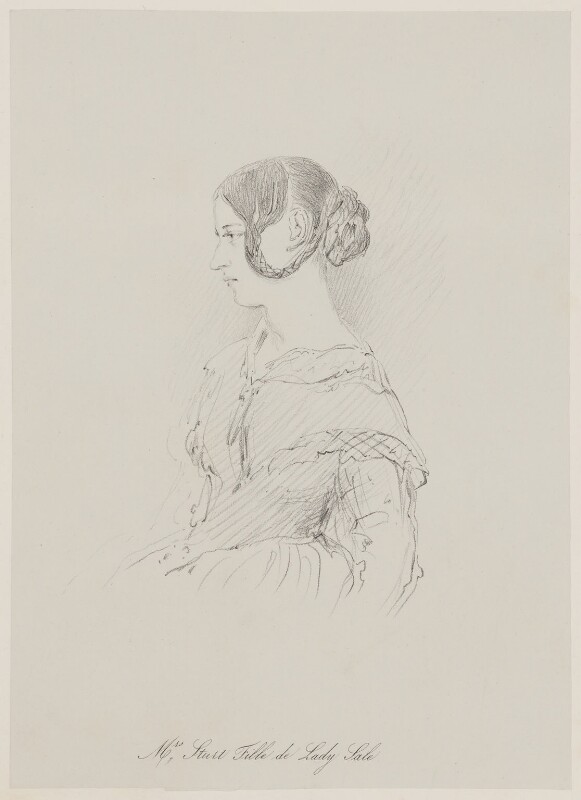
NPG D42115
Holmes’ wife was legendary in her own right – Alexandrina Sale. She was reputedly a woman of some beauty, and in her 34 years, she had lived through more than most women of her age, for she was none other than the youngest daughter of the formidable Lady Florentia Sale.
Major Holmes had first married Julia Sale – Alexandrina’s sister – in 1842. Julia sadly died in 1843 in childbirth. As fate would have it, his sister Matilda Martha would marry his dead wife’s brother, Robert Henry, in 1846 and in 1852, Holmes married Alexandrina. She was a woman of some metal – she had watched as her first husband, Captain John Sturt, was stabbed in the stomach on the retreat from Kabul and then had nursed him until he succumbed to his wounds. With her mother’s help, she buried him in as Christian a burial as could be managed. Pregnant, Alexandrina gave birth to her daughter, Julia, six months after her husband’s death while still in captivity in Kabul. Her first husband had been a brave man, not unlike Holmes himself; perhaps she had been fated to be his wife. As such, there was never any question of her leaving Sagauli – Alexandrina was a daughter of the army, and her place was with her husband.
Elsewhere in Bihar
Sagauli was but the start of a series of disasters in Bihar- the mutinous 12th made their way to Sewan, where they attacked the houses of the Deputy Magistrate and Sub-Deputy Opium Agent, Mr Lynch and Mr McDonell. They managed to escape, fleeing in some haste to Dinapore, pursued most of the way by men of the 12th Regiment. The Joint Magistrate of Chumparaun, H.C. Raikes, suddenly found his own position untenable in Mooteharee, and he was forced to abandon his station, finding refuge with the other Europeans at an indigo factory some miles away. Doing his due diligence, Raikes wrote to Calcutta, and the reply he received was hardly helpful.
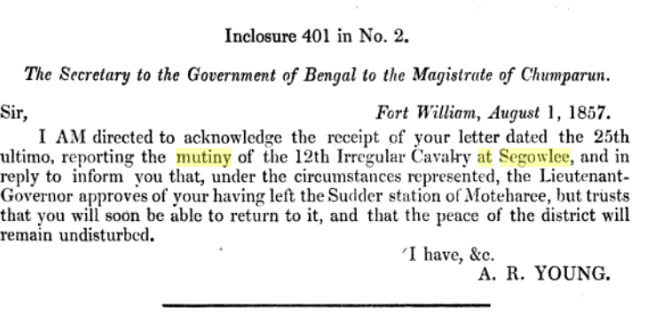
Calcutta was still oblivious to the fact that Bihar was primed to explode. Even a letter from Rajendar Kishen Singh, Maharajah of Bettiah wasn’t enough to convince them there was something wrong.
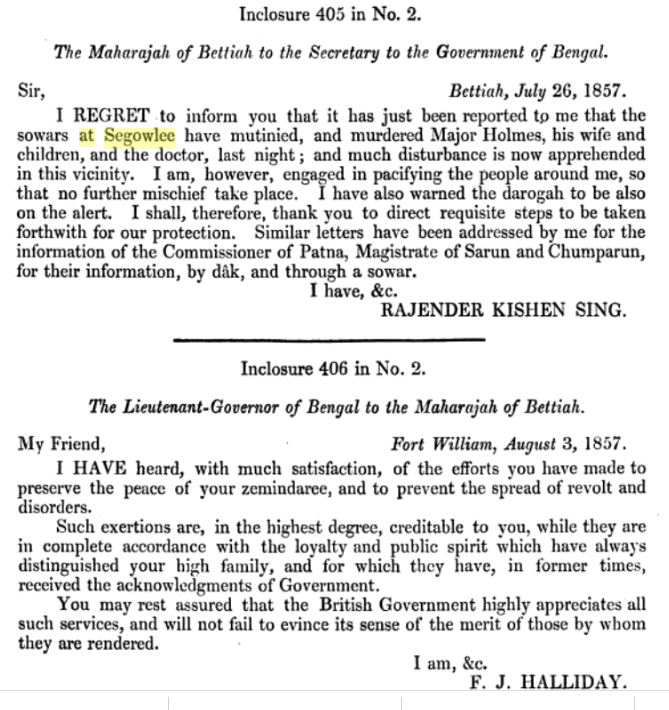
It was not the most helpful answer – while the Maharajah asked what he should do “for our protection”, the Government simply said thank you.
At Patna, Tayler was watching the events with growing worry. He no longer had Holmes, and the loss of the 12th Irregulars was a desperate blow. Frantic calls for help from Mr Alonzo Money in Gaya had prompted Tayler to send him a contingent of Rattray’s Sikhs; similar calls reached Arrah, and he promptly sent another 50 to assist that station. Meanwhile, in Dinapore, the three native regiments continued to fidget while Lloyd did nothing. On the 25th of July, the waiting was over, and Dinapore was suddenly in the grip of mutiny.
Sources:
Cochrane, J., comp. Narrative of the Indian Mutinies of 1857, Compiled for the Madras Military Male Orphan Asylum. Text prepared by William Thomas. Madras: Military Male Orphan Asylum Press, 1858.
Great Britain Parliament. Appendix (A) to Further Papers (No. 5) Relative to the Mutinies in the East Indies. London: Harrison and Sons, 1857.
Malleson, G. B. The Indian Mutiny of 1857. London: Seeley and Co., 1891.
Tayler, William. 38 Years in India. Vol. II. London: W. H. Allen & Co., 1882.
Tayler, William. Brief Narrative of Events Connected with the Removal of W. Tayler from the Commissionership of Patna. Calcutta: Privately printed, 1858.
Tayler, William. The Patna Crisis; or, Three Months at Patna During the Insurrection of 1857. London: James Nisbet and Co., 1858.
Wilson, Minden. History of the Behar Indigo Factories; Reminiscences of Behar; Tirhoot and Its Inhabitants of the Past; History of Behar Light Horse Volunteers. Calcutta: Calcutta General Printing Co., 1908.
 Mutiny Reflections