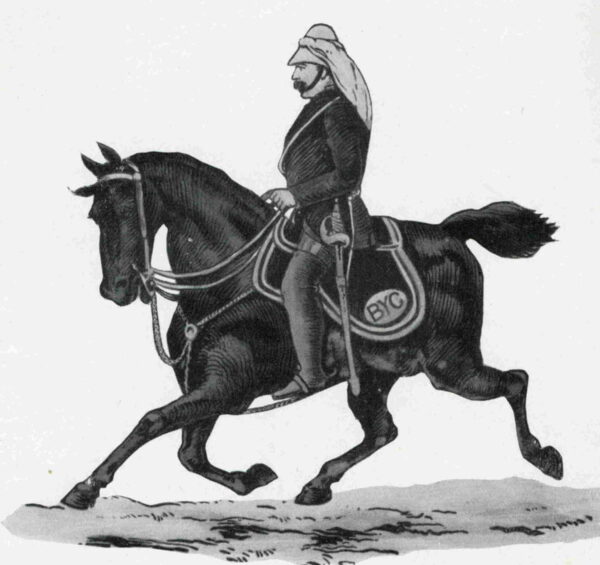
The Bengal Yeomanry Cavalry
The Bengal Yeomanry Cavalry (BYC) had been raised in Calcutta well back in July 1857, when a governmental announcement appeared in Calcutta, stating,
” The Governor-General in Council has reason to know that there are in Calcutta, Bengal, and the North-West Provinces many Englishmen whose peaceable avocations have been interrupted by the disturbed state of the country, and who, although in no way connected with the Government, are willing and eager to give an active support to its authority at the present time by sharing service in the Field with the troops of the Queen, and of the East India Company.
The Governor-General in Council has thorough confidence in the loyalty, courage, and enterprising zeal of the community to which he refers, and he is satisfied that service rendered in the spirit in which they are ready to give it will be most valuable to the State. With the view of availing himself of such service in the most effectual manner, his Lordship in Council directs that a Volunteer Corps of cavalry be formed, to be called the Bengal Yeomanry Cavalry, and to be equipped and prepared for duty in the disturbed districts…”
The idea was not to fill the regiment with “European adventurers and Eurasians” but “…of young military officers recently arrived from England, or those left idle by the mutiny of their regiments, of clerks in the Government and mercantile offices, of midshipmen belonging to the Peninsular and Oriental and other companies’ ships, of indigo planters, of some unemployed Europeans and Eurasians, of young men related to the best families in the country; and most of these were excellent riders, good shots, and keen sportsmen.” A good number of planters joined and even a few teachers. Enlistment was for one year, extendable should circumstances deem it necessary; the government provided uniforms, accoutrements and horses. Four lieutenants were chosen from among the men of the four troops themselves, presumably to either save time or prevent any squabbling over rank and seniority.
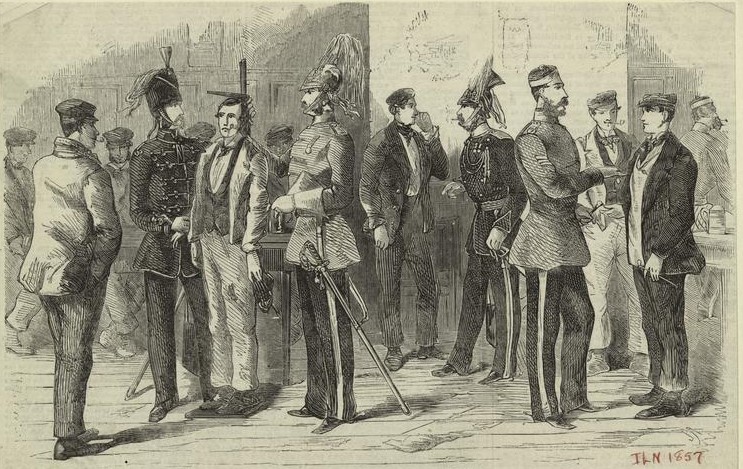
They would be organised under a Major and to a strength of 15 officers and 200 men in four troops. When they were finally ready for service, the Bengal Yeomanry Cavalry boasted of 258 officers and men and a doctor. Their first commanding officer was Major J.R.F. Robinson, described by Malleson as “the most gallant man living.” Before the mutiny, he had served in the Bengal Irregular Cavalry, in the 2nd Sikh War and had been wounded a total of 17 times at the Siege of Multan. It is little wonder when the mutiny broke out, Robinson was home on furlough – he arrived back in Calcutta to find he had neither a regiment nor an employment. Before his arrival, the raising of the cavalry had been left in the hands of the rather lavish Captain Chapman, previously of the 1st Bengal Light Cavalry, who quite relished dressing up his men.
The Bengal Yeomanry Cavalry’s uniform was distinctive with its brown corduroy breeches and knee-high boots, a loose blue flannel blouse and grey felt helmets covered in a white puggaree, for daily wear and tear. Chapman had received verbal sanction from Canning to order the helmets from England at the eye-watering price of Rs10 a piece, two and half times as much as the locally-made sun helmets. He thoughtfully provided the men with a full dress uniform, consisting of a French grey tunic with dark blue facings, blue overalls to match, and black leather belts; the pouches were either silver or steel with “BYC” badges. A dress helmet completed the outfit. Covered in black cloth, it was surmounted by a lion couchant. Where and when they would have a chance to kit themselves out in such finery was anyone’s guess, but at least the option was there! For weapons, they carried a heavy sabre, a light carbine and what was termed “a formidable revolver.” Their horses were carefully selected from young, powerful, but untrained animals capable of hard work, ostensibly not for show.
Before the Bengal Yeomanry Cavalry left Calcutta, they were inspected by Lord Canning and with his sincere praises and compliments still ringing in their ears, they were ferried across the Hoogly to Howrah; from here, a train took them to Raniganj. The scene at the terminus impressed one enthusiastic volunteer most distinctly,
“Masses of troops, horses for cavalry and artillery, baggage animals, immense parks of guns, magazine and commissariat stores, countless dolies or hospital litters, camp equipage and innumerable busy followers, demonstrated the unrelenting realities and stern agitation of the times. But all this bustle and chaos did not trouble us long; for before we could realise by the warlike scenes around us our sudden transformation from civilians to soldiers, we were ‘ told off ‘ to join a force proceeding to the North-West Provinces.”
At midnight, they were ready to march. Before them went several companies of European infantry who were covered by a troop of Horse Artillery. Behind them came the BYC, followed up by a native regiment of the Madras Army, covering the rear. The bugles rang out the ‘advance’ and off they went, along the Grand Trunk Road towards the North-Western Provinces. For the men of the BYC, everything was a novel experience. Their first camp was pitched shortly after dawn,
“Tents were pitched, arms piled, sentries posted, fires kindled, breakfasts served in short, the whole force, with its long train of camp followers and beasts of burden, settled down at ease; whilst amid the novelty and routine of camp life the day glided away pleasantly enough, and at eventide retiring to rest in good time, men slept soundly and refreshed themselves for the morrow’s work. So, in a word, began and closed the first march at the opening of our campaign.”
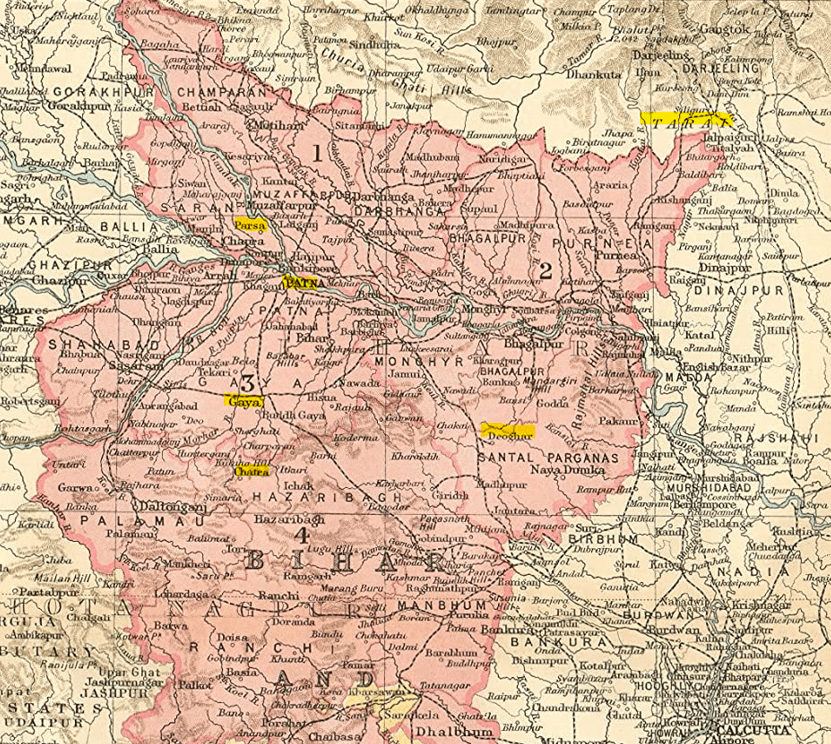
The next morning, refreshed and enthusiastic, the Bengal Yeomanry Cavalry saddled their horses and set off with the rest of the force, when quite suddenly an order came that there were mutineers to pursue – the BYC was swiftly detached, and they joined a lightly equipped column of European infantry, to proceed without delay, to Deoghar in the Santhal pargana. The Murderous Assault at Rohini explains what happened there in June.
After a few days’ ride, they arrived.
Deoghar presented an almost “sepulchral silence,” and they rode quietly past the ruined bungalows, all in ashes and ruins without a mutineer in sight. The BYC were still in ‘stimulated pursuit, and onwards we pressed. Over the hilly tracks, along execrable roads, through leafy labyrinths, down deep arid broad ravines, for several wearisome days we traversed long and rapid marches, but all to no purpose. The pursuit proved ineffectual, the expedition fruitless. The start of the fugitives was too great and unencumbered with baggage or other impedimenta…’ they had escaped into the North-Western Provinces. However, they continued onwards, traversing Santhal and searching for mutineers, only to discover the district had indeed been abandoned. A stone marker on the side of the road proclaimed Gyah was only four miles distant – the cavalry forded a broad but shallow river and made their way into Bihar. Cholera had stricken some of their numbers, while the dull scenery and the emptiness of the land had taken some of the ardour off of their enthusiasm. Somewhat demoralised, they entered Gyah.
However, things were about to change. While they had failed to catch up with the mutineers in Santhal, it was now perceived that a body was indeed wending its way towards Nepal. In some haste, they set off towards Patna.
“We crossed the Ganges at Patna. The river was at its lowest level; still the passage, beginning with dawn
glimmering upon our difficulties, continued the whole of the day, and did not terminate before the shadows of eventide compelled us to bivouac on its bank opposite the town. And here we endeavoured to make ourselves as comfortable for the night as circumstances would allow, in a wretched encampment teeming with mosquitoes and frogs, and reeking with malaria exhaled from putrid vegetation on the margin of the river.”
The following morning, the ride resumed, and to their surprise, it was far from a hostile country. Villagers came forward with supplies for the commissariat. All along their way, the fields were full of crops, and the villages were tranquil; it was as if nothing had happened at all. They pressed onto Parsa where it was rumoured the mutineers were considering looting the valuable governmental stud. Other informants claimed this was untrue; the rebels were in fact at the river, looking for boats. To add to the confusion, it was also presumed they had long since crossed into the Upper Provinces and were too far away to be caught. As such, on arriving at Parsa, there was once again not a mutineer in sight. The BYC halted to reorganise their transport train, replacing the irksome carts and their crawling bullocks with elephants and pack ponies for their baggage. After a week’s rest, it was onwards to the Nepal Frontier. Unfortunately, the BYC soon found that although the ponies were admirable in the plains, they were useless for hill work, overloaded as they were and soon they began to stagger and die on the roadside until so few were left, ‘we were compelled to part with our baggage, and stow away upon our horses, and about our own persons some indispensable things for our use on the road.’ As for mutineers, they remained as elusive as ever. By December, the BYC was still traversing the Nepal Frontier. They crossed the Kusi River and turned into the jungle region at the foothill of the Himalayas, the Terai. After a few more weeks of pointless meandering,
“It is needless to describe the rage and indignation that prevailed in the camp, when it was discovered that
every man in the expedition had been fooled and duped to hunt for rebels who had already crossed the Kose, and fled during that night when those loud and protracted shouts were heard in the jungles; and so, it will suffice to say, this jungly melodrama, in the end, confirmed the suspicions that had rested on our ‘allies’ as to their having been ‘charmed’ by the plundered treasure of the mutineers, and thus shall I say it? that ‘golden wand’ wafted them into thin air. We were now off on another flying march, and for days together literally lived in the saddle, and rode until our horses were fagged well-nigh to death. But this sweeping and rattling ride dogging the trail of the fugitives had the desired effect in pacifying apprehension among the European community of the neighbouring districts, and restoring confidence in a part of the country where alarm, bordering on panic, had already begun to exhibit itself uncomfortably.”
There were rebels in the area, and one Mr George Yule with his men had been skirting the forests on the edge of the Nepal frontier for some weeks, to guard against incursions into EICo territory and force the Dacca rebels to cross into Nepal. Then, continuing with his parallel course, always remaining in British territory, Yule crossed the Kusi River at Nathpur. The rebels were now only 50 miles distant from him at Chatra. On 11 January 1858, a reinforcement of Major Richardson and his Bengal Yeomanry Cavalry and a detachment of troops sent by Jung Bahadur of Nepal joined Yule – the idea now was to take the Dacca rebels. To do so, Yule intended to attack them from two sides, one side carried by him, the other by the Nepal troops. Unfortunately, the commander of the Nepal troops semphatically stated his men were raw recruits and any attempt to divide the force at this point would only lead to disaster. Frustrated, Yule agreed and placed the Nepal troops to guard the road while he and the remaining men would take Chatra. On 21 January, with his plans in place, Yule advanced. To his disgust, the Dacca rebels had once again outfoxed him. Taking the only road left open to them, which ran westwards into Oudh, they had taken advantage of darkness and disappeared. The pursuit was impossible, and the remainder of the two companies of the 73rd Regiment, Bengal Infantry, would never be heard from again. (In Pursuit).
Richardson and his men had tried to cut off the rebels by forced marches back towards Tirhut, but instead, the rebels were once again well ahead, and they made their way into north-eastern Oudh before he caught up with them. The rebels had well and truly vanished, so the BYC turned westward to join the Sarun Field Force.
The Bengal Yeomanry Cavalry continued to serve through the campaigns of 1858 and well into the early months of 1859. In all, they would fight in 14 engagements, and their ferocity was well noted by the rebels, who dubbed them Shaitan-i-Pultan or the Devil’s Regiment. They were formally disbanded in Calcutta in May 1859. Sir Colin Campbell, although he praised their valuable service, deemed them too expensive to keep (the incident with the helmets had raised his eyebrows alarmingly when he looked over the books), as they were a drain on the coffers, costing nearly three times as much as a regular cavalry unit. However, Lord Canning would not let them leave without much praise:
” His Excellency the Viceroy and Governor-General of India in Council cannot allow the officers and men of the Bengal Yeomanry Cavalry to separate, without expressing in General Orders his acknowledgment of the excellent services they have rendered, and his admiration of their endurance, and of their gallant bearing on the many occasions in which they have come in contact with the enemy.
“The Gazettes of the 23rd March, 27th April, 11th May, 6th and 13th July, 13th August, 12th and 19th October, 23rd November, 1858, and 11th and 18th January and 9th March, 1859, all testify that the Bengal Yeomanry Cavalry have borne a distinguished part in the several operations therein recounted.
Long marches, exposure, fatigue, and harassing patrol and picket duties have from the first fallen to the lot of this young Corps, and they have borne the whole in a truly soldier-like spirit. The Governor-General in Council desires to convey to the brave officers and men of the Bengal Yeomanry Cavalry a regiment of which all who have belonged to it may be proud and his best thanks for the good service they have rendered to the State, and in disbanding the Corps, he wishes the members of it a hearty farewell.”
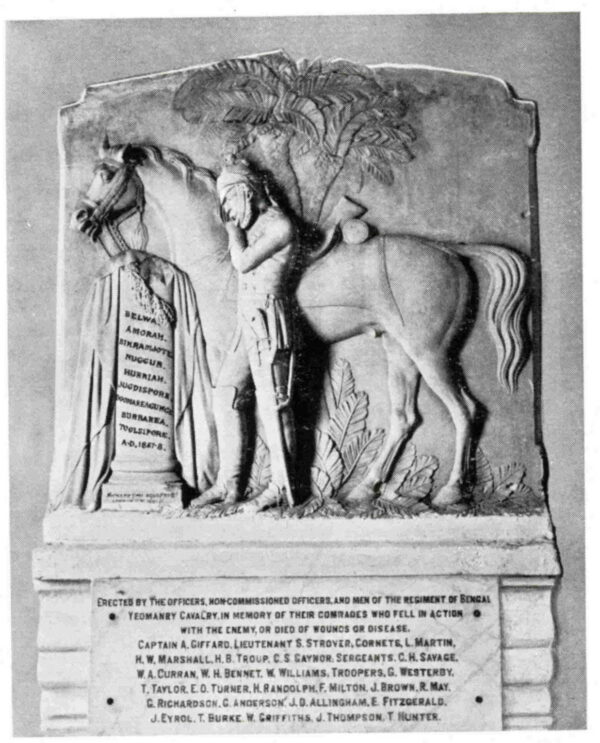
For their size, their casualties had been severe in both killed, wounded, and died of disease:
Capt. A. Giffard (ex 16th Bombay Infantry); killed at Dumureagunj, 26.11.58
Lt. S. Strover
Lt. H. B. Troup, killed at Tilga, 17.4.58
Lt. C. de Hoxar, wounded at Tilga, 17.4.58
Lt. Wm. P. Davies, wounded at Tilga, 17.4.58
Cornet W. Bridgeman, wounded at Tilga, 17.4.58
Cornet Durnford, wounded at Amorah, 5.3.58
Cornet Ellis, wounded
Cornet H. W. Marshall
Cornet L. Martin
Cornet P.M.H. Wynter, wounded at Amorah 5.3.58 and at Tilga, 17.4.58
QM Sgt. J. F. Dias, wounded at Dumureagunj, 26.11.58
Sgt. W. H. Bennett
Sgt. W. A. Curran
Sgt. C. S. Gaynor
Sgt. C. A. Savage
Sgt. W. Williams
Cpl. Ainslee (or Ainsley), slighly wounded at Amorah, 5.3.58
Tpr. G. Anderson
Tpr. J. D. Allingham
Tpr. Bass, severe bayonet wound at Amorah, 5.3.58
Tpr. Jas. Brown, killed at Tilga, 17.4.58
Tpr. T. Burke
Cpl. Jean Cuney, wounded at Tilga, 17.4.58
Tpr. E. Fitzgerald
Tpr. Danl. Gillmore, wounded at Tilga, 17.4.58
Tpr. W. Griffiths
Tpr. T. Hunter
Tpr. R. May
Tpr. F. Milton
Tpr. Hugh O’Donnell, severely wounded at Tilga, 17.4.58
Tpr. Henry Randolph, killed in action 27.2.58
Tpr. G. Richardson
Tpr. T. Taylor
Cpl. J. S. Thompson, severely wounded at Bhanpore, 11.11.58
Tpr. E.O. Turner
Tpr. G. Westerby
The Bengal Yeomanry Cavalry was by far not the only volunteer cavalry force, and two gained some notoriety.
 Mutiny Reflections