The army in India was divided into three separate entities – Bengal, Bombay and Madras. They differed in all aspects, from organization to their very size. Although in 1857, the Bombay Army did show some disaffection, there was little in Madras, and the uprising in Bombay was brief and quickly quelled.
Organisation of the Bengal Army
The Commander-in-Chief of the Bengal Army and Commander-in-Chief of India in 1857 was General Anson, who was in Simla at the time of the outbreak. He had seen active service during his career as an Ensign in the 3rd (Scots Fusiliers) Guards in the Napoleonic Wars and had fought at the Battle of Waterloo. The army, of which General Anson was in charge, was divided into seven divisions spread out over a vast area through the entire Bengal Presidency up to the Khyber Pass.
- Presidency Division, Calcutta. Commanded by Major General Sir John Bennet Hearsay
- Dinapore Division. Commanded by Major General Sir G.W.A. Lloyd
- Cawnpore Division. Commanded by Major General Sir Hugh Wheeler
- Meerut Division. Commanded by Major General S.H. Hewitt
- Sirhind Division. Commanded by Major General Sir Henry Barnard
- Lahore Division. Commanded by Major General G.E. Gowan
- Peshawar Divison. Commanded by Major General T. Reed.
Regular Native Troops in the Bengal Army
10 regiments of Bengal Light Cavalry
74 regiments of Bengal Native Infantry
18 companies of Bengal Foot Artillery, with 8 field batteries attached
12 companies of Bengal Sappers and Miners
18 regiments of Irregular Cavalry
The Men Who Served John’s Company in Bengal
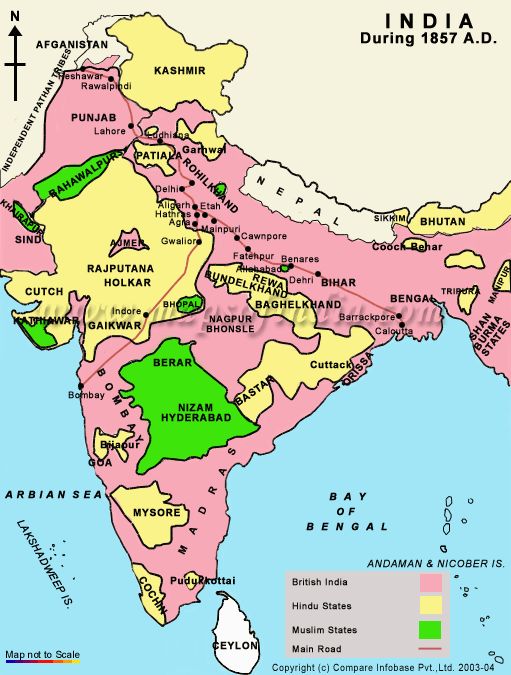
In 1857, the Bengal Army consisted of 151,361 men of all ranks, serving in 74 infantry regiments and 10 of cavalry. If the local contingents, the military police and other levies were included, the number rises to 176,834 men. This was complimented by 24’000 British troops in the Bengal Presidency, making for rather poor odds in the case of mutiny. In all of India, there were only 40,160 British soldiers and 5,362 officers, spread across three presidencies.
The majority of the irregular cavalry was made up of Muslims, the light cavalry and the infantry regiments were traditionally Hindus – the light cavalry regiments were almost exclusively of a high caste – – by 1857 the infantry regiments were composed of “Mahommedans, Brahmins—Rajputs, Gwallahs, Kaits, Aheers, Jats and some low caste men.” They came from Oudh, North and South Bihar, the Doab of the Ganges and the Jamuna, Rohilkhand, some from Bundelkhand and a few from the Punjab. Two-fifths of the Bengal Artillery were Muslims, while the remaining 57 per cent were Hindus of different castes.
The incentive to join the army was often a result of tradition, with the son following his father into the same regiment, or in the case of Sitaram in 1812, he was recruited by his uncle. Although recruiting parties would be sent out to find willing young men to join up, the preferred method was to let relatives bring in the boys themselves and thus guarantee by way of family ties not only their loyalty but their respectability.
It had been the policy of the EICo (East India Company) initially to recruit mainly high caste Hindus – Rajputs who were the traditional warrior caste in Northern India, Bhumimars (the military arm of the priest caste), and Brahmins themselves, the idea being that besides being physically fitter than men from the labourer classes, the Company felt they would not only prove to be the most loyal but somehow give the new rulers of India a stamp of legitimacy. If your army consists of the best men society has to offer, then how can the EICo, in its turn, be wrong? This was not perhaps the soundest judgment, but for some time, as the army grew and gained accolades in various campaigns, it appeared to at least be a functioning theory.
The first Governor-General of India, Lord William Bentinck, saw a danger in this kind of recruitment as it put an emphasis on religion and creed over duty and could potentially be a future threat to discipline. His worries were not unfounded, and by the 1840s, the army was actively recruiting from a broader segment of the population. It is interesting to note, however, that although caste always played an important part in all of the armies, be it Bengal, Bombay, or Madras, it was only in Bengal and briefly in Bombay that it became an issue. This, however, had more to do with the organization of the army of Bengal itself or the lack of it.
ORGANISATION OF A BENGAL REGIMENT
An infantry regiment of the Bengal Establishment was, in 1857, composed of 1000 privates, 120 non-commissioned officers, and 20 Indian commissioned officers. It was further divided into ten companies; each company contained 100 privates, 2 Indian commissioned officers, and 12 Indian non-commissioned officers.
Regiments did not live in barracks but in lines, which is where the thatched houses in which the men lived were built. The houses were organized in ten rows, one behind the other. Each company had its own lines. At every new station, the sepoys and non-commissioned officers had to either buy or build their huts- these were generally ten feet long, eight feet wide and seven feet high, made of mud and roofed by thatch, which leaked in the monsoons and were often situated on land that lacked adequate drainage. Commissioned officers had three huts in a small compound that was encircled by a low mud wall. In front of each row was a small round building where the weapons and accessories were stored when the men were off duty. The key was kept by the duty sergeant, or to give him his Indian name, the havildar.
Rising in the ranks was virtually impossible under the system in place in 1857 as it was strictly based on seniority. A man could join as a boy of 16 and find he has only attained the rank of naik (corporal) by the age of 36. The average age of a havildar (sergeant) was 45, a jemadar (lieutenant) at 54, and a subedar (captain) at the ripe old age of 60. The system was brutally unfair, and the commanding officer of a regiment had no power to pass over any man for promotion without the approval of the Commander-in-Chief.
| Indian Infantry | Indian Cavalry | British Infantry Rank |
|---|---|---|
| Sepoy | Sowar | Private |
| Lance Naik | Acting Lance Duffadar | Lance Corporal |
| Naik | Lance Duffadar | Corporal |
| Havildar | Duffadar | Sergeant |
| Havildar Major | Kot Duffadar | Sergeant Major |
| Jemadar | Jemadar | Lieutenant |
| Subedar | Risaldar | Captain |
| Subedar Major | Risaldar Major | Major |
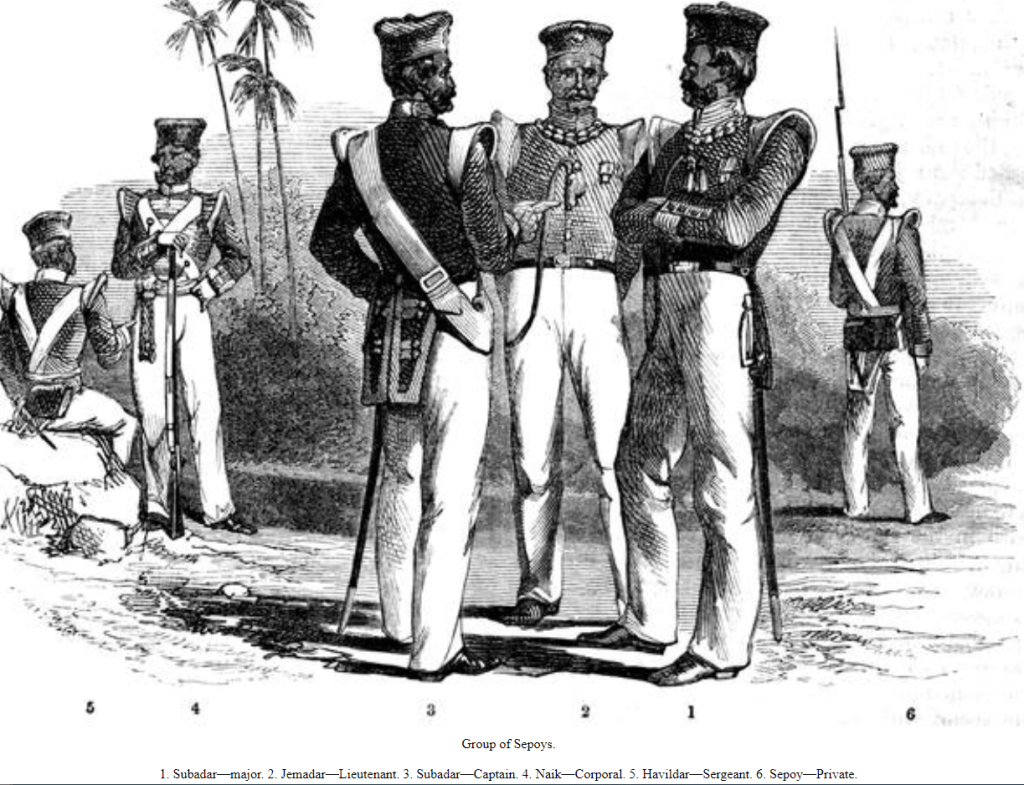
Needless to say, all Indian personnel were subordinate to even the most junior of European officers. The highest rank an Indian soldier could obtain was Subedar-Major, which in the East India Company army (HEICo) was in all actuality no more than a senior subaltern rank. Indian officers did not command, nor were they taught to – although some did prove themselves to be capable commanders during the mutiny, they had not been actively encouraged to take on leadership roles.
DUTIES AND THE LACK THEREOF
Peacetime duty was neither strenuous nor engaging. A sepoy was required to attend the morning parade for the cleaning of his weapon and accoutrements, and then while away the time until the evening parade for orders and guard duties. The monotony of this relentless routine was broken up by a brigade exercise once a week and regimental exercises four times a week. They were also increasingly used as an impromptu police force, detailed to escort treasure and guard prisoners.
As the chances of war decreased, so did the sepoys’ chance of bettering their finances. The pay was notoriously poor, and in 1857, it was the same as it had been at the turn of the century, a paltry 7 rupees or 14 shillings a month. The cost of living, however, had nearly doubled during the same time, and the introduction of long service pay helped matters only slightly as it was dependent solely on good conduct. It increased their pay by one rupee after 16 years of service and two after 20. Rank was not taken into consideration, nor was outstanding duty. In 1837, a new pension scheme came into effect, which entitled a sepoy to four rupees a month after 15 years and seven rupees for those who had served for 40 years. Disabled sepoys were entitled to the same amount, and their families received the pensions if a sepoy was killed in action. Where rank was concerned, a subedar or subedar major would retire on 25 rupees after 15 years and 40 after 40 years. But to qualify for a pension in the first place, a man had to be declared unfit for duty by a board of surgeons. This rarely happened, and as long as the sepoy could walk, he was expected to serve.
Sepoys were furthermore expected to feed and clothe themselves from their meagre salaries, although, after the reforms of 1828, they were provided with a jacket and a pair of trousers once every two years and the amount they had to pay for the other items of uniform was set to not cost more than five rupees a year which was unrealistic at best. Regardless of what the intent was, many sepoys inevitably fell into debt and subsisted on a hand-to-mouth existence. In the cavalry regiments, including the irregular ones, although better paid, they were expected to buy their horse and all the trappings, thus setting them further into debt than their infantry counterparts. The system was crying out for reform, but it would not be until 1895 that the sepoys saw any rise in their pay.
A successful campaign brought with it the reward of plunder, which the EICo stamped with the moniker “prize money,” thus legitimizing the long-standing practice of looting and pillaging. It was one way a soldier – sepoy and European alike – had to line their coffers, but by 1850, most of India had been conquered, and minor campaigns against troublesome tribes did not bring big rewards.
 Mutiny Reflections
what more can I say, an impressive amount of research!
LikeLike